
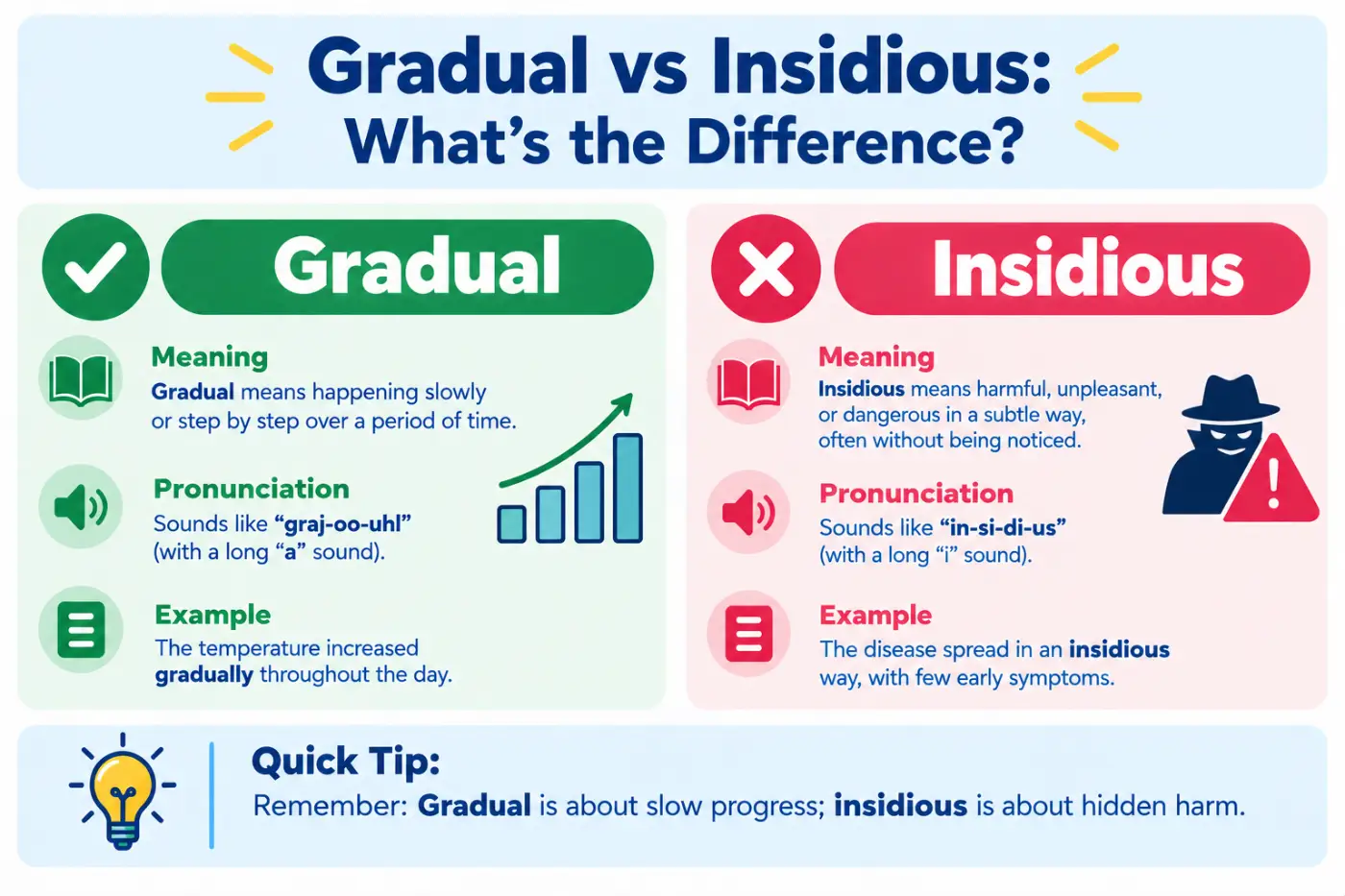
If you’re describing a change or process that develops over time, you may wonder about gradual vs insidious. Although both words can describe something that happens slowly, they have different meanings and are used in different contexts.
Gradual means happening slowly or in stages, often with a steady progression. Insidious describes something that develops subtly or gradually, usually in a harmful, unpleasant, or deceptive way.
The main difference is that gradual emphasizes the pace of change, while insidious highlights hidden or potentially harmful effects. This guide explains the meaning of each word, shows how to use them correctly, and provides clear examples to help you understand the difference.
What Does “Gradual vs Insidious” Mean?
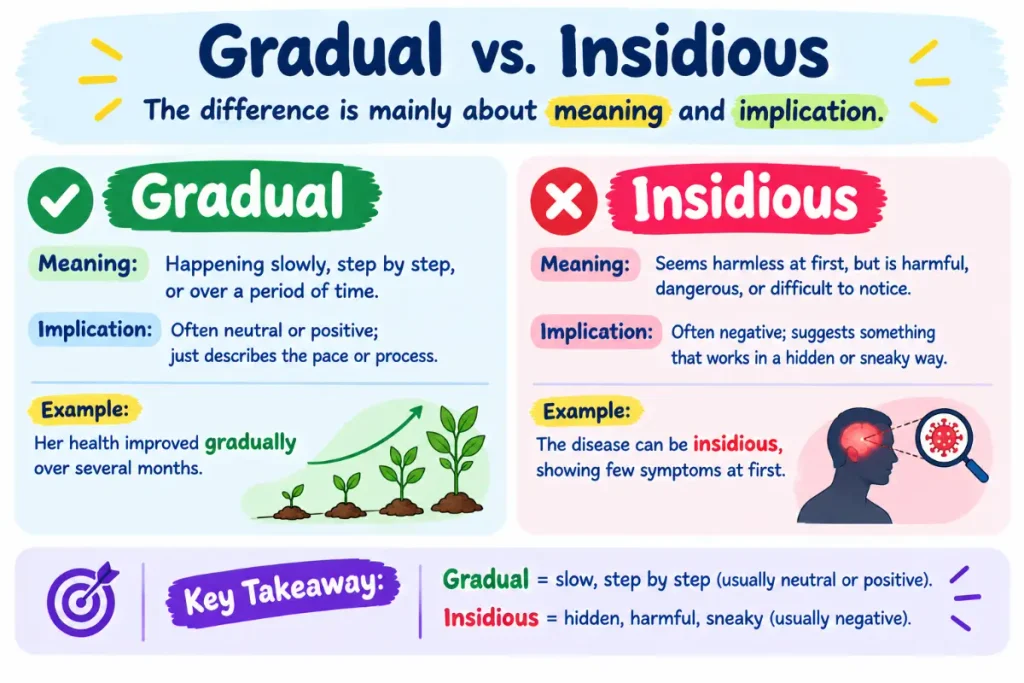
The difference between gradual vs insidious is mainly about meaning and implication:
| Word | Basic Meaning | Tone | Example |
|---|---|---|---|
| Gradual | Happening slowly over time | Neutral | The company experienced gradual growth. |
| Insidious | Developing slowly in a harmful or hard-to-notice way | Negative | The problem had an insidious effect on the community. |
A change can be gradual without being insidious. For example, a person may experience gradual improvement in a skill. There is nothing harmful or deceptive about it.
Something described as insidious, however, usually involves a hidden danger, damaging influence, or harmful process that may not be obvious at first.
Gradual: Meaning and Usage
Gradual is an adjective meaning something that happens slowly, little by little, or through a series of small changes. It can describe positive, negative, or neutral situations.
Examples of “Gradual”
- She made gradual progress in her reading skills.
- The temperature showed a gradual increase throughout the afternoon.
- His recovery was gradual but steady.
- The town has undergone gradual changes over the past decade.
- We noticed a gradual improvement in customer service.
The word does not suggest that anything is secretly harmful. It only tells the reader that the change is not sudden.
Common Phrases With “Gradual”
You will often see gradual paired with words such as:
- gradual change
- gradual increase
- gradual decrease
- gradual improvement
- gradual decline
- gradual growth
- gradual transition
- gradual shift
- gradual development
- gradual recovery
- gradual process
- gradual adjustment
For example:
The school introduced a gradual transition to the new schedule.
The transition happens in stages, but the sentence does not suggest anything negative or hidden.
Insidious: Meaning and Usage
Insidious is an adjective that describes something that develops gradually and subtly, especially when it causes harm or has a harmful influence. It often refers to a danger that is difficult to notice at first.
For example:
The effects of misinformation can be insidious.
This suggests that the harmful effects may build slowly and may not be immediately obvious.
Examples of “Insidious”
- The problem had an insidious effect on the organization.
- Stress can have an insidious influence on daily life.
- The group was concerned about the insidious spread of false information.
- The damage was insidious, developing over a long period.
- The habit had an insidious impact on his productivity.
Insidious is much more strongly negative than gradual.
Gradual vs Insidious: The Main Difference
The simplest way to remember gradual vs insidious is:
Gradual = slow.
Insidious = slow + harmful or subtly damaging.
Consider these two sentences:
The neighborhood experienced gradual change.
This simply means the neighborhood changed slowly.
The neighborhood experienced an insidious change.
This suggests the change was harmful, troubling, or difficult to recognize while it was happening. So, you should not automatically replace gradual with insidious. They overlap in the idea of slow development, but their meanings are not interchangeable.
Is “Gradual” Always Neutral?
Yes, gradual is generally neutral. It can describe something positive:
The patient showed gradual improvement.
It can describe something negative:
The company experienced a gradual decline in sales.
It can also describe something neither positive nor negative:
The gradual transition took several months.
The word itself does not tell the reader whether the result is good or bad.
Is “Insidious” Always Negative?
Insidious normally carries a negative meaning. It is commonly used for things that are harmful, dangerous, deceptive, or damaging in a way that may be difficult to recognize.
For example:
The insidious spread of the rumor caused serious problems.
Calling the spread insidious does more than say it was slow. It suggests that the spread had a harmful and subtle quality. Because of this strong negative meaning, insidious should not normally be used as a fancy synonym for gradual.
Gradual vs Insidious in Real Sentences
Here are some examples showing how the words work in different contexts.
1. Change
Gradual:
The city went through a gradual change over several years.
The sentence simply describes slow change.
Insidious:
The city faced an insidious problem that residents did not recognize at first.
Here, the problem is both subtle and harmful.
2. Growth
Gradual:
The business achieved gradual growth after opening its second location.
This is a neutral or positive use.
Insidious:
The company faced the insidious growth of a culture of dishonesty.
The word suggests a harmful development that became established slowly.
3. Influence
Gradual:
Her influence on the team increased gradually.
This tells us the influence grew slowly.
Insidious:
The insidious influence of the rumor affected how employees viewed one another.
The influence is presented as harmful and difficult to detect.
4. Decline
Gradual:
The building fell into gradual decline after years of neglect.
This focuses on the slow pace of deterioration.
Insidious:
The building suffered from insidious damage that was difficult to detect.
This emphasizes hidden or subtle harm.
5. Social Media
Gradual:
His social media use increased gradually during college.
There is no built-in judgment about the change.
Insidious:
The insidious spread of misleading posts made it difficult for readers to separate facts from rumors.
The word indicates a harmful and subtle influence.
When Should You Use “Gradual”?
Choose gradual when you mainly want to communicate that something happens slowly or in stages.
Use it for:
- changes
- progress
- growth
- decline
- improvement
- recovery
- transitions
- increases
- decreases
- adjustments
Example
The manager introduced a gradual change to the company’s schedule.
This is appropriate because the sentence focuses on the pace of the change. If you don’t intend to suggest hidden danger or harm, gradual is usually the safer choice.
When Should You Use “Insidious”?
Choose insidious when you want to emphasize that something develops slowly while being harmful, dangerous, or difficult to notice. It is especially useful when the negative effect is not immediately obvious.
Example
The insidious effects of the policy became clear only after several years.
The sentence suggests that the effects were harmful and developed in a subtle way. Insidious is more precise than gradual when hidden harm is an important part of the meaning.
Can “Gradual” and “Insidious” Be Used Together?
Yes. In some contexts, something can be both gradual and insidious.
For example:
The problem was gradual but increasingly insidious.
Here, gradual describes how slowly the problem developed, while insidious describes its harmful and subtle nature.
You might also write:
The gradual spread of the harmful practice became increasingly insidious.
The two words can work together because they describe different aspects of the same development.
Gradual vs Insidious: Tone and Connotation
Tone is one of the biggest differences between these words.
| Feature | Gradual | Insidious |
|---|---|---|
| Pace | Slow | Usually slow |
| Hidden quality | Not required | Usually important |
| Harmful meaning | Not required | Usually present |
| Positive use | Common | Rare |
| Neutral use | Common | Uncommon |
| Negative use | Possible | Strongly associated |
| Main focus | Speed of change | Subtle harmful development |
Compare:
The gradual increase in prices affected shoppers.
This is a factual description.
The insidious increase in prices affected shoppers.
This sounds much more critical. It suggests the increase was troubling, subtle, or harmful.
Gradual vs Slow: What’s the Difference?
Gradual and slow are close in meaning, but they are not always interchangeable. Slow focuses directly on speed.
The train was slow.
Gradual often describes a change that occurs in small steps.
The temperature gradually increased.
You can say:
The recovery was slow.
You can also say:
The recovery was gradual.
Both suggest that recovery took time, but gradual emphasizes development over stages.
Insidious vs Subtle: What’s the Difference?
Subtle means difficult to notice, understand, or recognize. It does not necessarily mean harmful.
There was a subtle change in her tone.
The change may be completely harmless.
Insidious generally suggests subtle harm or a damaging influence.
The insidious effects of the practice were difficult to recognize.
A useful rule is:
Subtle = not obvious.
Insidious vs Gradual: Which Word Is More Negative?
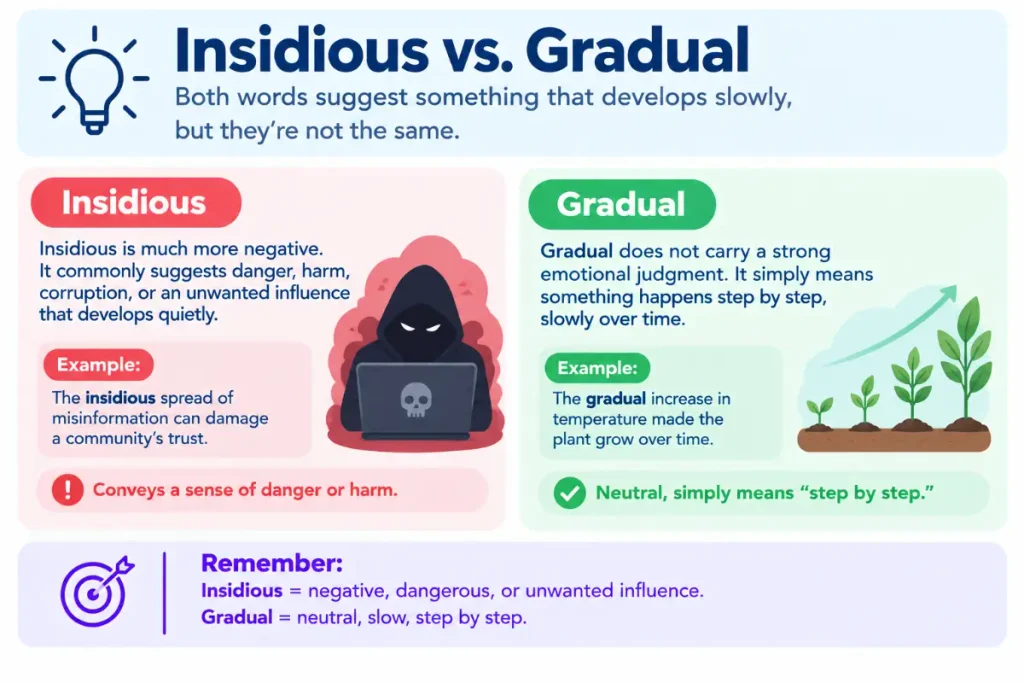
Insidious is much more negative. Gradual does not carry a strong emotional judgment. Insidious commonly suggests danger, harm, corruption, or an unwanted influence that develops quietly.
For example:
The company underwent gradual change.
This is neutral.
The company faced an insidious change in workplace culture.
This suggests a troubling development. If you’re writing a neutral report, be careful with insidious because it can add a strong negative implication.
Synonyms for “Gradual”
Depending on the context, useful alternatives include:
| Word/Phrase | Meaning | Tone | Example |
|---|---|---|---|
| Slowly | At a low speed | Everyday | The situation changed slowly. |
| Steadily | At a consistent rate | Neutral | Sales increased steadily. |
| Progressively | Increasing over stages | Formal | The condition became progressively worse. |
| Incrementally | In small amounts | Professional | The system was improved incrementally. |
| Little by little | In small stages | Casual | The project came together little by little. |
| Step by step | One stage at a time | Everyday | She learned the process step by step. |
| In stages | Through separate phases | Neutral | The plan was introduced in stages. |
| Gradational | Happening by degrees | Formal | The change was gradational. |
| By degrees | Slowly or in stages | Formal/Literary | The landscape changed by degrees. |
Not every alternative works in every sentence. Incrementally, for example, is especially common when discussing measurable changes, business decisions, or technical processes.
Synonyms for “Insidious”
Because insidious has a specific negative meaning, its alternatives depend heavily on context.
| Word/Phrase | Meaning | Tone | Example |
|---|---|---|---|
| Harmful | Causing damage | Neutral | The practice was harmful. |
| Damaging | Causing negative effects | Neutral | The decision was damaging. |
| Deceptive | Intended to mislead | Negative | The message was deceptive. |
| Stealthy | Difficult to detect | Neutral/Negative | The threat was stealthy. |
| Subtle | Difficult to notice | Neutral | The influence was subtle. |
| Hidden | Not easily seen | Neutral | The danger remained hidden. |
| Covert | Secret or concealed | Formal | The operation was covert. |
| Treacherous | Dangerous or unreliable | Strong | The conditions were treacherous. |
| Pernicious | Very harmful, often gradually | Formal | The practice had pernicious effects. |
| Corrosive | Gradually damaging | Figurative/Formal | The behavior had a corrosive effect on trust. |
Pernicious is particularly close to insidious in some contexts because it can describe something harmful that develops gradually.
Gradual vs Insidious: Mild to Strong Meaning
These words can be thought of as different points on a meaning scale, but they aren’t simply interchangeable levels of intensity.
Neutral
Gradual
The team made gradual improvements.
Subtle
Subtle
There was a subtle change in the team’s attitude.
Harmful and subtle
Insidious
The insidious influence of the conflict damaged the team’s relationships.
The important distinction is not just how strong the word sounds. The words focus on different qualities.
Common Mistakes With “Gradual” and “Insidious”
Mistake 1: Treating “insidious” as a direct synonym for “gradual”
Incorrect:
The company experienced insidious growth in revenue.
This is unusual if the only intended meaning is that revenue increased slowly.
Better:
The company experienced gradual growth in revenue.
Use insidious only if the growth itself has a harmful or troubling quality.
Mistake 2: Using “insidious” for positive development
Awkward:
She made insidious progress in her studies.
Better:
She made gradual progress in her studies.
Insidious normally doesn’t fit positive developments such as learning, recovery, or improvement.
Mistake 3: Assuming every gradual change is hidden
A gradual change does not have to be difficult to notice.
The gradual rise in temperature was obvious by noon.
The change is gradual, but it isn’t necessarily hidden.
Mistake 4: Using “gradual” when hidden harm is the key idea
Consider:
The gradual effects of the harmful practice were difficult to detect.
This is grammatically fine, but if you want to emphasize the combination of slow development and hidden harm, insidious may communicate that idea more directly:
The insidious effects of the harmful practice were difficult to detect.
How to Choose Between “Gradual” and “Insidious”
Ask yourself what you want the reader to understand.
Use “gradual” if:
- Something happens slowly.
- The change occurs in stages.
- You want a neutral description.
- The change may be positive, negative, or neutral.
- You are mainly describing pace.
Use “insidious” if:
- Something develops slowly.
- The development is harmful or troubling.
- The negative effect may be difficult to notice.
- You want to highlight a hidden or subtle danger.
- The context supports a clearly negative tone.
A quick test is to replace the word with “slow”. If slow preserves your intended meaning, gradual may be appropriate. If you also need the idea of subtle harm, insidious may be the better choice.
Formal vs Casual Usage
Gradual is common in everyday speech and formal writing.
We’re seeing a gradual change in customer behavior.
It also works naturally in:
- emails
- essays
- reports
- conversations
- resumes
- academic writing
Insidious is more formal and less common in casual conversation.
You might see it in:
- journalism
- essays
- academic writing
- literary writing
- professional reports
- discussions of social problems
In everyday conversation, people may use phrases such as slowly harmful, quietly damaging, or hard to notice at first instead of insidious.
Examples for School and Academic Writing
For an essay, the correct choice depends on your intended meaning.
Neutral
The gradual development of technology changed the way people communicate.
This simply describes a slow development.
Negative
The insidious spread of misinformation can make reliable information harder to identify. This emphasizes a harmful process that can develop subtly. Academic writers should choose insidious carefully because it carries a stronger judgment than gradual.
Examples for Workplace Communication
In professional writing, gradual is often useful when describing a planned or measurable process.
The company plans a gradual transition to the new software.
This sounds neutral and professional. Use insidious when the context genuinely involves a hidden or damaging problem:
Managers were concerned about the insidious effect of poor communication on employee trust.
Here, the word highlights a harmful effect that may develop quietly.
Examples for Everyday Conversation
In casual conversation, gradual is much more common.
My schedule has changed gradually over the past few months.
For insidious, a simpler phrase may sound more natural:
The problem slowly got worse without anyone noticing.
A formal version could be:
The problem had an insidious effect.
Both communicate a similar general idea, but the first is more conversational.
Word Origin
Gradual comes from Latin gradus, meaning “step” or “degree.” The idea behind the word is movement by steps or stages.
Insidious comes from Latin insidiae, associated with an ambush or trap. This history helps explain its modern sense: something may approach or develop in a way that is difficult to recognize until its harmful effects become apparent.
Quick Memory Trick
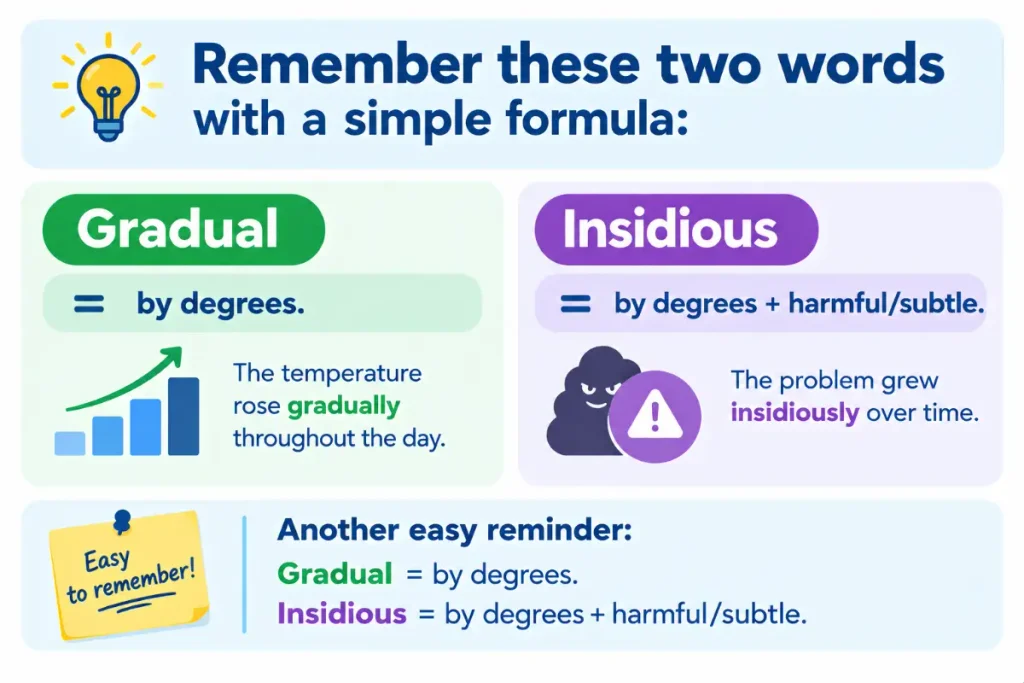
Remember these two words with a simple formula:
Gradual = by degrees.
Insidious = by degrees + harmful/subtle.
Another easy reminder:
Gradual tells you how fast. Insidious tells you how harmful and hidden the development can be.
This isn’t a perfect dictionary definition of either word, but it is a useful way to remember the central distinction.
Conclusion
Understanding gradual vs insidious becomes easier when you separate speed from meaning. Gradual describes something that happens slowly, usually through small steps or stages, and it can be positive, negative, or neutral. Insidious also involves gradual development, but it usually adds the idea of hidden, subtle, or harmful effects.
Use gradual for phrases such as “gradual improvement,” “gradual growth,” and “gradual change.” Choose insidious when you need to describe a problem or influence that quietly causes harm over time. In short, gradual focuses on the pace of change, while insidious highlights a slow development with a troubling or harmful quality.
Frequently Asked Questions
What is the difference between gradual and insidious?
Gradual means happening slowly or in stages, while insidious usually describes something that develops slowly in a subtle and harmful way. Gradual is neutral; insidious generally has a negative meaning.
Is “insidious” a synonym for “gradual”?
Insidious can overlap with gradual because both can describe something developing slowly, but they are not direct synonyms. Insidious adds the idea of hidden, harmful, or troubling effects.
Can something be both gradual and insidious?
Yes. Something can develop gradually while also having an insidious effect. For example, a harmful influence may grow slowly and remain difficult to recognize.
Is gradual positive or negative?
Gradual is neutral. It can describe positive changes, such as gradual improvement, or negative ones, such as gradual decline.
Is insidious always negative?
Insidious is normally negative. It usually suggests something harmful, dangerous, deceptive, or damaging that develops subtly.
What’s another word for gradual?
Depending on context, alternatives include slow, steady, incremental, progressive, step-by-step, and little by little. The best choice depends on whether you’re describing speed, stages, or a measurable change.
Which is correct, gradual or insidious?
Both are correct words, but they are used differently. Choose gradual for slow development and insidious when the development is also subtly harmful or troubling.
1 thought on “Gradual vs Insidious: What’s the Difference?”