
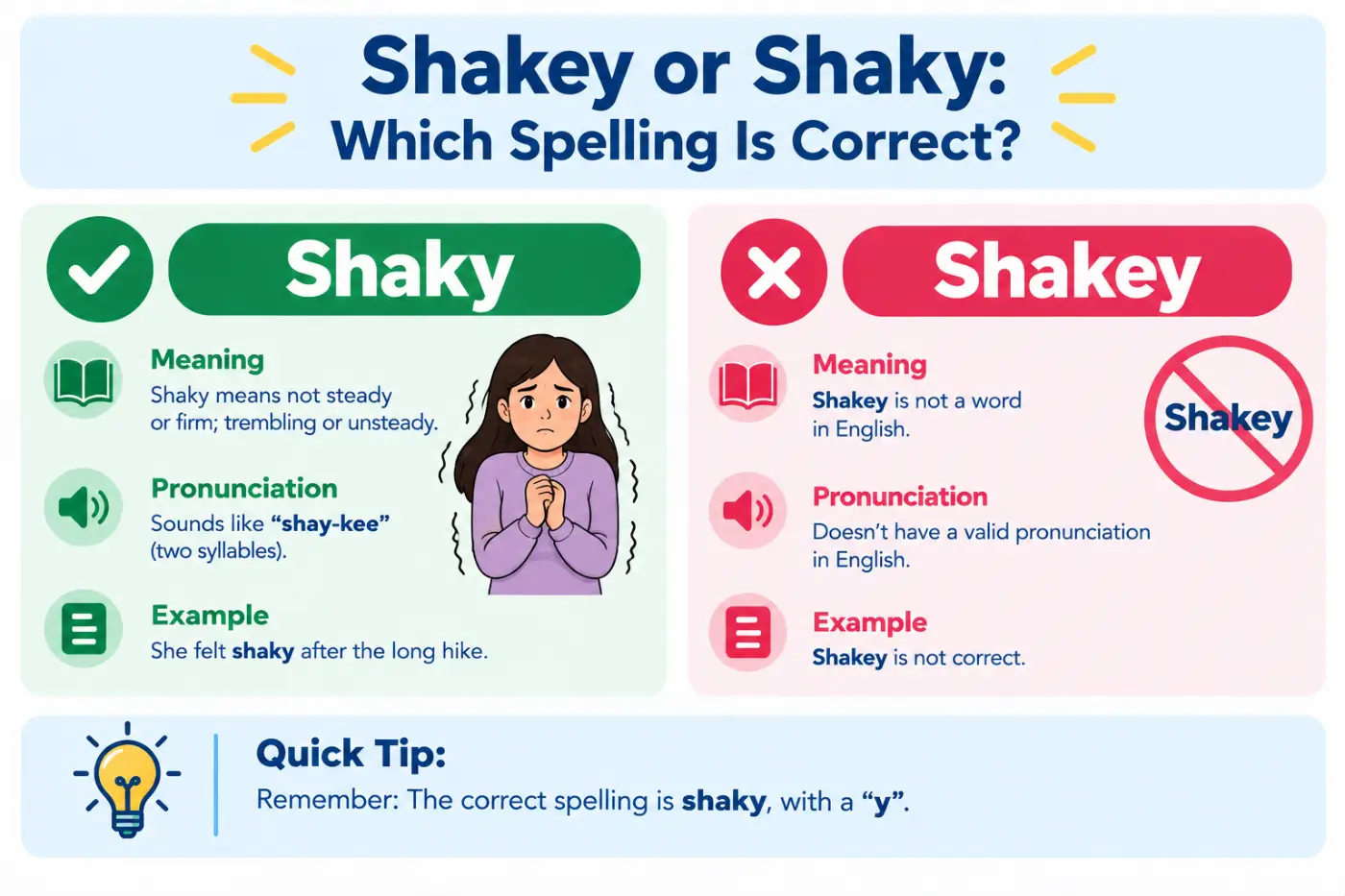
If you’re writing a text, email, essay, or social media post and wonder about shakey or shaky, the correct spelling is shaky. Although both words look similar, only shaky is the standard spelling in modern English.
Shaky is an adjective that describes something trembling, unstable, or unsteady. You can use it to describe a person’s hands, a weak argument, an uncertain situation, or something that lacks stability. Shakey is generally considered a misspelling, although it may appear as a name, nickname, or intentional variation.
In this guide, you’ll learn the difference between shakey vs. shaky, understand the meaning of shaky, and explore examples of how to use it correctly. You’ll also discover how shaky compares with similar words such as trembling, unstable, and unsteady.
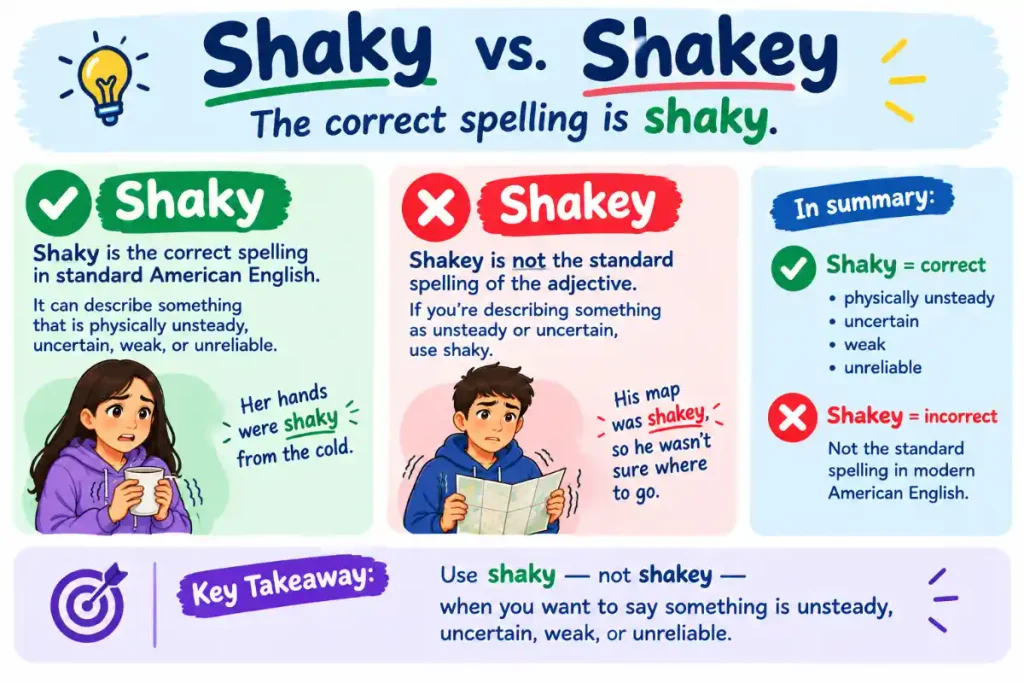
Shakey or Shaky: Which Is Correct?
Shaky is the correct spelling in standard American English. It can describe something that is physically unsteady, uncertain, weak, or unreliable.
Shakey is not the standard spelling of the adjective. If you’re describing something as unsteady or uncertain, use shaky.
| Spelling | Standard English? | Typical use |
|---|---|---|
| Shaky | Yes | Correct adjective |
| Shakey | No, generally | Usually a misspelling, name, or nickname |
Examples
- Correct: I had a shaky hand after the long workout.
- Correct: The old table has a shaky leg.
- Correct: His explanation sounded shaky.
- Incorrect: I had a shakey hand.
- Incorrect: The table has a shakey leg.
If you’re writing for school, work, a website, or a professional audience, choose shaky.
What Does Shaky Mean?
Shaky is an adjective that usually means physically trembling, unsteady, weak, uncertain, or unreliable. Its meaning depends on the context.
1. Physically trembling
Shaky can describe a person or body part that is trembling or not completely steady.
Her hands were shaky before the presentation.
Here, shaky means that her hands were trembling.
2. Physically unstable
It can also describe something that isn’t firmly supported or stable.
We sat on a shaky wooden bench.
The bench may move, wobble, or feel unsafe because it isn’t stable.
3. Uncertain or unreliable
Shaky can describe an argument, plan, explanation, or situation that isn’t convincing or dependable.
The company’s financial position looks shaky.
Here, shaky doesn’t mean physically trembling. It means weak or uncertain.
4. Nervous or lacking confidence
The word can also describe someone’s voice or performance when nervousness affects them.
He gave a shaky answer during the interview.
The answer may have sounded uncertain or lacking confidence.
How Do You Spell Shaky?
The correct spelling is shaky: S-H-A-K-Y.
It contains one e-free ending after shak-:
shake → shaky
The spelling shakey is generally incorrect when used as the ordinary adjective.
Why Is “Shakey” So Common?
The confusion comes from the base word shake, which ends in -e. It can feel natural to keep the e when adding a suffix. However, English spelling doesn’t always work by simply attaching a suffix without changing anything. In this case, the standard adjective is shaky, not shakey.
Compare:
- shake → shaky
- bake → bakey is not the normal standard adjective
- ache → achy
- scare → scary
The important form to remember is:
shaky = correct
shakey = generally incorrect
Why Do People Write “Shakey”?
There are several reasons you might encounter shakey even though shaky is the standard spelling.
Spelling by pronunciation
Because shaky sounds like SHAY-kee, some people spell it shakey based on how they think the word should look.
Confusion with “shake”
The word comes from shake, so writers may assume the e should remain:
shake + y = shakey
But standard English uses:
shake → shaky
Names and nicknames
Shakey can sometimes appear as a personal nickname, surname, business name, character name, or other proper name. In those cases, the spelling may be intentional.
For example, if someone’s official nickname is Shakey, you shouldn’t change it to Shaky simply because shaky is the standard adjective.
Informal or creative writing
A writer may intentionally use shakey as a stylized spelling in dialogue, branding, usernames, or fictional names. That doesn’t make it the standard spelling of the adjective.
Shaky vs. Shakey: Examples
The easiest way to understand the distinction is to see the words in context.
Standard adjective: Shaky
- The ladder looked shaky.
- My voice sounded shaky during the speech.
- She had a shaky start to the season.
- The evidence for the claim is shaky.
- His handwriting became shaky as he grew tired.
- The bridge appeared shaky from a distance.
- Their agreement is on shaky ground.
- I felt shaky after standing up too quickly.
- The team’s defense looked shaky in the second half.
- That explanation seems shaky to me.
Nonstandard spelling: Shakey
In ordinary writing, these should be changed to shaky:
- The ladder looked shakey. → The ladder looked shaky.
- His voice was shakey. → His voice was shaky.
- The argument was shakey. → The argument was shaky.
- My hands were shakey. → My hands were shaky.
The exception is when Shakey is being used as a proper name or deliberate stylized spelling.
Is “Shakey” Ever Correct?
Yes, but usually not as the standard adjective. If Shakey is someone’s name, nickname, brand name, character name, or another proper noun, its spelling can be correct because proper names don’t have to follow the ordinary spelling of the adjective.
For example:
The band’s nickname was Shakey.
In this sentence, Shakey is a name, so changing it to Shaky could change the intended name.
But if you’re describing an unstable chair, nervous voice, uncertain plan, or weak argument, use shaky.
Shaky as an Adjective
Shaky is an adjective. It modifies a noun or describes a person’s or thing’s condition.
Common combinations include:
- shaky hands
- shaky voice
- shaky legs
- shaky table
- shaky bridge
- shaky evidence
- shaky argument
- shaky foundation
- shaky relationship
- shaky plan
- shaky economy
- shaky confidence
Physical Examples
I couldn’t write clearly because my hands were shaky.
The chair felt shaky when I sat down.
Figurative Examples
The proposal is based on shaky evidence.
Their business is on shaky financial ground.
The physical and figurative meanings are related. In both cases, something lacks stability or firmness.
Shaky vs. Unsteady: What’s the Difference?
Shaky and unsteady can be synonyms, but they aren’t always interchangeable. Unsteady more directly suggests a lack of physical balance or stability.
| Word | Main idea | Example |
|---|---|---|
| Shaky | Trembling, weak, or uncertain | Her voice was shaky. |
| Unsteady | Not firmly balanced or stable | He walked with an unsteady step. |
For example:
She gave a shaky answer.
This suggests uncertainty or nervousness.
She took an unsteady step.
This focuses more on physical balance.
Shaky vs. Trembling: What’s the Difference?
Trembling specifically describes repeated, often involuntary movement or shaking.
Shaky has a broader meaning.
His hands were trembling.
This directly describes movement.
His hands were shaky.
This can describe the condition of his hands without focusing as strongly on the movement itself.
Shaky can also describe abstract things:
The argument was shaky.
You can’t normally replace this with trembling without changing the meaning.
Shaky vs. Unstable: What’s the Difference?
Unstable is often stronger and more direct than shaky when discussing physical or structural conditions.
The ladder is unstable.
This clearly means the ladder isn’t safely or firmly positioned.
The ladder looks shaky.
This sounds more conversational and may suggest that it appears weak, loose, or unreliable.
Shaky is also common in figurative expressions:
The evidence is shaky.
The deal is on shaky ground.
Unstable can also work in some of these contexts, but the tone and meaning may differ.
Shaky vs. Weak: What’s the Difference?
Weak focuses on a lack of strength. Shaky focuses more on instability, uncertainty, or trembling.
Compare:
The signal is weak.
The signal is shaky.
This could suggest that the connection is unreliable or inconsistent.
Likewise:
He has a weak argument.
This means the argument lacks strength or persuasive support.
He has a shaky argument.
This suggests that the reasoning or evidence isn’t reliable or convincing.
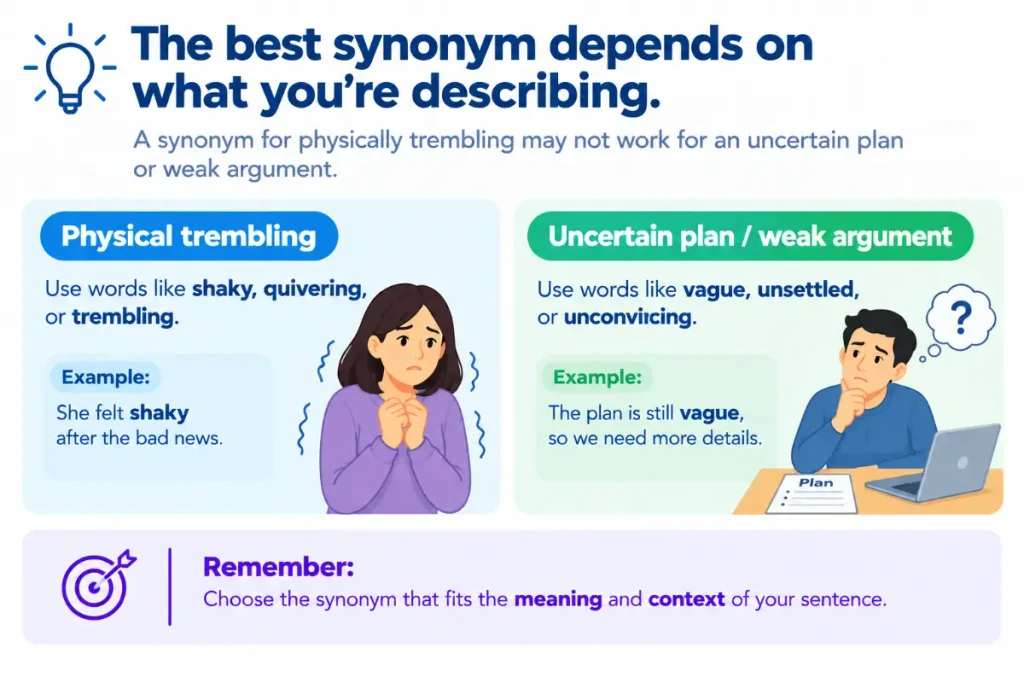
Synonyms for Shaky
The best synonym depends on what you’re describing. A synonym for physically trembling may not work for an uncertain plan or weak argument.
Physical or Movement-Related Synonyms
| Word/Phrase | Meaning | Tone | Example |
|---|---|---|---|
| Unsteady | Not firmly balanced | Neutral | She had an unsteady step. |
| Trembling | Shaking involuntarily | Neutral | His trembling hands made writing difficult. |
| Wobbly | Moving from side to side | Casual | The chair is wobbly. |
| Quivering | Shaking slightly | Neutral | Her voice was quivering. |
| Unstable | Not firmly supported | Neutral/Formal | The structure is unstable. |
| Jittery | Nervous or shaking | Casual | I felt jittery before the test. |
| Tremulous | Characterized by trembling | Formal | She spoke in a tremulous voice. |
Uncertain or Unreliable Synonyms
| Word/Phrase | Meaning | Tone | Example |
|---|---|---|---|
| Uncertain | Not known or definite | Neutral | The outcome is uncertain. |
| Unreliable | Not dependable | Neutral | The source is unreliable. |
| Questionable | Open to doubt | Neutral | The evidence is questionable. |
| Doubtful | Unlikely or uncertain | Neutral | His explanation seems doubtful. |
| Weak | Lacking strength or support | Neutral | The argument is weak. |
| Flimsy | Lacking solid support | Casual/Neutral | The excuse was flimsy. |
| Unsound | Not logically or practically reliable | Formal | The reasoning is unsound. |
| Precarious | Unstable or risky | Formal | Their financial position is precarious. |
| Dubious | Causing doubt | Formal | The claim is dubious. |
| Insecure | Lacking stability or confidence | Neutral | The arrangement feels insecure. |
Casual Alternatives
In everyday American English, you might also hear:
- wobbly
- iffy
- uncertain
- weak
- unstable
- questionable
- unreliable
- nervous
- jittery
- unsteady
The right choice depends on the intended meaning.
Shaky Synonyms by Intensity
There isn’t one perfect scale for every use of shaky, but these groups can help.
Mild
- uncertain
- unsteady
- questionable
- wobbly
Moderate
- weak
- unreliable
- unstable
- doubtful
- flimsy
Strong
- precarious
- seriously unstable
- highly unreliable
- unsound
- deeply questionable
For example, saying an argument is questionable is usually less forceful than calling it unsound.
Formal vs. Casual Alternatives to Shaky
The word shaky is perfectly normal in American English, but it can sound somewhat conversational depending on context.
Everyday conversation
That explanation sounds shaky.
Professional writing
The explanation appears questionable.
Academic writing
The argument is supported by limited evidence.
Business writing
The company’s financial position appears uncertain.
You don’t always need to replace shaky in formal writing. Choose another word only when it gives you a more precise or appropriate tone.
How to Use “Shaky” in Professional Writing
Shaky can be used professionally, but context matters.
For example:
The proposal relies on shaky assumptions.
This is understandable and natural, but it has a fairly direct tone. A more formal alternative might be:
The proposal relies on assumptions that have not been sufficiently supported.
For a workplace email, choose the version that best matches your relationship with the reader and the seriousness of the situation.
Is Shaky Appropriate for Academic Writing?
Yes, but a more precise alternative may sometimes be better. Academic writing often benefits from words such as:
- uncertain
- unsupported
- questionable
- unreliable
- insufficient
- inconclusive
- unsound
For example:
The study’s conclusion is based on shaky evidence.
This is understandable, but:
The study’s conclusion is based on limited evidence.
may sound more precise in an academic context.
Common Expressions With Shaky
Several common English expressions use shaky in a figurative sense.
On shaky ground
On shaky ground means in an uncertain, weak, or unstable position.
The company is on shaky ground after several difficult quarters.
Shaky foundation
A shaky foundation can be literal or figurative.
The building was constructed on a shaky foundation.
The theory has a shaky foundation.
Shaky evidence
Shaky evidence means evidence that isn’t strong or reliable.
The accusation was based on shaky evidence.
Shaky confidence
Shaky confidence describes confidence that isn’t strong or secure.
Her shaky confidence improved after more practice.
Shaky start
A shaky start means a weak or uncertain beginning.
The team had a shaky start but improved later.
Common Mistakes With Shaky
Mistake 1: Writing “shakey”
The most common error is adding the e from shake.
Incorrect: The table is shakey.
Correct: The table is shaky.
Mistake 2: Assuming every “shakey” is an error
If Shakey is a person’s nickname or another proper name, don’t automatically correct it.
Context matters.
Mistake 3: Using “shaky” when you mean “shaking”
These words are related but not identical.
My hands are shaky.
describes their condition.
My hands are shaking.
describes the action happening now.
Mistake 4: Using “shaky” for every kind of weakness
Sometimes another word is more precise.
For example, if a person lacks physical strength, weak may be better. If a person lacks balance, unsteady may be better. If a source cannot be trusted, unreliable may be better.
Shaky vs. Shaking
This is another useful distinction.
Shaky is an adjective:
My hands are shaky.
Shaking can function as a present participle or adjective:
My hands are shaking.
The first describes a condition. The second emphasizes the action or movement.
Compare:
- shaky voice = a voice that sounds unsteady or nervous
- shaking voice = a voice that is visibly or audibly trembling
Both can be correct, but they emphasize slightly different things.
What Is the Opposite of Shaky?
The best antonym depends on the meaning.
For physical stability, possible opposites include:
- steady
- stable
- firm
- secure
- balanced
For confidence or certainty:
- confident
- certain
- assured
- convincing
- reliable
Examples:
Her hands were shaky. → Her hands were steady.
The evidence was shaky. → The evidence was strong.
The company’s position was shaky. → The company’s position was stable.
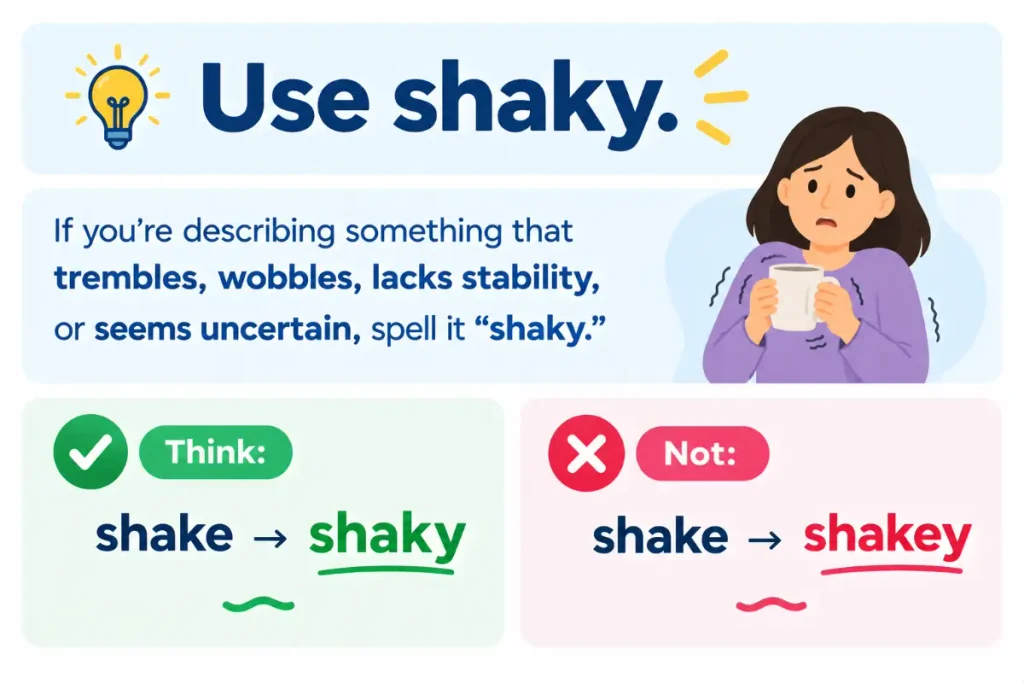
Quick Rule to Remember Shaky
Use this simple rule:
If you’re describing something that trembles, wobbles, lacks stability, or seems uncertain, spell it “shaky.”
Think:
shake → shaky
Not:
shake → shakey
If Shakey appears as a name, nickname, or intentional proper noun, preserve that spelling when appropriate.
Conclusion
When choosing between shakey or shaky, the correct standard spelling is shaky. Use it when describing something that trembles, lacks physical stability, or seems weak, uncertain, or unreliable. The spelling shakey is generally not correct as the ordinary adjective, although it can be valid as a name, nickname, or intentional stylized spelling.
Remember the simple pattern: shake → shaky. If you’re writing an email, school assignment, professional document, or everyday message, shaky is the safe and standard choice. When a different word would be more precise, consider alternatives such as unsteady, unstable, uncertain, or unreliable.
Frequently Asked Questions
Is “shakey” or “shaky” correct?
Shaky is the standard spelling of the adjective. Shakey is generally a misspelling, although it can be correct when used as a proper name or nickname.
How do you spell shaky?
The correct spelling is shaky, spelled S-H-A-K-Y. The form shakey is not the standard spelling of the adjective.
Is “shakey” a real word?
Shakey can appear as a name, nickname, or stylized spelling, but it isn’t the standard spelling of the adjective meaning unsteady, trembling, weak, or uncertain.
What does shaky mean?
Shaky means physically trembling or unstable, and it can also mean uncertain, weak, or unreliable. For example, you can have shaky hands or a shaky argument.
What is another word for shaky?
Depending on the context, alternatives include unsteady, trembling, wobbly, unstable, uncertain, unreliable, questionable, weak, and precarious.
Is shaky formal or informal?
Shaky is standard English and can be used in both casual and professional writing. In highly formal or academic contexts, a more precise word such as uncertain, unsupported, or unreliable may sometimes be preferable.
Why do people spell shaky as “shakey”?
The spelling shakey likely comes from the base word shake, which can make the added e feel natural. However, the standard adjective is shaky.
2 thoughts on “Shakey or Shaky: Which Spelling Is Correct?”