

If you’re writing an email, essay, resume, or text and wondering about offered vs. offerred, the correct spelling is offered. The word offerred is a common misspelling and is not accepted in standard American English.
Offered is the past tense and past participle of offer. It means to give, present, propose, or make something available to someone. For example, “The company offered her a new position.” The word uses the double f from offer but only one r before the -ed ending.
The confusion often arises because offer ends in -fer, which may make writers think they need to double the final r before adding -ed. However, the correct form is always offered, not offerred. Understanding this spelling rule will help you avoid common mistakes and use the word confidently in everyday and professional writing.
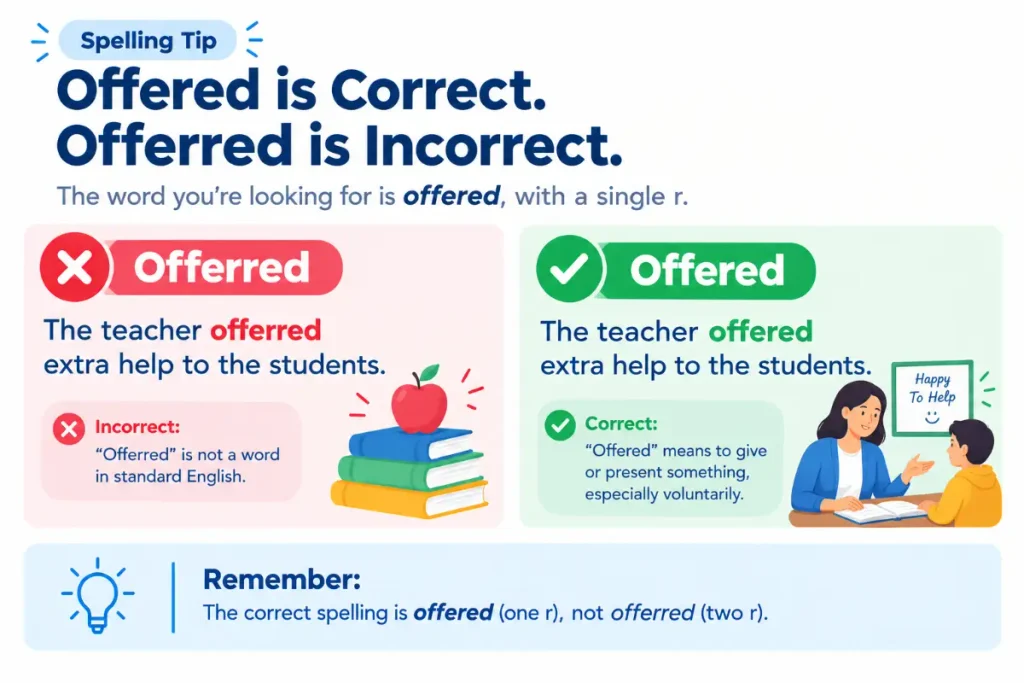
Offered vs Offerred: What’s the Difference?
Offered is correct. Offerred is incorrect.
| Spelling | Correct? | Example |
|---|---|---|
| offered | Yes | The company offered me a position. |
| offerred | No | The company offerred me a position. |
The key rule is simple:
Offer + ed = offered
You do not add another r.
Why Is “Offered” Correct?
The base verb is offer:
offer → offered
The word already contains two f’s, but only one r at the end. When -ed is added, the spelling becomes:
o-f-f-e-r-e-d
So the correct form has:
- ff in the middle
- r followed by e
- ed at the end
That gives us offered, not offerred.
What Does “Offered” Mean?
Offered is the past tense and past participle of the verb offer. It can have several closely related meanings depending on context.
1. Gave Someone Something
It can mean that someone presented something for another person to accept.
She offered me a cup of coffee.
2. Made Something Available
It can describe a product, service, or opportunity that was made available.
The school offered several evening classes.
3. Proposed or Suggested Something
It can mean that someone proposed an idea, plan, or solution.
He offered a practical solution to the problem.
4. Expressed Willingness to Help
It can also describe someone volunteering to do something.
Maria offered to help with the project.
5. Presented Something for Consideration
In formal writing, offered can mean that an explanation, argument, or piece of evidence was presented.
The researcher offered several possible explanations.
How Do You Spell “Offered” Correctly?
The correct spelling is:
OFFERED
A useful way to remember it is to start with the base word:
OFFER + ED = OFFERED
Do not write:
OFFER + RED = OFFERRED
The ending of offer does not cause the final r to double.
Correct Spelling
- offered
- offering
- offer
- offers
- offerable
Incorrect Spelling
- offerred
- offerred
- offerred
The most common error is adding an unnecessary second r.
Why Do People Spell It “Offerred”?
The mistake is understandable because English has many words in which a final consonant doubles when a suffix is added.
For example:
- stop → stopped
- plan → planned
- admit → admitted
There are also words with doubled letters that can make spelling patterns harder to remember. Because offer contains two f’s, writers may incorrectly assume that the final r should also double:
offer → offerred ❌
But English spelling doesn’t work that way. The correct form is:
offer → offered ✅
The word offer simply takes -ed without doubling its final r.
Offered in Different Parts of Speech
Offered is primarily the past tense and past participle of the verb offer, but it can also function as a participial adjective in some sentences.
As a Past-Tense Verb
The manager offered me a promotion. Here, offered tells us what the manager did in the past.
As a Past Participle
The company has offered several solutions.
Here, offered works with the auxiliary verb has to form the present perfect.
They had offered him a different position.
Here, offered forms part of the past perfect.
As an Adjective
In some contexts, offered can describe something that has been presented or made available.
The offered price was lower than expected.
In this sentence, offered modifies price.
10 Examples of “Offered” in Real Sentences
Here are natural examples showing how offered works in everyday American English.
- The restaurant offered us a table near the window.
- My teacher offered helpful advice before the exam.
- The company offered her a full-time position.
- He offered to drive us to the airport.
- The store offered a discount to new customers.
- Our neighbor offered to water the plants while we were away.
- The university offered several online courses.
- She offered an explanation for the delay.
- The organization offered financial assistance to eligible families.
- I offered my seat to an older passenger.
Notice that offered can be followed by a noun, an infinitive phrase, or other structures depending on its meaning.
“Offered” vs. “Offer”: What’s the Difference?
Offer is the base or present form, while offered is the past tense and past participle.
| Word | Function | Example |
|---|---|---|
| offer | Present/base form | They offer free delivery. |
| offers | Present tense, third-person singular | The store offers free delivery. |
| offered | Past tense/past participle | The store offered free delivery. |
| offering | Present participle/gerund | The store is offering free delivery. |
Compare These Sentences
Present:
The company offers health benefits.
Past:
The company offered health benefits.
Present continuous:
The company is offering health benefits.
All three forms are correct, but they describe different grammatical situations.
Offered vs. Offering
Offered
Use offered for a completed action or in perfect constructions.
The company offered me a position last week.
Offering
Use offering when describing an action that is happening now or as a noun-like form.
The company is offering several new positions.
Compare:
| Word | Typical use | Example |
|---|---|---|
| offered | Past/completed action | She offered to help. |
| offering | Ongoing action or noun | She is offering to help. |
Offered vs. Proposed
These words can sometimes be similar, but they aren’t always interchangeable. Offered generally means that something was given, presented, made available, or voluntarily provided.
The company offered me a job.
Proposed usually means that someone suggested an idea, plan, or course of action for consideration.
The committee proposed a new policy.
You can offer help, while you typically propose a plan.
Offered vs. Suggested
Suggested means recommended or put forward as an idea.
She suggested taking the train.
Offered has a broader meaning.
She offered to drive us.
In the first sentence, she recommends an option. In the second, she volunteers to do something.
Offered vs. Provided
These words overlap in some contexts, but their meanings differ. Provided usually emphasizes actually supplying something.
The hotel provided breakfast.
Offered can emphasize that something was made available or presented as an option.
The hotel offered breakfast to its guests.
The distinction isn’t always strict, but offered often focuses on availability or willingness, while provided focuses more directly on supplying something.
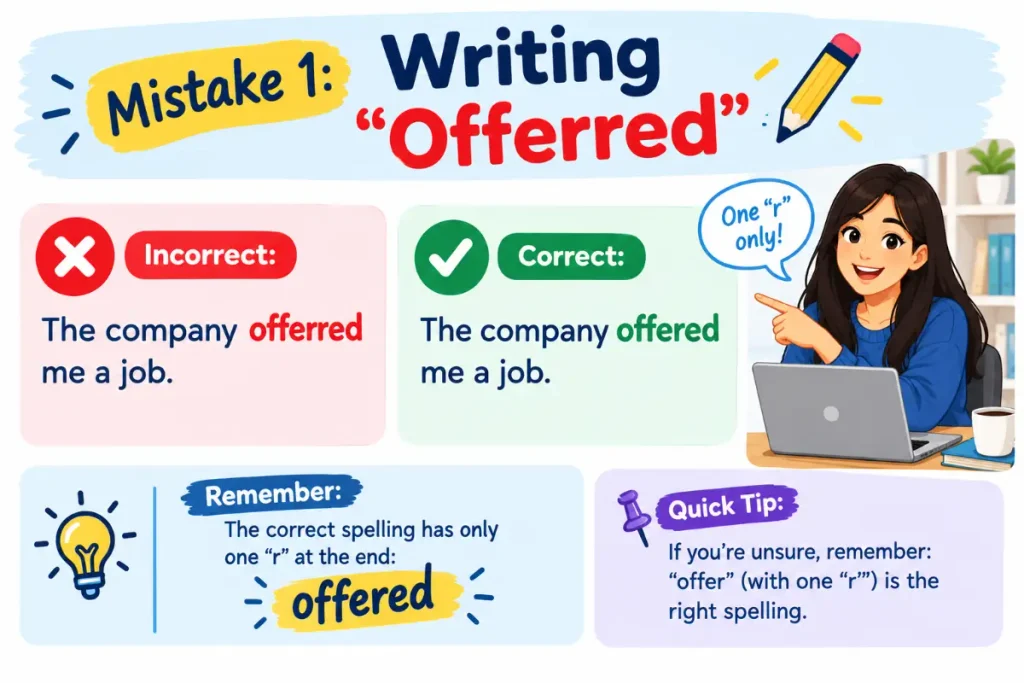
Common Mistakes With “Offered”
Mistake 1: Writing “Offerred”
❌ The company offerred me a job.
✅ The company offered me a job.
This is the most common spelling mistake involving the word.
Mistake 2: Adding an Extra “R”
The correct spelling has only one r after the two f’s:
offered ✅
Not:
offerred ❌
Mistake 3: Confusing “Offered” With “Offering”
These forms serve different grammatical purposes.
❌ The company is offered a new service.
Depending on the intended meaning, you might write:
✅ The company is offering a new service.
or:
✅ The company offered a new service.
Mistake 4: Using “Offered” When “Offers” Is Needed
If the sentence describes something that happens regularly or is true in the present, use offers rather than offered.
❌ This store offered free shipping every weekend.
✅ This store offers free shipping every weekend.
If you’re talking about a past period, offered may be correct:
The store offered free shipping last weekend.
Offered in Professional Writing
Offered is completely appropriate for professional and business communication. It is neither slang nor overly casual.
In a Professional Email
We offered the client several options for resolving the issue.
In a Resume
Offered technical support to customers and resolved account issues.
For a resume, make sure the tense matches the rest of your bullet points. Past jobs typically use past-tense verbs such as offered, managed, created, and supported.
In an Academic Essay
The study offered a different explanation for the results.
This is a natural and appropriate use in academic writing.
In Workplace Communication
The company offered employees additional training.
Again, offered is the standard spelling and usage.
Is “Offerred” Ever Correct?
No. Offerred is not the standard spelling of the past tense or past participle of offer. The correct form is always offered in standard English. If you see offerred in a text, email, website, or document, it is almost certainly a spelling error.
Why “Offered” Has Two F’s but One R
This is one of the easiest ways to remember the spelling.
Start with:
offer
The word contains:
- two f’s
- one r
Then add -ed:
offer + ed = offered
The f’s stay doubled, while the r stays single.
A Simple Memory Trick
Think:
Two F’s, one R, then ED.
O F F E R E D
Not:
O F F E R R E D
This small spelling rule can help you avoid the most common error.
Does “Offered” Change in American and British English?
No significant spelling difference exists between American and British English for offered.
Both use:
offered ✅
The same is true for the base word:
offer ✅
So this isn’t a case like color/colour or favorite/favourite, where American and British English use different spellings. American and British writers both spell the past tense offered.
Offered vs. Offerred in a Quick Comparison
| Feature | Offered | Offerred |
|---|---|---|
| Standard English | ✅ Yes | ❌ No |
| Correct past tense of offer | ✅ Yes | ❌ No |
| Correct past participle | ✅ Yes | ❌ No |
| Used in American English | ✅ Yes | ❌ No |
| Used in British English | ✅ Yes | ❌ No |
| Appropriate for formal writing | ✅ Yes | ❌ No |
What Is the Past Tense of “Offer”?
The past tense of offer is offered.
Unlike some irregular English verbs, offer does not change into a completely different form in the past tense. It simply takes the regular -ed ending.
Present:
I offer my assistance.
Past:
I offered my assistance.
Present perfect:
I have offered my assistance.
Past perfect:
I had offered my assistance.
What Is the Past Participle of “Offer”?
The past participle is also offered. It can appear with auxiliary verbs such as has, have, had, and be.
Examples:
She has offered to help.
They had offered several alternatives.
A refund was offered to the customer.
The spelling remains offered in each case.
Related Forms of “Offer”
Understanding the other forms of the word can make the spelling easier to remember.
| Form | Example |
|---|---|
| offer | I offer my help. |
| offers | The company offers training. |
| offered | The company offered training. |
| offering | The company is offering training. |
| offer as a noun | They made an offer. |
| offers as a noun | We received two offers. |
The important spelling point is that none of these forms uses offerr-.
“Offered” in Common Expressions
The word appears in many common English phrases.
Offered to Help
She offered to help with the move.
This means she voluntarily said that she was willing to help.
Offered an Opportunity
The program offered students an opportunity to gain experience.
This means the opportunity was made available.
Offered a Position
He was offered a position at the company.
This means the company proposed giving him the job.
Offered an Explanation
The manager offered an explanation for the decision.
This means the manager provided or presented an explanation.
Offered Support
The organization offered support to local families.
This means the organization made assistance available.
How to Choose the Right Form
Use offered when you’re talking about an offer that happened in the past or has been presented using a perfect or passive construction. Use offer for the base form or after certain helping verbs:
I want to offer my assistance.
Use offers with a singular third-person subject in the present:
The company offers flexible schedules.
Use offering for an ongoing action or gerund:
The company is offering flexible schedules.
A quick reference:
- offer → base/present
- offers → present, he/she/it
- offered → past/past participle
- offering → ongoing action/gerund
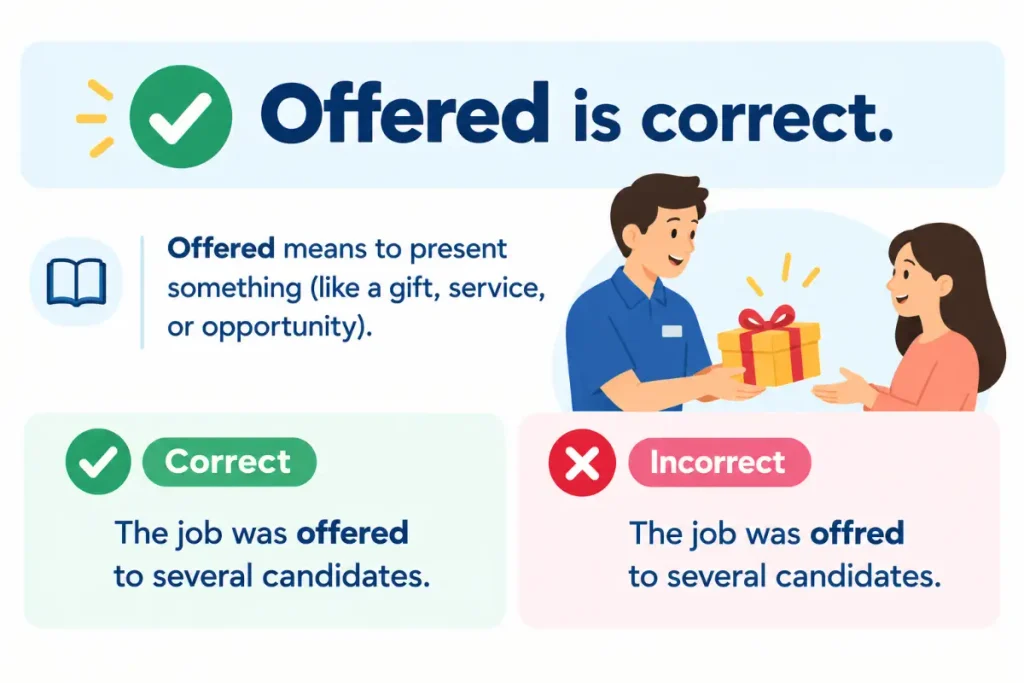
Quick Tips to Remember the Correct Spelling
Keep these rules in mind:
- Offered is correct.
- Offerred is incorrect.
- Start with offer.
- Add -ed directly: offer + ed = offered.
- Remember that offer has two F’s but one R.
- Don’t double the final r.
- The spelling is the same in American and British English.
- Use offered for both the past tense and past participle.
Conclusion
In conclusion, “offered” is the correct spelling, while “offerred” is an incorrect spelling. “Offered” is the past tense and past participle of the verb “offer,” meaning to present or provide something for someone to accept or consider.
The confusion often occurs because some verbs double their final consonant when adding -ed, but “offer” does not follow that pattern. The correct form simply adds -ed to create “offered.”
Overall, whenever you are choosing between “offered” and “offerred,” use “offered.” Using the correct spelling will make your writing clearer, more accurate, and grammatically polished.
Frequently Asked Questions
Is “offered” or “offerred” correct?
Offered is correct, while offerred is a misspelling. The past tense and past participle of offer are both spelled offered.
How do you spell “offered”?
The correct spelling is O-F-F-E-R-E-D: offered. Remember that offer has two f’s but only one r.
Why isn’t “offerred” correct?
Offerred incorrectly doubles the final r. The verb offer simply takes the -ed ending, producing offered.
What is the past tense of “offer”?
The past tense is offered. For example, “The company offered me a position.”
Is “offered” correct in American English?
Yes. Offered is the standard spelling in American English. British English uses the same spelling.
Is “offered” a verb?
Yes. Offered is the past-tense and past-participle form of the verb offer. In some sentences, it can also function as a participial adjective.
What is an easy way to remember “offered”?
Remember “two F’s, one R.” Start with offer and add -ed: offer + ed = offered.
1 thought on “Offered vs Offerred: Which Spelling Is Correct?”