
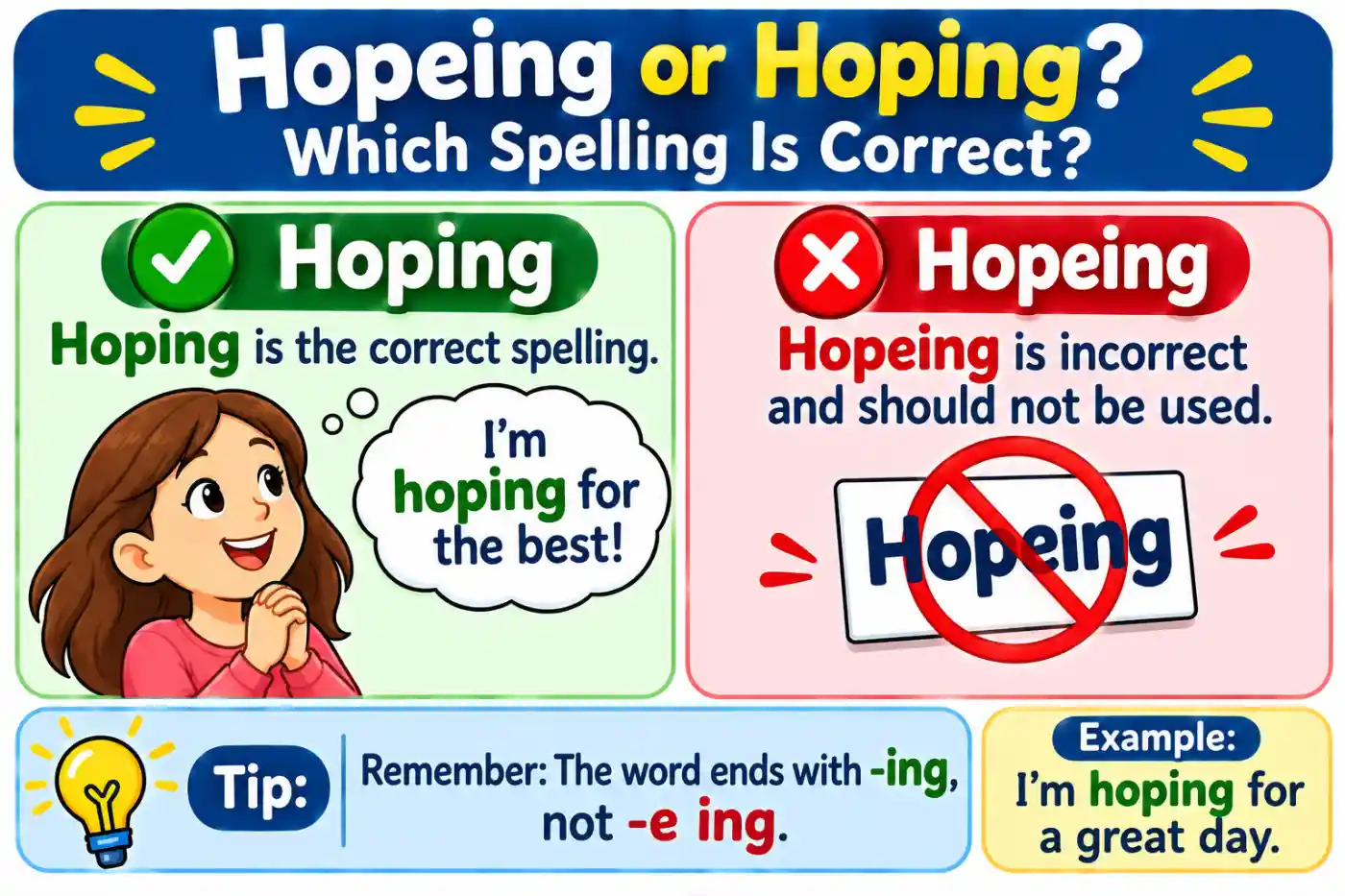
If you’re writing an email, text message, school assignment, or social media post, you may wonder whether hopeing or hoping is the correct spelling. Both forms look reasonable because the word hope ends with a silent e, and adding a suffix can sometimes change how a word is written.
However, only one spelling is correct in standard American English.
Hoping is the correct spelling. Hopeing is incorrect because you must drop the silent e from hope before adding the suffix -ing.
Understanding this simple spelling rule can help you avoid similar mistakes with other English verbs. Let’s look at the difference between these spellings, learn how to use hoping in sentences, and explore other words that follow the same pattern.
Hopeing or Hoping: Which Is Correct?
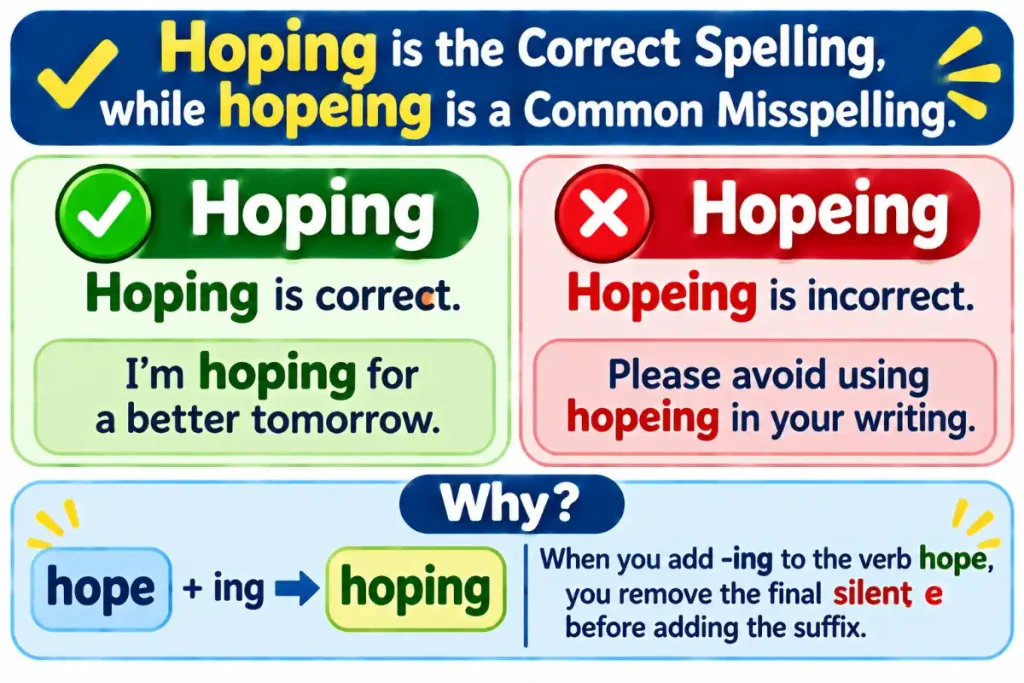
Hoping is the correct spelling, while hopeing is a common misspelling. When you add -ing to the verb hope, you remove the final silent e before adding the suffix.
The correct spelling is:
- CorrectHoping
- IncorrectHopeing
For example:
- Correct: I am hoping to hear from the company soon.
- Incorrect: I am hopeing to hear from the company soon.
The spelling change happens because English generally drops a silent final e when adding -ing to verbs such as hope, write, and smile. Remember that the silent e disappears, but the long vowel sound remains. That’s why hope becomes hoping, not hopping.
What Does Hoping Mean?
Hoping means wishing for something good to happen or expecting a positive result. It describes having a desire or feeling of possibility about something in the future. It comes from the verb hope and is the present participle or gerund form of that verb.
Here are a few examples:
- I am hoping for good news today.
- She is hoping to pass her final exam.
- We’re hoping the weather improves before the weekend.
- He kept hoping for another opportunity.
In each example, the word expresses a positive wish or expectation.
Hoping as a Present Participle
A present participle is the -ing form of a verb. It can work with a helping verb to describe an ongoing action or feeling.
Examples:
- I am hoping for a better result.
- They are hoping to finish the project today.
- She was hoping to visit her family.
- We have been hoping for an answer.
In these sentences, hoping forms part of a verb phrase.
Hoping as a Gerund
A gerund is a verb ending in -ing that functions as a noun.
Examples:
- Hoping for the best keeps her positive.
- Hoping won’t solve the problem without action.
- His hoping for success encouraged him to keep working.
Here, hoping acts as the subject of the sentence.
Why Is Hopeing Incorrect?
The spelling hopeing is incorrect because it keeps the final silent e when the suffix -ing requires it to be dropped.English has a common spelling rule for verbs ending in a silent e: Drop the final silent e before adding -ing.
For example:
| Base Verb | Correct -ing Form | Incorrect Form |
|---|---|---|
| Hope | Hoping | Hopeing |
| Make | Making | Makeing |
| Write | Writing | Writeing |
| Smile | Smiling | Smileing |
| Bake | Baking | Bakeing |
| Dance | Dancing | Danceing |
| Drive | Driving | Driveing |
| Close | Closing | Closeing |
| Take | Taking | Takeing |
| Use | Using | Useing |
This rule makes spelling easier once you recognize the pattern. However, English has exceptions and other spelling patterns, so it’s important to consider the final letters of a verb before adding a suffix.
How to Spell Hoping Correctly
To spell hoping correctly, follow these three simple steps:
- Start with the base verb hope.
- Remove the final silent e.
- Add -ing to the remaining letters.
Correct spelling
Notice that the vowel sound stays the same even after removing the final e.
Compare:
- Hope: /hoʊp/
- Hoping: /ˈhoʊpɪŋ/
The first vowel still has the long O sound.
Hopeing vs Hoping: What’s the Difference?
The main difference between these two spellings is correctness.
| Feature | Hopeing | Hoping |
|---|---|---|
| Spelling status | Incorrect | Correct |
| Standard English | No | Yes |
| Base verb | Hope | Hope |
| Suffix | -ing | -ing |
| Final silent e | Incorrectly retained | Properly removed |
| Suitable for formal writing | No | Yes |
| Suitable for casual writing | No | Yes |
There is no difference in intended meaning because hopeing is simply a misspelling of hoping. If you’re writing a professional email, academic assignment, application, or everyday message, always use hoping.
15 Examples of Hoping in Real Sentences
The best way to understand a word is to see how people use it in everyday situations. Here are 15 original examples of hoping in different contexts.
Everyday Conversations
- I’m hoping to visit my grandparents during the holidays.
- She’s hoping for a sunny day so we can enjoy the picnic.
- We’re hoping everything goes well with the new house.
- He’s hoping to find his lost keys before leaving.
School and Education
- Maya is hoping to receive a good grade on her science project.
- The students are hoping their teacher will extend the deadline.
- I’m hoping to get accepted into my preferred college.
Workplace and Professional Emails
- I’m hoping you can review the attached document before Friday.
- Our team is hoping to complete the project ahead of schedule.
- I’m hoping to hear your thoughts about the proposed changes.
Family and Relationships
- My parents are hoping to see everyone at the family gathering.
- She was hoping her brother could attend the graduation ceremony.
Travel and Future Plans
- We’re hoping to travel to California next summer.
- He is hoping to book a flight before prices change.
- I’m hoping the traffic clears before we reach the airport.
These examples show that hoping works naturally in personal conversations, professional communication, and formal writing.
Common Grammar Patterns With Hoping
The word hoping appears in several common grammatical structures. Learning these patterns can help you use it naturally.
1. Hoping + For
Use hoping for when you want or expect something.
Examples:
- I’m hoping for a positive response.
- They’re hoping for better weather.
- She is hoping for a promotion.
2. Hoping + To + Verb
Use hoping to when someone wants to do something.
Examples:
- I’m hoping to learn Spanish.
- He is hoping to start a business.
- We are hoping to visit New York.
3. Hoping + That + Clause
Use hoping that before a complete idea or expected situation.
Examples:
- I’m hoping that everything works out.
- She is hoping that her application gets approved.
- They are hoping that the meeting ends early.
4. Was/Were Hoping
Use was hoping or were hoping to describe a hope someone had in the past.
Examples:
- I was hoping to speak with the manager.
- We were hoping for a different outcome.
- She was hoping that everyone would attend.
5. Have Been Hoping
Use have been hoping to describe a hope that started in the past and continues into the present.
Examples:
- I’ve been hoping to visit that museum for years.
- They have been hoping for an opportunity to work together.
- We’ve been hoping to hear from you.
Hoping vs Hopping: What’s the Difference?
Although hoping and hopping look similar, they have different meanings and spellings. Hoping means wishing for something to happen, while hopping means jumping on one foot or making short jumps.
| Word | Meaning | Example |
|---|---|---|
| Hoping | Wishing for something | I’m hoping to win the competition. |
| Hopping | Jumping or moving in short jumps | The rabbit is hopping across the grass. |
When to Use Hoping
Use hoping when discussing wishes, expectations, or positive possibilities.
Examples:
- She’s hoping to get a new job.
- I’m hoping for good results.
- They are hoping to move next month.
When to Use Hopping
Use hopping when describing physical movement or jumping.
Examples:
- The child is hopping on one foot.
- A rabbit was hopping through the garden.
- We watched the frog hopping near the pond.
Memory tip: Hoping comes from hope, while hopping comes from hop. The second word doubles the P because of a different spelling rule.
Hoping vs Hope: What’s the Difference?
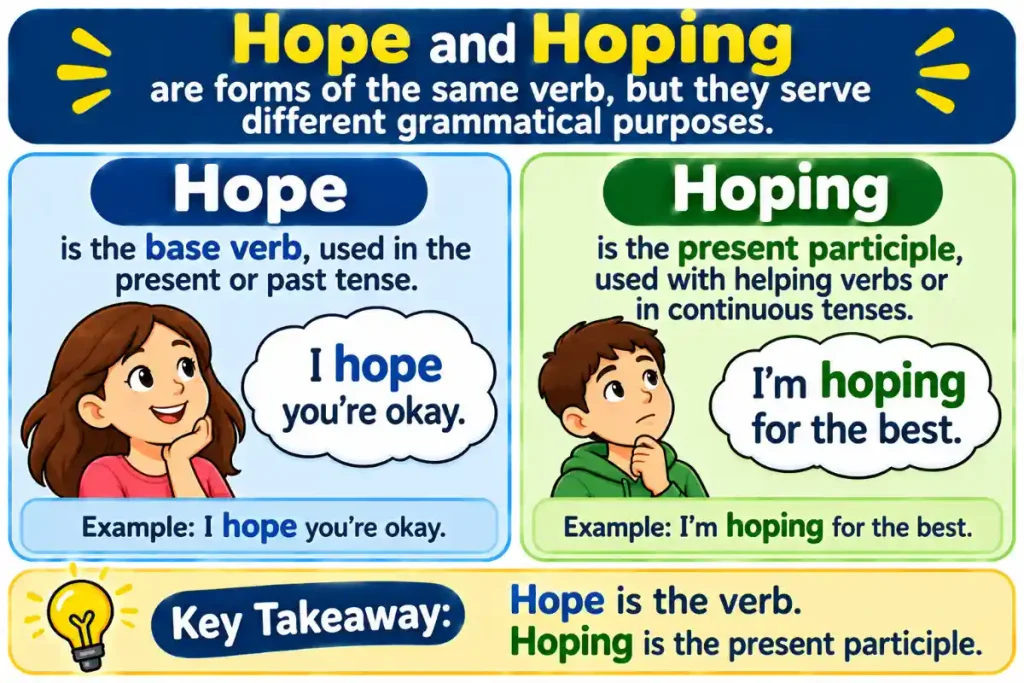
Hope and hoping are forms of the same verb, but they serve different grammatical purposes.
| Word | Part of Speech or Form | Example |
|---|---|---|
| Hope | Base verb or noun | I hope you feel better. |
| Hoping | Present participle or gerund | I’m hoping you feel better. |
Examples of Hope
- I hope you enjoy your vacation.
- We hope to see you soon.
- Her greatest hope is to become a teacher.
Examples of Hoping
- I’m hoping to see you soon.
- They’re hoping for a successful event.
- Hoping for success motivates him.
Use hope when the sentence requires the base form or noun. Use hoping when the sentence calls for the -ing form.
Other Words That Follow the Same Spelling Rule
Many English verbs drop their final silent e before adding -ing. Learning these examples can help you remember the correct spelling of hoping.
| Base Word | Correct Form | Incorrect Form |
|---|---|---|
| Hope | Hoping | Hopeing |
| Love | Loving | Loveing |
| Come | Coming | Comeing |
| Give | Giving | Giveing |
| Save | Saving | Saveing |
| Write | Writing | Writeing |
| Ride | Riding | Rideing |
| Bake | Baking | Bakeing |
| Move | Moving | Moveing |
| Shine | Shining | Shineing |
| Care | Caring | Careing |
| Share | Sharing | Shareing |
| Wake | Waking | Wakeing |
| Taste | Tasting | Tasteing |
| Change | Changing | Changeing |
These words share the same general pattern: the final silent e disappears before the -ing suffix.
Why Does Making Become Making Instead of Makeing?
The word making follows the same rule as hoping.
- Make + ing = Making
- Hope + ing = Hoping
The final silent e is removed before adding -ing.
This pattern applies to many common verbs and is useful to remember when writing.
When Do You Keep the Final E Before Adding a Suffix?
Not every suffix causes the final e to disappear. The spelling depends on which suffix you add.
For example:
| Base Word | Suffix | Correct Word |
|---|---|---|
| Hope | -ing | Hoping |
| Hope | -ful | Hopeful |
| Hope | -less | Hopeless |
| Hope | -ed | Hoped |
| Care | -ing | Caring |
| Care | -ful | Careful |
| Use | -ing | Using |
| Use | -ful | Useful |
The general pattern is:
- Drop the silent e before a vowel-starting suffix such as -ing.
- Usually keep the e before a consonant-starting suffix such as -ful or -less.
There are exceptions, but this rule explains many everyday spelling changes.
Common Mistakes When Using Hoping
Even though hoping is a simple word, writers sometimes make spelling and grammar mistakes. Here are some common problems and their corrections.
1. Keeping the Silent E
Incorrect: I am hopeing for a better result.
Correct: I am hoping for a better result.
Why: Remove the final silent e before adding -ing.
2. Adding an Extra P
Incorrect: I am hopping that you understand.
Correct: I am hoping that you understand.
Why: Hopping means jumping. Hoping expresses a wish or expectation.
3. Using Hope Instead of Hoping
Incorrect: I am hope to get the position.
Correct: I am hoping to get the position.
Why: After am, use the present participle hoping in this continuous verb structure.
4. Confusing Hoping With Expecting
Incorrect: I’m hoping the package will arrive yesterday.
Better: I was hoping the package would arrive yesterday.
Why: Match the verb tense to the time being discussed.
5. Using an Unnecessary Helping Verb
Incorrect: I am hoping to will receive an answer.
Correct: I am hoping to receive an answer.
Why: The phrase hoping to is followed by the base form of a verb.
Is Hoping Formal or Informal?
Hoping is appropriate in both formal and informal English. It works in professional emails, academic writing, everyday conversations, and personal messages.
The tone depends on the rest of the sentence.
| Context | Example | Tone |
|---|---|---|
| Professional email | I’m hoping to receive your feedback by Monday. | Polite |
| Academic writing | The researchers are hoping to explore this question further. | Formal |
| Job application | I’m hoping to contribute to your organization. | Professional |
| Text message | Hoping we can meet this weekend! | Casual |
| Everyday conversation | I’m hoping it doesn’t rain today. | Natural |
| Social media | Hoping for a great weekend! | Friendly |
Using Hoping in Professional Emails
The word hoping can make a request sound polite and considerate.
Examples:
- I’m hoping you can share the updated report.
- We’re hoping to schedule a meeting next week.
- I’m hoping to receive your response when convenient.
However, in very direct business writing, you may sometimes prefer a clearer statement.
For example:
Instead of: I’m hoping you can send the files today.
Write: Could you please send the files today?
Both are correct, but the second is more direct.
Is Hoping Used Differently in American and British English?
No. Hoping is spelled the same way in standard American and British English. Both varieties follow the same spelling pattern when adding -ing to the verb hope.
| English Variety | Correct Spelling |
|---|---|
| American English | Hoping |
| British English | Hoping |
| Canadian English | Hoping |
| Australian English | Hoping |
The misspelling hopeing is not an accepted regional spelling. You can confidently use hoping in writing for American, British, Canadian, and Australian readers.
Word Origin: Where Does Hoping Come From?
The word hoping comes from the verb hope, which has roots in Old English. The original verb developed from the Old English word hopa, associated with hope or expectation. Over time, its spelling and usage developed into the modern English word hope. Adding the suffix -ing creates hoping, which expresses an ongoing wish or expectation. The spelling follows the traditional English pattern of dropping a silent final e before adding a suffix that begins with a vowel. mThis explains why the modern spelling is hoping rather than hopeing.
Quick Tips to Remember the Correct Spelling
If you sometimes forget whether to write hopeing or hoping, these simple tips can help.
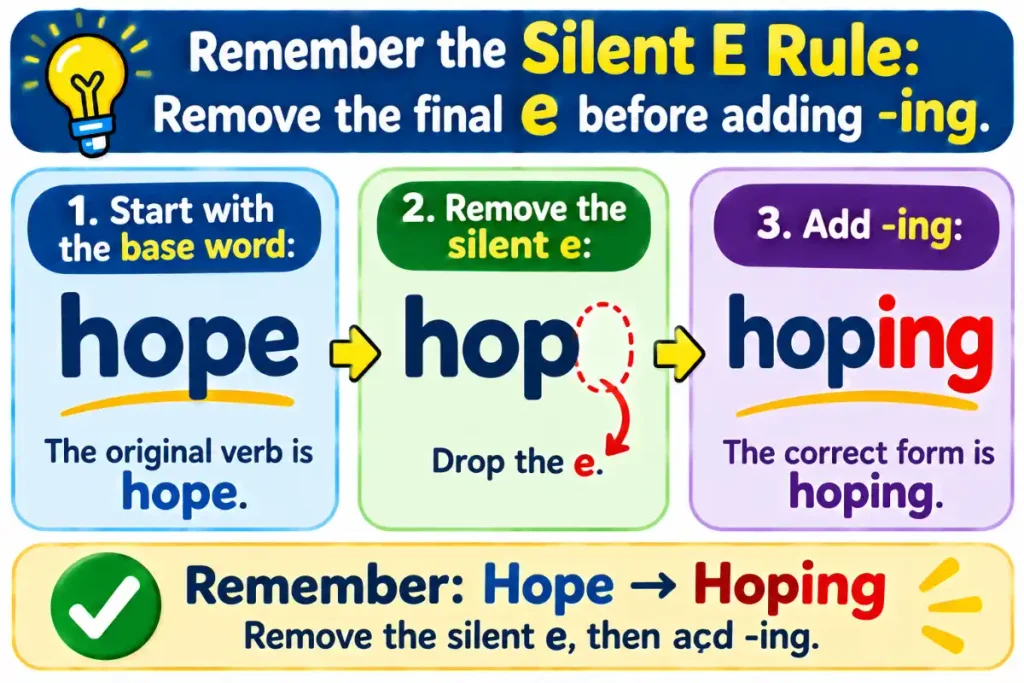
- Remember the silent E rule: Remove the final e before adding -ing.
- Think of the base word: The original verb is hope.
- Compare similar words: Make becomes making, and write becomes writing.
- Watch the double P: Hopping means jumping, not wishing.
- Read your sentence aloud: Make sure the spelling matches the meaning.
- Use a spelling checker: A grammar or spell-checking tool can catch common mistakes.
A useful memory trick is:
Hope + ing = Hoping.
Once you remember this pattern, you’ll find it easier to spell many other English verbs correctly.
Conclusion
Choosing between hopeing or hoping is easy once you understand the silent E spelling rule. The correct spelling is hoping because you must remove the final e from hope before adding the suffix -ing. The form hopeing is a common spelling mistake and should be avoided in both formal and casual writing.
Remember that hoping expresses a wish or positive expectation, while hopping describes jumping or moving in short steps. Although these words look similar, their meanings are different. Practice using hoping in emails, conversations, school assignments, and everyday sentences. With a little attention to the spelling pattern, you’ll be able to recognize and use the correct form confidently.
Frequently Asked Questions
1. Is hopeing or hoping correct?
Hoping is correct, and hopeing is incorrect. Remove the final silent e from hope before adding -ing.
2. How do you spell hoping?
The correct spelling is H-O-P-I-N-G. It contains six letters and does not include the final e from the original word hope.
3. Why is hoping spelled without an E?
Hoping is spelled without an e because English usually drops a silent final e before adding the suffix -ing. The same rule applies to words such as making, writing, and smiling.
4. Is hoping a real English word?
Yes, hoping is a standard English word. It is the present participle and gerund form of the verb hope.
5. What is the difference between hoping and hopping?
Hoping means wishing for something to happen, while hopping means jumping or moving in short jumps. They come from different base verbs: hope and hop.
6. Is hoping correct in American English?
Yes, hoping is the correct spelling in American English. It is also standard in British, Canadian, and Australian English.
7. What are some words similar to hoping?
Words related to hoping include wishing, expecting, anticipating, looking forward to, and desiring. However, these alternatives have slightly different meanings and aren’t always interchangeable.
1 thought on “Hopeing or Hoping: Which Spelling Is Correct?”