
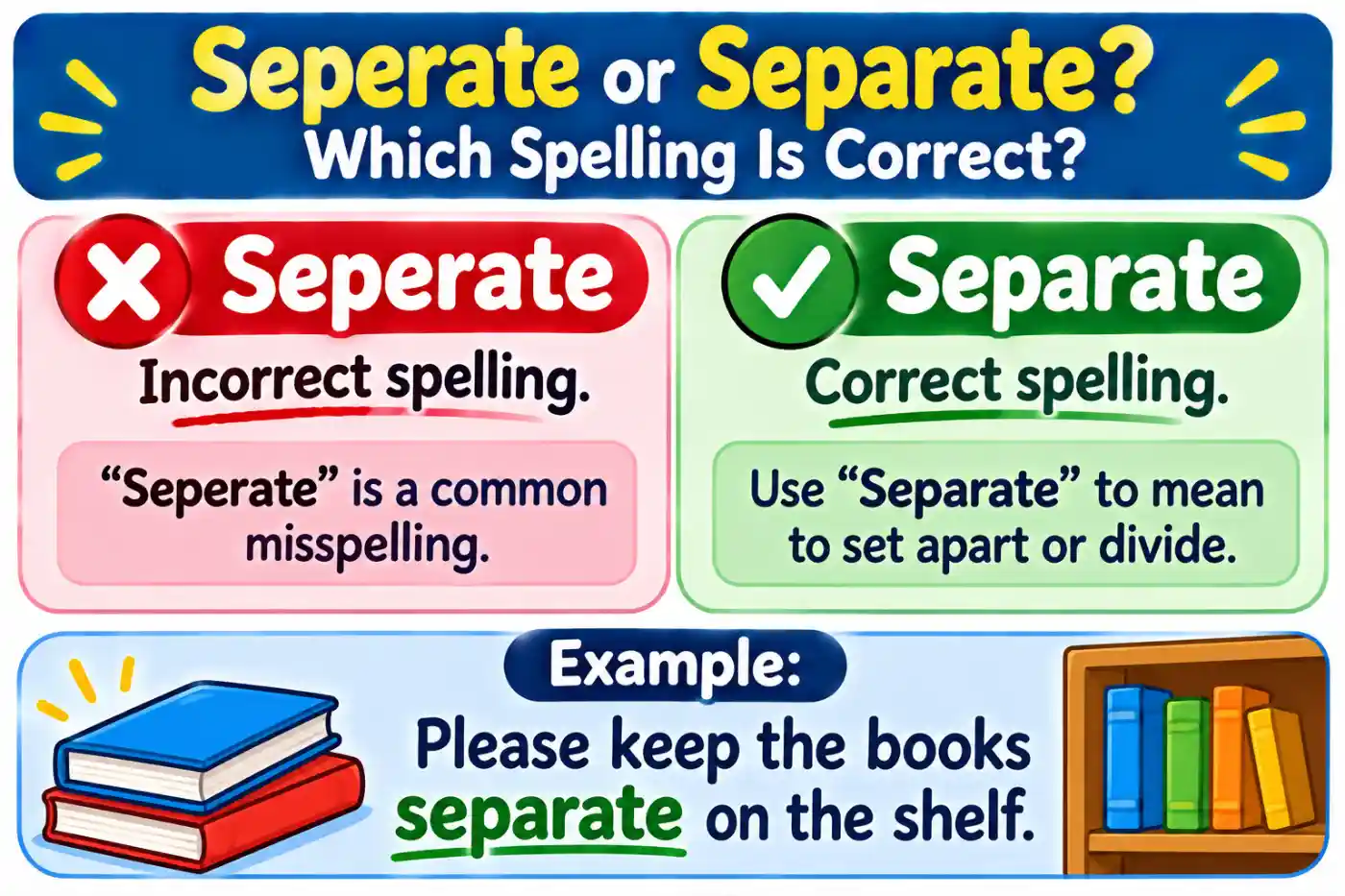
If you’re writing an email, completing a school assignment, or updating your resume, you may wonder whether seperate or separate is the correct spelling. The two forms look similar, and the difference is easy to miss when typing quickly. However, only one is accepted in standard American English.
Separate is the correct spelling. Seperate is a misspelling. The word separate can mean to divide things, keep people or objects apart, or identify something as distinct from another thing. You can use it as a verb, adjective, or noun in certain contexts.
The confusion often comes from the way people pronounce the word. The middle vowel can sound like a short uh sound in everyday speech, which may lead writers to use an e where an a belongs.
In this guide, you’ll learn how to spell separate correctly, understand its meanings, see examples in everyday situations, and discover simple ways to avoid this common spelling mistake.
What Is the Correct Spelling: Seperate or Separate?
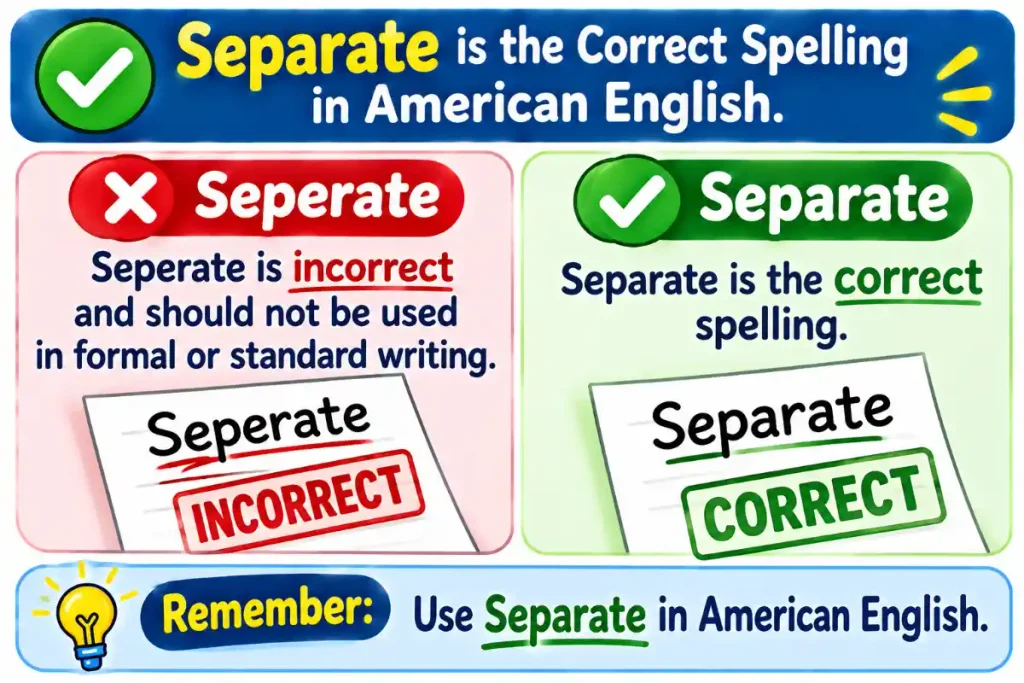
Separate is the correct spelling in American English. The spelling seperate is incorrect and should not be used in formal or standard writing.
| Spelling | Correct or Incorrect? | Meaning |
|---|---|---|
| Separate | Correct | To divide, keep apart, or identify as distinct |
| Seperate | Incorrect | A common misspelling of separate |
The correct spelling contains the letter a in the middle syllable: sep-a-rate. The incorrect spelling replaces that a with an e.
Here are a few examples:
- Correct: Please separate the clean clothes from the dirty ones.
- Incorrect: Please seperate the clean clothes from the dirty ones.
- Correct: We booked separate hotel rooms for the trip.
- Incorrect: We booked seperate hotel rooms for the trip.
The word separate works in many situations, including schoolwork, business communication, personal messages, and everyday conversations. Learning its spelling will help you communicate more clearly and avoid a mistake that spell-check tools may catch but cannot always prevent.
What Does Separate Mean?
The word separate has several related meanings. Its exact meaning depends on how you use it in a sentence.
1. Separate as a Verb
As a verb, separate means to divide something into parts, move things apart, or distinguish one thing from another.
Examples:
- Please separate the recyclable materials from the regular trash.
- The teacher asked the students to separate into small groups.
- We need to separate the facts from the opinions in this report.
- The fence separates our yard from the neighbor’s property.
- She used a divider to separate the documents into categories.
In these examples, separate describes an action. It tells the reader that something is being divided, distinguished, or moved apart.
The verb can also describe people or groups who stop staying together.
For example: “The two friends decided to separate after years of working together on the project.”
2. Separate as an Adjective
As an adjective, separate describes things that are distinct, independent, or not joined together.
Examples:
- We have separate accounts for personal and business expenses.
- The school assigned separate classrooms to the two groups.
- Please submit each assignment in a separate file.
- My brother and I have separate phone plans.
- The restaurant offers separate menus for lunch and dinner.
Here, the word describes the relationship between people, objects, places, or activities. It does not describe the act of dividing them.
3. Separate as a Noun
In some informal contexts, separate can function as a noun, particularly in the phrase go your separate ways. In fashion, separates is a plural noun referring to individual clothing pieces that can be combined into different outfits.
For example:
- The store sells separates that customers can mix and match.
- After the disagreement, the partners decided to go their separate ways.
The noun use is less common than the verb and adjective forms. Most writers encounter separate in sentences describing an action or distinguishing one thing from another.
Why Do People Confuse Seperate and Separate?
The spelling mistake usually happens because English spelling does not always match pronunciation. People may hear a word one way but remember or type its letters differently.
Several factors contribute to the confusion.
1. The Middle Vowel Sounds Unclear
The most common reason for misspelling separate is the vowel in its middle syllable. In ordinary American speech, the first vowel in the middle syllable may sound like a reduced, unstressed vowel. This can make the correct a difficult to distinguish from an e by sound alone. As a result, someone might write seperate because that spelling seems to match what they hear. However, standard spelling requires separate, with an a in the middle.
2. English Has Many Unpredictable Spelling Patterns
English contains words whose pronunciation does not clearly reveal every letter.
Consider these examples:
| Correct Word | Common Misspelling | What Causes the Confusion? |
|---|---|---|
| Separate | Seperate | The middle vowel is easy to misremember |
| Definitely | Definately | The unstressed vowel encourages an incorrect spelling |
| Accommodation | Accomodation | The double consonant is often missed |
| Occurred | Occured | The double r is easy to overlook |
| Privilege | Priviledge | The ending is confused with a familiar spelling pattern |
These words illustrate why relying entirely on pronunciation can lead to errors. Learning the standard spelling and recognizing the parts of a word can make writing more accurate.
3. Typing Quickly Can Cause Errors
People often make spelling mistakes when typing messages, emails, or documents in a hurry. Because seperate looks similar to separate, the error may go unnoticed during proofreading. For example, you might write, “Please seperate the invoices by department,” without realizing that the middle vowel is wrong. A quick spelling check would correct the sentence to:
“Please separate the invoices by department.” Reading your writing slowly and checking commonly misspelled words can help you catch these errors before submitting or sending a document.
How Do You Spell Separate Correctly?
The easiest way to spell separate correctly is to remember that the word contains an a in the middle, not an e.
The word has three syllables:
sep-a-rate
You can break it down into smaller parts to make the spelling easier to remember.
| Part | Letters | Tip |
|---|---|---|
| First syllable | sep | Begin with sep |
| Middle syllable | a | Remember the middle a |
| Final syllable | rate | Finish with rate |
Putting the parts together gives you separate. Although syllable division is useful for remembering the spelling, it does not mean that every speaker pronounces each syllable with equal emphasis. The main purpose is to give you a visual pattern to remember.
A Simple Memory Trick
Try this sentence:
There’s a rat in separate.
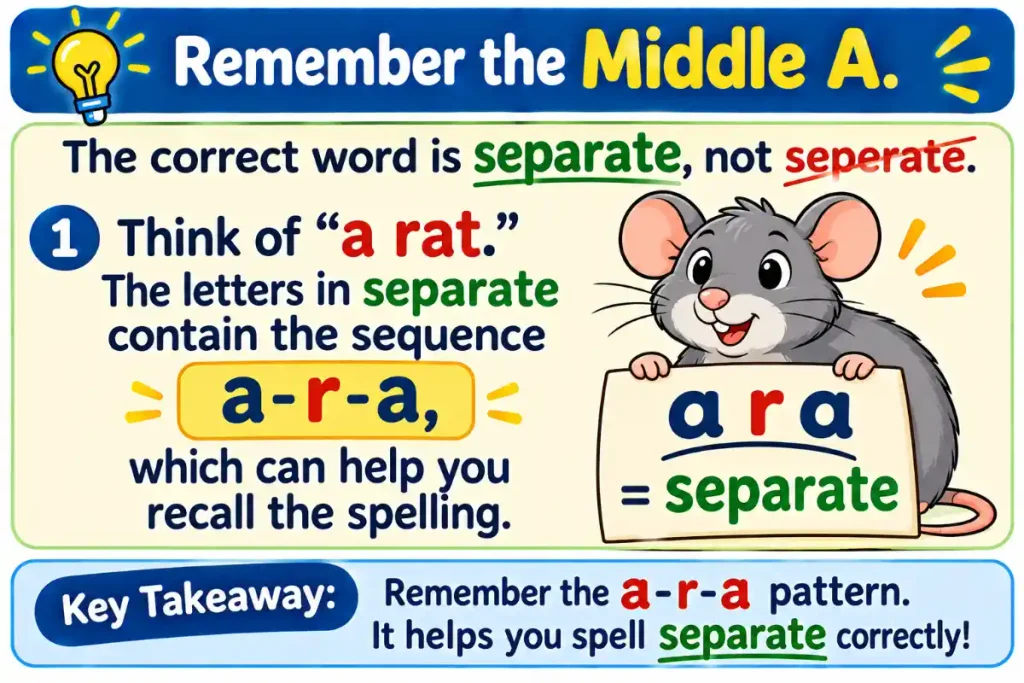
The word separate contains the letters a-r-a in sequence: sep-a-rate. Thinking about the word rat inside the spelling can help you remember the middle a. Another helpful trick is to associate separate with the phrase a part. When you separate things, you divide them into parts or keep them apart.
For example:
- Separate the papers into two piles.
- Keep the two projects separate.
- Separate the ingredients before mixing them.
Each sentence reinforces the same spelling and meaning.
Separate vs Seperate: Correct and Incorrect Usage
Recognizing the spelling difference is easier when you compare the two forms directly.
| Sentence | Status | Correction or Explanation |
|---|---|---|
| Please separate the files by date. | Correct | Separate is spelled properly. |
| Please seperate the files by date. | Incorrect | Replace seperate with separate. |
| We have separate bedrooms. | Correct | The adjective describes distinct rooms. |
| We have seperate bedrooms. | Incorrect | The spelling should be separate. |
| The teacher separated the students into teams. | Correct | Separated is the correct past-tense form. |
| The teacher seperated the students into teams. | Incorrect | The base word is separate. |
The important point is that seperate is not an accepted alternative spelling in standard American English. It is a misspelling, regardless of whether the word functions as a verb or an adjective. When you add endings such as -d, -ly, or -ion, you must also use the correct base spelling.
Examples include:
- Separate
- Separated
- Separately
- Separation
Each of these words follows the spelling pattern associated with separate.
Examples of Separate in Real Sentences
Seeing the correct word in different situations can help you understand both its meaning and its spelling. The following examples cover school, work, email, personal life, and other common contexts.
Everyday Life
- Please separate the white laundry from the colored clothes before starting the washing machine.
- We keep our winter decorations in a separate storage box.
- The grocery store has separate checkout lines for regular purchases and express customers.
- I placed the clean dishes on a separate shelf to make room for the new ones.
School and Education
- The teacher asked us to separate the main ideas from the supporting details.
- Each student must submit a separate report about the science experiment.
- The librarian helped us separate the reference books from the novels.
- Our class divided into separate teams to complete the group activity.
Work and Professional Communication
- Please separate the travel expenses from the regular office expenses in the spreadsheet.
- The manager requested separate summaries for the sales and marketing departments.
- We maintain separate records for each client to prevent confusion.
- The company uses separate email addresses for customer support and billing.
Email and Messaging
- Could you send the two documents as separate attachments?
- I’ll create a separate email thread for the scheduling discussion.
- Please keep the meeting notes separate from the budget proposal.
Technology and Digital Files
- I saved the photos in separate folders so I could find them more easily.
- The application allows users to separate personal data from work files.
- We created a separate account for the new software project.
Travel and Personal Plans
- My friends booked separate hotel rooms because they wanted more privacy.
- We planned separate activities for the morning and afternoon.
- The tour guide asked the two groups to separate before entering the museum.
Business and Finance
- The owner keeps separate bank accounts for business and personal expenses.
- Our accountant prepared separate invoices for each department.
- The company tracks each project’s costs in a separate budget.
These examples show how separate applies to different subjects without changing its core spelling.
What Are the Different Forms of Separate?
The spelling of separate remains important when you change its grammatical form. Some forms add endings, while others use the word as part of a related noun or adverb.
| Word Form | Part of Speech | Meaning | Example |
|---|---|---|---|
| Separate | Verb or adjective | Divide or distinct | Keep the files separate. |
| Separates | Verb | Divides or keeps apart | This wall separates the rooms. |
| Separated | Past-tense verb or adjective | Divided or apart | The documents were separated by topic. |
| Separating | Verb form or participle | Dividing or keeping apart | She is separating the recyclable items. |
| Separately | Adverb | In a distinct or independent way | Please label each package separately. |
| Separation | Noun | The act or state of being divided | The separation of the two sections improved the layout. |
Separate and Separated
Separate is the base form of the verb, while separated usually describes an action that happened in the past or a resulting condition.
- Present: “I separate the receipts by month.”
- Past: “I separated the receipts yesterday.”
- Adjective: “The receipts are separated into monthly folders.”
The word’s spelling remains consistent in all three examples.
Separate and Separately
Separate can describe something that is distinct or the action of dividing it. Separately describes how an action is performed.
Compare these sentences:
- “We prepared separate reports.” Here, separate describes the reports.
- “We prepared the reports separately.” Here, separately describes how the reports were prepared.
Using the correct form makes your sentence clearer and more precise.
Separate and Separation
Separate describes an action or a quality, while separation names the act or condition of being divided.
For example:
- “Please separate the documents before filing them.”
- “The separation of the documents made filing easier.”
The words are related, but they serve different grammatical purposes.
Separate or Divide: What’s the Difference?
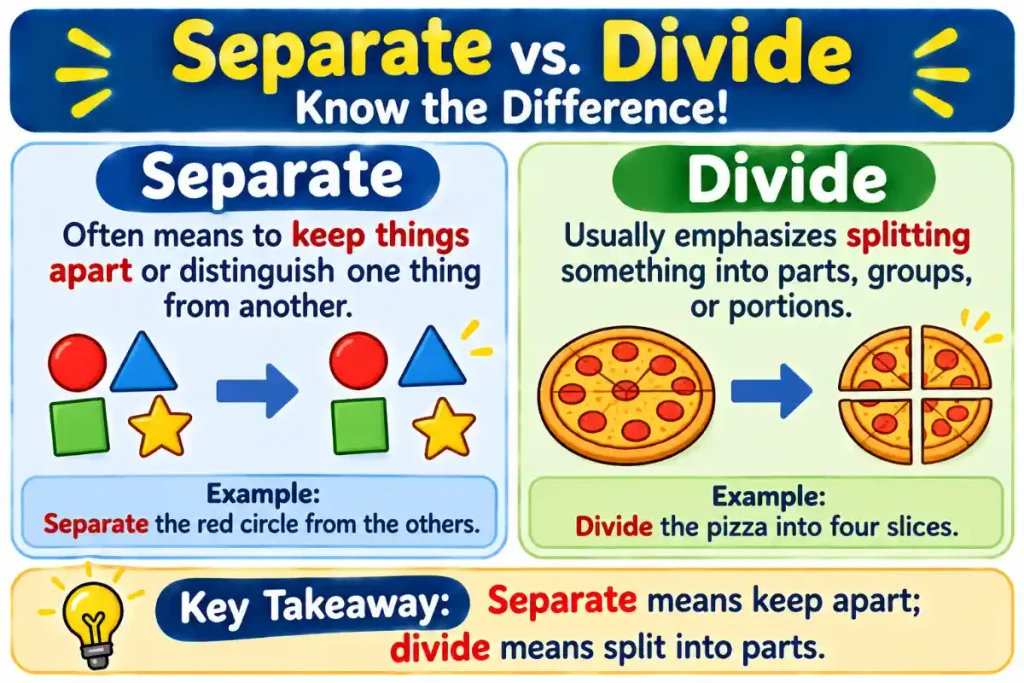
Separate often means to keep things apart or distinguish one thing from another. Divide usually emphasizes splitting something into parts, groups, or portions.
| Word | Main Meaning | Example |
|---|---|---|
| Separate | Keep apart or distinguish | Separate the clean clothes from the dirty ones. |
| Divide | Split into parts or portions | Divide the pizza into eight slices. |
Consider these additional examples:
- “The fence separates the two properties.” The fence marks a boundary between them.
- “The teacher divided the class into four groups.” The teacher created four groups from the class.
You can sometimes use either word, but the emphasis changes slightly. For example, you can divide a collection into smaller groups and then separate those groups into different boxes. The two actions are related but not identical.
Separate or Distinct: What’s the Difference?
Separate often emphasizes distance, division, or independence. Distinct emphasizes a clear difference in identity, appearance, meaning, or character.
| Word | Meaning | Example |
|---|---|---|
| Separate | Not joined or kept apart | The office has separate rooms for interviews and training. |
| Distinct | Clearly different or recognizable | The two departments have distinct responsibilities. |
Here are more examples:
- “The company operates two separate offices.” The offices are physically or organizationally apart.
- “The two proposals have distinct advantages.” The proposals offer different benefits.
In some situations, both words work naturally. For example, two departments may be separate from each other and have distinct responsibilities. However, you would not normally replace separate with distinct when describing a physical action such as separating mixed recycling materials.
Separate or Apart: What’s the Difference?
Separate and apart both express the idea of things being divided or not together. The difference lies in their grammatical use and the emphasis they provide. Separate can be a verb or an adjective. Apart commonly functions as an adverb or appears in expressions such as apart from.
| Word | Common Use | Example |
|---|---|---|
| Separate | Verb or adjective | Please separate the papers into two piles. |
| Apart | Adverb | The two houses stand several feet apart. |
Compare the following:
- “Keep the chemicals separate.” The adjective describes their required condition.
- “Keep the containers apart.” The adverb emphasizes the distance between them.
The phrases set apart and keep apart are also common in American English. Their meanings depend on the surrounding sentence. For example, “Her experience sets her apart from other applicants” means that her experience makes her different from the others.
Is Separate Spelled Differently in American and British English?
No. Separate is the standard spelling in both American and British English. Some English words have regional spelling differences. For example, American English generally uses color, while British English generally uses colour. However, separate does not follow that pattern.
| Variety of English | Correct Spelling | Incorrect Spelling |
|---|---|---|
| American English | Separate | Seperate |
| British English | Separate | Seperate |
| Canadian English | Separate | Seperate |
| Australian English | Separate | Seperate |
You can use separate in an American school assignment, a British business email, a Canadian report, or an Australian website. The spelling does not change based on the country or audience. This makes it easier to remember: choose separate regardless of which standard variety of English you are writing.
Common Mistakes to Avoid When Using Separate
Knowing the correct spelling is important, but writers can also make mistakes with word forms and sentence structure.
1. Writing Seperate Instead of Separate
This is the main spelling error.
- Incorrect: “Please seperate the receipts by category.”
- Correct: “Please separate the receipts by category.”
Remember the middle a to avoid this mistake.
2. Misspelling Related Words
The same error can appear in other forms of the word.
- Incorrect: “The files were seperated by date.”
- Correct: “The files were separated by date.”
- Incorrect: “Please save the images seperately.”
- Correct: “Please save the images separately.”
- Incorrect: “The seperation between the sections is clear.”
- Correct: “The separation between the sections is clear.”
Learning the related forms together helps reinforce the correct spelling pattern.
3. Using Separate When You Mean Different
Although separate and different sometimes overlap, they are not always interchangeable.
For example:
- “We have separate rooms.” This means the rooms are distinct or not shared.
- “We have different rooms.” This usually means the rooms are not the same, perhaps in size, design, or location.
If you mean that two things are not alike, different may be the better word. If you mean they are divided or kept apart, separate is often more precise.
4. Confusing Separate and Separately
Writers sometimes use an adjective where an adverb is needed.
- Incorrect: “Please review the documents separate.”
- Correct: “Please review the documents separately.”
The adverb separately explains how the documents should be reviewed.
However, the adjective separate is correct in a sentence such as “Please review the separate documents.”
The right choice depends on what the word describes.
5. Forgetting the Correct Ending
Some writers accidentally change the spelling when adding a suffix.
Remember these standard forms:
- Separate
- Separated
- Separating
- Separately
- Separation
Avoid forms such as seperated, seperating, and seperately.
Is Separate a Formal or Informal Word?
Separate is appropriate in both formal and informal English. It works naturally in everyday conversation, professional communication, academic writing, and official documents.
In Formal Writing
Use separate when you need to distinguish categories, responsibilities, records, or processes.
Examples:
- “The report contains separate sections for the findings and recommendations.”
- “Applicants must submit separate forms for each position.”
- “The research team analyzed the two data sets separately.”
The word is clear and professional without sounding overly complicated.
In Casual Conversation
You can use separate in ordinary speech without sounding formal.
Examples:
- “Let’s keep our snacks separate.”
- “Can you put those toys in a separate box?”
- “I’ll make a separate list for the things we still need.”
There is no need to replace separate with a more casual word unless another expression better fits your meaning.
In Resumes and Job Applications
The word can help clarify responsibilities or accomplishments.
Examples:
- “Maintained separate records for multiple client accounts.”
- “Created separate tracking sheets for inventory and sales.”
- “Managed separate schedules for three project teams.”
In these contexts, separate communicates organization and clear distinctions. Use it only when the distinction is meaningful to the reader.
What Are Some Synonyms for Separate?
Several words can replace separate, depending on whether you mean to divide something, keep things apart, or describe items as distinct. The best synonym depends on the context. A word that works well for physical objects may not fit a discussion about ideas or responsibilities.
| Word or Phrase | Meaning | Example |
|---|---|---|
| Divide | Split into parts | Divide the class into groups. |
| Split | Break into parts | Split the bill between us. |
| Disconnect | Break a connection | Disconnect the device. |
| Isolate | Keep apart | Isolate the affected equipment. |
| Distinguish | Recognize differences | Distinguish facts from assumptions. |
| Differentiate | Identify differences | Differentiate the two methods. |
| Segregate | Separate into groups | Segregate materials by type. |
| Detach | Remove something attached | Detach the label. |
| Partition | Divide into sections | Partition the room. |
| Disentangle | Free from a tangle | Disentangle the cables. |
These alternatives have different meanings, so they are not always direct replacements for separate. For example, detach works when removing an attached part, while distinguish works when identifying differences. Divide is often the best choice when you need to split one whole into portions.
What Is the Opposite of Separate?
The opposite of separate depends on the intended meaning. If you mean to keep things apart, an opposite may describe joining them together. If you mean to distinguish items, the opposite may suggest treating them as one.
Common antonyms include:
| Antonym | Meaning | Example |
|---|---|---|
| Join | Bring things together | Join the two pieces with glue. |
| Combine | Put things together | Combine the two reports into one document. |
| Unite | Bring people or groups together | The project helped unite the teams. |
| Connect | Establish a link | Connect the printer to the computer. |
| Merge | Combine into one | Merge the two files into a single document. |
| Unite together | Bring separate groups into a shared whole | The event helped unite the community. |
| Integrate | Combine parts into a functioning whole | Integrate the new system with the existing software. |
| Attach | Fasten one thing to another | Attach the receipt to the expense form. |
For example, separate the documents suggests keeping them apart, while combine the documents suggests putting them together. Choose the antonym that best matches the action you want to describe.
Quick Tips to Remember the Correct Spelling
If you frequently confuse seperate and separate, a few simple habits can help you remember the correct form.
- Remember the middle A. The correct word is separate, not seperate.
- Think of “a rat.” The letters in separate contain the sequence a-r-a, which can help you recall the spelling.
- Learn related words together. Practice separate, separated, separately, and separation as a group.
- Use the word in a sentence. Writing “Please separate the files by date” reinforces the correct spelling.
- Check important documents. Review resumes, school assignments, reports, and emails before submitting them.
- Use spell-check tools. A spelling checker can flag seperate, but read the sentence yourself to make sure the corrected word fits the meaning.
- Avoid relying only on sound. The middle vowel may sound unclear in ordinary speech, so remember the written form instead.
With regular practice, the correct spelling becomes easier to recognize and use.
Conclusion
The correct spelling is separate, not seperate. Although the two forms look similar, only separate is accepted in standard American English. It can function as a verb meaning to divide or keep things apart and as an adjective describing things that are distinct or independent.
The easiest way to remember the spelling is to focus on the middle a. You can also practice related forms such as separated, separately, and separation to reinforce the same pattern. These words appear frequently in school assignments, professional emails, business reports, and everyday conversations, so learning them together is useful.
Whenever you’re unsure about seperate or separate, remember the correct spelling and check it before submitting important writing. A small spelling habit can make your communication clearer, more accurate, and more professional.
Frequently Asked Questions
Is seperate or separate correct?
Separate is correct, and seperate is incorrect. Use separate in standard American English and other major varieties of English.
How do you spell separate correctly?
Spell the word s-e-p-a-r-a-t-e. Remember the middle a to avoid writing seperate.
Why do people spell separate as seperate?
People often misspell separate because its middle vowel can sound unclear in everyday speech. The correct spelling contains an a, even when the vowel sounds similar to an unstressed e.
Is separate an adjective or a verb?
Separate can function as both an adjective and a verb. As a verb, it means to divide or keep apart; as an adjective, it describes things that are distinct or independent.
Is separated spelled with an a or an e?
Separated is spelled with an a in the same position as separate. The correct spelling is separated, not seperated.
Is separate spelled differently in British English?
No. Separate is the standard spelling in both American and British English. The misspelling seperate is not the standard form in either variety.
What is the difference between separate and separately?
Separate is commonly used as a verb or adjective, while separately is an adverb. For example, you can prepare “separate reports” or prepare the reports “separately.”
2 thoughts on “Seperate or Separate: Which Spelling Is Correct?”