

If you’re writing an email, completing a school assignment, or describing something that happened in the past, you may wonder whether to use begun or began. Both words are correct, but they serve different grammatical purposes. Choosing the right one depends on how you structure your sentence and whether you use a helping verb.
Began is the simple past tense of begin, while begun is its past participle. Use began to describe an action that started in the past, and use begun with a helping verb such as has, have, or had.
For example, you would write, “The meeting began at nine,” but “The meeting has begun.” Both sentences describe a starting point, yet they follow different grammatical patterns.
Understanding the difference between these forms will help you write more naturally and avoid common tense mistakes. This guide explains their meanings, grammatical rules, sentence patterns, examples, and practical tips for choosing the correct word.
Begun or Began: What’s the Difference?
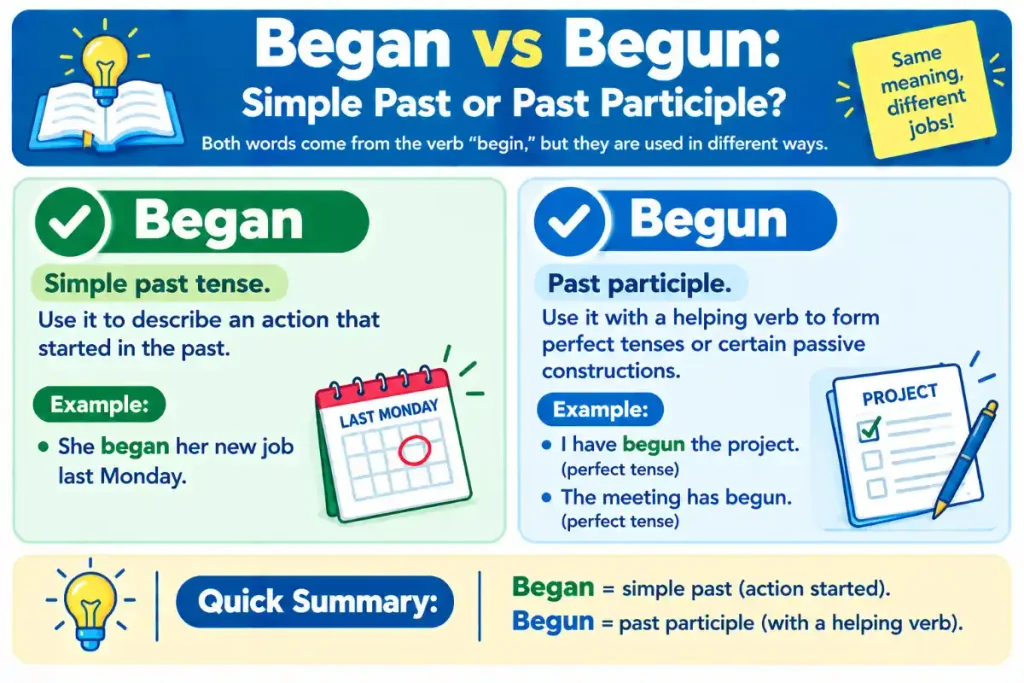
The main difference between begun and began is their grammatical function. Both come from the verb begin, which means to start something or cause something to start.
- Began: Simple past tense. Use it to describe an action that started in the past.
- Begun: Past participle. Use it with a helping verb to form perfect tenses or certain passive constructions.
Compare these examples:
| Word | Grammatical Form | Example |
|---|---|---|
| Begin | Base form | I begin work at eight every morning. |
| Began | Simple past tense | I began work at eight yesterday. |
| Begun | Past participle | I have begun my new project. |
The key is to examine the other words in your sentence. If you are describing a completed starting event without a helping verb, began is usually correct. If you use has, have, or had to form a perfect tense, choose begun.
What Does Began Mean?
Began is the simple past tense of begin. It describes an action or event that started at a particular time in the past. Use began when you want to state that something started, without using a perfect-tense helping verb.
Examples:
- The concert began at 7 p.m.
- She began her homework after dinner.
- Our company began operations in 2018.
- The rain began shortly before midnight.
- He began learning Spanish last summer.
In each example, began identifies a starting point in the past. The sentence does not need has, have, or had before the verb. You can also use began with a noun or an infinitive phrase.
With a noun:
- The coach began the practice session.
- The teacher began the lesson with a short quiz.
With an infinitive phrase:
- Maya began to understand the instructions.
- We began to notice a change in the weather.
You can use began in everyday conversations, professional emails, academic writing, and storytelling. It works in both formal and casual situations.
What Does Begun Mean?
Begun is the past participle of begin. It usually appears with a helping verb to show that an action has started before or by a particular point in time. The most common helping verbs used with begun are has, have, and had.
Examples:
- I have begun reading the book.
- She has begun a new job.
- They had begun the meeting before we arrived.
- The students have begun preparing for their exams.
- Construction has begun on the new library.
Notice that begun does not normally stand alone as the main verb in a standard past-tense sentence. For example, “She begun the project yesterday” is incorrect in standard English. The correct sentence is “She began the project yesterday.” However, begun is not limited to perfect tenses. It can also appear in passive constructions, such as “The process was begun by the previous manager.” Although this construction is grammatically possible, active wording often sounds more natural: “The previous manager began the process.”
When Should You Use Began?
Use began when you describe an action that started in the past and do not use a perfect-tense helping verb. The simple past tense is especially useful when the sentence identifies a past event or gives a specific time for the action.
1. To Describe a Completed Past Event
Use began to explain when an event started.
Examples:
- The movie began after the advertisements ended.
- The school year began in August.
- Our vacation began with a short drive to the coast.
- The interview began with a few questions about my experience.
These sentences report events that started in the past. The simple past tense keeps the timeline clear.
2. To Describe the Start of an Activity
Use began when someone started a task, habit, or process.
Examples:
- I began exercising regularly last spring.
- Daniel began working at the hospital in June.
- The team began reviewing the proposal yesterday.
- She began writing her research paper after class.
You can use began before a noun, an -ing form, or an infinitive with to.
For example:
- He began the assignment.
- He began working on the assignment.
- He began to work on the assignment.
All three sentences are grammatically correct, although their emphasis may vary slightly with context.
3. To Tell a Story
Writers frequently use began to introduce actions, events, and changes in a story.
Examples:
- The town began to change after the new factory opened.
- A loud noise began somewhere outside the house.
- She began telling us about her trip to California.
In narrative writing, began helps establish the sequence of events. It also allows writers to connect the beginning of one action with what happened next.
When Should You Use Begun?
Use begun when the sentence requires the past participle of begin. In most everyday sentences, this means pairing it with has, have, or had.
1. Use Begun With Has or Have
The present perfect tense connects a past action to the present. It often describes something that has started and remains relevant now.
Examples:
- I have begun studying for my final exams.
- She has begun working on the report.
- The children have begun their music lessons.
- Our neighbors have begun renovating their kitchen.
The structure is:
Subject + has/have + begun
Use has with singular third-person subjects such as he, she, and it. Use have with I, you, we, and they.
Compare:
- Correct: He has begun his training.
- Incorrect: He has began his training.
The first sentence uses the correct past participle after has.
2. Use Begun With Had
The past perfect tense describes an action that happened before another past event.
Examples:
- The movie had begun before we reached the theater.
- She had begun preparing dinner when the guests called.
- They had begun the project before the new manager arrived.
- I had begun reading the article when my internet connection failed.
The structure is:
Subject + had + begun
Because had already establishes the past perfect tense, the verb that follows it must use the past participle begun, not the simple past began.
3. Use Begun With Other Helping Verbs When Appropriate
Although has, have, and had are the most common partners, begun can appear in other grammatical constructions.
For example:
- The ceremony was begun with a short prayer.
- The project may have begun earlier than expected.
- The work could have begun last week.
- The investigation should have begun sooner.
In the first example, was begun is a passive construction. In the other examples, begun follows have within a modal perfect construction. These patterns show why you should examine the full verb phrase rather than choosing a form based only on the meaning of the sentence.
Begun or Began: Comparison Table
The following table summarizes the main differences between the two forms.
| Feature | Began | Begun |
|---|---|---|
| Part of speech | Verb form | Verb form |
| Grammatical role | Simple past tense | Past participle |
| Typical pattern | Subject + began | Subject + has/have/had + begun |
| Helping verb required? | No, not for simple past | Usually yes in ordinary finite sentences |
| Main purpose | Reports a past starting event | Forms perfect tenses or participial constructions |
| Example | The class began at ten. | The class has begun. |
| Common mistake | Using it after has | Using it alone as the simple past |
Both words are correct English forms. Neither is inherently more formal or more professional than the other. The sentence’s grammar determines which one you need.
15 Examples of Begun and Began in Real Sentences
Seeing the words in different contexts can make the distinction easier to remember. The following examples cover school, work, daily life, travel, and communication.
Examples Using Began
- School: The teacher began the lesson with a review of yesterday’s homework.
- Work: Our department began testing the new software on Monday.
- Everyday life: I began cooking dinner as soon as I got home.
- Travel: The road trip began early Saturday morning.
- Conversation: She began explaining her idea before everyone had arrived.
- Sports: The basketball game began a few minutes late.
- Writing: He began his essay with a personal story.
- Weather: The snow began falling shortly after sunset.
Each example uses began to describe a starting event in the past.
Examples Using Begun
- School: I have begun reviewing my notes for the history test.
- Work: The manager has begun interviewing applicants.
- Everyday life: We have begun planning our summer vacation.
- Travel: The passengers had begun boarding before the announcement.
- Conversation: She has begun to feel more comfortable speaking in public.
- Sports: The players had begun warming up when the coach arrived.
- Writing: The author has begun work on a new novel.
These examples use begun with helping verbs to form perfect tenses.
Common Mistakes With Begun and Began
Even fluent English speakers sometimes confuse irregular verb forms. Most mistakes happen when writers use the simple past where a past participle belongs, or vice versa.
Mistake 1: Using Began After Has or Have
Incorrect: She has began learning to drive.
Correct: She has begun learning to drive.
Why? Has requires the past participle begun in the present perfect tense.
Mistake 2: Using Begun as the Simple Past
Incorrect: The meeting begun at noon.
Correct: The meeting began at noon.
Why? The sentence reports a past event without a helping verb, so the simple past form began is appropriate.
Mistake 3: Using Began After Had
Incorrect: They had began the presentation before the guests arrived.
Correct: They had begun the presentation before the guests arrived.
Why? The past perfect tense uses had followed by a past participle.
Mistake 4: Mixing Verb Forms in One Sentence
Incorrect: I have began the assignment, and I will finish it tonight.
Correct: I have begun the assignment, and I will finish it tonight.
Why? The first clause uses the present perfect tense, which requires begun. The second clause uses the future tense.

Mistake 5: Assuming Begun Always Means an Action Is Still Happening
Incorrect assumption: If an action has begun, it must still be in progress.
Correct understanding: Begun indicates that an action started, but it does not automatically tell you whether that action continues.
For example, “The investigation has begun” tells readers that the investigation started. It does not guarantee that investigators are still working on it at the time of writing.
Mistake 6: Adding an Unnecessary Helping Verb
Incorrect: The concert has began yesterday.
Correct: The concert began yesterday.
Why? The simple past normally works with a specific, finished time such as yesterday. The present perfect usually does not combine with a finished past-time expression in this way.
If the time is not specified, you could write, “The concert has begun.”
Begun, Began, and Begin: How Are They Different?
The verb begin has three commonly used forms. Learning all three together helps prevent tense errors.
| Verb Form | Name | Example |
|---|---|---|
| Begin | Base form | We begin work at nine. |
| Began | Simple past | We began work at nine yesterday. |
| Begun | Past participle | We have begun work for the day. |
Begin: The Base Form
Use begin in the present tense with I, you, we, and they. It also appears after modal verbs such as will, can, should, and must.
Examples:
- I begin my shift at eight.
- They begin each meeting with a short update.
- We will begin the presentation soon.
- You should begin your application today.
The base form also follows to in infinitive phrases, as in “I want to begin now.”
Began: The Simple Past Form
Use began for actions that started in the past.
Examples:
- The store began offering delivery last year.
- We began our journey before sunrise.
- The class began with a short discussion.
Begun: The Past Participle Form
Use begun after the appropriate helping verb or in other constructions that require a past participle.
Examples:
- The store has begun offering delivery.
- We had begun our journey before sunrise.
- The discussion may have begun already.
A simple memory aid is to learn the sequence as a set: begin, began, begun.
Began or Started: What’s the Difference?
Began and started often mean the same thing. Both can describe the point when an action, event, or process first happens.
Examples:
- The meeting began at ten.
- The meeting started at ten.
Both sentences are correct and communicate the same basic idea. However, start can have additional uses, especially in everyday American English. For example, people often say, “My car won’t start,” or “Start the computer.” In these contexts, start is the more natural choice.
The two verbs also follow different forms:
| Base Form | Simple Past | Past Participle |
|---|---|---|
| Begin | Began | Begun |
| Start | Started | Started |
This distinction is useful because started serves as both the simple past and the past participle, while began and begun have different grammatical roles.
Compare:
- The event began yesterday.
- The event has begun.
- The event started yesterday.
- The event has started.
All four sentences are grammatically correct.
Began or Had Begun: Which Is Correct?
Both forms can be correct, but they express different grammatical relationships. Use began to report a past starting event. Use had begun when you want to show that the start occurred before another past event.
Compare these sentences:
- The meeting began at nine.
- The meeting had begun before I arrived.
In the first sentence, the writer simply reports the meeting’s starting time. In the second, the past perfect connects the meeting’s start to another event in the past. You do not need to use had begun every time you describe something that happened earlier. Use it when the sequence of past events makes the additional tense useful.
For example:
“The store began renovations in May” is clear on its own.
“The store had begun renovations before the new owner took over” emphasizes that renovations started before the ownership change.
Has Begun vs. Had Begun: What’s the Difference?
The difference between has begun and had begun depends on the time reference. Has begun uses the present perfect tense. It connects the beginning of an action to the present.
Example: The company has begun accepting applications.
This tells readers that the application process has started and is relevant now. Had begun uses the past perfect tense. It places the beginning of an action before another past event or time.
Example: The company had begun accepting applications before the website crashed.
This tells readers that applications were already being accepted when the website crashed. Use has begun when the present is your reference point. Use had begun when you are looking back from another moment in the past.
Is Begun Ever Correct Without a Helping Verb?
Yes, begun can appear without an immediately preceding helping verb in certain grammatical structures. However, it does not normally function alone as the main verb in a standard simple-past sentence.
For example:
- The project, begun last year, is nearly complete.
- The ceremony was begun by the principal.
- The recently begun program has attracted many students.
In the first and third examples, begun functions as a participle modifying a noun. In the second, it appears in a passive construction with was. These sentences are grammatically possible, although a more direct active construction may sound better in everyday writing. For instance, instead of “The ceremony was begun by the principal,” you could write, “The principal began the ceremony.” The important distinction is that begun is a past participle, not the simple past form of begin.
How to Choose the Correct Form in Professional Writing
Both began and begun are appropriate for professional communication. The best choice depends on the tense you need, not on how formal the document is.
In Emails and Workplace Messages
Use began to report a past event:
“The review began on Tuesday, and we expect to finish it by Friday.”
Use begun with a helping verb:
“We have begun reviewing the updated proposal.”
Both versions are clear and professional.
In Academic Essays
Use began when describing a historical event, a research process, or an action that occurred in the past.
Example: The movement began in the early twentieth century.
Use begun when a perfect tense fits the meaning.
Example: Researchers have begun examining the effects of the new policy.
In academic writing, choose the form that accurately expresses the timeline. Do not use a more complicated tense simply because it sounds formal.
In Resumes and Job Applications
Resumes often use concise action statements. If a position or project began at a specific time, you can use began in a complete sentence.
Example: “I began managing customer accounts in 2024.”
For a resume bullet, a direct action verb may be more effective:
- Managed customer accounts beginning in 2024.
- Started a customer onboarding process that improved communication.
If you use begun, make sure the sentence contains the necessary grammatical structure.
Example: “I have begun training new team members” is correct, but a resume bullet may sound more direct as “Trained new team members.”
In Everyday Conversation
Both forms occur naturally in conversation.
Examples:
- “The show began a little late.”
- “The show has begun, so let’s find our seats.”
- “I began learning guitar last month.”
- “I’ve begun learning guitar, but I’m still a beginner.”
Contractions such as I’ve and she’s are common in casual American English. In “I’ve begun,” the contraction stands for “I have begun,” so the past participle remains necessary.
Does American English Use Begun or Began Differently From British English?
American and British English generally follow the same grammatical distinction between began and begun. Both varieties use began as the simple past tense and begun as the past participle.
Examples in American English:
- The meeting began at ten.
- The meeting has begun.
These same forms are standard in British English.
Regional differences may affect vocabulary, spelling, or preferences in some expressions, but they do not change this basic rule. If you are writing for a US audience, use began for a simple past event and begun with the appropriate helping verb.
Quick Tips for Remembering Begun or Began
If you find yourself hesitating between the two words, use these practical tips.
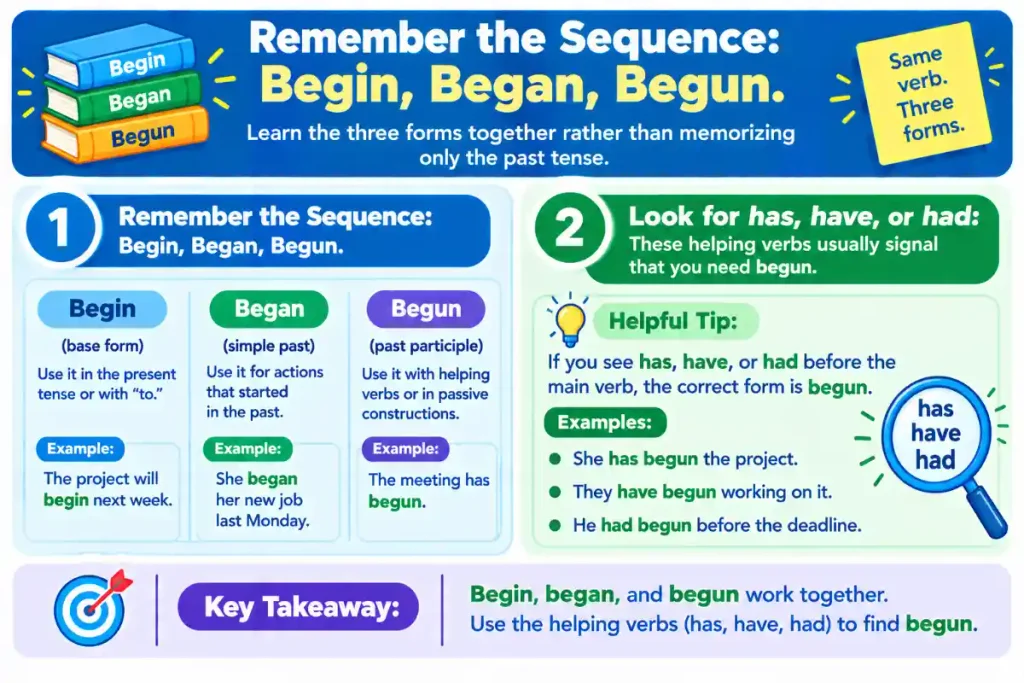
- Remember the sequence: Begin, began, begun. Learn the three forms together rather than memorizing only the past tense.
- Look for has, have, or had: These helping verbs usually signal that you need begun.
- Check the timeline: If you are simply reporting something that started in the past, began is usually the right choice.
- Use a comparison sentence: “The class began” is correct, and “The class has begun” is also correct.
- Avoid unnecessary tense changes: Do not replace began with begun just to make a sentence sound more formal.
- Read the whole sentence: A verb may be part of a longer phrase, so check every helping verb before deciding.
A useful memory trick is to associate began with a finished past-time statement and begun with has, have, or had. This shortcut works for many everyday sentences, though participial constructions can use begun in other ways.
Conclusion
Choosing between begun or began becomes much easier when you understand their grammatical roles. Began is the simple past tense of begin and describes an action that started in the past. Begun is the past participle and usually appears with helping verbs such as has, have, and had.
For example, write “The class began at nine” when reporting a past event, and write “The class has begun” when using the present perfect tense. Both forms are correct, but they cannot always replace each other.
When you are unsure, look at the entire verb phrase and identify any helping verbs. Practicing the sequence begin, began, begun will help you remember the difference and use the correct form in emails, essays, workplace communication, and everyday conversation.
Frequently Asked Questions
Which is correct, begun or began?
Both are correct, but they serve different grammatical functions. Began is the simple past tense, while begun is the past participle used with helping verbs such as has, have, and had.
Is it correct to say “I have began”?
No. The standard form is “I have begun.” The present perfect tense requires the past participle begun after have.
Should I say “It has begun” or “It has began”?
Say “It has begun.” The helping verb has requires the past participle, so begun is correct.
Is “The meeting began” grammatically correct?
Yes. “The meeting began” is correct because began is the simple past tense of begin. You can also write “The meeting has begun” when the present perfect tense fits the context.
Can I say “had began”?
No. In standard English, use had begun. The past perfect tense follows the pattern had plus the past participle.
What is the past tense of begin?
The simple past tense of begin is began. For example, “The class began at nine yesterday.”
What is the past participle of begin?
The past participle of begin is begun. You can use it in sentences such as “We have begun the project” and “They had begun the discussion.”
1 thought on “Begun or Began: Which Is Correct in American English?”