
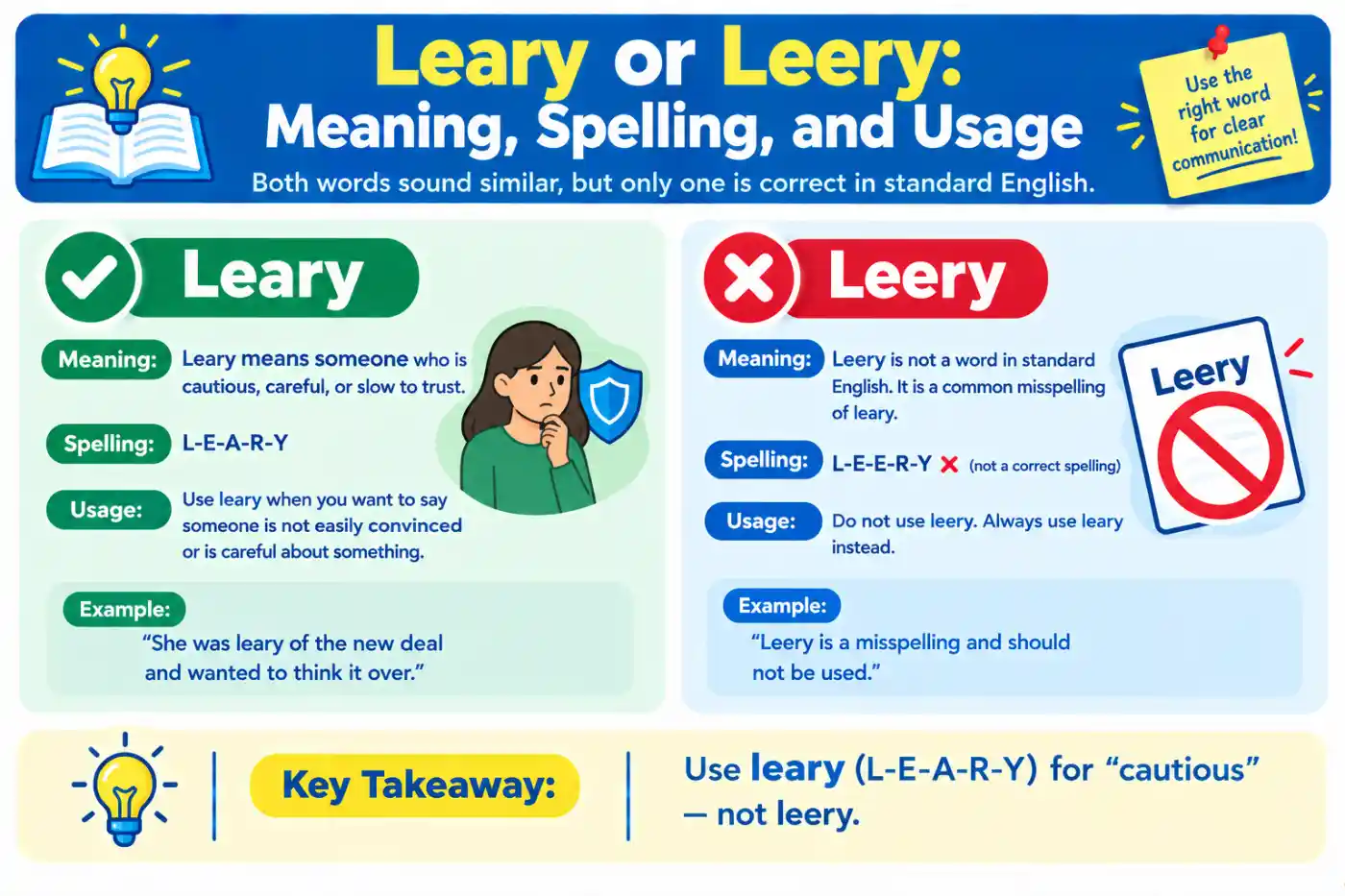
If you’re writing an email, completing a school assignment, or describing why you don’t fully trust a situation, you might wonder whether to use leary or leery. The two spellings look similar, and both may appear in informal writing, but one is the more widely accepted standard form in American English.
Leery is the standard spelling for an adjective meaning cautious, suspicious, or hesitant because you don’t fully trust someone or something. Leary is also used as a variant spelling, but leery is the safer choice for formal writing, schoolwork, and professional communication.
For example, you might say, “I’m leery of clicking a link from an unknown sender.” The word shows that you’re being careful because something seems potentially risky.
Understanding the difference between leary and leery will help you choose the right spelling, understand its meaning, and use it naturally in everyday conversations and writing.
What Does Leery Mean?
Leery is an adjective that describes someone who feels cautious, doubtful, or suspicious about a person, situation, or possible outcome. A leery person usually wants more information before deciding whether to trust something. The word often suggests that a person has noticed a possible risk. However, it doesn’t necessarily mean that the person knows something is wrong. They may simply feel uncertain or want to protect themselves from a bad experience.
Here are a few examples:
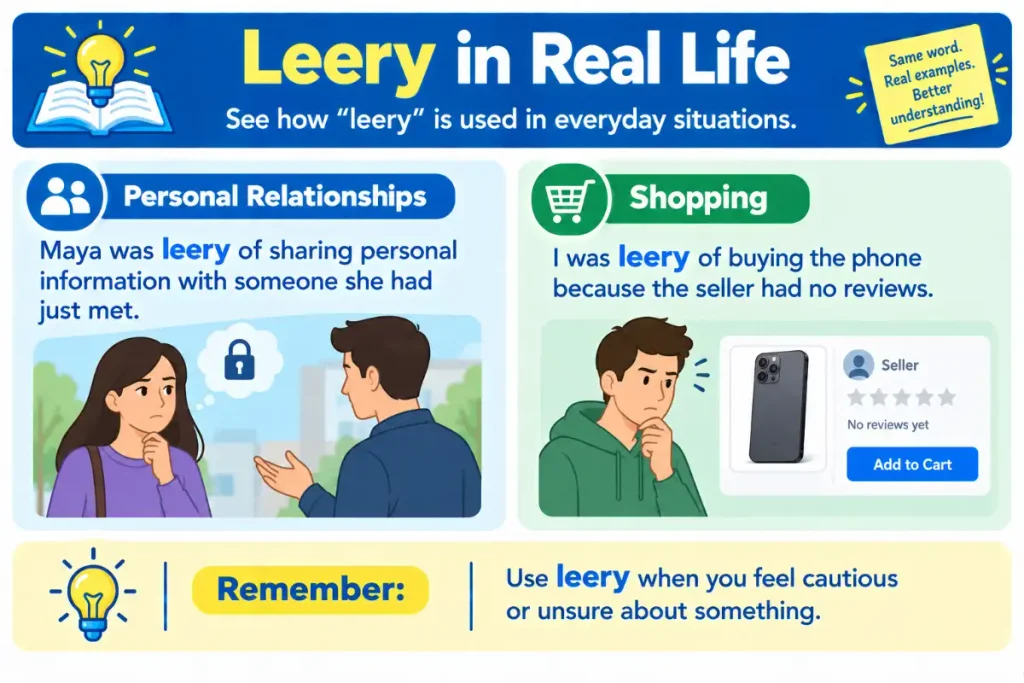
- Personal relationships: Maya was leery of sharing personal information with someone she had just met.
- Shopping: I was leery of buying the phone because the seller had no reviews.
- Work: The manager was leery of approving the proposal without seeing the budget.
- Travel: We were leery of driving through the mountain pass during the storm.
In each example, the person approaches something with caution rather than complete trust.
What Part of Speech Is Leery?
Leery functions as an adjective. It describes a person’s attitude or feelings toward something. You can use it before a noun or after a linking verb.
| Sentence | Grammatical use |
|---|---|
| She gave me a leery look. | Before a noun |
| He seemed leery of the offer. | After a linking verb |
| They are leery about the new policy. | After a linking verb |
| We remained leery of the unfamiliar website. | After a linking verb |
The word commonly appears with of, as in “leery of strangers.” It can also appear with about, as in “leery about making a decision.” Both constructions are natural in American English.
Leary or Leery: What’s the Difference?
The main difference between leary and leery is their spelling and level of acceptance in standard English. Leery is the preferred spelling when you mean cautious or suspicious, while leary appears as a less common variant.
| Word | Meaning | Standard usage | Example |
|---|---|---|---|
| Leery | Cautious, suspicious, or hesitant | Preferred spelling | I’m leery of the deal. |
| Leary | A less common spelling variant of leery; also a surname | Less common in ordinary writing | The writer used leary in an informal passage. |
If you’re unsure which spelling to choose, use leery. It is widely recognized in American English and is the better option for essays, business emails, reports, and other edited writing.
Is Leary Incorrect?
Not necessarily. Leary appears as a variant spelling of leery in some dictionaries and informal usage. However, it is much less common in standard edited writing. You should also remember that Leary is a proper surname. For example, Timothy Leary was a well-known American psychologist and writer. When you use the name of a person, preserve its correct spelling.
Consider these examples:
- Preferred: I’m leery of investing in a company with no public track record.
- Less common variant: I’m leary of investing in a company with no public track record.
- Proper name: The article discusses Timothy Leary’s work.
The second sentence communicates the intended meaning, but the first is the better choice for standard American English.
Why Do People Confuse Leary and Leery?
The confusion between leary and leery mainly comes from their similar pronunciation and spelling. Both forms may be pronounced the same way when leary is used as a variant of leery. Three factors help explain why people mix them up.
1. They Sound Alike
In ordinary American English, leery is pronounced approximately LEER-ee. The less common variant leary can have the same pronunciation. Because the words sound alike, listeners cannot always tell which spelling a speaker intends. Writers must remember the conventional spelling instead of relying on sound alone.
2. English Has Many Similar-Looking Words
English contains words that share sounds but use different letter combinations. For example:
- Weary: Feeling tired or exhausted.
- Cheery: Happy or cheerful.
- Eerie: Strange, mysterious, or frightening.
- Leery: Cautious or suspicious.
These words have different meanings, but their similar spelling patterns can make them harder to remember.
3. The Letter Combinations Can Be Confusing
The combination eer appears in many familiar English words, including cheer, deer, and steer. Remembering this pattern can help you spell leery correctly. However, spelling patterns alone cannot settle every English spelling question. The most reliable approach is to learn the standard form and use it consistently.
How to Use Leery Correctly in a Sentence
Use leery when someone feels uncertain, suspicious, or cautious about a person, offer, decision, or situation. The word often suggests that the person sees a possible problem but may not have proof of one. Here are natural examples from everyday American English.
Everyday Life
- I’m leery of buying a used car without seeing its maintenance records. The buyer wants to avoid a potentially expensive problem.
- She was leery of the unfamiliar dog at first. She approached the animal cautiously.
- He looked leery when his friend suggested an unusual shortcut. He seemed unsure about the suggestion.
Work and Professional Communication
- The director was leery of approving the project without a detailed budget. The director wanted more information before making a decision.
- I’m leery of the contract because several terms remain unclear. The speaker has concerns about the agreement.
- Our team is leery of changing the system before testing the new software. The team wants to reduce the risk of problems.
School and Academic Writing
- The students were leery of the website because it listed no sources. They questioned its reliability.
- The researcher remained leery of the results until the experiment was repeated. The researcher wanted additional evidence.
Online Shopping and Technology
- I’m leery of online stores that offer expensive products at unusually low prices. The prices raise concerns about the seller’s reliability.
- She was leery of opening an attachment from an unknown sender. She wanted to avoid a possible security risk.
Personal Decisions
- He was leery of moving to a new city without finding a job first. He was concerned about the uncertainty.
- They were leery of accepting the invitation because the details kept changing. The inconsistent information made them suspicious.
These examples show that leery works in both casual and professional settings. You can use it whenever caution or doubt is an important part of the situation.
Leery Of or Leery About: Which Is Correct?
Both leery of and leery about are acceptable in American English, but they can emphasize slightly different ideas.
| Phrase | Typical emphasis | Example |
|---|---|---|
| Leery of | Distrust or suspicion toward a person or thing | I’m leery of that salesperson. |
| Leery about | Hesitation or concern regarding a decision or situation | I’m leery about accepting the offer. |
These distinctions are tendencies, not strict grammatical rules. In many situations, either preposition works naturally. For example, you could say, “She’s leery of moving abroad” or “She’s leery about moving abroad.” Both communicate hesitation about the decision. The best approach is to choose the phrase that sounds natural in context. Don’t use leary simply because you are uncertain about which preposition follows leery.
Leery or Wary: What’s the Difference?
Leery and wary are close synonyms. Both describe caution, but leery often carries a stronger sense of suspicion or distrust, while wary emphasizes careful attention to possible danger.
| Feature | Leery | Wary |
|---|---|---|
| Main meaning | Suspicious or hesitant | Cautious and alert |
| Common emphasis | Doubt about trustworthiness | Awareness of risk |
| Typical phrase | Leery of an offer | Wary of danger |
| Example | I’m leery of his promises. | I’m wary of walking alone in an unfamiliar area. |
Consider these examples:
- Leery: Nina was leery of the seller because the product description seemed misleading.
- Wary: Nina was wary of carrying her phone in a crowded area.
The first sentence emphasizes distrust of a seller. The second emphasizes caution about a possible risk. In everyday conversation, the words often overlap. You can use either when describing a cautious attitude, although leery may sound more suspicious.
Leery or Suspicious: How Are They Different?
Both words can describe doubt, but suspicious often expresses a more direct belief that something may be wrong or dishonest.
| Feature | Leery | Suspicious |
|---|---|---|
| Main meaning | Cautious or hesitant | Distrustful or believing something may be wrong |
| Strength | Often moderate | Can be stronger |
| Example | I’m leery of the proposal. | I’m suspicious of the proposal because the figures don’t add up. |
For instance, you might be leery of a job offer because the salary seems unusually high. You may simply want to investigate further. You might describe the offer as suspicious if the employer requests an upfront payment and refuses to provide verifiable company details. The distinction depends on context. Neither word automatically proves that a person or situation is untrustworthy.
Leery or Reluctant: Which Word Fits Better?
Reluctant means unwilling or hesitant to do something. Leery suggests hesitation caused by caution, suspicion, or concern.
| Word | Main emphasis | Example |
|---|---|---|
| Leery | Concern about trust or risk | I’m leery of signing the agreement. |
| Reluctant | Unwillingness or hesitation | I’m reluctant to sign the agreement because I need more time. |
A person can be reluctant without being suspicious. For example, someone might be reluctant to attend a late-night event because they are tired. A person who is leery of attending the event may have concerns about the location, the organizers, or the circumstances. Use leery when distrust or caution matters. Use reluctant when you want to emphasize unwillingness or hesitation.
Leery or Skeptical: What’s the Difference?
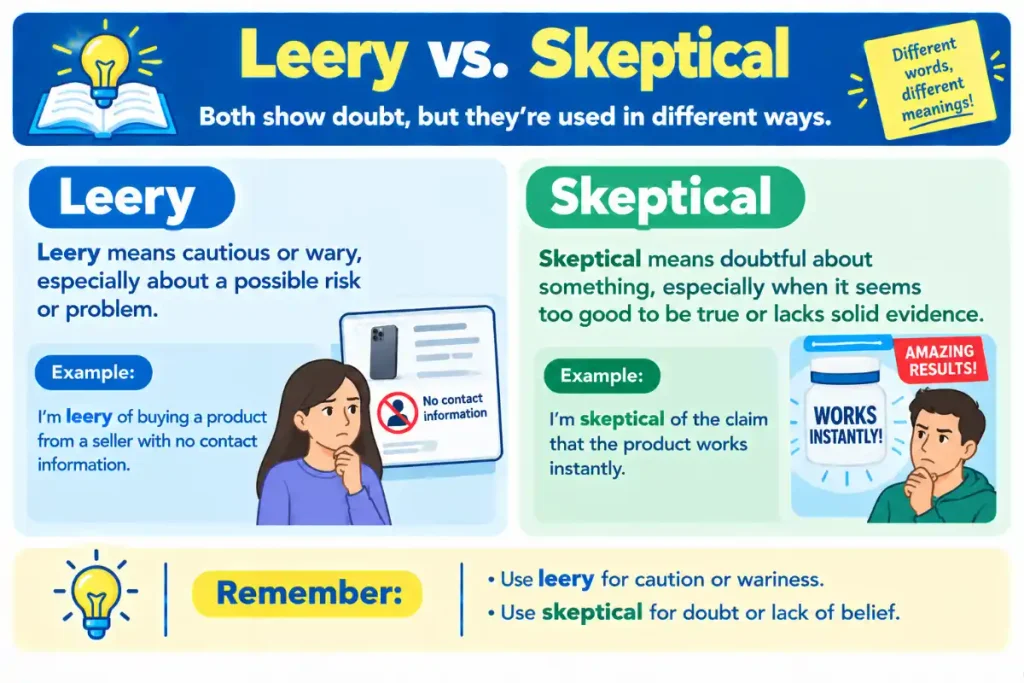
Skeptical means inclined to question whether something is true, reliable, or reasonable. Leery emphasizes caution or distrust toward a person, action, or situation.
For example:
- Leery: I’m leery of buying a product from a seller with no contact information.
- Skeptical: I’m skeptical of the claim that the product works instantly.
The first sentence focuses on the risks of dealing with a seller. The second questions whether a claim is believable. These words can overlap, especially when someone doubts an offer or a promise. However, skeptical is often the better choice when discussing evidence, claims, or arguments.
What Are the Best Synonyms for Leery?
The best synonym depends on the kind of caution you want to express. Some alternatives suggest mild hesitation, while others imply stronger distrust.
| Word or phrase | Meaning | Tone | Example |
|---|---|---|---|
| Cautious | Careful to avoid problems | Neutral | Be cautious when sharing personal details. |
| Wary | Alert to possible danger | Neutral | She’s wary of unfamiliar websites. |
| Suspicious | Doubting someone’s honesty or intentions | Stronger | He was suspicious of the unexpected request. |
| Skeptical | Doubting a claim or idea | Neutral | I’m skeptical of those results. |
| Doubtful | Unsure that something is true or likely | Neutral | She was doubtful about the promise. |
| Hesitant | Slow to act because of uncertainty | Neutral | He was hesitant to accept. |
| Reluctant | Unwilling or resistant | Neutral | They were reluctant to proceed. |
| Guarded | Careful about what you reveal or trust | Neutral | She remained guarded during the interview. |
| Distrustful | Lacking trust | Strong | He was distrustful of the company. |
| Mistrustful | Having little confidence in someone | Neutral to strong | They were mistrustful of the offer. |
| Doubting | Questioning whether something is true | Neutral | I was doubting the explanation. |
| Unconvinced | Not persuaded by an argument | Neutral | The committee remained unconvinced. |
| Careful | Paying attention to avoid mistakes | Neutral | Be careful before signing. |
| Prudent | Showing good judgment and caution | Formal | It was prudent to review the terms. |
| Circumspect | Careful to consider risks before acting | Formal | The attorney was circumspect in her response. |
| Guardedly | In a cautious or reserved manner | Neutral | He answered guardedly. |
| Leery-eyed | Not a common standard synonym | Unusual | Avoid this expression in formal writing. |
Not every word in the table can replace leery in every sentence. For example, skeptical fits a questionable claim, while wary often fits a potential danger. Choose the alternative that preserves the meaning you intend.
Mild, Moderate, and Strong Alternatives
You can also select a synonym based on the strength of the feeling.
- Mild caution: Careful, hesitant, uncertain.
- Moderate caution: Wary, leery, doubtful, skeptical.
- Strong distrust: Suspicious, distrustful, mistrustful.
These are general groupings rather than fixed levels. A person’s tone and the surrounding sentence can change how strong a word sounds.
What Is the Opposite of Leery?
The opposite of leery depends on whether you want to emphasize trust, confidence, or a lack of concern.
| Antonym | Meaning | Example |
|---|---|---|
| Trusting | Willing to believe or rely on someone | She was trusting of her longtime friend. |
| Confident | Feeling sure about something | He was confident in the team’s decision. |
| Reassured | Made less worried or doubtful | The explanation left me reassured. |
| Open | Willing to consider or accept something | They were open to the proposal. |
| Unconcerned | Not worried about a situation | She seemed unconcerned about the delay. |
| Assured | Confident or certain | He felt assured after reviewing the evidence. |
These antonyms have slightly different meanings. Someone can be confident without trusting another person, and someone can be unconcerned without having any particular confidence. For a direct contrast, trusting is often the best choice when leery describes suspicion toward another person.
Is Leery Formal or Informal?
Leery works in both formal and informal English. It is a standard adjective, not slang, although it often appears in conversational writing. The right choice depends on the context and the tone you want.
In Everyday Conversation
Leery sounds natural when talking about personal decisions, unfamiliar people, or possible risks.
Example: “I’m a little leery of that restaurant after reading the recent reviews.”
You could also say, “I’m not sure I trust that restaurant.” The first version is concise, while the second explains the concern more directly.
In Professional Emails
You can use leery in workplace communication, but consider your audience. In a formal business email, words such as concerned, cautious, or hesitant may sound more neutral.
For example:
- Conversational: “I’m leery of approving the request without more details.”
- Professional: “I’m concerned about approving the request without additional documentation.”
Both sentences communicate caution, but the second may be more suitable for a formal exchange.
In Academic Writing
Leery is grammatically acceptable in academic writing, especially when discussing a person’s attitude. However, more precise words may work better in analytical or research-based writing.
For example:
- General: “The researchers were leery of the initial results.”
- More precise: “The researchers questioned the reliability of the initial results.”
The second sentence identifies the specific concern rather than relying on a general description of caution.
Common Mistakes When Using Leary or Leery
Learning the preferred spelling is only part of using the word correctly. You should also avoid these common errors.
Mistake 1: Using Leary in Formal Writing
Because leary appears as a variant, some writers assume it is equally suitable in every context.
Less preferred: I’m leary of the investment.
Preferred: I’m leery of the investment.
Use leery in school assignments, business documents, and edited publications unless you have a specific reason to preserve the variant spelling.
Mistake 2: Confusing Leery With Weary
Leery means cautious or suspicious. Weary means tired or exhausted.
- Correct: She was leery of the unfamiliar driver.
- Correct: She was weary after the long trip.
A person may feel both leery and weary, but the words describe different things.
Mistake 3: Treating Leery as Proof of Wrongdoing
Being leery of someone doesn’t mean that person has done something wrong. It simply means that you feel cautious or uncertain.
For example, “I’m leery of the offer” expresses concern. It doesn’t establish that the offer is fraudulent.
Mistake 4: Using Leery When You Mean Tired
Don’t use leery to describe physical exhaustion.
Incorrect for the intended meaning: I was leery after working all night.
Correct: I was weary after working all night.
If you mean that you feel tired, choose weary. If you mean that you feel suspicious or cautious, choose leery.
Mistake 5: Using the Word Without a Clear Reason
Leery works best when the context suggests doubt, risk, or a lack of trust. If you simply dislike something, another word may communicate your feelings more accurately.
For example, “I’m leery of the new color scheme” may suggest concern about its effect or suitability. If you merely dislike the color, say, “I don’t like the new color scheme.”
How to Remember the Correct Spelling
If you frequently confuse leary and leery, a simple memory technique can help.
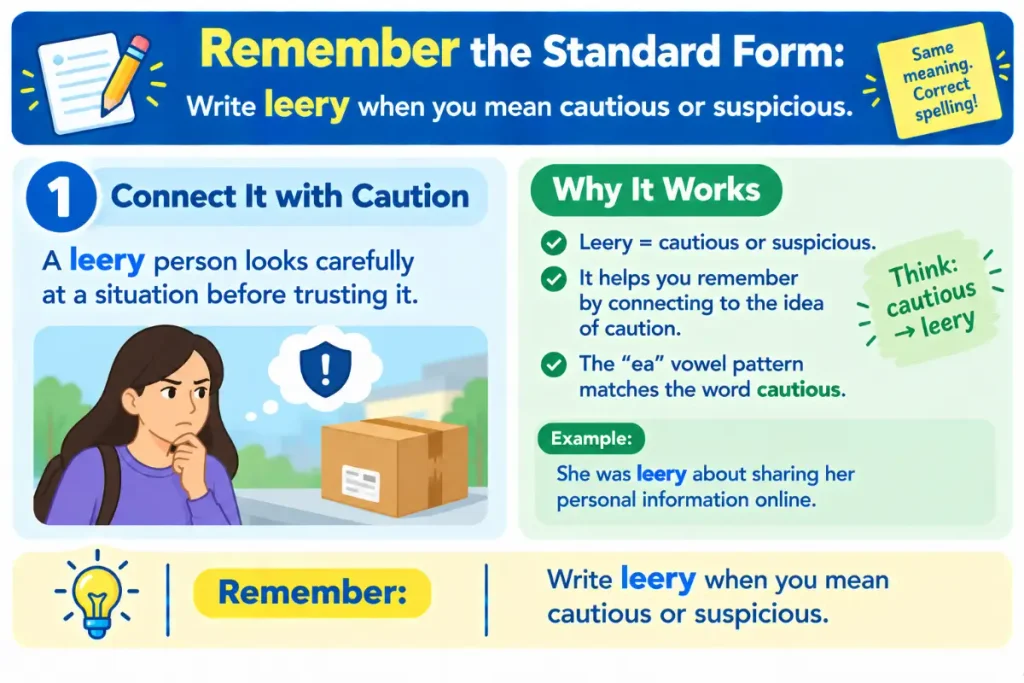
- Remember the standard form: Write leery when you mean cautious or suspicious.
- Connect it with caution: A leery person looks carefully at a situation before trusting it.
- Learn it alongside wary: Both words describe caution, making them useful mental partners.
- Check formal writing: If you are unsure, choose leery for the standard American English form.
- Distinguish it from weary: Weary describes tiredness; leery describes caution.
A useful reminder is: Leery means careful about trust, not weary from work.
Conclusion
When choosing between leary or leery, remember that leery is the preferred spelling for standard American English when describing someone who feels cautious, suspicious, or hesitant. Although leary appears as a less common variant, it is generally better to use leery in schoolwork, professional emails, and other formal writing.
Use leery of when expressing doubt about a person or thing, and use leery about when discussing concerns surrounding a decision or situation. Words such as wary, skeptical, and suspicious can also express similar ideas, but each carries a slightly different meaning. Choosing the right word helps you communicate your thoughts clearly and accurately. When in doubt, stick with leery and make sure the surrounding sentence explains what causes the caution.
Frequently Asked Questions
Is Leary or Leery the Correct Spelling?
Leery is the preferred spelling in standard American English when you mean cautious or suspicious. Leary is a less common variant, so leery is the safer choice for formal and professional writing.
What Does Leery Mean in Simple Terms?
Leery means cautious because you don’t fully trust someone or something. For example, you might be leery of a deal that sounds too good to be true.
Is Leary a Real Word?
Yes, leary appears as a less common variant spelling of leery. It is also a surname, but leery is the preferred spelling for ordinary writing about suspicion or caution.
What Is Another Word for Leery?
Common alternatives include wary, cautious, suspicious, skeptical, and hesitant. The best choice depends on whether you want to emphasize possible danger, distrust, or uncertainty.
Is Leery the Same as Wary?
They have similar meanings, but leery often emphasizes suspicion or distrust, while wary emphasizes alertness to possible danger. In many everyday sentences, you can use either word.
How Do You Use Leery in a Sentence?
Use leery to describe a cautious or suspicious attitude. For example, “I’m leery of accepting an offer without reading the contract first.”
Is Leery Appropriate for Professional Writing?
Yes, leery is a standard English word and can appear in professional writing. For a more formal or neutral tone, consider alternatives such as cautious, concerned, or hesitant.
1 thought on “Leary or Leery: Meaning, Spelling, and Usage”