
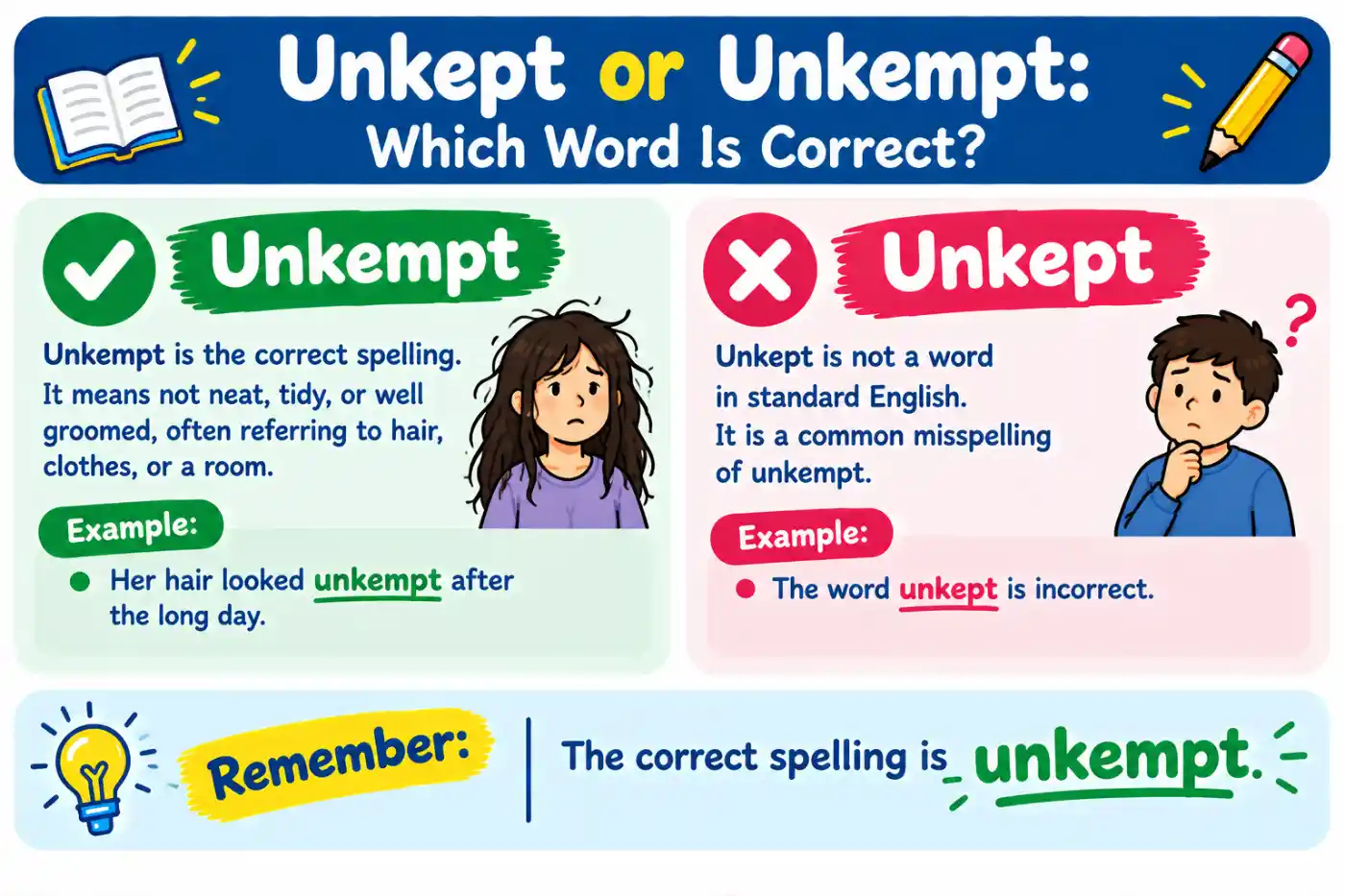
If you’re describing messy hair, an untidy room, or a promise someone failed to keep, you might wonder whether to use unkept or unkempt. Although these words look similar, they have different meanings and uses in American English.
Unkempt is the correct word for something that looks messy, untidy, or poorly groomed. Unkept is also a valid English word, but it usually means something that has not been kept, maintained, or fulfilled, such as an unkept promise.
The key is to match the word to what you want to describe. Understanding the difference between unkept and unkempt will help you choose the right spelling in everyday conversation, professional writing, emails, and school assignments.
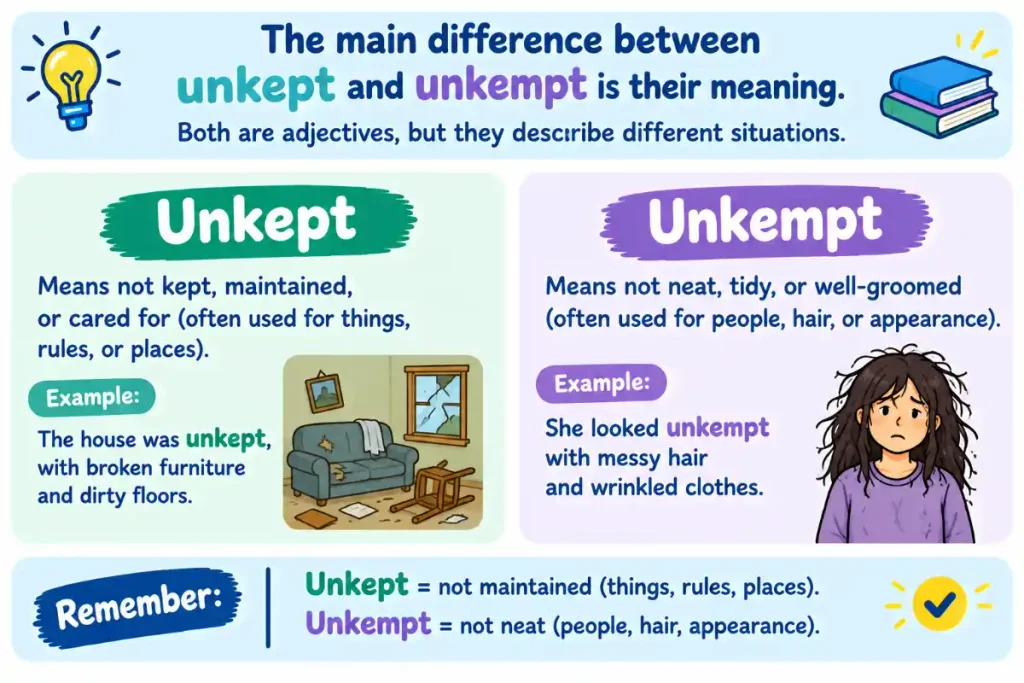
Unkept or Unkempt: What’s the Difference?
The main difference between unkept and unkempt is their meaning. Both are adjectives, but they describe different situations.
| Word | Meaning | Example |
|---|---|---|
| Unkept | Not kept, maintained, or fulfilled | He apologized for his unkept promise. |
| Unkempt | Messy, untidy, or poorly groomed | His unkempt hair fell across his forehead. |
Use unkept when something has not been kept as expected. Use unkempt when something looks neglected or disorganized, especially a person’s hair, appearance, or a physical place. For example, an unkept promise is a promise someone has failed to fulfill. An unkempt garden is a garden that looks overgrown or poorly maintained. Although both words can suggest neglect, they do not serve as direct substitutes for each other.
What Does Unkept Mean?
Unkept means not kept, maintained, observed, or fulfilled. Writers most often use it to describe promises, commitments, agreements, or other obligations that someone has failed to honor. The word combines the prefix un-, meaning “not,” with kept, the past participle of the verb keep.
Consider these examples:
- She felt disappointed by his unkept promise to help her move.
- The company faced criticism for its unkept commitments to customers.
- His unkept obligations created problems for the entire team.
- The agreement remained unkept despite several reminders.
In each example, unkept refers to something that a person or organization failed to fulfill or honor.
When Should You Use Unkept?
Use unkept when you want to emphasize that someone did not fulfill a promise, commitment, or responsibility.
Common expressions include:
- Unkept promise: A promise that someone has not fulfilled.
- Unkept commitment: A commitment that someone has failed to honor.
- Unkept agreement: An agreement that someone has not followed through on.
- Unkept obligation: A duty or responsibility that remains unfulfilled.
For example, a manager might make an unkept promise to review an employee’s performance. A friend might leave an unkept commitment to attend a birthday party. However, unkept is not always the most natural choice. In modern American English, phrases such as broken promise, unfulfilled commitment, and unmet obligation are often clearer and more common.
Is Unkept a Real Word?
Yes, unkept is a real English word. It is not simply a misspelling of unkempt. However, its meaning is narrower in everyday usage. People generally use unkept for things that have not been honored, fulfilled, or maintained, while unkempt commonly describes a messy appearance.
For example:
- Correct: She regretted making an unkept promise.
- Incorrect word choice: She brushed her unkept hair before the interview.
- Better: She brushed her unkempt hair before the interview.
The second sentence uses the wrong word for the intended meaning. Unkempt describes hair that looks messy or neglected.
What Does Unkempt Mean?
Unkempt means messy, untidy, or poorly groomed. It usually describes hair, a person’s appearance, clothing, or a place that looks neglected. For example, someone who has messy hair after waking up might have unkempt hair. A yard full of weeds and overgrown plants might also look unkempt. The word often suggests that someone has not taken the time or effort to keep something neat. However, it does not automatically mean that the person is dirty or unhygienic.
Here are some examples:
- He arrived at the meeting with unkempt hair and a wrinkled shirt.
- The abandoned house had an unkempt yard.
- Her unkempt appearance suggested that she had been working all night.
- The park looked unkempt because nobody had trimmed the grass.
- His beard looked unkempt after several weeks without grooming.
In each sentence, unkempt describes an untidy or neglected appearance.
When Should You Use Unkempt?
Use unkempt when you describe something that looks messy, untrimmed, or poorly cared for.
Common expressions include:
- Unkempt hair: Hair that looks messy or uncombed.
- Unkempt beard: Facial hair that appears untidy or untrimmed.
- Unkempt appearance: A person’s overall look seems messy or poorly groomed.
- Unkempt garden: A garden with overgrown plants, weeds, or neglected landscaping.
- Unkempt lawn: Grass that has grown too long or has not been properly maintained.
For example, you might write, “The actor appeared on stage with unkempt hair and a thick beard.” You could also say, “The house had an unkempt front yard filled with weeds.” Although unkempt often describes physical appearance, you can use it for places and outdoor areas as well.
Can Unkempt Describe a Person?
Yes, unkempt can describe a person, particularly their appearance. It usually suggests that their hair, clothing, or overall presentation looks untidy.
For example:
- The unkempt man walked into the coffee shop.
- She looked unkempt after spending the night studying.
- The reporter described the character as unkempt and tired.
When you apply the word directly to a person, be aware that it can sound critical or judgmental. In professional or sensitive situations, a more neutral description may be better. For instance, instead of saying, “The employee looked unkempt,” you could write, “The employee’s clothing appeared wrinkled, and their hair was untidy.” This alternative describes what you observed without making a broad judgment about the person.
Why Are Unkept and Unkempt Confused?
Unkept and unkempt are easy to confuse because they look and sound similar. Both begin with un-, and both can suggest that something has been neglected. However, their word histories and meanings help explain the difference.
The Meaning Behind Unkept
Unkept comes from un- and kept. The word kept is the past participle of keep, which can mean to maintain, preserve, observe, or fulfill. When you add un-, the word expresses the opposite idea.
For example:
- A kept promise has been honored.
- An unkept promise has not been honored.
This relationship makes unkept relatively easy to understand once you connect it to the verb keep.
The Meaning Behind Unkempt
Unkempt has a different history. It comes from an older use of kempt, which means combed or neatly groomed. Kempt is related to the verb comb and has roots in Old English. Adding un- reverses that meaning. Therefore, unkempt describes hair or an appearance that has not been properly combed or groomed.
For example:
- Kempt hair looks neat and combed.
- Unkempt hair looks messy or uncombed.
Although kempt is a valid word, people rarely use it in everyday American English. Most speakers use neat, tidy, or well-groomed instead.
A Simple Way to Remember the Difference
Connect each word to a related word you already know:
- Unkept → keep: Something has not been kept, honored, or fulfilled.
- Unkempt → comb: Something looks uncombed, messy, or poorly groomed.
Remembering these connections can help you avoid mixing up the two words.
Unkept vs. Unkempt in Example Sentences
The best way to learn the difference between unkept and unkempt is to see how each word works in natural sentences.
Examples of Unkept
Use unkept for promises, commitments, and obligations that someone has not fulfilled.
- Personal promise: He apologized for his unkept promise to visit his grandparents.
- Workplace commitment: The manager faced complaints over several unkept commitments.
- Friendship: Their friendship suffered because of repeated unkept promises.
- Business agreement: The client became frustrated by the company’s unkept agreement.
- Personal responsibility: Her unkept obligations made it difficult to complete the project on time.
In everyday American English, you could often replace unkept with broken, unfulfilled, or unmet, depending on the context. For example, “He broke his promise to visit” sounds more natural in casual conversation than “He made an unkept promise to visit.”
Examples of Unkempt
Use unkempt to describe something that appears messy or neglected.
- Hair: He arrived at school with unkempt hair after rushing out of the house.
- Garden: The unkempt garden needed weeding, pruning, and regular care.
- Appearance: She changed her clothes before the interview because she thought she looked unkempt.
- Beard: His unkempt beard made him look different from his usual appearance.
- Property: The old building stood behind an unkempt lawn covered with weeds.
- Travel: After a long flight, his hair looked unkempt and his clothes were wrinkled.
- Fiction: The detective noticed the character’s unkempt appearance and tired expression.
These examples show that unkempt focuses on visible untidiness rather than a broken promise or an unfulfilled responsibility.
Unkept vs. Unkempt vs. Neglected
The word neglected can sometimes replace unkempt, but the two words have different meanings. Understanding the distinction helps you choose more precise language.
| Word | Main meaning | Example |
|---|---|---|
| Unkept | Not fulfilled or honored | She regretted her unkept promise. |
| Unkempt | Messy or poorly groomed | His unkempt hair needed a trim. |
| Neglected | Not given proper care or attention | The neglected garden was full of weeds. |
Unkept emphasizes something that has not been kept or fulfilled. Unkempt emphasizes an untidy appearance. Neglected is broader and can describe a person, place, responsibility, or object that has not received sufficient care. For example, an unkempt garden may also be a neglected garden. However, a neglected responsibility does not usually make sense as an unkempt responsibility.
Unkempt vs Untidy
Both words describe a lack of neatness, but untidy is more general and often sounds less judgmental.
- Unkempt: His unkempt hair fell over his eyes.
- Untidy: His desk was untidy, with papers scattered everywhere.
Use unkempt when something looks poorly groomed or overgrown. Use untidy when you mean that something is not arranged neatly.
Unkempt vs Disheveled
Disheveled describes someone or something that looks disordered, especially after activity, stress, or a disturbance. Unkempt more often suggests a lack of grooming or ongoing care.
- Unkempt: He had unkempt hair and an uneven beard.
- Disheveled: She looked disheveled after running through the rain.
The two words overlap, particularly when describing a person’s appearance. However, disheveled often fits a temporary state, while unkempt can suggest longer-term untidiness.
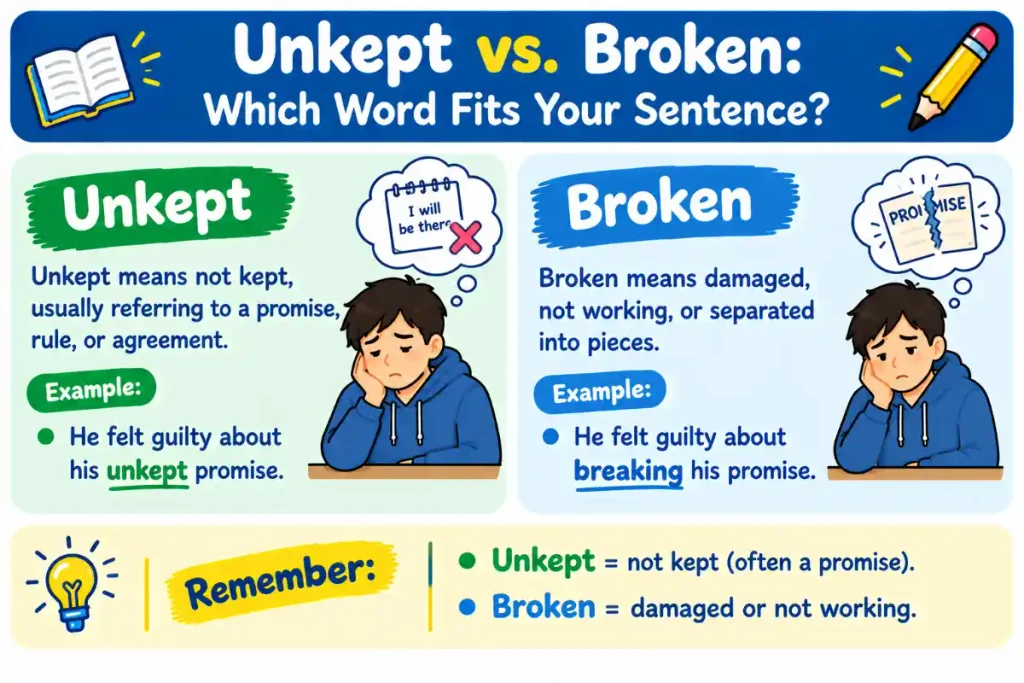
Unkept vs Broken
When discussing promises, broken is generally the more common choice in American English.
- Unkept: He felt guilty about his unkept promise.
- Broken: He felt guilty about breaking his promise.
Both sentences communicate the same general idea. The second sounds more direct and conversational. Use broken promise in everyday conversation, personal messages, and most professional writing. Unkept promise remains understandable but may sound less natural to some readers.
What Are the Best Alternatives to Unkept and Unkempt?
The best alternative depends on the meaning you want to express. Since unkept and unkempt describe different situations, you should choose synonyms separately rather than treating them as interchangeable.
Alternatives to Unkept
These words and phrases can describe something that has not been fulfilled, honored, or completed.
| Word or phrase | Meaning | Tone | Example |
|---|---|---|---|
| Broken | Not honored, especially a promise | Everyday | He made a broken promise. |
| Unfulfilled | Not completed or satisfied | Neutral | She regretted her unfulfilled ambition. |
| Unmet | Not achieved or satisfied | Professional | The project had unmet requirements. |
| Unhonored | Not respected or fulfilled | Formal | The agreement remained unhonored. |
| Uncompleted | Not finished | Neutral | The task remained uncompleted. |
| Unobserved | Not followed or respected, especially a rule | Formal | The policy went unobserved. |
| Unmaintained | Not properly maintained | Neutral | The equipment was unmaintained. |
| Unpaid | Not paid when due | Everyday | The invoice remained unpaid. |
| Unanswered | Not responded to | Neutral | Her question remained unanswered. |
| Unfinished | Not completed | Everyday | He left the work unfinished. |
These alternatives are not exact synonyms in every situation. For example, unpaid refers to money owed, while unfulfilled often refers to promises, goals, or expectations.
Alternatives to Unkempt
Use these words when you want to describe an untidy appearance or a poorly maintained place.
| Word or phrase | Meaning | Tone | Example |
|---|---|---|---|
| Messy | Not neat or organized | Casual | His room was messy. |
| Untidy | Not arranged neatly | Neutral | Her desk looked untidy. |
| Disheveled | Disorderly in appearance | Neutral | He arrived looking disheveled. |
| Uncombed | Hair that has not been combed | Neutral | Her uncombed hair covered her face. |
| Tousled | Slightly messy, especially hair | Often descriptive | He had tousled hair. |
| Scruffy | Rough or untidy in appearance | Casual | He wore a scruffy jacket. |
| Shaggy | Long, thick, or untidy hair | Descriptive | The dog had shaggy fur. |
| Untrimmed | Not cut or shaped | Neutral | His untrimmed beard was noticeable. |
| Overgrown | Grown too much or left untrimmed | Neutral | The backyard was overgrown. |
| Neglected | Not receiving proper care | Neutral | The neglected property needed repairs. |
| Unpolished | Not refined or finished | Neutral | The presentation felt unpolished. |
| Sloppy | Careless or untidy | Informal, critical | His appearance looked sloppy. |
Choose the word that best fits the situation. For example, tousled may describe hair that looks naturally messy, while neglected suggests that something has not received the care it needs.
Common Mistakes When Using Unkept and Unkempt
Several mistakes can make writing less clear. The most common one is choosing a word based on how it looks rather than what it means.
Mistake 1: Using Unkept to Describe Messy Hair
Incorrect or unnatural for the intended meaning: “He had unkept hair.”
Better: “He had unkempt hair.”
Use unkempt because the sentence describes hair that looks messy or poorly groomed.
Mistake 2: Using Unkempt for a Broken Promise
Incorrect word choice: “She apologized for her unkempt promise.”
Better: “She apologized for her broken promise.”
You could also write, “She apologized for failing to keep her promise.”
The problem is not the spelling of unkempt. The problem is that the word does not convey the intended meaning.
Mistake 3: Assuming Unkept Is Always Incorrect
Some people believe that unkept is simply a misspelling of unkempt. That is not true.
Correct: “He regretted his unkept commitment.”
More natural alternative: “He regretted failing to honor his commitment.”
Both forms communicate the idea that he did not fulfill his commitment, although the alternative is often clearer.
Mistake 4: Treating Unkempt and Neglected as Identical
These words overlap, but they emphasize different things.
- Unkempt: The lawn looked unkempt.
- Neglected: The lawn had been neglected for several months.
The first describes the lawn’s appearance. The second emphasizes the lack of care it received.
Mistake 5: Using Unkempt When a Neutral Description Is Better
Calling someone unkempt may sound critical. In formal reports, workplace communication, or sensitive conversations, specific observations can be more appropriate. Instead of writing, “The applicant looked unkempt,” you might write, “The applicant’s hair was untidy, and their clothing was wrinkled.” This wording focuses on observable details rather than making a broad judgment.
How to Choose the Correct Word in Different Situations
Your choice should depend on the subject and the tone of your writing.
| Situation | Best word or phrase | Example |
|---|---|---|
| A promise someone did not fulfill | Broken or unkept | He apologized for his broken promise. |
| Hair that looks messy | Unkempt | Her hair looked unkempt. |
| A garden with overgrown weeds | Unkempt or neglected | The garden looked neglected. |
| An unmet business obligation | Unfulfilled or unmet | The company had unmet obligations. |
| A desk covered with papers | Untidy or messy | His desk was untidy. |
| Hair that is messy after sleeping | Tousled or unkempt | He woke up with tousled hair. |
| A rule that someone did not follow | Unobserved or ignored | The rule was ignored. |
For School and Academic Writing
In essays and assignments, choose the word that states your meaning precisely. Use unkempt for appearance and unkept when discussing an unfulfilled promise or commitment.
For example:
“The character’s unkempt appearance reflects the difficult conditions he has experienced.”
Or:
“The character’s unkept promise creates conflict in the story.”
In academic writing, you can often replace unkept with a more precise phrase such as unfulfilled commitment or broken promise.
For Professional Emails
In workplace communication, clarity matters more than choosing a less familiar word. Instead of writing, “The project remains unkept,” specify the problem:
- “The project remains unfinished.”
- “The team has not fulfilled its commitments.”
- “The maintenance schedule has not been followed.”
For appearance-related descriptions, use unkempt only when the observation is relevant and appropriate.
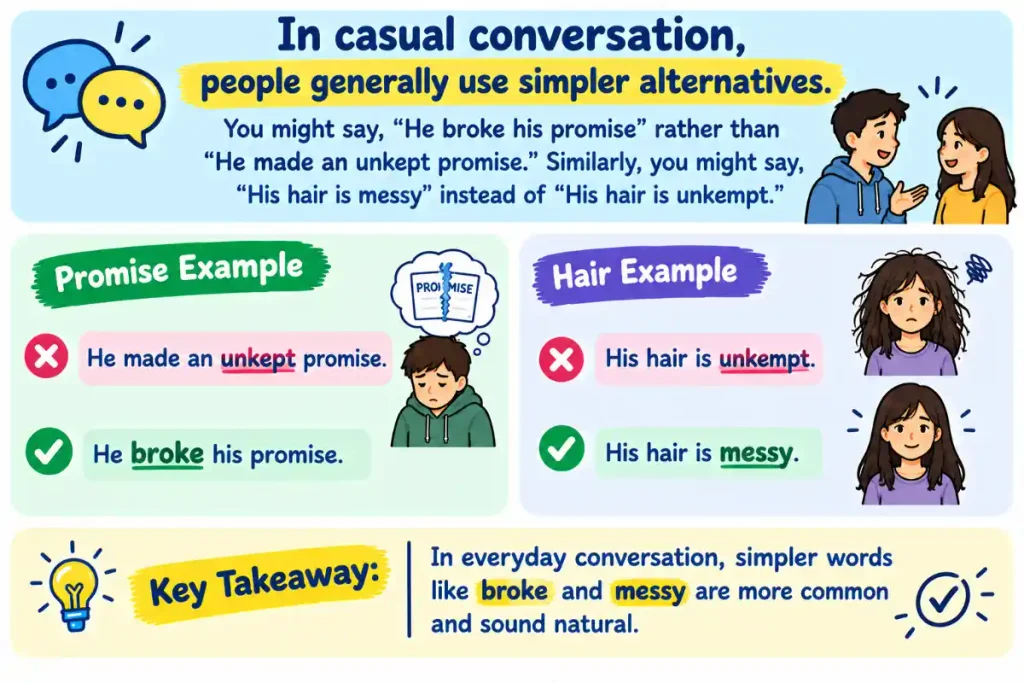
For Everyday Conversation
In casual conversation, people generally use simpler alternatives. You might say, “He broke his promise” rather than “He made an unkept promise.” Similarly, you might say, “His hair is messy” instead of “His hair is unkempt.” However, unkempt is a perfectly natural word when you want a more precise description of someone’s appearance or a neglected outdoor area.
Conclusion
Choosing between unkept and unkempt becomes easy when you focus on the meaning. Unkept describes something that has not been kept, honored, or fulfilled, such as a promise or commitment. Unkempt describes something messy or poorly groomed, such as hair, a beard, a lawn, or a person’s appearance.
Remember the connection between unkept and keep, and between unkempt and comb. These simple associations can help you select the right word in everyday conversation, school assignments, and professional writing.
Although both words are valid, they are not interchangeable. If you’re describing messy hair, choose unkempt. If you’re discussing a promise someone failed to honor, unkept is appropriate, though broken promise may sound more natural.
Frequently Asked Questions
Which is correct, unkept or unkempt?
Both are correct English words, but they have different meanings. Use unkept for something not fulfilled or maintained, and unkempt for something messy or poorly groomed.
Is unkept a misspelling of unkempt?
No, unkept is a valid word. It usually describes an unfulfilled promise, commitment, or obligation, while unkempt describes an untidy appearance or place.
How do you spell unkempt?
The correct spelling is unkempt: U-N-K-E-M-P-T. It describes something messy, untidy, or poorly groomed, such as unkempt hair.
Can you say unkept hair?
People may understand what you mean, but unkempt hair is the standard and more natural expression for messy or poorly groomed hair.
What is another word for unkempt?
Common alternatives include messy, untidy, disheveled, scruffy, and uncombed. The best choice depends on whether you’re describing hair, clothing, a person’s appearance, or a physical place.
What is the opposite of unkempt?
Possible opposites include neat, tidy, well-groomed, and well-kept. For example, well-groomed hair is the opposite of unkempt hair.
Is an unkept promise the same as a broken promise?
Yes, both expressions describe a promise that someone has not fulfilled. However, broken promise is generally more common and natural in everyday American English.
1 thought on “Unkept or Unkempt: Which Word Is Correct?”