
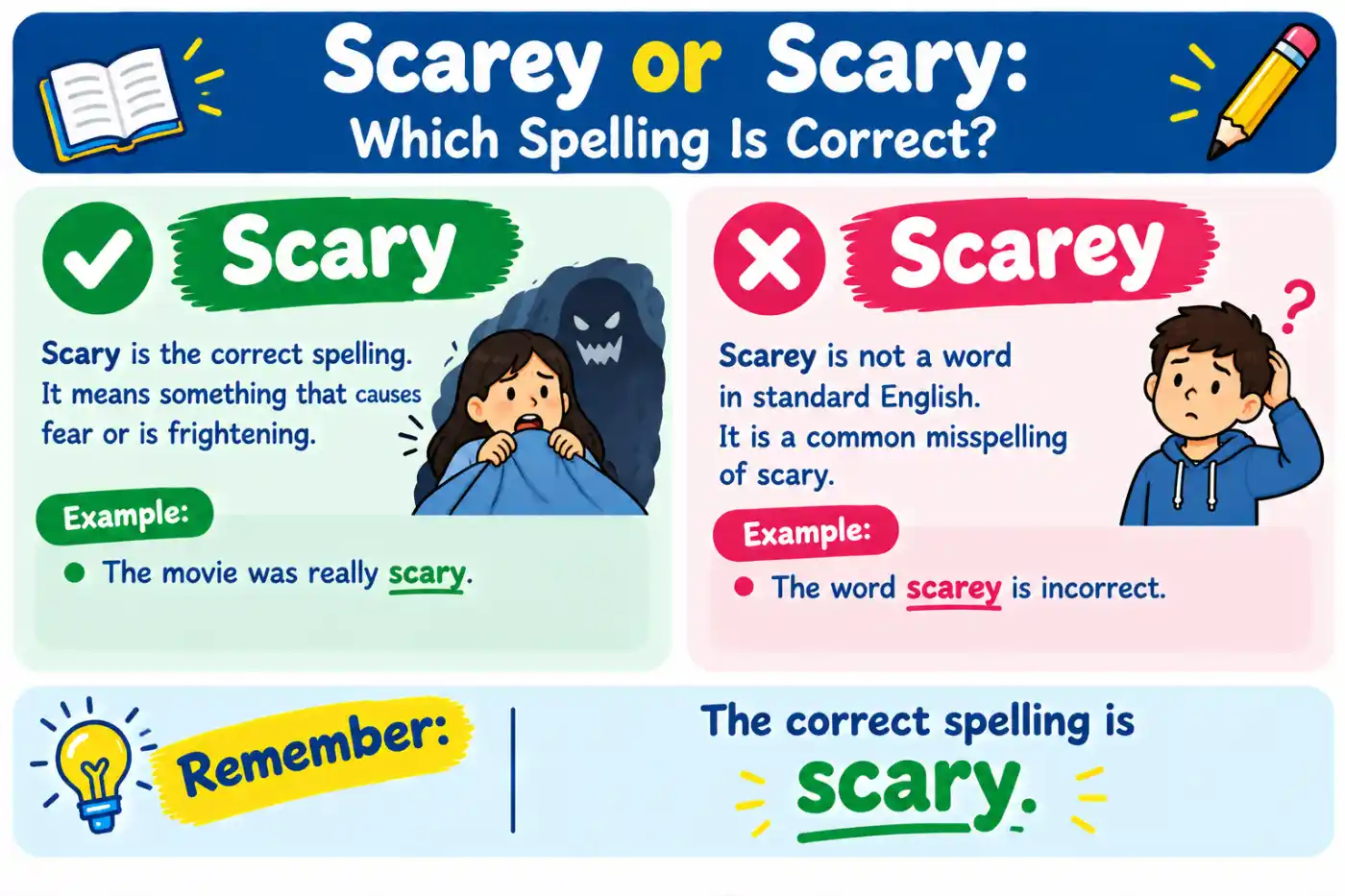
If you’re writing a text, school assignment, story, or social media post, you might wonder whether scarey or scary is the correct spelling. The two forms look similar, but only one is standard in modern American English.
Scary is the correct spelling. Scarey is a common misspelling of scary, an adjective that describes something frightening, alarming, or likely to cause fear.
You can use scary to describe a horror movie, a strange noise at night, a dangerous situation, or an experience that makes you feel afraid. It can also describe something unsettling or unexpectedly serious.
Understanding why scary is correct will help you avoid spelling mistakes in everyday writing. This guide explains the meanings, spelling rules, sentence examples, related words, and common mistakes associated with scarey or scary.
Scarey vs Scary: What’s the Difference?
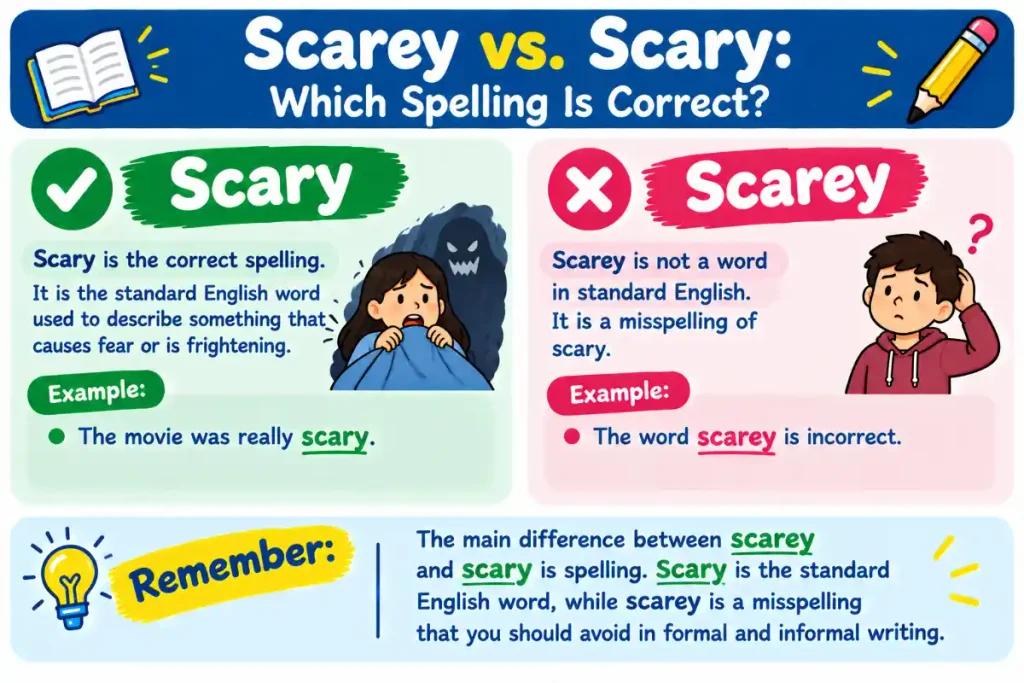
The main difference between scarey and scary is spelling. Scary is the standard English word, while scarey is a misspelling that you should avoid in formal and informal writing.
| Word | Correct or Incorrect? | Meaning | Example |
|---|---|---|---|
| Scary | Correct | Causing fear or alarm | That was a scary movie. |
| Scarey | Incorrect in standard modern English | Intended as a misspelling of scary | That was a scarey movie. |
The word scary appears in standard dictionaries and everyday English. Writers use it in conversations, books, news reports, school assignments, and professional communication when they need to describe something frightening. The spelling scarey may appear in usernames, creative names, informal posts, or older texts. However, those uses do not make it the standard spelling of the adjective.
For example:
- Correct: The thunderstorm was scary.
- Incorrect: The thunderstorm was scarey.
- Correct: My little brother thinks spiders are scary.
- Incorrect: My little brother thinks spiders are scarey.
If you are unsure which form to choose, use scary.
What Does Scary Mean?
Scary is an adjective that describes something that causes fear, nervousness, or concern. The word can refer to actual danger, an imagined threat, or an experience that feels frightening. Its meaning depends on the situation. A scary movie might frighten you with suspense, while a scary driving experience might involve a genuine risk of an accident.
Here are the main ways people use the word.
1. Causing Fear
The most common meaning of scary is frightening or likely to make someone afraid.
Examples:
- The abandoned house looked scary in the dark.
- We watched a scary movie on Halloween.
- A scary noise came from the basement.
- The children told scary stories around the campfire.
In these examples, scary describes something that creates a feeling of fear.
2. Creating Worry or Anxiety
People also use scary to describe situations that cause worry, even when they do not involve ghosts, monsters, or physical threats.
Examples:
- Moving to a new city can feel scary at first.
- It was scary when the doctor said I needed more tests.
- Starting my first job seemed scary, but I soon felt comfortable.
- The sudden drop in temperature was scary for the farmers.
In these situations, scary communicates uncertainty, concern, or nervousness.
3. Describing Something Alarming
Sometimes, scary describes an event or fact that seems disturbing because of its seriousness or unexpected nature.
Examples:
- The report revealed a scary increase in traffic accidents.
- It is scary how quickly misinformation can spread online.
- The driver had a scary close call on the highway.
The word does not always mean that someone feels terrified. It can also express surprise, discomfort, or serious concern.
Why Is Scary the Correct Spelling?
The spelling scary follows a common English spelling pattern. The word comes from scare, a verb meaning to frighten someone, and the suffix -y, which helps form adjectives. When you add -y to scare, the final silent e drops out. The result is scary, not scarey.
The spelling follows this pattern:
- Start with the verb scare.
- Remove the final e.
- Add -y.
- Write scary.
This spelling pattern appears in other English words, too.
| Base Word | Correct Adjective | Incorrect Form |
|---|---|---|
| Shine | Shiny | Shiney |
| Noise | Noisy | Noisey |
| Taste | Tasty | Tastey |
| Ice | Icy | Icey |
| Scare | Scary | Scarey |
Notice that English does not always follow one simple spelling rule in every situation. However, these examples provide a useful pattern for remembering the correct form.
How to Use Scary Correctly in a Sentence
Use scary before a noun or after a linking verb when you want to describe something frightening or alarming.
Scary Before a Noun
You can place scary directly before the noun it describes.
Examples:
- We heard a scary sound outside the window.
- My cousin recommended a scary book about a haunted house.
- The children enjoyed a scary Halloween story.
- She had a scary experience while driving through the storm.
- The documentary described a scary situation in the wilderness.
In each sentence, scary gives the reader more information about the noun that follows it.
Scary After a Linking Verb
You can also use scary after verbs such as is, was, seems, and looks.
Examples:
- That movie is scary.
- The dark hallway looked scary.
- Starting college seemed scary to him.
- The sudden noise was scary.
- The situation sounds scary, but we should learn the facts first.
Here, the adjective describes the subject rather than appearing directly before a noun.
Scary in Everyday Conversations
People often use scary in casual conversations to describe experiences that cause fear or uncertainty.
Examples:
- “That was a scary ride!”
- “It’s scary to walk alone in an unfamiliar area at night.”
- “The weather forecast sounds scary.”
- “I find public speaking scary.”
- “That was a scary moment, but everyone is safe now.”
These examples show how naturally the word fits into everyday American English.
15 Example Sentences Using Scary
The following sentences demonstrate how to use scary in different situations.
| Context | Example Sentence |
|---|---|
| Movies | The scary movie kept everyone on the edge of their seats. |
| School | Giving my first classroom presentation felt scary. |
| Work | The company faced a scary financial challenge. |
| Weather | The scary storm forced us to stay indoors. |
| Driving | A car suddenly swerved into our lane, creating a scary moment. |
| Travel | Exploring an unfamiliar cave was scary for the inexperienced hikers. |
| Childhood | My little sister thinks thunderstorms are scary. |
| Halloween | We decorated the porch with scary skeletons and pumpkins. |
| Books | The author wrote a scary story about a mysterious visitor. |
| Technology | The thought of losing all my files was scary. |
| Health | Waiting for the test results was a scary experience. |
| Sports | The player had a scary fall during the game. |
| Nature | The loud growl in the forest sounded scary. |
| Social media | She shared a scary story about getting lost while hiking. |
| Daily life | It was scary when the lights suddenly went out. |
These examples also demonstrate that scary can describe both fictional situations and real-life experiences.
Scary vs. Frightening vs. Terrifying
Scary, frightening, and terrifying have similar meanings, but they differ slightly in tone and intensity.
| Word | Meaning | Tone | Example |
|---|---|---|---|
| Scary | Causing fear or worry | Everyday and conversational | The movie was scary. |
| Frightening | Causing fear or alarm | Neutral or slightly formal | The report described a frightening incident. |
| Terrifying | Causing extreme fear | Strong and intense | The storm was terrifying. |
| Alarming | Causing concern about a possible problem | Serious | The results were alarming. |
| Spooky | Strange, mysterious, or mildly frightening | Playful or atmospheric | The old house looked spooky. |
| Chilling | Creating a deep sense of fear or unease | Dramatic | The story had a chilling ending. |
When Should You Use Scary?
Choose scary for everyday situations, casual conversations, entertainment, and general descriptions.
Example: The haunted house was scary, but we had fun exploring it.
When Should You Use Frightening?
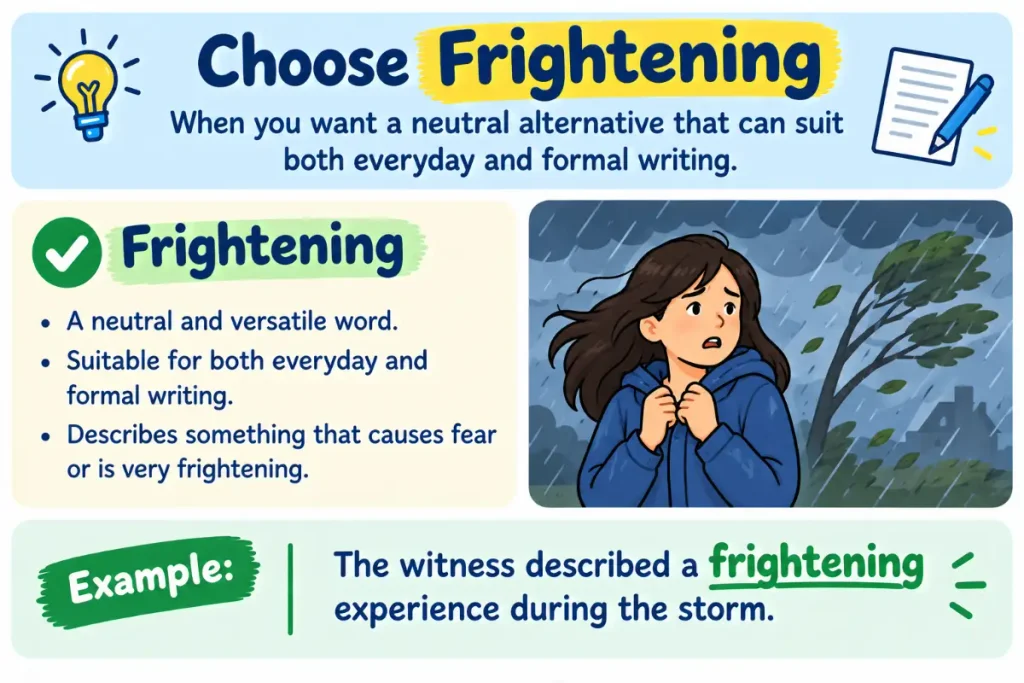
Choose frightening when you want a neutral alternative that can suit both everyday and formal writing.
Example: The witness described a frightening experience during the storm.
When Should You Use Terrifying?
Choose terrifying when the situation causes intense fear.
Example: The sudden turbulence was terrifying for the passengers.
When Should You Use Spooky?
Choose spooky for something eerie, mysterious, or playfully frightening, especially around Halloween.
Example: The fog made the cemetery look spooky.
These words are related, but they are not always interchangeable. Select the one that best expresses the level and type of fear you want to describe.
Scary vs Scared: What’s the Difference?
Scary and scared are both correct words, but they serve different purposes.
- Scary describes something that causes fear.
- Scared describes how someone feels when experiencing fear.
Compare these sentences:
| Word | Example | Explanation |
|---|---|---|
| Scary | The dog looked scary. | The dog appeared frightening. |
| Scared | The child was scared. | The child felt afraid. |
| Scary | That was a scary experience. | The experience caused fear. |
| Scared | I felt scared during the experience. | The speaker experienced fear. |
A simple way to remember the difference is to think about the cause and the feeling. Something scary causes fear, while someone who is scared experiences fear.
For example, you might say, “The scary noise made me feel scared.”
Both words are correct in that sentence because they describe different things.
Scary vs Scarier vs Scariest
The word scary also has comparative and superlative forms.
| Form | Usage | Example |
|---|---|---|
| Scary | Base adjective | That movie is scary. |
| Scarier | Comparative form | This movie is scarier than the first one. |
| Scariest | Superlative form | That was the scariest movie I’ve ever watched. |
English typically changes an adjective ending in a consonant plus y to -ier for comparisons and -iest for the highest degree.
For example:
- Happy → Happier → Happiest
- Easy → Easier → Easiest
- Scary → Scarier → Scariest
Avoid incorrect forms such as scareier or scareiest. The standard forms are scarier and scariest. You can also use more scary and most scary in some contexts, but scarier and scariest are the more natural choices in ordinary American English.
Is Scary Formal or Informal?
Scary works in both casual and formal writing, although the best word depends on the context.
In Casual Writing
Use scary freely in text messages, social media posts, personal stories, and everyday conversations.
Examples:
- That was such a scary movie!
- The roller coaster looked scary.
- I had a scary dream last night.
The word sounds natural and familiar in these situations.
In Academic Writing
You can use scary in an essay when discussing fear, personal experiences, or literature. However, frightening, alarming, or disturbing may be more suitable for an analytical discussion, depending on your meaning.
Casual: The novel has a scary ending.
More analytical: The novel creates a frightening atmosphere through suspense and uncertainty. Neither word is automatically wrong in academic writing. Choose vocabulary that matches the purpose of the assignment.
In Professional Emails
Use scary when a conversational tone is appropriate, but consider more precise wording for serious workplace issues.
Casual: The sudden system failure was scary.
Professional: The sudden system failure raised serious concerns about data security.
The second sentence communicates the concern more precisely without relying on an emotional description.
Is Scarey Ever Correct?
In standard modern English, scarey is not the accepted spelling of the adjective meaning frightening. You should write scary in schoolwork, professional documents, articles, and everyday communication. However, you may encounter Scarey as a deliberately chosen name, username, brand name, fictional character name, or stylized spelling. A creative name does not have to follow ordinary spelling conventions.
For example, a person might use ScareyCat as a username or choose Scarey as a character’s name in a fictional story.
Such uses are intentional names or stylistic choices, not evidence that scarey is the standard spelling of the adjective. If you are correcting ordinary English, use scary.
Common Mistakes to Avoid
Several spelling and usage mistakes can occur when people write scary.
1. Writing Scarey Instead of Scary
Incorrect: The ending of the film was scarey.
Correct: The ending of the film was scary.
Tip: Remove the final e from scare before adding -y.
2. Confusing Scary With Scared
Incorrect: I was very scary during the thunderstorm.
Correct: I was very scared during the thunderstorm.
The incorrect sentence suggests that the speaker frightened other people. If you mean that you felt fear, use scared.
3. Writing Scareyer Instead of Scarier
Incorrect: This haunted house is scareyer than the other one.
Correct: This haunted house is scarier than the other one.
The comparative form changes -y to -ier.
4. Writing Scareyest Instead of Scariest
Incorrect: That was the scareyest story in the book.
Correct: That was the scariest story in the book.
Use scariest when comparing three or more things and identifying the one that causes the most fear.
5. Using Scary When a More Precise Word Fits Better
Scary is a useful general adjective, but it may not communicate the exact meaning you intend.
For example:
- The warning was alarming because it suggested a serious risk.
- The ending was shocking because it revealed an unexpected fact.
- The abandoned building was spooky because it seemed mysterious.
- The experience was terrifying because it caused extreme fear.
Choose the word that best describes the situation rather than using scary for every expression of fear or concern.
How to Remember the Correct Spelling of Scary
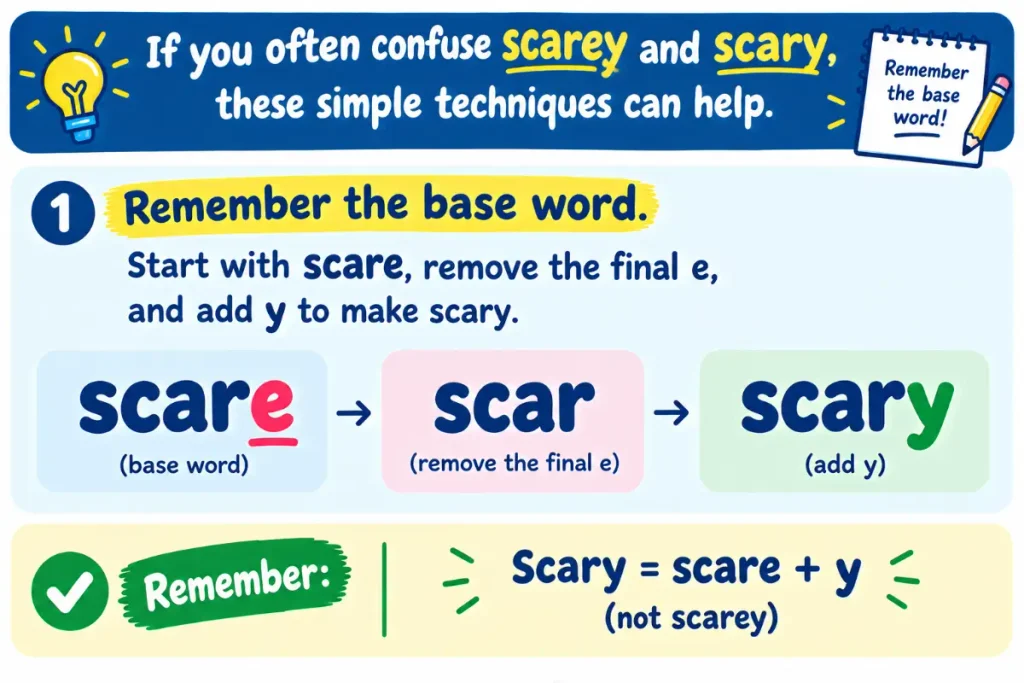
If you often confuse scarey and scary, these simple techniques can help.
1. Remember the base word. Start with scare, remove the final e, and add y to make scary.
2. Connect it with similar words. Think of shiny, noisy, and tasty. These examples can remind you that the final e often disappears when forming these adjectives.
3. Practice a short sentence. Write “The scary story frightened me.” Repeating a correct example can help reinforce the spelling.
4. Check the comparative forms. Remember the sequence scary, scarier, scariest. These forms make the spelling pattern easier to recognize.
5. Use spell-check tools when needed. A spelling checker can flag scarey in ordinary writing, but always review suggestions in context, especially when writing names or creative titles.
The most useful rule is simple: write scary when you mean frightening.
Conclusion
The correct spelling is scary, not scarey, when you want to describe something frightening, alarming, or likely to cause fear. The word works naturally in everyday conversations, school assignments, stories, emails, and many other forms of writing.
The easiest way to remember the difference between scarey or scary is to start with scare, remove the final e, and add y. You can also remember the related forms scarier and scariest, which follow the same spelling pattern.
Although you might encounter Scarey as a creative name or intentional spelling choice, use scary in standard English. Choosing the correct form keeps your writing clear, accurate, and easy to understand.
Frequently Asked Questions
Is scarey or scary correct?
Scary is correct. It is the standard spelling of the adjective that means frightening or causing fear. Scarey is a misspelling in ordinary modern English.
How do you spell scary?
The correct spelling is S-C-A-R-Y. Start with scare, remove the final e, and add y.
Why do people spell scary as scarey?
People may write scarey because they recognize the base word scare and mistakenly keep its final e when adding y. The standard spelling drops that e.
Is scarey a real word?
Scarey can appear as a creative name, username, or stylized spelling, but it is not the standard spelling of the adjective scary. In ordinary writing, use scary.
What is the difference between scary and scared?
Scary describes something that causes fear, while scared describes a person or animal experiencing fear. For example, “The movie was scary, and I was scared.”
What are the comparative and superlative forms of scary?
The comparative form is scarier, and the superlative form is scariest. For example, “This movie is scarier than the last one” and “That was the scariest movie of the year.”
What is another word for scary?
Depending on the context, you can use frightening, terrifying, spooky, chilling, alarming, or unsettling. Choose the word that best matches the intensity and type of fear you want to express.
1 thought on “Scarey or Scary: Which Spelling Is Correct?”