
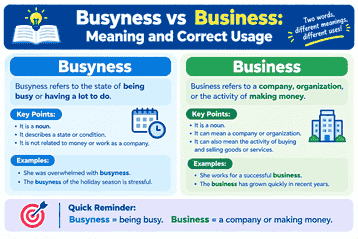
If you’ve ever typed busyness vs. business and wondered which word belongs in your sentence, you’re not alone. The two words look similar, but they have different meanings. Busyness refers to the state of being busy, while business refers to work, commercial activity, a company, or a matter that needs attention.
The correct choice depends on what you want to say. Use busyness when describing a busy schedule or a lot of activity. Use business when discussing a company, professional work, trade, or an important matter.
Busyness and business are both correct English words, but they are not interchangeable. The spelling business is far more common in everyday writing, while busyness is useful when you specifically mean the condition of being busy.
This guide explains the meanings, spelling rules, sentence examples, common mistakes, and differences between these two words so you can choose the right one confidently.
What Does Busyness vs Business Mean?
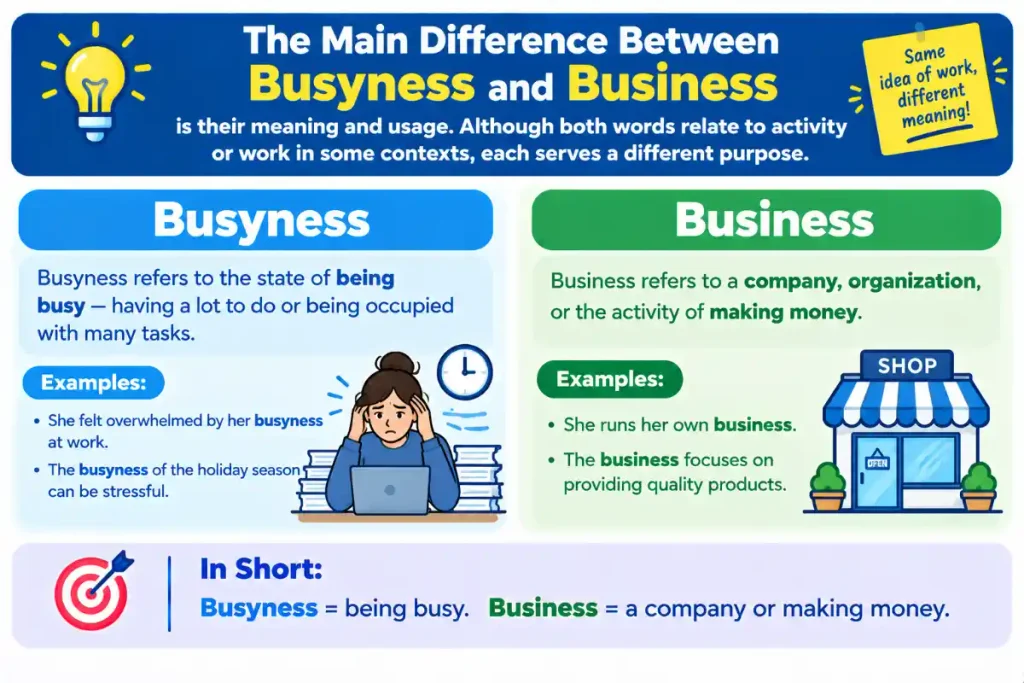
The main difference between busyness and business is their meaning and usage. Although both words relate to activity or work in some contexts, each serves a different purpose.
| Word | Meaning | Part of Speech | Example |
|---|---|---|---|
| Busyness | The state of being busy or occupied | Noun | The busyness of the holiday season left everyone tired. |
| Business | Commercial activity, a company, professional work, or a matter | Noun | She started a small business from home. |
What Does Busyness Mean?
Busyness is a noun that describes the state or quality of being busy. It refers to having many things to do, dealing with constant activity, or experiencing a schedule filled with tasks.
For example:
- The busyness of the school year made it difficult to find free time.
- I enjoy the busyness of a crowded city.
- Her busyness kept her from answering messages promptly.
- The restaurant’s busyness increased during the dinner rush.
In each sentence, busyness describes a condition or level of activity. It does not refer to a company or commercial organization. Although the word is correct, writers often choose simpler expressions such as busy schedule, heavy workload, or constant activity. These alternatives may sound more natural depending on the sentence.
What Does Business Mean?
Business is a common noun with several meanings. It can refer to a company, the activity of buying and selling goods or services, professional work, or a matter that someone needs to handle.
For example:
- My parents own a family business.
- She studied business in college.
- We discussed the project during a business meeting.
- It’s none of your business.
- He has important business to attend to.
The meaning changes with the context, but none of these examples uses business simply to mean the state of being busy.
How Do You Spell Busyness and Business Correctly?
Both busyness and business are correct spellings. The challenge is remembering which word matches your intended meaning.
How to Spell Busyness
The word busyness comes from the adjective busy. To form the noun, change the y to i and add -ness.
The spelling process looks like this:
- Start with busy.
- Change the final y to i.
- Add -ness.
- The result is busyness.
For example:
- Correct: The busyness of the office made it difficult to concentrate.
- Incorrect for this meaning: The business of the office made it difficult to concentrate.
The second sentence could refer to the office’s work or commercial activity, but it does not clearly express the condition of being busy.
How to Spell Business
Business has an established spelling that you need to memorize. Although it relates to the word busy, you cannot form its spelling by simply adding a suffix to busy.
For example:
- Correct: She wants to open her own business.
- Incorrect: She wants to open her own busyness.
The word busyness cannot replace business when referring to a company. Memory tip: If you’re talking about a company, trade, or professional matter, use business. If you’re describing how occupied someone is, use busyness.
Why Are Busyness and Business Confusing?
These words confuse writers because they look and sound similar, share a historical connection, and relate to activity in different ways.
1. They Have Similar Spellings
Both words contain the letters b, u, s, and i, and both end with a similar sound. Their visual similarity makes it easy to type one when you intend the other.
For example, someone writing about a crowded workplace might accidentally type:
“The business of the office made it hard to focus.”
If the writer means the constant activity in the office, busyness is more precise.
2. Both Words Can Relate to Work
Busyness can describe how occupied people are at work, while business can refer to their professional responsibilities.
Compare these sentences:
- Busyness: The busyness of the week left little time for family activities.
- Business: I have several business matters to discuss with my manager.
The first sentence describes a busy condition. The second refers to professional matters.
3. Business Has Several Meanings
Unlike busyness, which has a relatively narrow meaning, business appears in many common expressions.
Examples include:
- Small business: A company that operates on a relatively small scale.
- Business trip: Travel for work.
- Business hours: The hours during which an organization normally operates.
- Mind your own business: Avoid interfering in someone else’s private affairs.
- Business as usual: Continuing normal activities despite a change or problem.
Because business appears in so many contexts, writers may mistakenly use it whenever they want to describe activity.
Busyness vs Business in Real Sentences
The easiest way to understand the difference is to see how each word works in everyday situations.
| Context | Example with Busyness | Example with Business |
|---|---|---|
| Workplace | The busyness of the office increased before the deadline. | The business hired two new employees. |
| School | The busyness of exam week made it hard to relax. | She plans to study business in college. |
| Family | The busyness of family life leaves little time for hobbies. | My uncle runs a family business. |
| Shopping | The busyness of the mall surprised us. | The store is a family-owned business. |
| Holidays | The busyness of the holiday season can feel overwhelming. | Our business closes on major holidays. |
| Personal schedule | His busyness prevented him from attending the event. | He had personal business to take care of. |
| Meetings | The busyness of the day left no room for another meeting. | We discussed the company’s business goals. |
| City life | I enjoy the busyness of downtown streets. | The city supports many small businesses. |
| I apologize for my busyness this week. | Please contact me regarding your business account. | |
| Social life | The busyness of the weekend kept us at home. | She prefers not to discuss her family’s business publicly. |
These examples show that both words can appear in similar situations, but they communicate different ideas.
Five More Examples Using Busyness
- The busyness of the hospital increased during flu season.
- Despite the busyness of her schedule, Maria made time for exercise.
- I miss the busyness of campus life during summer break.
- The manager noticed the busyness of the store before closing time.
- His constant busyness made it difficult for him to enjoy his vacation.
Five More Examples Using Business
- My sister launched an online business selling handmade gifts.
- The team discussed its business strategy during the meeting.
- Please send the invoice to our business email address.
- He decided to leave the family business and pursue another career.
- The lawyer helped the client resolve a business dispute.
Busyness vs Business: Which Word Should You Use?
Choose the word based on the idea you want to communicate, rather than how the sentence sounds. Use busyness for a state of being busy. Choose it when describing a packed schedule, a crowded environment, or constant activity.
Example: The busyness of the week left me exhausted.
Use business for work, companies, trade, or matters.
Choose it when discussing an organization, professional responsibilities, or something that needs attention.
Example: Her business serves customers across the country.
When you’re unsure, ask yourself one question: Am I describing how busy someone is, or am I talking about work, a company, or a matter?
If you’re describing the condition, busyness may fit. If you’re referring to commercial activity or a professional matter, business is usually the right choice.
Busyness vs. Busy: What’s the Difference?
Busyness and busy come from the same adjective, but they serve different grammatical purposes.
- Busy is an adjective that describes a person, place, or situation.
- Busyness is a noun that names the condition of being busy.
| Word | Part of Speech | Example |
|---|---|---|
| Busy | Adjective | I’m busy this afternoon. |
| Busyness | Noun | My busyness has increased this month. |
Consider these additional examples:
- Busy: The restaurant is busy tonight.
- Busyness: The busyness of the restaurant surprised the new manager.
- Busy: She has a busy schedule.
- Busyness: Her busyness makes scheduling meetings difficult.
In everyday American English, busy often sounds more natural than busyness. For example, “I’ve been busy lately” is generally more conversational than “I’ve experienced considerable busyness lately.” Use busyness when the noun itself matters, especially when discussing the level, nature, or effects of activity.
Business vs Work: What’s the Difference?
Business and work overlap in meaning, but they are not always interchangeable. Work is a broad term for tasks, effort, or employment. Business can refer to commercial activity, a company, professional matters, or an area of responsibility.
| Word | Main Meaning | Example |
|---|---|---|
| Business | A company or commercial activity | She owns a successful business. |
| Business | A professional matter | I have some business to discuss. |
| Work | Tasks or effort | I have a lot of work to finish. |
| Work | Employment | He goes to work at 8 a.m. |
For example, “I have a lot of work today” means you have many tasks to complete. “I have a lot of business today” may suggest professional matters or commercial activity, but it does not express the same idea as naturally in ordinary conversation. Likewise, a person can work for a business without owning one. Understanding this distinction helps you select the most natural word for emails, school assignments, and everyday conversations.
Common Expressions With Business
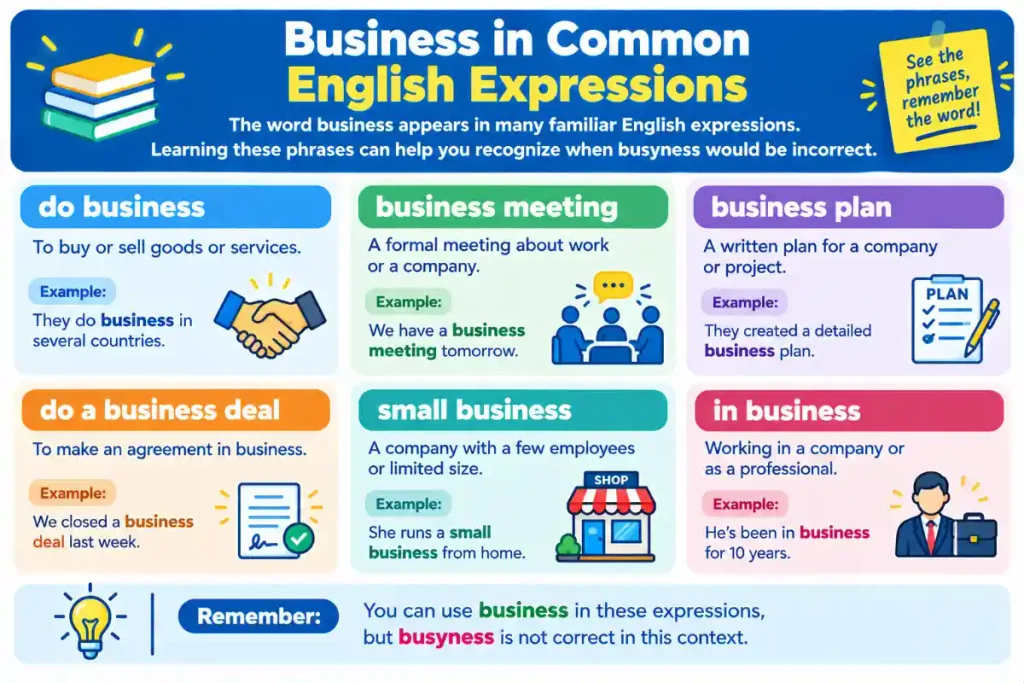
The word business appears in many familiar English expressions. Learning these phrases can help you recognize when busyness would be incorrect.
| Expression | Meaning | Example |
|---|---|---|
| Mind your own business | Avoid interfering in someone else’s affairs | He told his brother to mind his own business. |
| Business as usual | Normal activity continues | After the holiday, it was business as usual. |
| Get down to business | Start focusing on the main task | Let’s get down to business and review the plan. |
| Go out of business | Stop operating as a company | The store went out of business last year. |
| Mean business | Be serious about an intention | The coach means business this season. |
| Business partner | Someone who shares ownership or responsibilities in a business | Her business partner handles the finances. |
| Have no business doing something | Have no right or reason to do something | He had no business sharing that private information. |
| Business opportunity | A chance to start or develop commercial activity | They discussed a new business opportunity. |
Notice that none of these standard expressions uses busyness in place of business.
Can Busyness Be Used in Formal Writing?
Yes. Busyness is a valid noun and can appear in formal, academic, or professional writing when you need to describe the state of being busy. However, it may sound abstract or awkward when a more direct phrase communicates the same idea.
For example:
- Acceptable: The busyness of the department increased during the final quarter.
- More direct: The department experienced a heavier workload during the final quarter.
- Acceptable: The busyness of urban life can affect people’s daily routines.
- More direct: The demands of urban life can affect people’s daily routines.
The best choice depends on your purpose. Busyness can work well when you want to discuss the general condition of constant activity. Heavy workload, high activity levels, and demanding schedule may be clearer in reports and workplace communication.
Which Word Works Best in Emails?
For most professional emails, choose business for commercial matters and busy or a more specific phrase to describe your schedule.
Instead of writing:
“I apologize for my busyness this week.”
You could write:
“I apologize for the delay. I’ve had a busy week.”
The second version sounds more natural in most workplace situations.
Use busyness when you have a specific reason to emphasize the condition of being busy, rather than simply explaining that you have many tasks to complete.
Common Mistakes When Using Busyness and Business
Several mistakes occur when writers confuse the two words or choose an unnatural expression.
Mistake 1: Using Business to Mean a Busy Schedule
Incorrect for the intended meaning: The business of the week left me exhausted.
Better: The busyness of the week left me exhausted.
You could also write, “My busy schedule left me exhausted.” This version is often more natural.
Mistake 2: Using Busyness to Refer to a Company
Incorrect: She started a busyness selling handmade candles.
Correct: She started a business selling handmade candles.
A company is a business, not a busyness.
Mistake 3: Assuming Busyness Is a Misspelling
Incorrect assumption: Busyness is not a real English word.
Correct understanding: Busyness is a legitimate noun. It is less common than business, but it has its own meaning.
Do not automatically mark it as a spelling error. Check how the writer uses it.
Mistake 4: Using Busyness When Busy Would Sound Better
Awkward: I am experiencing busyness at work today.
More natural: I’m busy at work today.
Although the first sentence is understandable, the adjective busy expresses the idea more directly.
Mistake 5: Confusing Business With Professional Workload
Potentially unclear: My business is too much this week.
Clearer: I have too much work this week.
Use business when you mean commercial activity or professional matters. Use workload when you mean the amount of work you must complete.
Are There Synonyms for Busyness and Business?
Yes, but the best alternative depends on the meaning. Since these words have different uses, their synonyms are not interchangeable.
Synonyms for Busyness
The following words and phrases can describe activity, a demanding schedule, or a state of being occupied.
| Word or Phrase | Meaning | Tone | Example |
|---|---|---|---|
| Activity | Things happening or being done | Neutral | The activity in the office increased. |
| Workload | The amount of work someone must complete | Professional | My workload doubled this month. |
| Full schedule | A calendar with little free time | Everyday | I have a full schedule this week. |
| Heavy workload | A large amount of work | Professional | The team faced a heavy workload. |
| Hectic pace | A fast, demanding rate of activity | Conversational | We worked at a hectic pace. |
| Bustle | Lively, energetic activity | Descriptive | I enjoyed the bustle of the market. |
| Hustle | Energetic effort or activity | Casual | The hustle of city life keeps him motivated. |
| Demands | Responsibilities requiring time or effort | Neutral | The demands of school kept her occupied. |
| Commotion | Noisy or confused activity | Neutral | The commotion in the hallway interrupted class. |
| Packed schedule | A calendar filled with commitments | Everyday | She has a packed schedule tomorrow. |
These alternatives express different aspects of busyness. For example, commotion emphasizes disorder or noise, while workload focuses on the amount of work.
Synonyms for Business
The appropriate alternative depends on whether business refers to a company, commercial activity, or a matter.
| Word or Phrase | Meaning | Tone | Example |
|---|---|---|---|
| Company | An organization that provides goods or services | Neutral | Her company employs 50 people. |
| Enterprise | A business or organized undertaking | Formal | The enterprise expanded into new markets. |
| Firm | A business, often in professional services | Professional | He joined a law firm. |
| Corporation | A legally incorporated company | Formal | The corporation opened a new office. |
| Venture | A business project or undertaking | Professional | They launched a new venture. |
| Trade | The buying and selling of goods or services | Formal | International trade supports many industries. |
| Commerce | The activity of buying and selling | Formal | The city has a long history of commerce. |
| Organization | A structured group or institution | Neutral | The organization hired new staff. |
| Operation | A business or its activities | Professional | The operation serves customers nationwide. |
| Affair | A matter or concern requiring attention | Formal | The issue was a private affair. |
Choose an alternative that matches the intended meaning. For example, company can replace business when you mean an organization, but it cannot replace busyness when describing a full schedule.
Are Busyness and Business Different in American and British English?
No major US-versus-UK spelling distinction separates these words. Both busyness and business are valid in American and British English. Their meanings remain broadly consistent across both varieties of English.
Examples in American English:
- The busyness of the office increased before the deadline.
- She owns a small business in Chicago.
Examples in British English:
- The busyness of the town center surprised us.
- He runs a small business in London.
The words themselves do not require different spellings based on region. Writers in both countries should choose the word that matches their intended meaning.
Quick Tips to Remember the Difference
Use these practical reminders when writing or editing:
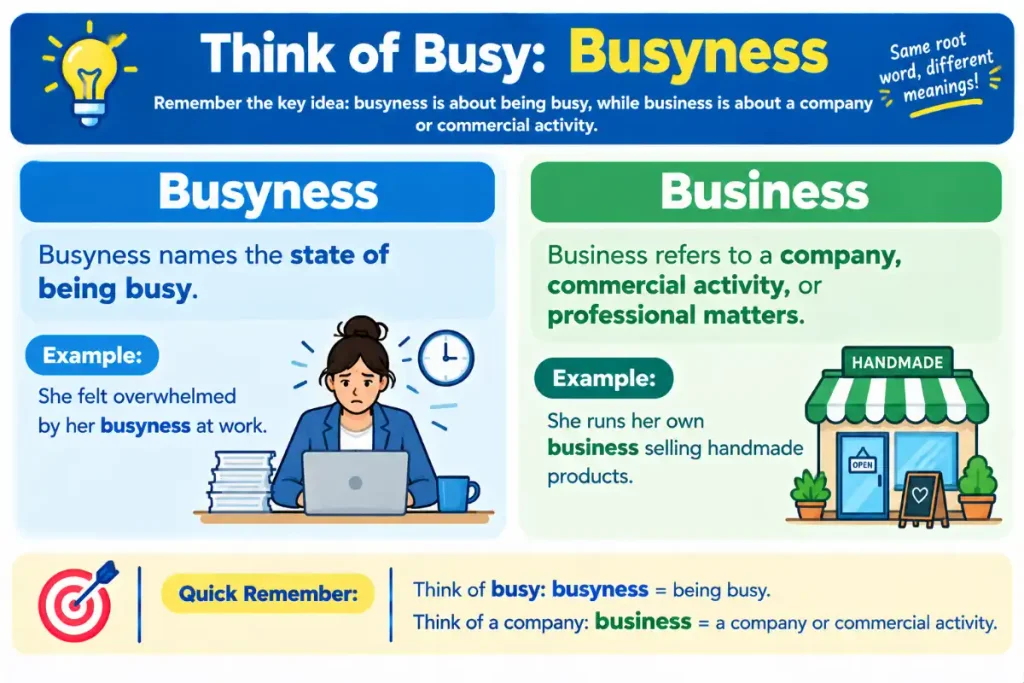
- Think of busy: Busyness names the state of being busy.
- Think of a company: Business refers to a company, commercial activity, or professional matters.
- Check the sentence: If you mean a packed schedule, busy, busyness, or workload may fit, depending on the grammar.
- Read the sentence aloud: “She owns a busyness” sounds wrong because the intended noun is business.
- Don’t reject busyness automatically: It is a real word, even though people use it less often than business.
- Prefer clear wording: In everyday conversation, “I’ve been busy” is often more natural than “I’ve experienced busyness.
Conclusion
Understanding busyness vs. business comes down to recognizing what each word means. Busyness describes the state of being occupied, having a full schedule, or dealing with constant activity. Business refers to a company, commercial activity, professional work, or a matter that requires attention.
Both spellings are correct, so neither should automatically be treated as a mistake. The important thing is to match the word to the meaning you want to express. When describing a demanding schedule, busy or workload may sound more natural than busyness. When talking about a company or professional matter, use business. Remembering this simple distinction will help you write more clearly in emails, school assignments, workplace documents, and everyday conversations.
Frequently Asked Questions
Is busyness a real word?
Yes, busyness is a real English noun that means the state or condition of being busy. It is less common than business, but it is correct when used to describe constant activity or a demanding schedule.
Which is correct, busyness or business?
Both are correct, but they have different meanings. Use busyness for the state of being busy and business for a company, commercial activity, professional work, or a matter.
How do you spell busyness correctly?
The correct spelling is busyness. It comes from busy, with the final y changed to i before adding -ness.
Why is business spelled differently from busyness?
Business has an established spelling that developed historically, while busyness follows the common pattern of forming a noun from an adjective by adding -ness. Their similar appearance does not make them interchangeable.
Can I use busyness in a professional email?
Yes, but it may sound less natural than busy schedule, workload, or heavy workload in many workplace emails. For example, “I’ve had a busy week” is usually clearer than “I’ve experienced considerable busyness.”
What is another word for busyness?
Depending on the context, you can use activity, workload, bustle, hectic pace, or packed schedule. Each alternative has a slightly different meaning, so choose the one that best describes the situation.
Is busyness more common than business?
No. Business is much more common in everyday English because it has several widely used meanings. Busyness appears less often and usually refers specifically to the state of being busy.
1 thought on “Busyness vs Business: Meaning and Correct Usage”