
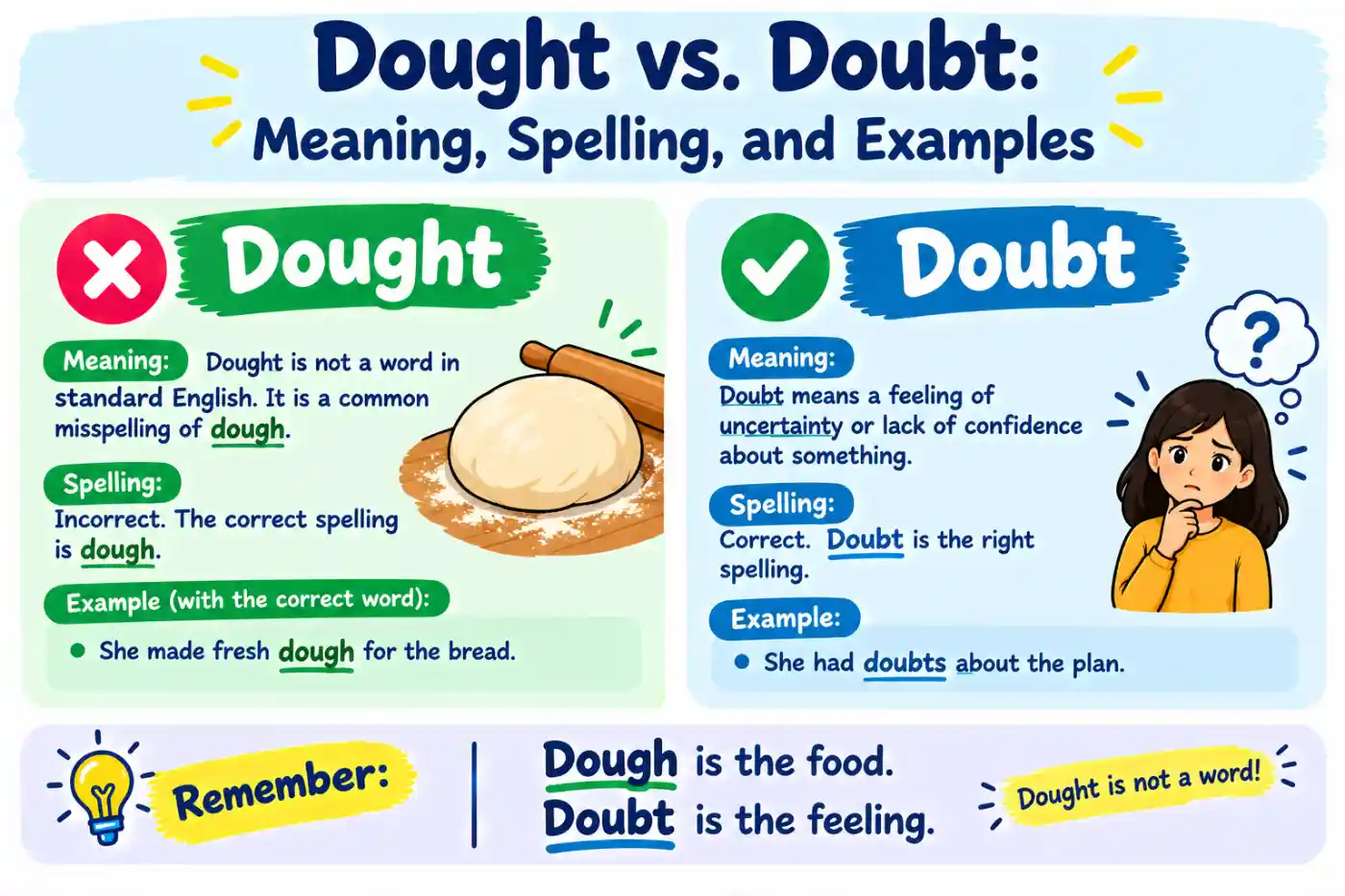
If you’re writing an email, school assignment, or social media post, you might wonder about dought vs doubt. The two words look similar, but they have different meanings, and only one is the standard spelling of the word commonly used to express uncertainty.
Doubt is the correct word when you mean uncertainty, a lack of confidence, or a question about whether something is true. Dought is an obsolete or rare historical word, not the standard spelling of doubt in modern American English.
The confusion often comes from the silent b in doubt. Although the letter appears in the spelling, you do not pronounce it in standard English. This guide explains the meanings of doubt and dought, shows how to use doubt correctly, and provides examples, spelling tips, and answers to common questions.
Dought vs Doubt: What’s the Difference?
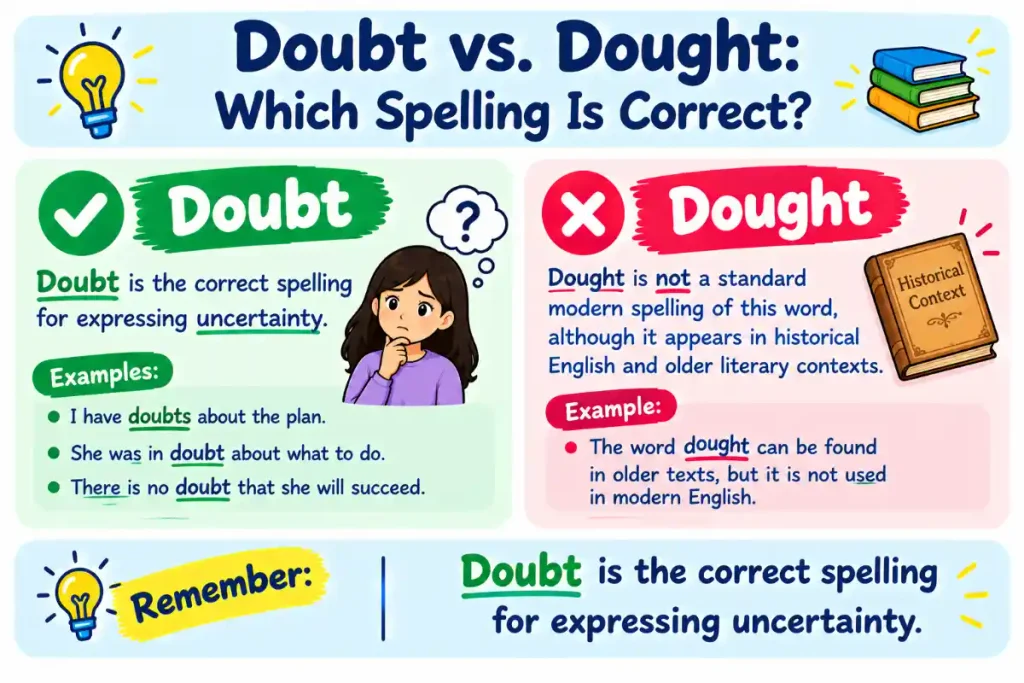
Doubt is the correct spelling for expressing uncertainty. Dought is not a standard modern spelling of this word, although it appears in historical English and older literary contexts.
| Word | Meaning | Modern Usage | Example |
|---|---|---|---|
| Doubt | Uncertainty or lack of confidence | Common and standard | I doubt that the store is open. |
| Dought | An obsolete or rare historical form associated with older English usage | Rare; generally avoid in modern writing | The word may appear in historical texts. |
Use doubt in everyday conversations, professional emails, academic writing, and formal documents.
What Does Doubt Mean?
Doubt means feeling uncertain about something or questioning whether it is true, possible, or reliable. It can function as both a noun and a verb. As a noun, doubt describes a feeling of uncertainty.
- I have some doubt about the accuracy of the report.
- Her confidence left no room for doubt.
- There is little doubt that practice improves performance.
As a verb, doubt means to question or feel uncertain about something.
- I doubt that it will rain today.
- He doubts whether the plan will work.
- She never doubted her ability to learn.
The word appears in everyday expressions such as no doubt, without a doubt, and beyond a reasonable doubt.
What Does Dought Mean?
Dought is an obsolete or rare historical English form rather than a standard modern spelling of doubt. It may appear in older texts, but modern readers should not use it as a substitute for doubt.
For example:
- Incorrect in modern standard English: I dought that he will arrive.
- Correct: I doubt that he will arrive.
If you encounter dought in an old poem, manuscript, or historical document, its meaning may depend on the period and context. Check the surrounding passage or a historical dictionary rather than assuming it means exactly the same thing as modern doubt.
Why Do People Confuse Dought and Doubt?
The confusion between dought and doubt mainly comes from their similar appearance. Both contain the letters d, o, and u, and their final letters can make the words look related. There are two main reasons people mix them up.
The Silent B in Doubt
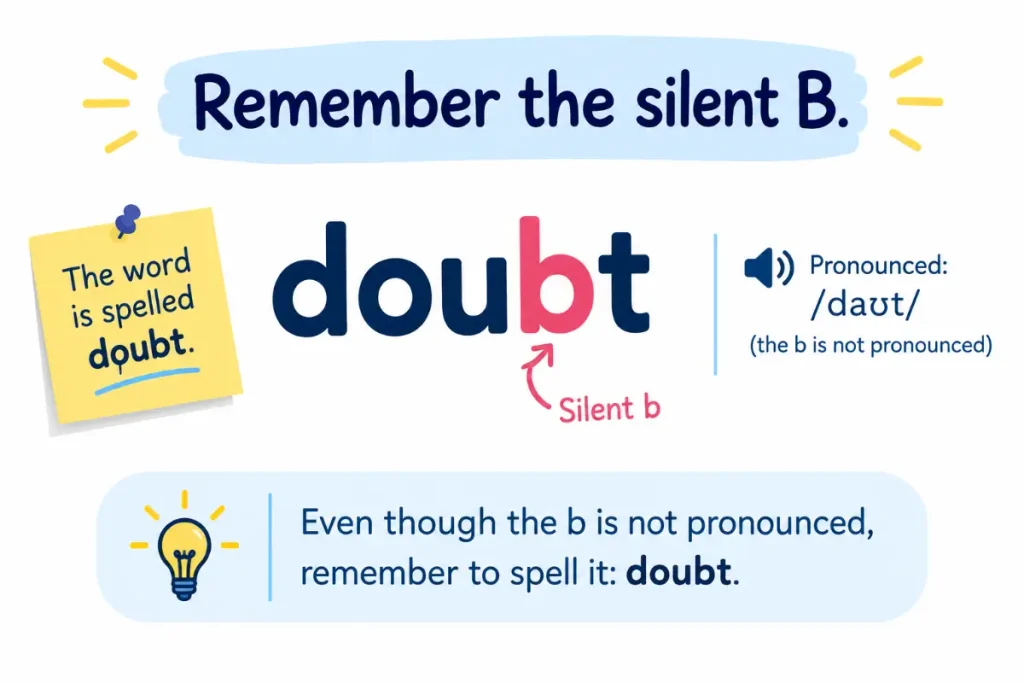
The b in doubt is silent. The word is pronounced /daʊt/, which sounds like “dowt.” Because you cannot hear the b, you might assume the spelling does not need it. However, the standard spelling always includes the letter.
Compare these words:
- Doubt — pronounced “dowt”
- Doubts — pronounced “dowts”
- Doubtful — pronounced “DOWT-ful”
- Doubting — pronounced “DOW-ting”
The spelling stays consistent even though the b is not spoken.
Similar-Looking Words
English contains many words whose spelling does not perfectly match their pronunciation. This can make spelling decisions difficult, especially when a word contains a silent letter.
For example:
| Word | Silent Letter | Example |
|---|---|---|
| Doubt | B | I doubt his explanation. |
| Debt | B | She paid off her debt. |
| Subtle | B | He noticed a subtle change. |
| Island | S | They visited the island. |
| Honest | H | She gave an honest answer. |
These examples show why spelling should not depend on pronunciation alone.
How Do You Spell Doubt Correctly?
The correct spelling is d-o-u-b-t: doubt. Remember to include the silent b. The word does not become dought simply because the two spellings look similar or because the b is not pronounced.
Here are common forms of the word:
| Word Form | Correct Spelling | Example |
|---|---|---|
| Base word | Doubt | I doubt the claim. |
| Plural noun | Doubts | She expressed several doubts. |
| Third-person verb | Doubts | He doubts the result. |
| Present participle | Doubting | They are doubting the decision. |
| Past tense | Doubted | I doubted the explanation. |
| Adjective | Doubtful | The outcome seems doubtful. |
| Adverb | Doubtfully | She looked at him doubtfully. |
These forms retain the correct spelling of the base word, doubt, with appropriate endings added.
Examples of Doubt in Real Sentences
The best way to understand a word is to see how people use it in different situations. The following examples show how doubt works in everyday conversation, school, work, and formal writing.
Everyday Examples
- I doubt that the restaurant will be crowded this early.
- She had no doubt that her friend would remember the appointment.
- There is some doubt about whether the package will arrive today.
- He began to doubt his decision after hearing the new information.
- Without a doubt, this is one of the best books I’ve read.
School and Academic Examples
- The student expressed doubt about the answer to the final question.
- I doubt that the experiment will produce the same results.
- The teacher encouraged students to question claims and resolve their doubts.
- The evidence left little doubt about the conclusion.
- Researchers still have doubts about the reliability of the early data.
Work and Professional Examples
- I doubt we can finish the project before Friday.
- The manager had no doubt that the team could meet its goal.
- Please contact me if you have any doubt about the instructions.
- The client expressed doubt about the proposed schedule.
- We should address any doubts before signing the agreement.
Personal and Social Examples
- She never doubted her ability to learn a new language.
- I have no doubt that you will do well in the interview.
- He began doubting the story after noticing several inconsistencies.
- Their support helped me overcome my doubts.
- There’s no doubt that honest communication can strengthen friendships.
In all these sentences, doubt is the correct spelling. The word expresses uncertainty, questions, or a lack of confidence.
Doubt vs Doubtful: What’s the Difference?
Doubt and doubtful are closely related, but they serve different grammatical purposes.
| Word | Part of Speech | Meaning | Example |
|---|---|---|---|
| Doubt | Noun or verb | Uncertainty or to question something | I doubt the explanation. |
| Doubtful | Adjective | Uncertain or unlikely | It is doubtful that we will finish today. |
When Should You Use Doubt?
Use doubt when expressing uncertainty or questioning a claim.
- I doubt his story.
- She has some doubt about the result.
- They doubted whether the plan would succeed.
When Should You Use Doubtful?
Use doubtful when describing a person’s uncertainty or suggesting that something is unlikely.
- I am doubtful about the proposed solution.
- It is doubtful that the flight will leave on time.
- The outcome remains doubtful.
The choice depends on how the word fits into the sentence.
Doubt vs Suspect: Which Word Is Better?
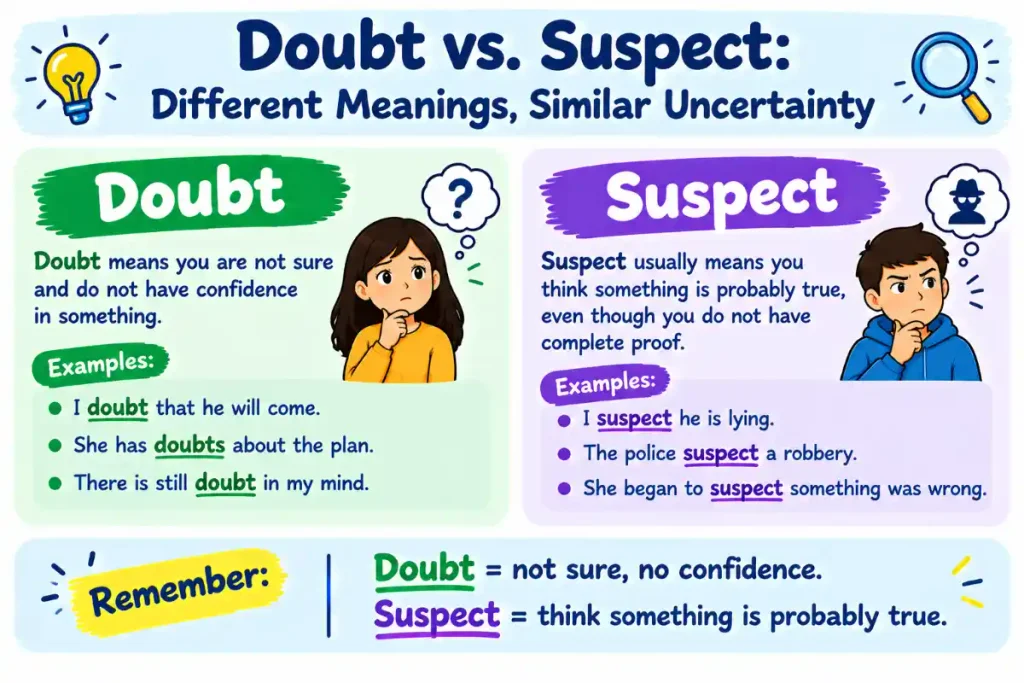
Doubt and suspect can both express uncertainty, but they often communicate different ideas. Suspect usually means you think something is probably true, even though you do not have complete proof.
| Word | Meaning | Example |
|---|---|---|
| Doubt | Question whether something is true | I doubt that he forgot the meeting. |
| Suspect | Believe something is probably true | I suspect that he forgot the meeting. |
Notice the difference in the examples.
If you say, “I doubt that he forgot the meeting,” you question whether forgetting was the reason.
If you say, “I suspect that he forgot the meeting,” you think forgetting was probably the reason.
Choose the word that best communicates your level of confidence.
Doubt vs Uncertainty: What’s the Difference?
Doubt and uncertainty are similar in meaning, but they are not always interchangeable. Uncertainty describes a broader lack of knowledge or confidence about what will happen or what is true.
| Word | Meaning | Example |
|---|---|---|
| Doubt | Questioning whether something is true or correct | I have doubts about the accuracy of the report. |
| Uncertainty | Not knowing what to expect or believe | There is uncertainty about the project’s future. |
For example, you might doubt that a particular candidate has enough experience. You might also feel uncertainty about which candidate will perform best. Use doubt when questioning a particular claim or belief. Use uncertainty when describing a situation in which the answer or outcome is unclear.
Common Expressions With Doubt
The word doubt appears in several common English expressions. Learning these phrases can help you use the word naturally.
| Expression | Meaning | Example |
|---|---|---|
| No doubt | Certainly or very likely | She will no doubt appreciate your help. |
| Without a doubt | Definitely; with complete confidence | He is without a doubt the right person for the job. |
| Beyond a reasonable doubt | To a very high level of certainty; a legal standard used in criminal trials in the US | The prosecution must prove guilt beyond a reasonable doubt. |
| Have doubts | Feel uncertain | I have doubts about the plan. |
| Leave no doubt | Make something completely clear | Her performance left no doubt about her ability. |
| Self-doubt | Lack of confidence in yourself | He worked through his self-doubt before the presentation. |
| Doubtful of | Uncertain about something | She was doubtful of the claim. |
| In doubt | Uncertain or undecided | The final result remains in doubt. |
These phrases work in both everyday and professional settings, although some are more formal than others.
Common Mistakes When Using Doubt
Writers sometimes confuse the spelling of doubt or use it in ways that do not fit the intended meaning. Here are a few mistakes to avoid.
Mistake 1: Writing Dought Instead of Doubt
Incorrect: I dought that the answer is correct.
Correct: I doubt that the answer is correct.
Why: Doubt is the standard modern spelling. The silent b must remain in the word.
Mistake 2: Forgetting the B in Related Forms
Incorrect: She has several doutful concerns.
Correct: She has several doubtful concerns.
A more natural version would be: She has several doubts about the proposal.
Why: The adjective doubtful and noun doubts retain the b from doubt.
Mistake 3: Confusing Doubt With Suspect
Potentially misleading: I doubt that she is the person who called.
If you mean that you believe she probably called, write:
Correct: I suspect that she is the person who called.
Why: Doubt questions whether something is true, while suspect often expresses a tentative belief that it is true.
Mistake 4: Using Doubt When You Mean a Question
Less natural: I have a doubt for you.
More natural: I have a question for you.
Why: In American English, I have a question is the usual expression when asking someone for information. I have a doubt is more appropriate when describing uncertainty about a claim or situation.
Mistake 5: Confusing Doubt and Doubted
Incorrect: Yesterday, I doubt his explanation.
Correct: Yesterday, I doubted his explanation.
Why: Use the past-tense form doubted for an action or state in the past.
Does Doubt Have Any Synonyms or Antonyms?
Yes. Several words have meanings similar to doubt, and others express the opposite idea. The best choice depends on the sentence and the kind of uncertainty you want to describe.
Synonyms for Doubt
| Word | Meaning | Tone | Example |
|---|---|---|---|
| Uncertainty | Lack of certainty | Neutral | There is uncertainty about the result. |
| Hesitation | A pause caused by uncertainty | Everyday | She answered without hesitation. |
| Suspicion | A belief that something may be wrong or true without proof | Neutral | His actions raised suspicion. |
| Skepticism | An attitude of questioning claims | Formal | The proposal was met with skepticism. |
| Distrust | Lack of trust | Stronger | The mistake created distrust. |
| Misgiving | A feeling of concern or doubt | Formal | I had misgivings about the decision. |
| Reservation | A concern or qualification | Professional | She expressed reservations about the plan. |
| Question | A matter of uncertainty or something requiring an answer | Neutral | There is a question about the report’s accuracy. |
These alternatives are related but not identical. For example, skepticism often describes a general habit of questioning claims, while misgiving suggests a specific concern about a decision.
Antonyms for Doubt
| Word | Meaning | Example |
|---|---|---|
| Certainty | The state of being sure | She spoke with certainty. |
| Confidence | Belief in someone or something | He has confidence in the team. |
| Assurance | A feeling or statement of confidence | Her explanation gave us assurance. |
| Conviction | A firm belief | He expressed his conviction clearly. |
| Trust | Belief in the reliability of someone or something | I trust her judgment. |
| Belief | Acceptance that something is true | His belief remained strong. |
These words express confidence or belief rather than uncertainty. However, not every antonym works in every sentence, so consider the intended meaning before replacing doubt.
Easy Ways to Remember the Correct Spelling
If you often mix up dought and doubt, use these simple techniques to remember the correct form.
- Remember the silent B. The word is spelled doubt, even though the b is not pronounced.
- Connect it with debt. Both doubt and debt contain a silent b.
- Use a simple sentence. Practice writing, “I doubt that claim,” until the spelling feels familiar.
- Check related words. Remember the b in doubts, doubted, and doubtful.
- Read the sentence aloud, then check the spelling. Pronunciation can help you identify the word you want, but it cannot always tell you which letters to write.
The key rule is simple: use doubt for uncertainty and avoid dought in ordinary modern English.
Conclusion
The difference between dought vs doubt comes down to spelling, meaning, and modern usage. Doubt is the correct standard word for expressing uncertainty, questioning a statement, or describing a lack of confidence. The spelling includes a silent b, which can make it confusing if you rely only on pronunciation. Although dought appears in some historical English contexts, it is not an appropriate substitute for doubt in everyday American English.
Remember that doubt can function as both a noun and a verb, while related forms such as doubtful and doubted serve different grammatical roles. Whether you’re writing an email, completing a school assignment, or preparing a professional report, choose doubt whenever you mean uncertainty.
Frequently Asked Questions
1. Which is correct, dought or doubt?
Doubt is correct when expressing uncertainty or questioning something. Dought is not the standard modern spelling of this word.
2. How do you spell doubt?
The correct spelling is doubt, spelled D-O-U-B-T. The letter b is silent but must be included.
3. What does doubt mean?
Doubt means uncertainty or a lack of confidence in whether something is true. As a verb, it means to question or feel unsure about something.
4. Why is the B silent in doubt?
The spelling reflects the word’s historical development from French and Latin forms. The b is retained in modern spelling even though standard English pronunciation does not include the sound.
5. Is dought an English word?
Dought appears in rare or historical English usage, but it is not the standard spelling of modern doubt. In everyday writing, use doubt.
6. What is the difference between doubt and doubtful?
Doubt is a noun or verb, while doubtful is an adjective. For example, “I doubt the result” uses a verb, while “The result is doubtful” uses an adjective.
7. What is another word for doubt?
Common alternatives include uncertainty, skepticism, hesitation, misgiving, and reservation. The best choice depends on whether you mean general uncertainty, a specific concern, or a questioning attitude.
1 thought on “Dought vs Doubt: Meaning, Spelling, and Examples”