
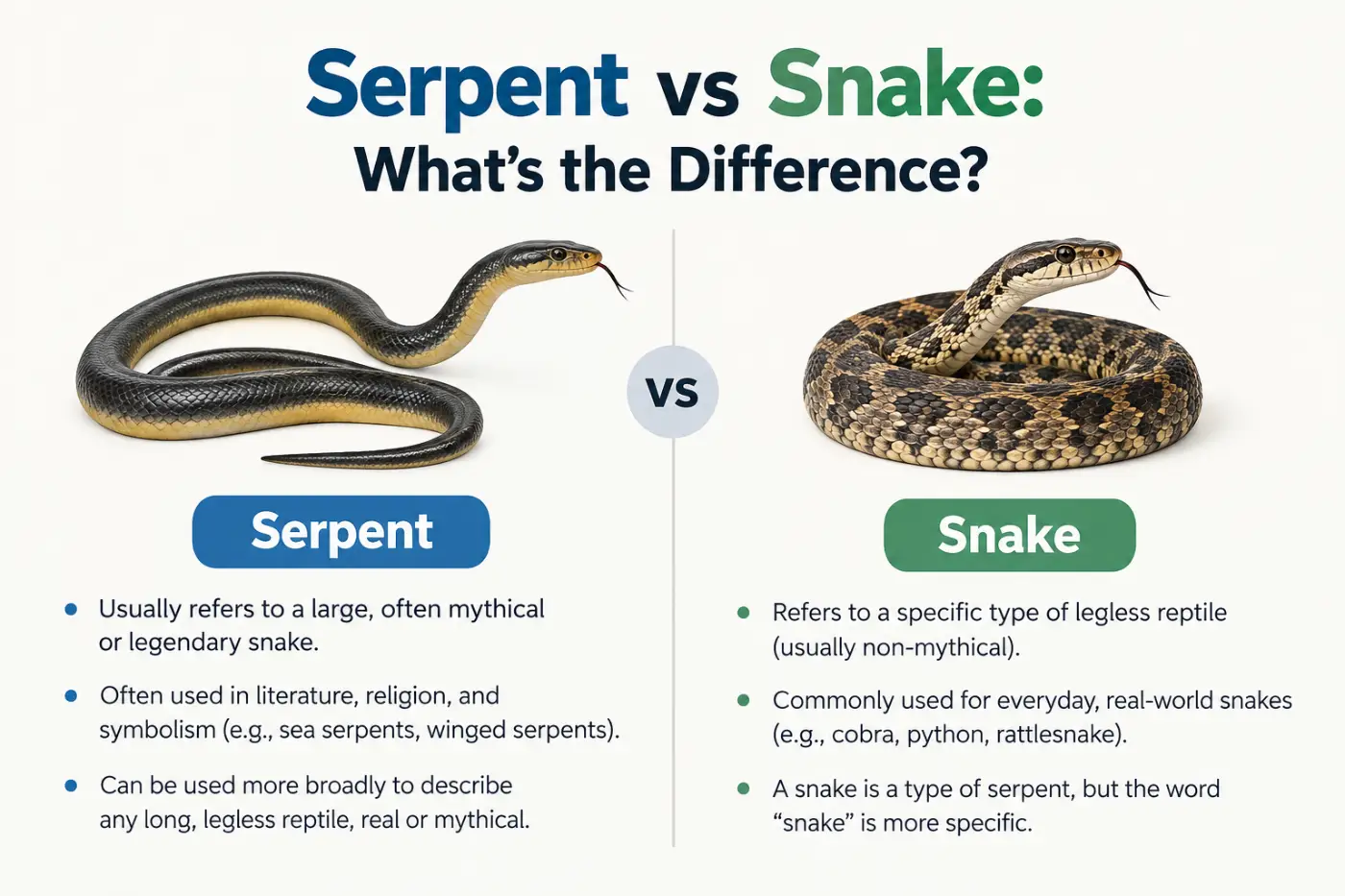
If you’re writing an essay, reading a novel, or simply wondering whether serpent vs snake refers to two different animals, the answer is fairly simple: a serpent is usually a snake, but the two words are not used in exactly the same way. “Snake” is the normal everyday term, while “serpent” is more literary, formal, historical, or symbolic.
In zoological terms, there is no separate animal group called “serpents” that is distinct from snakes. Both words can refer to long, limbless reptiles in the suborder Serpentes.
The main difference is usage and tone. “Snake” is neutral and common; “serpent” often sounds more dramatic, poetic, biblical, mythical, or old-fashioned.
This guide explains the difference between serpent vs snake, when to use each word, how they compare in meaning and tone, and the common situations where one sounds more natural than the other.
Serpent vs Snake: The Quick Answer
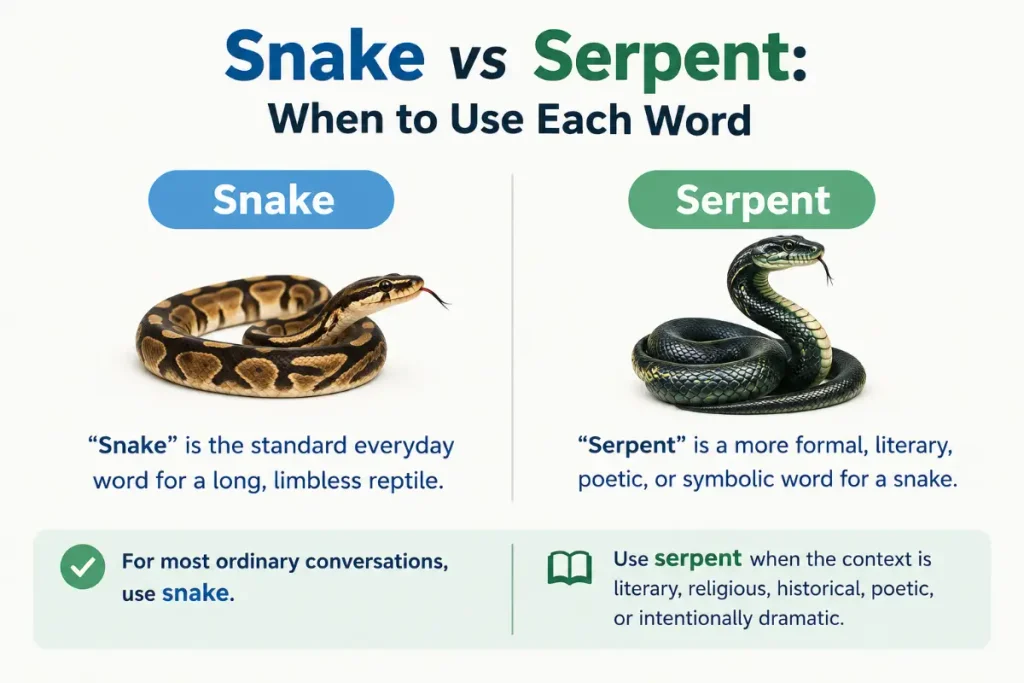
“Snake” is the standard everyday word for a long, limbless reptile, while “serpent” is a more formal, literary, poetic, or symbolic word for a snake. For most ordinary conversations, use snake. Use serpent when the context is literary, religious, historical, poetic, or intentionally dramatic.
| Word | Basic meaning | Tone | Typical use |
|---|---|---|---|
| Snake | A long, limbless reptile | Neutral | Everyday speech and writing |
| Serpent | A snake or snake-like creature | Literary/formal | Literature, religion, mythology, symbolism |
What Does “Serpent” Mean?
A serpent is a snake, especially when the word is used in a literary, formal, poetic, or symbolic context. The word can describe an actual animal:
The serpent moved quietly through the grass.
But it can also have a symbolic meaning:
The serpent represented temptation in the ancient story.
“Serpent” is therefore broader in tone than “snake.” It can refer to the physical animal while also suggesting ideas such as danger, mystery, wisdom, temptation, evil, or ancient power. The exact association depends heavily on context.
What Does “Snake” Mean?
A snake is a long, limbless reptile belonging to the group of animals known scientifically as snakes or Serpentes. Snake” is the normal word Americans use in everyday conversation.
For example:
- “There’s a snake in the backyard.”
- “I saw a snake on the hiking trail.”
- “What kind of snake is that?”
- “She keeps a pet snake.”
- “The snake disappeared into the bushes.”
None of these sentences would normally require the word serpent. In ordinary American English, snake is the natural choice.
Serpent vs Snake: The Main Difference
The biggest difference isn’t the animal itself. It is the way the word is used.
Snake is everyday and neutral
Use snake when you are simply identifying the animal.
We saw a snake near the garage.
This sounds natural and straightforward.
Serpent is more literary or symbolic
Use serpent when you want a more elevated, poetic, historical, religious, or dramatic tone.
The ancient serpent appeared in the legend.
This sounds very different from:
The ancient snake appeared in the legend.
Both can describe a snake, but serpent fits the style better.
The same animal can be called either
A rattlesnake is still a snake if you call it a serpent. A cobra can also be described as a serpent. The word serpent does not normally identify a different biological category.
Is a Serpent a Snake?
Yes. In ordinary English, a serpent is a snake. The difference is mainly one of vocabulary, tone, and context rather than basic animal classification.
For example:
The snake slid beneath the rock.
and
The serpent slid beneath the rock.
Both can describe the same animal. The first sounds ordinary. The second sounds more literary or dramatic. This is similar to choosing between everyday and elevated words in other contexts. The object remains the same, but the word changes the feel of the sentence.
Why DoAuthors may use “serpent” because it creates a more vivid People Say “Serpent” Instead of “Snake”?
People choose serpent for several reasons.
1. Literary style
Authors may use “serpent” because it creates a more vivid or poetic image.
A silver serpent wound through the dark forest.
Calling something a “serpent” can make the description feel more atmospheric than simply calling it a snake.
2. Religious language
“Serpent” has a long history in religious writing and translations of religious texts. For English-speaking readers, the word can immediately evoke biblical stories and symbolism. That association is one reason “serpent” often sounds more solemn or significant than “snake.”
3. Mythology and folklore
Myths and legends frequently use elevated terms for creatures.
The hero faced a giant serpent beneath the mountain.
“Giant snake” is understandable, but “giant serpent” has a more legendary tone.
4. Symbolism
A serpent may represent something beyond the physical animal. Depending on the tradition, a serpent can symbolize ideas such as:
- Temptation
- Danger
- Rebirth
- Transformation
- Wisdom
- Mystery
- Evil
- Healing
These meanings are cultural and contextual rather than inherent to every snake.
5. Dramatic effect
A writer might deliberately choose “serpent” to make a description sound ominous.
Compare:
A snake was waiting in the cave.
with:
A serpent was waiting in the cave.
The second sentence feels more mysterious, even though both may describe the same creature.
Snake vs Serpent in Everyday American English
For US readers, snake is overwhelmingly the more natural everyday choice. Use snake when talking about:
- A snake in your yard
- A snake on a hiking trail
- Pet snakes
- Snake species
- Snake bites
- Snake habitats
- Snake behavior
- Wildlife sightings
For example:
We saw a black snake behind the shed.
This sounds completely natural in American English.
You could say:
We saw a black serpent behind the shed.
It isn’t necessarily grammatically wrong, but it sounds unusually formal or dramatic for an ordinary backyard sighting.
When Should You Use “Serpent”?
Choose serpent when the tone calls for something more elevated or symbolic. It works especially well in:
Literature
The serpent emerged from the ancient ruins.
Poetry
A golden serpent curled beneath the moon.
Mythology
The warrior battled a massive serpent.
Religious discussion
The serpent is an important figure in the biblical story.
Historical writing
Ancient cultures often depicted the serpent in religious art.
Fantasy
The wizard summoned a giant sea serpent.
Dramatic descriptions
A dark serpent waited among the stones.
In ordinary conversation, however, snake will usually sound more natural.
10 Examples of “Snake” in Real Sentences
Here are natural examples of the everyday word:
- I saw a snake crossing the road while I was driving.
- My neighbor found a snake under the porch.
- The snake quickly disappeared into the tall grass.
- We learned how to identify venomous snakes in biology class.
- She was surprised to discover a small snake in the garage.
- The park has several species of snakes.
- A snake had curled up beneath the warm rock.
- He took a photo of the snake from a safe distance.
- The wildlife officer removed the snake from the building.
- I don’t mind seeing snakes as long as I keep my distance.
These examples use snake because the situations are ordinary and straightforward.
10 Examples of “Serpent” in Real Sentences
Now compare examples where the elevated word fits the context:
- The ancient serpent guarded the entrance to the temple.
- A giant serpent rose from the dark water.
- The poem describes a golden serpent winding around the tree.
- The legend tells of a serpent that lived beneath the mountain.
- The artist painted a serpent beside the ancient king.
- The hero confronted the mythical serpent at dawn.
- A stone serpent stood at the entrance to the ruined city.
- The story uses the serpent as a symbol of temptation.
- The creature moved like a serpent through the shadows.
- The old tale warns travelers about a mysterious serpent in the forest.
Notice that these examples tend to involve stories, symbols, myths, imagery, or dramatic descriptions.
Snake vs Serpent: Tone Comparison
| Feature | Snake | Serpent |
|---|---|---|
| Everyday use | Very common | Uncommon |
| Neutral tone | Yes | Less often |
| Formal tone | Possible | Common |
| Literary tone | Possible | Common |
| Poetic tone | Sometimes | Strong |
| Religious context | Possible | Very common |
| Mythological context | Possible | Very common |
| Symbolic meaning | Sometimes | Common |
| Dramatic effect | Moderate | Strong |
| American conversation | Natural | Often unusual |
The important point is that serpent isn’t simply a more correct version of snake. It is a different stylistic choice.
Serpent vs Snake in Science
In scientific writing, snake is generally the clearer everyday term.
Scientists may refer to snakes as members of the suborder Serpentes, which is the scientific classification associated with snakes. This creates an interesting distinction:
- Snake = common English word
- Serpentes = scientific taxonomic name
- Serpent = ordinary English word with a literary, formal, or historical flavor
If you’re writing a school science report about reptiles, “snake” is usually the clearest word unless you’re specifically discussing taxonomy or a source that uses “serpent.”
For example:
Snakes are limbless reptiles found on every continent except Antarctica.
This is clearer for a general audience than:
Serpents are limbless reptiles…
The second sentence is understandable, but it sounds more formal than necessary.
Serpent vs Snake in the Bible and Religion
The word serpent has a particularly strong association with biblical language. Readers may encounter phrases involving “the serpent” in discussions of Genesis, temptation, evil, or religious symbolism. In those contexts, replacing serpent with snake can change the tone even if the basic animal reference remains understandable.
For example:
The serpent tempted Eve.
has a distinctly religious and literary tone.
By comparison:
The snake tempted Eve.
is easier to understand in everyday English but may sound less traditional or less formal. When discussing a specific religious text, it’s best to preserve the terminology used by the translation or tradition being discussed rather than assuming one word is universally preferred.
Serpent vs Snake in Mythology
Serpent is especially common in mythology because myths often treat snakes as symbolic or supernatural creatures.
Examples include stories involving:
- Giant serpents
- Sea serpents
- Dragon-like serpents
- Guardian serpents
- Serpent deities
- Mythical snake creatures
In a fantasy novel, for instance:
The serpent guarded the sacred spring.
sounds more natural than:
The snake guarded the sacred spring.
The second sentence isn’t impossible, but it sounds more like a literal wildlife report.
Can “Serpent” Mean Something Other Than a Snake?
Yes. In some contexts, serpent can describe something that resembles a snake in shape or movement.
For example:
A serpent of smoke rose into the sky.
Here, “serpent” is being used metaphorically. Smoke isn’t literally a snake.
Writers can also use the word to describe winding roads, rivers, flames, or other long, twisting forms. That figurative flexibility is another reason serpent has a more literary feel.
Serpent vs Snake: Which Word Is More Formal?
Serpent is more formal or literary than snake. However, “formal” doesn’t always mean “better.” If you’re writing a workplace email, academic explanation, or everyday message, clarity usually matters more than using an elevated word.
For example:
A snake was found near the building.
is appropriate for a workplace safety notice.
A serpent was discovered near the building.
sounds unnecessarily dramatic unless the situation is intentionally being described in a literary way.
Which Word Should You Use in Different Situations?
| Situation | Best choice | Why |
|---|---|---|
| Everyday conversation | Snake | Natural and familiar |
| Text message | Snake | Simple and direct |
| Social media post | Snake | Conversational |
| School science paper | Snake | Clear and precise |
| Workplace email | Snake | Neutral |
| Wildlife report | Snake | Standard common term |
| Poem | Serpent | More evocative |
| Fantasy story | Serpent | Dramatic and mythical |
| Religious discussion | Serpent | Traditional association |
| Mythology | Serpent | Fits symbolic language |
| Historical literature | Serpent | Often matches the period and style |

Common Mistakes With “Serpent” and “Snake”
Mistake 1: Assuming they are two different animals
This is the most common misunderstanding. Correction: In normal English, a serpent is generally a snake. The distinction is mostly about usage, tone, and context.
Mistake 2: Using “serpent” in casual conversation
You can do it, but it may sound theatrical.
Instead of:
There’s a serpent in my backyard!
most people would naturally say:
There’s a snake in my backyard!
“Serpent” can be fun if you’re joking or being dramatic, but it isn’t the normal everyday choice.
Mistake 3: Thinking “serpent” is always more sophisticated
Not necessarily. Good writing uses the word that best fits the context. A simple word is often stronger when simplicity is the goal. If you’re reporting a wildlife sighting, snake is usually better.
Mistake 4: Treating “serpent” as a separate scientific category
“Serpent” isn’t the everyday name for a distinct group that exists separately from snakes. If you’re discussing biological classification, use the appropriate scientific terminology.
Mistake 5: Assuming “snake” is too informal for serious writing
“Snake” is perfectly appropriate in serious writing, including educational and scientific contexts. There’s nothing inherently informal about it.
Snake vs Serpent: Which Sounds More Dangerous?
Serpent often sounds more dangerous, but that’s a matter of tone rather than biology.
Compare:
A snake moved through the grass.
with:
A serpent moved through the grass.
The second sentence can create a darker, more ominous image. This doesn’t mean serpents are more dangerous than snakes. It means the word serpent carries stronger literary and cultural associations.
Snake vs Serpent: Which Sounds More Mysterious?
Serpent usually sounds more mysterious. Writers often use it when they want the animal to feel ancient, supernatural, symbolic, or threatening.
For example:
The snake lived near the river.
is a straightforward statement.
The serpent had guarded the river for centuries.
immediately suggests a legend or story.
Related Words and Alternatives
Neither “snake” nor “serpent” needs a huge synonym list because most supposed synonyms change the meaning. Still, several related terms can be useful.
| Word/Phrase | Meaning | Tone | Example |
|---|---|---|---|
| Snake | A limbless reptile | Neutral | “A snake crossed the path.” |
| Serpent | A snake, often literary | Literary | “The serpent guarded the gate.” |
| Viper | A type of venomous snake | Specific | “The viper struck quickly.” |
| Cobra | A specific group of snakes | Neutral/scientific | “The cobra raised its head.” |
| Python | A group of large constricting snakes | Neutral | “The python wrapped around the branch.” |
| Boa | A group of constricting snakes | Neutral | “The boa rested in its enclosure.” |
| Rattlesnake | A venomous snake with a rattle | Neutral | “The rattlesnake warned us.” |
| Constrictor | A snake that kills prey by constriction | Technical | “The constrictor captured its prey.” |
| Reptile | A broader animal group | Scientific/general | “A snake is a reptile.” |
| Ophidian | Relating to or resembling a snake | Formal | “The creature had an ophidian shape.” |
Terms such as viper, cobra, python, and rattlesnake are not interchangeable with “snake” in every sentence because they refer to particular kinds of snakes.
Snake vs Serpent vs Viper
These three words are sometimes confused, but they aren’t equivalent.
Snake
The broad everyday term.
We saw a snake in the woods.
Serpent
Usually another word for a snake, with a more literary or symbolic tone.
The serpent appeared in the legend.
Viper
A specific type of venomous snake belonging to the viper family.
The hiker spotted a viper near the trail.
So:
Every viper is a snake, but not every snake is a viper.
And a viper could also be called a serpent, especially in literary language.
Snake vs Serpent vs Reptile
“Reptile” is broader still.
A snake is a type of reptile, along with animals such as:
- Lizards
- Turtles
- Tortoises
- Crocodilians
- Tuatara
So you shouldn’t automatically replace “snake” with “reptile.”
A snake entered the garage.
contains more specific information than:
A reptile entered the garage.
The second sentence could describe several kinds of animals.
Is “Serpent” a Synonym for “Snake”?
Yes, in many contexts, serpent is a synonym for snake. The important difference is style.
“Snake” is the standard, neutral word.
“Serpent” is often used when the writer wants a literary, poetic, religious, historical, mythical, or dramatic effect.
Because of that difference, the words aren’t always equally natural in the same sentence.
Does “Serpent” Sound Old-Fashioned?
It can.
The word is still used today, especially in literature, religion, mythology, fantasy, and formal descriptions. But in casual American English, it can sound old-fashioned or deliberately dramatic.
For example:
Watch out for that snake.
sounds completely ordinary.
Beware the serpent.
sounds like dialogue from a legend, fantasy story, or old text. That stylistic difference is often exactly why a writer chooses “serpent.”
What Is the Plural of Serpent?
The plural of serpent is serpents.
Examples:
The story describes three serpents.
Ancient paintings show serpents surrounding the temple.
The plural of snake is snakes.
Several snakes were found in the area.
Neither plural form is unusual or irregular.
Pronunciation of “Serpent” and “Snake”
Snake is pronounced like “snayk.”
Serpent is commonly pronounced approximately “SUR-pent.”
The first syllable carries the main stress:
SER-pent
The word has two syllables, while snake has one.
Word Origin and History
The words also have different histories.
Snake is an old English word with Germanic roots. It developed from earlier forms related to words for snakes and creeping creatures.
Serpent entered English through Old French from Latin serpens, meaning a creeping or crawling creature and ultimately associated with a snake.
That Latin connection helps explain why “serpent” has long appeared in formal, literary, and religious English.
You don’t need to know the etymology to choose between the words, but it explains why they have developed such different stylistic associations.
Quick Rule: Snake or Serpent?
Use this simple test:
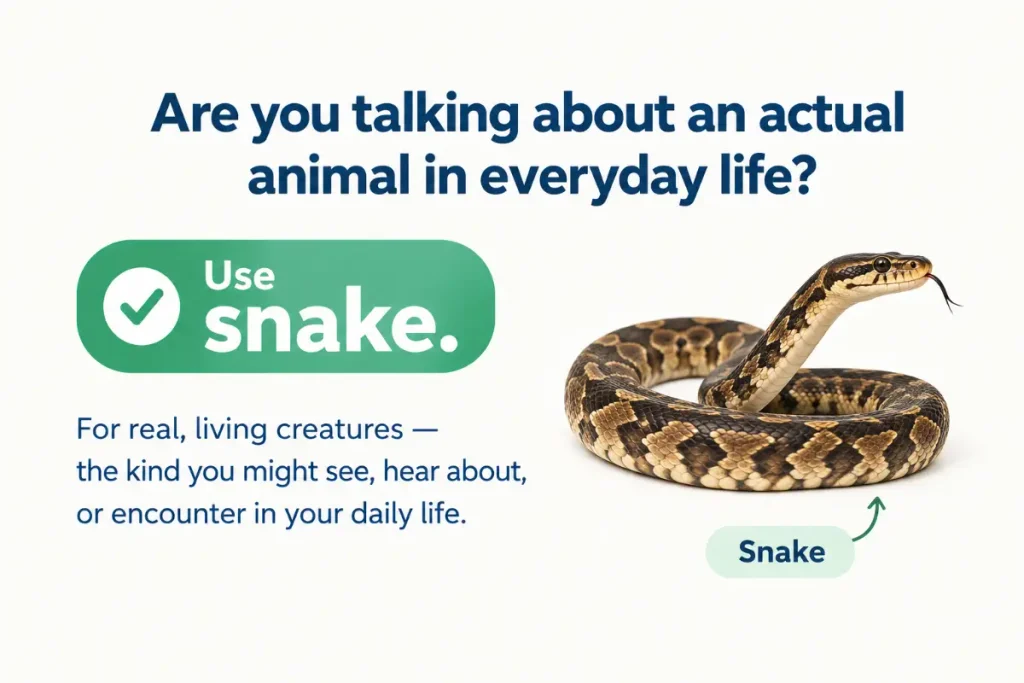
- Are you talking about an actual animal in everyday life? Use snake.
- Are you writing about science or wildlife? Usually use snake.
- Are you discussing a myth or legend? Serpent may fit better.
- Are you writing poetry or fantasy? Serpent can create a stronger image.
- Are you discussing religious symbolism? Serpent may be the traditional choice.
- Do you want the most neutral word? Choose snake.
- Do you want a more dramatic or literary tone? Consider serpent.
The easiest memory trick is:
Snake = everyday.
Serpent = literary or symbolic.
Conclusion
In conclusion, serpent vs. snake mainly differs in usage and tone rather than in the basic creature they describe. Both words can refer to a long, legless reptile, but “snake” is the common term used in everyday English.
“Serpent” is more formal, literary, or symbolic and is often found in mythology, religious texts, stories, and descriptive writing. “Snake,” on the other hand, is the more natural choice for everyday conversations and general descriptions.
Understanding this difference makes it easier to choose the right word for your context. Whether you are writing an essay, article, story, or casual message, knowing when to use “serpent” and “snake” can make your writing clearer and more effective.
Frequently Asked Questions
Is a serpent the same as a snake?
Yes. In ordinary English, a serpent is generally a snake. The main difference is that “serpent” has a more literary, formal, poetic, religious, or symbolic tone.
Which is correct, serpent or snake?
Both are correct. Snake is usually the better choice for everyday American English, while serpent fits literary, mythological, religious, and dramatic contexts.
Is a serpent a different type of animal?
No. “Serpent” is not normally a separate animal category from snakes. It is a word commonly used to refer to snakes.
Why is a snake called a serpent?
“Serpent” is an snake is the normal, neutral word Americans use when talking about the animal in everyday life. Serpent can mean the same thing, but it often carries older word for a snake that entered English through French from Latin. Over time, it developed strong literary, religious, and symbolic associations.
Is “serpent” more formal than “snake”?
Yes. “Serpent” generally sounds more formal, literary, poetic, or dramatic than “snake,” although the best word depends on the context.
Which word should I use in everyday English?
Use snake. It is the natural and neutral choice in most everyday American conversations, messages, school assignments, and practical writing.
Can “serpent” be used for a mythical creature?
Yes. Serpent is especially common for mythical or legendary snake-like creatures. It can make a creature sound ancient, mysterious, powerful, or supernatural.
2 thoughts on “Serpent vs Snake: What’s the Difference?”