
If you’re writing a text, email, school assignment, product description, or social media post, you may wonder about shiny vs shiney. Both forms look plausible, but only one is the standard spelling in American English.
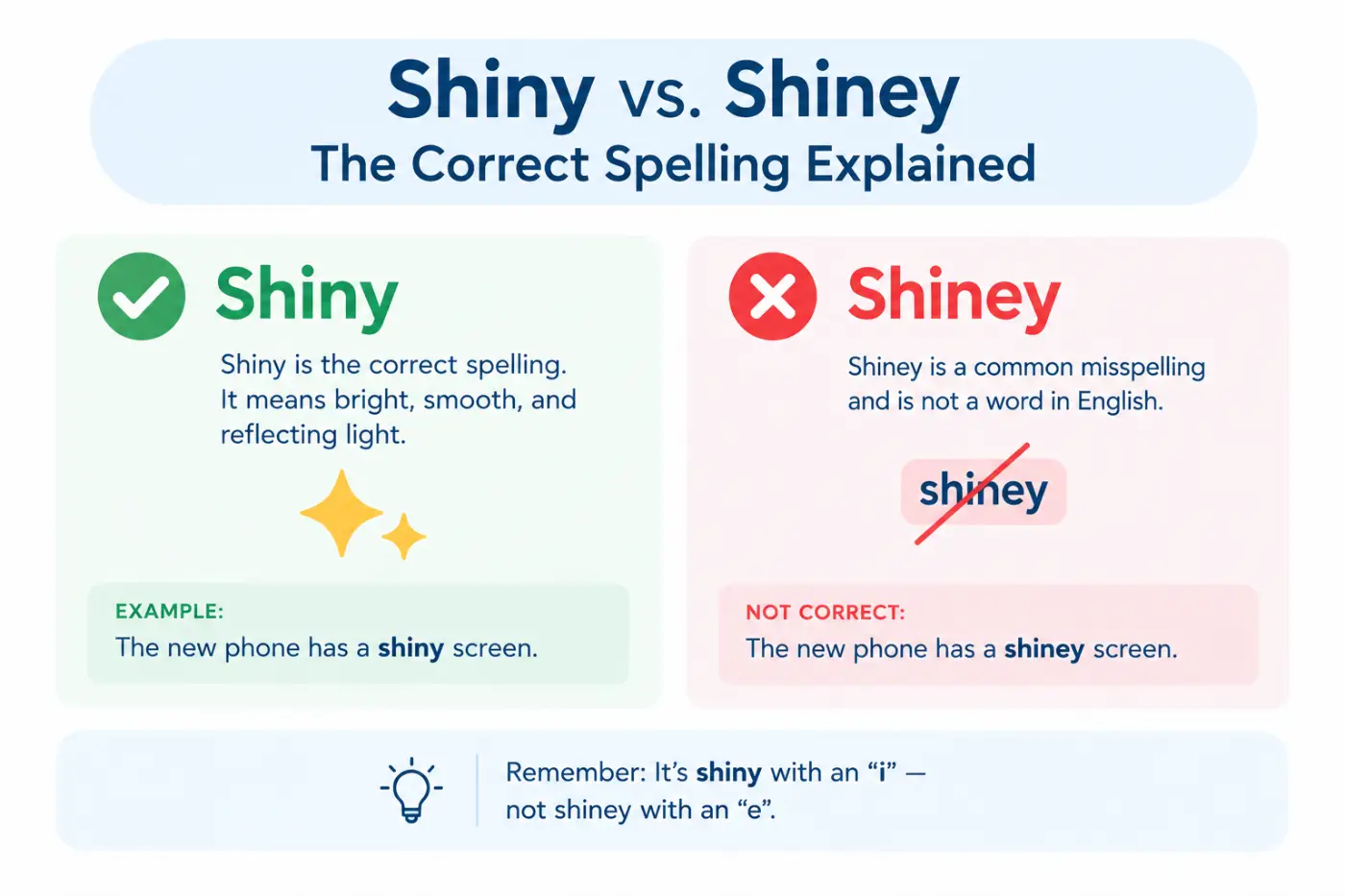
Shiny is the correct spelling. Shiney is a common misspelling and should generally be avoided in standard writing.
The word shiny is an adjective that describes something that reflects light, has a bright or polished surface, or looks glossy. This article explains why the spelling is shiny, how to use it correctly, and how it differs from related words such as shine, shining, glossy, and sparkly.

Shiny vs Shiney: Which Spelling Is Correct?
The correct spelling is shiny, with an i before the final y.
| Spelling | Correct? | Meaning | Example |
|---|---|---|---|
| shiny | Yes | Bright, glossy, or reflective | She bought a shiny new purse. |
| shiney | No in standard English | Usually intended as a misspelling of shiny | ❌ The shoes are shiney. |
So if you’re deciding between shiny vs shiney, choose shiny.
Correct:
The new car has a shiny finish.
Incorrect:
The new car has a shiney finish.
The confusion is understandable because the word comes from shine, which may make shiney seem like the logical spelling. English spelling doesn’t always work that way.
What Does Shiny Mean?
Shiny is an adjective meaning reflecting light, having a bright surface, or appearing glossy or polished.
For example:
The floor looked shiny after it was cleaned.
He wore a shiny black jacket.
The new phone has a shiny back.
The word can describe physical surfaces, objects, hair, clothing, and even things used figuratively.
Common examples include:
- shiny shoes
- shiny hair
- shiny metal
- shiny floors
- shiny paper
- shiny fabric
- shiny jewelry
- shiny new car
- shiny surface
- shiny object
Why Is “Shiney” Wrong?
The spelling shiney looks reasonable because the base word is shine. However, the standard adjective is formed as shiny, not shiney.
The spelling follows a common English pattern in which the final e of a word is dropped before adding -y.
Compare:
- shine → shiny
- noise → noisy
- ice → icy
- spice → spicy
- grease → greasy
- taste → tasty
The exact spelling behavior varies across English words, so it’s best to learn shiny as the standard form rather than assuming shine + y always keeps the e.
How Do You Spell Shiny?
Shiny is spelled:
S-H-I-N-Y
It has five letters.
A useful way to remember it is to think of:
shine → shiny
The e disappears before the -y is added.
So:
- shine + y → shiny
- not shine + y → shiney
If you’re proofreading an essay, email, or other formal writing, replace shiney with shiny.
Why Do People Write “Shiney”?
The most likely reason is that people connect the adjective directly to the spelling of shine. The reasoning may look like this:
shine + y = shiney
But standard English spelling uses:
shine → shiny
This is similar to other words where adding a suffix changes the spelling of the base word. People may also type shiney because it follows the pronunciation more intuitively in their minds. Since shiny and shiney would normally be pronounced the same way, hearing the word doesn’t tell you which spelling to use. That makes this a spelling issue, not a pronunciation difference.
Shiny vs Shiney in a Sentence
Here are some examples showing the correct spelling.
Correct
The countertop has a shiny surface.
She polished her shiny black boots.
The children were excited about the shiny decorations.
His new bicycle has shiny silver handlebars.
Incorrect
The countertop has a shiney surface.
She polished her shiney black boots.
The children were excited about the shiney decorations.
In standard American English, replace shiney with shiny in each example.
10 Examples of Shiny in Real Sentences
Here are natural examples from everyday situations:
- The newly waxed car looked shiny in the afternoon sun.
- She wore a pair of shiny black shoes to the interview.
- The kitchen floor was so shiny that it reflected the lights.
- He bought a shiny new laptop for school.
- The package was wrapped in shiny silver paper.
- Her hair looked smooth and shiny after the treatment.
- The restaurant had shiny metal tables.
- The kids collected shiny rocks along the trail.
- The artist used shiny paint to highlight the details.
- A shiny red balloon floated above the crowd.
These examples show that shiny can describe many kinds of surfaces and objects.
Shiny vs. Glossy: What’s the Difference?
Shiny and glossy are close in meaning, but they aren’t always interchangeable. surface. Glossy often suggests a smooth surface that reflects light, especially on paper, paint, photographs, hair, or other finished materials.
| Word | Meaning | Common contexts | Example |
|---|---|---|---|
| shiny | Reflecting a noticeable amount of light | Objects, metal, shoes, hair, floors | The shoes are shiny. |
| glossy | Smooth and highly reflective | Paper, paint, photos, hair, surfaces | The magazine has a glossy cover. |
For example:
She has shiny hair.
This sounds natural.
The brochure has a glossy finish.
This is especially natural because glossy is often used to describe printed materials. The two words overlap, but glossy can sound more specific when discussing a smooth, polished finish.
Shiny vs. Shining: What’s the Difference?
Shiny and shining are related, but they describe different ideas.
The table is shiny.
Shining usually describes something that is actively giving off or reflecting light.
The sun is shining.
Compare:
| Word | Part of speech | Main idea | Example |
|---|---|---|---|
| shiny | Adjective | Having a bright or reflective surface | She has shiny hair. |
| shining | Present participle/adjective | Giving off or reflecting light; appearing bright | The moon is shining. |
You can also use shining figuratively:
She has a shining reputation.
He is a shining example of good leadership.
In these cases, shining means something closer to excellent, impressive, or outstanding.
Shiny vs. Sparkly: What’s the Difference?
The car has a shiny finish.
Sparkly suggests many small points or flashes of reflected light.
Her dress was sparkly.
A diamond may be described as both shiny and sparkly, but the words emphasize different visual qualities.
- Shiny → smooth, bright, reflective
- Sparkly → glittering, flashing, full of small points of light
Shiny vs. Gleaming: What’s the Difference?
Gleaming is another close word, but it often suggests something especially bright, polished, or clean.
Compare:
The table is shiny.
This simply describes its surface.
The table is gleaming.
This suggests that the table looks exceptionally bright, polished, or clean. Gleaming can therefore sound stronger or more vivid than shiny.
Is Shiny an Adjective?
Yes. Shiny is an adjective.
An adjective describes a noun, and shiny describes the appearance or surface quality of something.
Examples:
- a shiny car
- a shiny floor
- shiny shoes
- shiny hair
- a shiny coin
- shiny paper
You can place it before a noun:
She bought a shiny necklace.
Or after a linking verb:
The necklace looks shiny.
In both cases, shiny describes the necklace.
Is Shiny a Verb?
No. Shiny is normally an adjective, not the standard verb form of shine.
The verb is shine.
Examples:
The sun shines brightly.
The stars shine at night.
She shined the shoes.
He shone a flashlight into the room.
The exact past-tense form of shine depends on the sense and variety of English, but shiny remains an adjective.
Don’t write:
The sun shiny through the window.
Instead:
The sun shines through the window.
Shine vs. Shiny: What’s the Difference?
This distinction is important because shine is the base word from which shiny is formed.
Shine can be a verb or noun.
As a verb:
The sun will shine tomorrow.
As a noun:
The polish gave the table a nice shine.
Shiny is an adjective:
The polished table looks shiny.
Here’s the basic relationship:
| Word | Part of speech | Example |
|---|---|---|
| shine | Verb | The sun will shine. |
| shine | Noun | The shoes have a nice shine. |
| shiny | Adjective | The shoes are shiny. |
| shining | Verb form/adjective | The sun is shining. |
Understanding this relationship also makes the spelling easier to remember.
Shiny vs. Polished: What’s the Difference?
Shiny describes appearance, while polished can describe both appearance and the process used to create that appearance.
The floor is shiny.
This tells you what the floor looks like.
The floor was polished.
This tells you something was done to the floor.
You can combine the ideas:
The polished floor has a shiny surface.
A polished object may be shiny, but not everything shiny has been polished.
Is Shiney Ever Correct?
For standard American English, shiney is not the standard spelling of the adjective meaning bright or reflective. If you mean that something has a bright or glossy surface, write shiny. There can be unusual names, usernames, product names, or creative spellings that use Shiney, but those are proper or stylistic uses rather than the standard English adjective.
In ordinary writing, use shiny.
Does British English Spell It “Shiney”?
No. The standard British spelling is also shiny.
This isn’t an American-versus-British spelling difference.
For example:
- American English: shiny
- British English: shiny
- Canadian English: shiny
- Australian English: shiny
The spelling shiney is generally a misspelling rather than a regional variant.
Common Mistakes With Shiny
Mistake 1: Adding the “e”
Incorrect:
The car is shiney.
Correct:
The car is shiny.
Mistake 2: Using “shiney” in professional writing
Incorrect:
We offer a range of shiney finishes.
Correct:
We offer a range of shiny finishes.
This matters in product descriptions, business websites, reports, and other customer-facing writing.
Mistake 3: Confusing shiny with shining
Incorrect:
The floor is shining because it has a reflective surface.
This isn’t necessarily grammatically wrong, but it may not express the intended meaning. If you’re describing the floor’s surface quality, shiny is often more precise:
The floor is shiny.
Use shining when you’re emphasizing an active source or reflection of light:
The sun is shining through the window.
Mistake 4: Confusing shiny with shine
Incorrect:
The shoes are very shine.
Correct:
The shoes are very shiny.
Or:
The shoes have a nice shine.
The adjective is shiny; the noun is shine.
How to Remember the Spelling of Shiny
The simplest memory trick is:
Shine loses the E before Y.
Think:
shine → shiny
Not:
shine → shiney
You can use the same pattern as a spelling reminder with familiar words such as:
- noise → noisy
- ice → icy
- spice → spicy
- grease → greasy
These examples aren’t identical in every detail, but they reinforce the idea that adding -y can change the spelling of the base word. Another useful trick is to remember the phrase:
shiny shoes
If you picture the correct phrase shiny shoes, the spelling becomes easier to recall.
How to Use Shiny in Different Types of Writing
In a resume
Shiny isn’t especially common in resumes unless you’re describing a physical product, material, or design.
For example:
Designed packaging with a shiny metallic finish.
For professional writing, choose a more precise term if the material matters:
Designed packaging with a high-gloss metallic finish.
In an essay
Shiny is perfectly grammatical, but the best word depends on what you’re describing.
The author uses the image of a shiny object to symbolize wealth.
If you’re writing academically, make sure the adjective contributes meaning rather than simply adding decoration.
In a professional email
A sentence such as this is perfectly natural:
The sample has a shiny finish rather than the matte finish we requested.
In product descriptions
Shiny is common and useful:
This shiny silver finish gives the product a polished appearance.
If the exact finish matters, terms such as glossy, high-gloss, reflective, or polished may be more precise.
In texting and casual conversation
Shiny is completely natural:
Your new shoes are so shiny!
That’s a pretty shiny car.
You don’t need a more formal synonym in ordinary conversation.
Synonyms for Shiny
There isn’t always a perfect substitute for shiny. The best alternative depends on the exact visual effect you want.
| Word/Phrase | Meaning | Tone | Example |
|---|---|---|---|
| glossy | Smooth and reflective | Neutral | The magazine has a glossy cover. |
| gleaming | Very bright and polished | Vivid | The kitchen looked gleaming clean. |
| polished | Smooth and often reflective | Neutral | The table has a polished surface. |
| lustrous | Having a soft, attractive shine | Formal | The fabric has a lustrous finish. |
| glinting | Reflecting a small flash of light | Vivid | The metal was glinting in the sun. |
| glittering | Reflecting many bright points of light | Vivid | The decorations were glittering. |
| sparkling | Shining brightly or with flashes | Neutral | The water was sparkling in the sun. |
| sparkly | Glittering with small points of light | Casual | She wore a sparkly dress. |
| bright | Giving or reflecting much light | Neutral | The surface was bright and clean. |
| reflective | Sending light back from a surface | Technical | The material is highly reflective. |
| sheen-covered | Having a visible surface luster | Descriptive | The fabric had a soft sheen. |
| brilliant | Very bright or vivid | Strong | The gemstones looked brilliant. |
| radiant | Giving off or seeming to give off light | Vivid/formal | Her face looked radiant. |
| shimmering | Reflecting light with a soft, changing effect | Vivid | The lake was shimmering. |
| iridescent | Showing changing colors as light moves | Technical/descriptive | The shell had an iridescent surface. |
These words shouldn’t be treated as interchangeable in every sentence. Reflective is more technical, sparkly is more casual, and lustrous is more literary or formal.
Shiny by Degree: Mild to Strong
Sometimes you don’t just want to say that something reflects light. You want to describe how it looks.
A rough progression might be:
Bright → shiny → glossy → gleaming → sparkling But this isn’t a strict scale. Each word emphasizes a slightly different visual quality.
- Bright: noticeable light or color
- Shiny: reflects light from a surface
- Glossy: smooth and strongly reflective
- Gleaming: especially bright, polished, or clean
- Sparkling: produces many small flashes or points of light
For example:
The shoes are shiny.
is a straightforward description.
The shoes are gleaming.
makes them sound exceptionally polished.
The shoes are sparkling.
suggests flashes of light rather than simply a smooth reflective surface.
Shiny, Glossy, Sparkly, or Metallic?
When describing a product, these words can communicate different finishes.
| Term | Best for | Visual impression |
|---|---|---|
| Shiny | General surfaces | Bright and reflective |
| Glossy | Paper, paint, finishes | Smooth and highly reflective |
| Sparkly | Clothing, decorations, accessories | Many small flashes of light |
| Metallic | Paint, materials, finishes | Resembles the look of metal |
| Polished | Wood, metal, stone, shoes | Smooth and carefully finished |
| Matte | Paint, paper, cosmetics, finishes | Little or no reflection |
This distinction is especially useful when writing product descriptions. A shiny finish isn’t necessarily metallic, and a metallic finish isn’t necessarily covered in glitter or sparkles.
Does Shiny Mean the Same as Clean?
Not necessarily.
Something can be shiny because it is clean, but shine and cleanliness are different qualities.
For example:
The freshly cleaned windows are shiny.
But:
The dirty chrome bumper is still shiny.
The second sentence is possible because a surface can reflect light even when it isn’t clean. Similarly, polished may imply that something has been cleaned or treated, but shiny simply describes its appearance.
Does Shiny Mean New?
No. Shiny doesn’t literally mean new.
However, the phrase shiny new is common.
She bought a shiny new car.
Here, new tells you the car is recently purchased or made, while shiny describes its appearance. The expression can also be used figuratively:
The company introduced a shiny new app.
In this context, shiny new can suggest something attractive and exciting, sometimes with a hint that its newness is getting extra attention.
Conclusion
The answer to shiny vs shiney is straightforward: shiny is the correct standard spelling. Use it when describing something that reflects light, has a glossy surface, or looks bright and polished. Shiney is generally a misspelling, not an alternative American or British form.
Remember the simple pattern: shine → shiny. The final e is dropped before the -y. If you need a more specific description, words such as glossy, gleaming, sparkly, polished, and reflective can work depending on the surface and effect you’re describing. For everyday writing, though, you can safely choose shiny whenever you mean bright or reflective.
Frequently Asked Questions
Is shiny or shiney correct?
Shiny is correct. Shiney is generally a misspelling when you mean something that is bright, glossy, or reflective.
How do you spell shiny?
The correct spelling is S-H-I-N-Y. The final e in shine is dropped before the adjective ending -y.
Why is shiney wrong?
Shiney is not the standard spelling of the adjective. The accepted form is shiny, even though shiney may seem logical because the base word is shine.
Is shiny an adjective?
Yes. Shiny is an adjective that describes something with a bright, glossy, polished, or reflective appearance.
Is shiny the same as glossy?
Not exactly. Shiny is a broad term for a surface that reflects light, while glossy often describesNot as the standard adjective meaning reflective or glossy. It may appear as a name, username, or intentional creative spelling, but a smooth surface with a particularly strong or polished reflection.
Is “shiney” ever a correct word?
Not as the standard adjective meaning reflective or glossy. It may appear as a name, username, or intentional creative spelling, but standard English uses shiny.
Is shiny spelled differently in British English?
No. Shiny is the standard spelling in both American and British English. Shiney isn’t a standard regional alternative.
1 thought on “Shiny vs Shiney: The Correct Spelling Explained”