
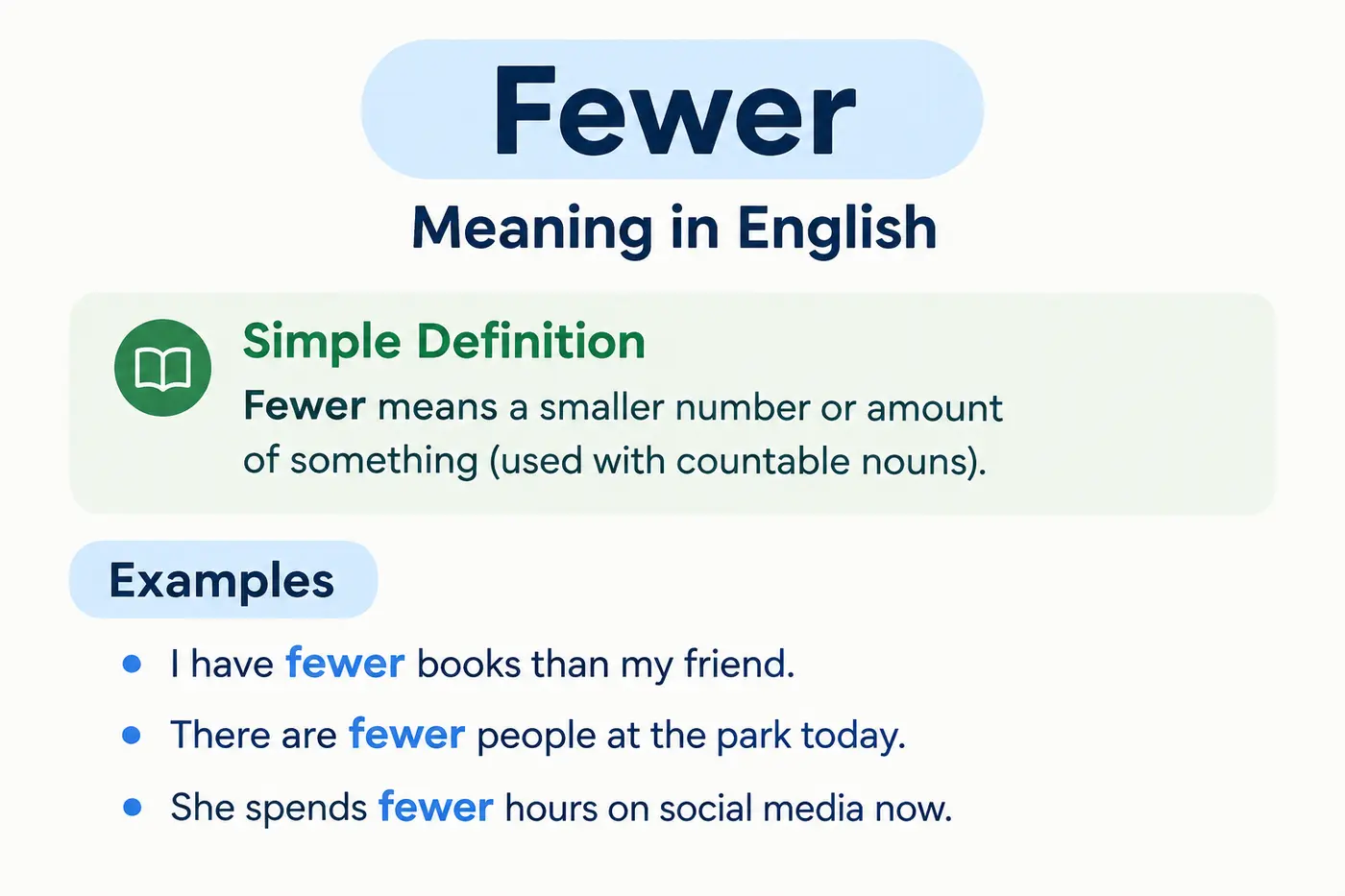
If you’ve ever wondered about the difference between fewer and less, you’re not alone. The word fewer appears often in everyday English, workplace writing, school assignments, and conversations. It is usually connected to things that can be counted individually, such as books, people, cars, or mistakes.
Fewer means a smaller number of people or things that can be counted individually. For example, “There are fewer students in the class today” means the class has a smaller number of students than before or than another class.
The basic rule is simple: use fewer with countable plural nouns and less with uncountable nouns. This article explains the fewer meaning, shows how to use it correctly, and compares it with related words such as few, less, and more.
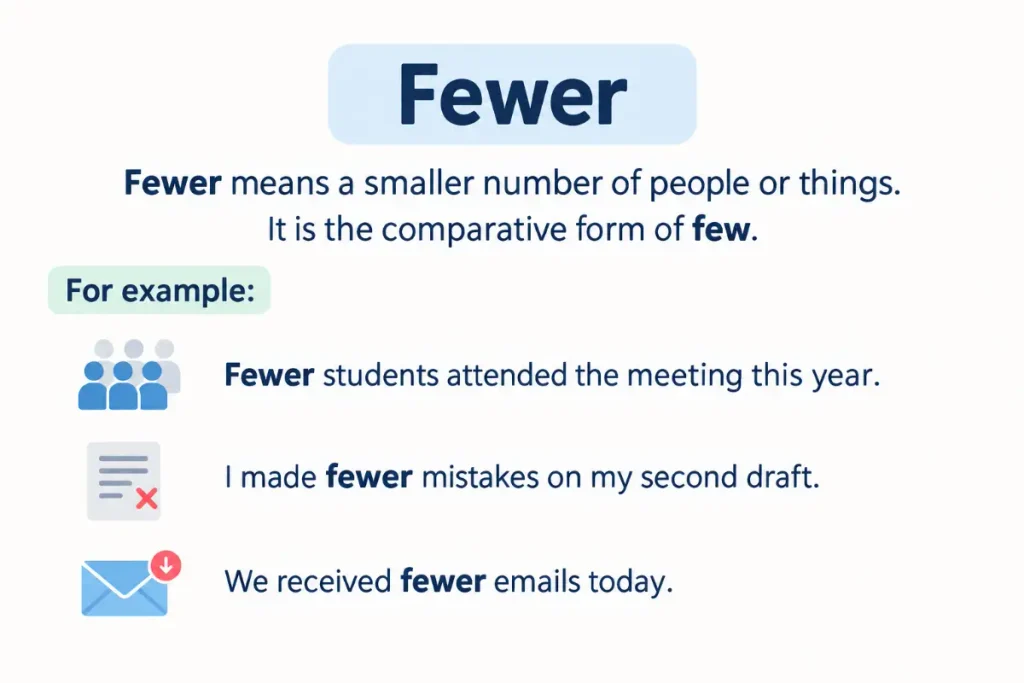
What Does “Fewer” Mean?
Fewer means a smaller number of people or things. It is used when the noun can be counted one by one.
For example:
- There are fewer cars on the road today.
- I made fewer mistakes this time.
- We need fewer chairs for the meeting.
- She has fewer books than her brother.
In each example, the noun can be counted: one car, two cars, three cars; one mistake, two mistakes, three mistakes, and so on.
Fewer Meaning in Simple English
In simple terms, fewer = not as many.
Compare these sentences:
- We have fewer employees this year.
- We don’t have as many employees this year.
Both sentences communicate a smaller number of employees.
The word fewer is a comparative term. It normally compares one number with another, either directly or indirectly.
Is “Fewer” Used for Countable Nouns?
Yes. Fewer is normally used with plural countable nouns.
A countable noun is something you can count using numbers.
| Countable noun | Example with “fewer” |
|---|---|
| apples | fewer apples |
| students | fewer students |
| houses | fewer houses |
| emails | fewer emails |
| questions | fewer questions |
| people | fewer people |
| books | fewer books |
| mistakes | fewer mistakes |
You can say “three apples” or “ten emails,” so these nouns work naturally with fewer.
Examples
- This store has fewer customers on Monday.
- I received fewer emails this morning.
- Our team made fewer errors in the second report.
- There are fewer houses on this side of the street.
- The new test has fewer questions.
Fewer vs. Less: What’s the Difference?
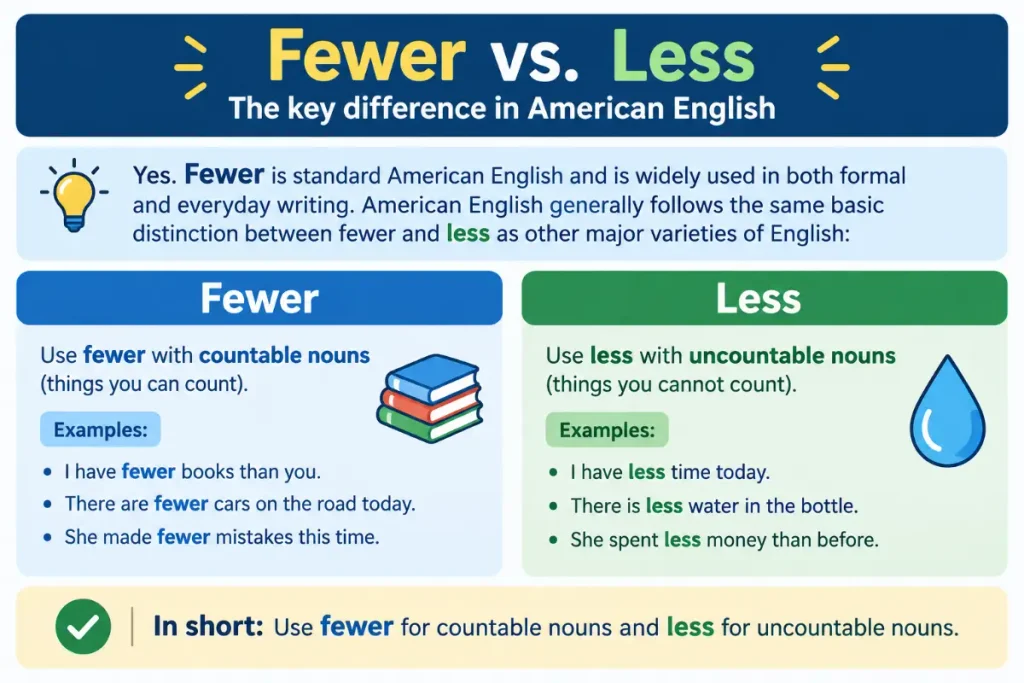
The main difference between fewer and less is the type of noun that follows them.
Fewer generally goes with plural countable nouns, while less generally goes with uncountable nouns.
| Word | Used with | Example |
|---|---|---|
| Fewer | Plural countable nouns | fewer books |
| Less | Uncountable nouns | less water |
You can count books individually:
- one book
- two books
- three books
So fewer books is correct.
You don’t normally count water as individual units when talking about an amount, so less water is correct.
Fewer Examples
- fewer students
- fewer cars
- fewer problems
- fewer appointments
- fewer questions
- fewer opportunities
Less Examples
- less money
- less time
- less water
- less information
- less traffic
- less stress
A useful memory rule is:
Fewer = number. Less = amount.
This is a helpful general rule, although everyday English has some exceptions and special cases.
Fewer vs. Few: What’s the Difference?
Few and fewer are related, but they don’t perform the same job. Few means a small number. Fewer is generally used to compare numbers.
Compare:
- Few people attended the event.
- Fewer people attended the event this year.
The first sentence simply says that the number of attendees was small. The second compares the number with another point of reference, such as last year.
| Word | Main idea | Example |
|---|---|---|
| Few | A small number | Few students finished early. |
| Fewer | A smaller number | Fewer students finished early this year. |
Another Example
- Few customers complained.
- Fewer customers complained this month than last month.
The first sentence focuses on a small number. The second makes a comparison.
Fewer vs. More
Fewer and more express opposite directions in number.
- Fewer = a smaller number
- More = a larger number
For example:
- This year, we have fewer visitors.
- Next year, we hope to have more visitors.
Other examples include:
- fewer assignments / more assignments
- fewer employees / more employees
- fewer questions / more questions
- fewer mistakes / more mistakes
- fewer choices / more choices
Example in a Comparison
The new form has fewer questions than the old form.
This means the new form contains a smaller number of questions.
How Do You Use “Fewer” Correctly?
Use fewer before a plural countable noun when you mean a smaller number.
The basic pattern is:
fewer + plural countable noun
Examples:
- fewer cars
- fewer people
- fewer days
- fewer problems
- fewer students
You can also use fewer without immediately naming the noun when the meaning is already clear.
For example:
I used to have five classes, but now I have fewer.
Here, fewer means fewer classes.
“Fewer Than” in Comparisons
The phrase fewer than is common when comparing quantities.
Examples:
- Fewer than 20 students attended.
- The package arrived in fewer than five days.
- Fewer than 100 tickets were sold.
- She made fewer than three mistakes.
- We received fewer than ten applications.
The noun or quantity being discussed determines whether fewer is appropriate.
10 Natural Examples of “Fewer”
Here are examples from different everyday situations:
- Fewer people are using the parking lot on weekends.
- I made fewer mistakes on my second attempt.
- The teacher assigned fewer questions for homework.
- We received fewer applications than expected.
- There are fewer buses running after midnight.
- She bought fewer clothes this month.
- The restaurant had fewer customers during the afternoon.
- Our office uses fewer paper documents than it did before.
- The updated form requires fewer signatures.
- He wants to spend fewer hours on social media.
Each highlighted noun represents separate items or people that can be counted.
Fewer in Everyday Conversation
People use fewer naturally in conversation, especially when talking about numbers.
For example:
“How many people are coming?”
“Probably fewer than ten.”
Or:
“Why did you buy fewer tickets this time?”
“Because fewer people are coming.”
In casual speech, people sometimes use less in situations where traditional grammar recommends fewer. This doesn’t mean the standard distinction is useless. In careful writing, choosing fewer for plural countable nouns remains a clear and reliable choice.
Fewer in Professional and Academic Writing
Fewer works well in professional, academic, and formal writing when you are discussing a smaller number of countable items.
Professional email
The revised schedule includes fewer meetings each month.
Academic writing
The second study included fewer participants than the first study.
Workplace communication
The new process requires fewer steps to complete the application.
Resume
Reduced processing time by introducing a system that required fewer manual steps.
In all of these cases, fewer clearly communicates a reduction in number.
Fewer With Time, Distance, and Money
This is where the simple fewer = countable, less = uncountable rule needs some care. Traditional usage often treats measurements such as time, money, distance, and weight as amounts, so less is usually preferred when the measurement is viewed as a single quantity.
Examples:
- less than five minutes
- less than $20
- less than 10 miles
- less than 10 pounds
However, fewer can be correct when the measurement refers to separate countable units or events.
For example:
- fewer than five days may be used when thinking of days as individual calendar units.
- fewer than five visits is clearly countable because visits are separate events.
- fewer than five appointments is countable because appointments are individual events.
The intended meaning and context matter.
A Helpful Comparison
Compare:
The trip took less than five hours.
Here, five hours is treated as a total amount of time.
But:
We spent fewer than five hours in separate training sessions.
Here, the focus can be on individual hours or sessions, depending on the exact intended meaning. For most everyday writing, use less for a total amount of time, money, distance, or weight unless you’re clearly referring to separate countable units.
Can You Say “Fewer People”?
Yes. Fewer people is correct.
For example:
Fewer people attended the meeting this year.
People is a plural countable noun, so fewer people follows the standard rule.
You can count people:
- one person
- two people
- three people
Therefore:
- fewer people ✓
- less people — common in some informal speech, but generally not preferred in standard formal English
For professional, academic, and carefully edited writing, fewer people is the safer choice.
Can You Say “Fewer Money”?
No. In standard English, fewer money is incorrect. Use less money because money is generally treated as an uncountable noun.
Correct:
I have less money this month.
Incorrect:
I have fewer money this month.
However, you can use fewer with countable monetary units:
I have fewer dollars than I expected.
Here, dollars can be counted.
Common Mistakes With “Fewer”
Understanding the fewer meaning is easy, but several common mistakes can still cause confusion.
Mistake 1: Using “fewer” with uncountable nouns
Incorrect:
I need fewer water.
Correct:
I need less water.
Water is normally treated as an uncountable noun.
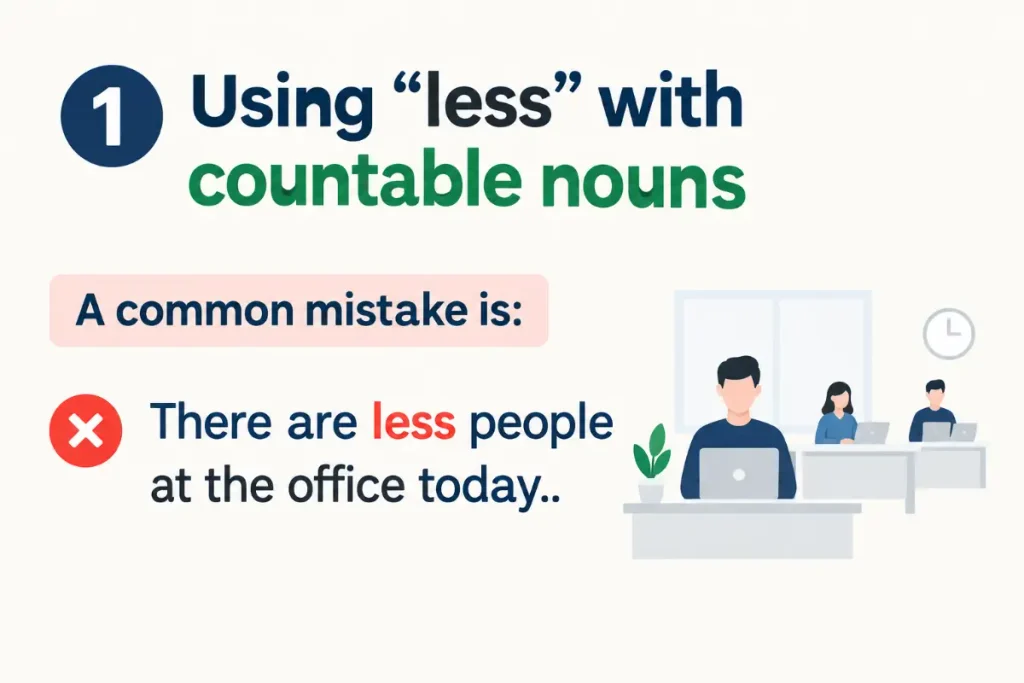
Mistake 2: Using “less” with a plural countable noun
Incorrect in standard usage:
There are less students in the classroom.
Preferred:
There are fewer students in the classroom.
Students are individual people who can be counted.
Mistake 3: Confusing “few” and “fewer”
Incorrect:
There are few cars today than yesterday.
Correct:
There are fewer cars today than yesterday.
Use fewer when making a comparison.
Mistake 4: Forgetting the plural noun
Incorrect:
There are fewer car on the street.
Correct:
There are fewer cars on the street.
Because fewer normally modifies a plural countable noun, the noun should usually be plural.
Correct vs. Incorrect Examples
| Incorrect or less preferred | Correct standard usage |
|---|---|
| less students | fewer students |
| fewer water | less water |
| fewer money | less money |
| less books | fewer books |
| fewer information | less information |
| less mistakes | fewer mistakes |
| fewer traffic | less traffic |
| less questions | fewer questions |
The easiest way to choose is to ask: Can I count the noun as individual items? If yes, fewer is usually the right choice. If you’re talking about an amount that isn’t normally counted individually, less is usually better.
Fewer vs. Less With “Information”
Information is uncountable, so use less information, not fewer information.
Correct:
The report contains less information than the previous version.
If you want to count individual pieces, change the noun:
The report contains fewer details than the previous version.
This distinction is useful because some nouns that describe collections of things are still grammatically uncountable.
Fewer vs. Less With “Problems”
Problems are countable, so use fewer problems.
Correct:
The new software has fewer problems.
Not:
The new software has less problems.
You can count problems individually:
- one problem
- two problems
- three problems
Therefore, fewer problems follows the standard rule.
Fewer vs. Less With “Work”
Work is generally uncountable when it means tasks or employment as a general concept.
Correct:
I have less work today.
But if you use a countable noun for individual tasks, fewer works:
I have fewer tasks today.
This is a useful example of how the noun—not simply the general idea—determines the choice.
Fewer vs. “A Few”
The expressions fewer and a few have different meanings. A few means some, usually a small number. Fewer means a smaller number in comparison.
Compare:
I have a few questions.
This means I have some questions.
I have fewer questions than yesterday.
This means my number of questions is smaller than yesterday.
The expressions aren’t interchangeable.
What Is the Opposite of “Fewer”?
The most direct opposite of fewer is more.
For example:
- fewer students ↔ more students
- fewer questions ↔ more questions
- fewer problems ↔ more problems
- fewer choices ↔ more choices
If you want to express a small number rather than a comparison, few can contrast with many:
- few students ↔ many students
- few questions ↔ many questions
- few opportunities ↔ many opportunities
Fewer Synonyms and Alternatives
There aren’t many exact one-word synonyms for fewer, because its meaning depends on a comparison involving number. However, several phrases can communicate a similar idea.
| Word/Phrase | Meaning | Tone | Example |
|---|---|---|---|
| not as many | A smaller number | Everyday | We have not as many guests. |
| a smaller number of | A reduced number | Formal | A smaller number of students attended. |
| a reduced number of | A lower number | Formal | A reduced number of errors was reported. |
| a lower number of | A smaller quantity by number | Neutral | A lower number of applications arrived. |
| a limited number of | A restricted or small number | Formal | Only a limited number of seats remain. |
| fewer in number | A smaller total | Formal | The participants were fewer in number. |
| a smaller group of | A group with fewer members | Neutral | A smaller group of students stayed behind. |
| not so many | A smaller number | Casual | There aren’t so many people here. |
| a reduced amount of | A reduced quantity | Formal | Use this only when the noun refers to an amount. |
| a smaller quantity of | A smaller quantity | Formal | A smaller quantity may be required. |
The best alternative depends on the sentence. Not as many is often the most natural conversational replacement for fewer.
For example:
There are fewer customers today.
can become:
There aren’t as many customers today.
How to Remember the Difference Between Fewer and Less
A simple memory trick is:
Fewer = numbers you can count.
Less = amounts you measure.
Think about:
- fewer apples
- fewer students
- fewer cars
- fewer emails
Then compare:
- less water
- less money
- less time
- less traffic
Another useful test is to add a number.
If you can naturally say:
one, two, three…
the noun is probably countable, making fewer a good choice.
For example:
- one book, two books → fewer books
- one mistake, two mistakes → fewer mistakes
- one employee, two employees → fewer employees
But:
- water
- information
- money
- traffic
are normally treated as amounts rather than individual countable items.
Is “Fewer” American or British English?
Fewer is standard in both American and British English. There is no major US-versus-UK spelling difference for this word. The same basic distinction is taught in both varieties:
- fewer for plural countable nouns
- less for uncountable nouns
For example, both American and British English use:
fewer people
and:
less water
Differences can sometimes appear in how speakers use less in informal contexts, especially with measurements and other borderline cases, but fewer itself is not an exclusively American or British word.
Is “Fewer” Formal or Casual?
Fewer is appropriate in both casual and formal English.
You can use it in:
- everyday conversation
- text messages
- emails
- workplace communication
- school assignments
- academic writing
- professional reports
- resumes
For example:
I have fewer classes this semester.
sounds natural in conversation.
Likewise:
The revised procedure resulted in fewer processing errors.
works well in a formal report. There’s no need to avoid fewer simply because you’re writing casually.
Quick Rule for Fewer
Use this three-step test:
- Look at the noun.
- Ask whether you can count it individually.
- If it’s a plural countable noun, use “fewer.”
Examples:
- students → fewer students
- tickets → fewer tickets
- emails → fewer emails
- mistakes → fewer mistakes
If the noun describes an uncountable amount, use less:
- water → less water
- time → less time
- money → less money
- information → less information
This rule handles most everyday situations.
Conclusion
The simplest fewer meaning is a smaller number of countable people or things. Use it with plural nouns that can be counted individually, such as fewer students, fewer books, fewer mistakes, and fewer cars.
The main word to compare with fewer is less. In standard English, fewer generally describes number, while less describes an amount. So you would normally write “fewer questions” but “less information.” Learning this distinction makes your writing clearer and helps you avoid one of the most common word-choice mistakes in English.
When you’re unsure, look at the noun and ask whether you can count it one by one. If you can, fewer is usually the right choice. This quick test works well for everyday speech, school writing, emails, and professional communication.
Frequently Asked Questions
What does fewer mean?
Fewer means a smaller number of people or things that can be counted individually. For example, “fewer books” means a smaller number of books.
Is fewer correct grammar?
Yes. Fewer is grammatically correct when used with plural countable nouns, such as fewer students, fewer cars, and fewer questions.
What’s the difference between fewer and less?
Fewer is generally used with plural countable nouns, while less is generally used with uncountable nouns. You say “fewer apples” but “less water.”
Can I say “fewer people”?
Yes. Fewer people is the standard form because people can be counted individually.
Is it fewer or less students?
The standard choice is fewer students because students is a plural countable noun.
Can you use fewer for time?
It depends on how the time is being viewed. Less time is common when referring to time as an overall amount, while fewer can work when referring to separate countable time units or events.
What is the opposite of fewer?
The direct opposite of fewer is more. For example, fewer employees contrasts with more employees.