
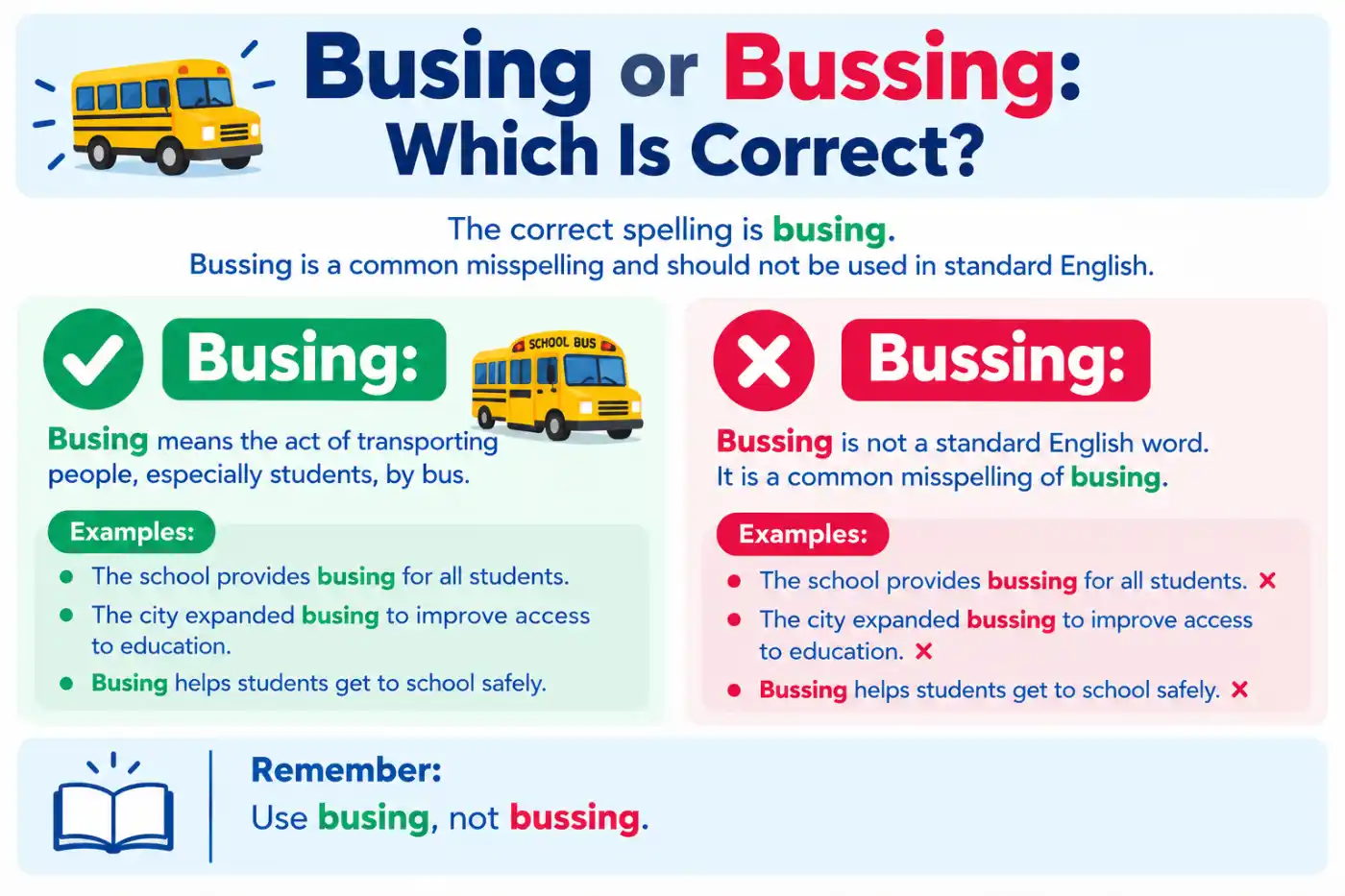
If you’re writing about transporting people by bus, you may wonder whether the correct spelling is busing or bussing. Both forms exist, but American English generally uses busing for the verb bus when it means transporting people by bus. Bussing is also used, especially in British English and in the restaurant sense of clearing tables.
For most US writing, use busing when you mean transporting people by bus. Use bussing when referring to the restaurant job or service of clearing tables, although busing is also accepted in that context.
The difference can be confusing because the verb bus has more than one meaning, and English spelling conventions vary by region. Here’s how to choose the right form in American English.
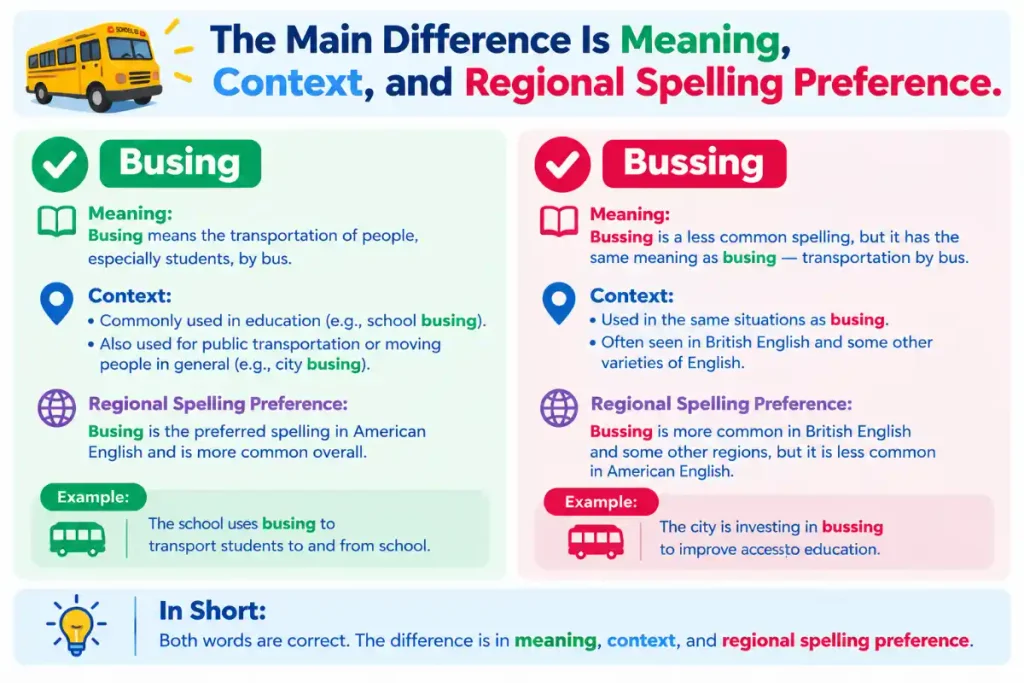
Busing or Bussing: What’s the Difference?
The main difference is meaning, context, and regional spelling preference.
| Word | Common US use | Example |
|---|---|---|
| busing | Transporting people by bus; also clearing tables | The school is busing students to another campus. |
| bussing | Clearing tables; also used for transporting people, especially outside standard US usage | She is bussing tables at the restaurant. |
Cambridge lists busing as the US present participle of bus when the verb means taking people somewhere by bus, while bussing is listed as a form used mainly in British English for that meaning. At the same time, bussing is widely seen in American English in restaurant contexts, such as bussing tables. Cambridge’s US dictionary examples include this usage. So, the best spelling depends on what you are trying to say.
What Does “Busing” Mean?
Busing is the present participle of bus. In American English, it commonly means transporting people somewhere by bus.
For example:
- The district is busing students to a nearby school.
- We are busing employees to the conference.
- The company started busing workers between its offices.
The word is especially common in discussions about school transportation, where students are transported by bus to schools outside their immediate neighborhoods. Cambridge specifically identifies this US meaning of bus.
Busing as a transportation term
In American English, busing can describe many kinds of transportation:
- school busing
- employee busing
- public-event busing
- airport busing
- commuter busing
- shuttle busing
For example:
The company provides busing between the parking lot and the main building.
Here, busing clearly means transporting people by bus.
What Does “Bussing” Mean?
Bussing is another form of the present participle of bus, but its use depends heavily on context. In American English, bussing is especially common when talking about restaurant work. To bus a table means to remove used plates, glasses, dishes, and other items from a table after customers have finished eating. Cambridge gives this as a US meaning of bus.
Examples include:
- She is bussing tables during the dinner shift.
- I got my first restaurant job bussing tables.
- The server asked someone to start bussing the empty tables.
In this context, bussing is very familiar in American English.
Is “Busing” Correct?
Yes. Busing is correct.
In American English, busing is the usual spelling when bus means to transport people by bus.
Examples:
- The school is busing students to the new building.
- The company is busing employees to the training center.
- The event organizers are busing guests from the hotel.
It is not a misspelling or an informal shortcut.
Is “Bussing” Correct?
Yes. Bussing is also a valid word. Its most familiar American use is in phrases such as bussing tables or bussing dishes. It can also appear as a spelling of the present participle of bus when the verb means transportation, particularly in British English. For US readers, however, busing is generally the clearer choice when you mean transporting people by bus.
Example
Transportation meaning:
The school is busing students to the other campus.
Restaurant meaning:
Marcus is bussing tables after lunch.
The context makes the intended meaning clear.
Why Is “Busing or Bussing” Confusing?
The confusion comes partly from the spelling of the base word bus. English often doubles a final consonant when adding a suffix beginning with a vowel. That rule explains forms such as:
- run → running
- sit → sitting
- stop → stopping
So it may seem natural to assume:
bus → bussing
And that spelling is indeed used.
However, American English commonly treats bus differently when forming the present participle for transportation. Cambridge specifically lists busing as the US form and bussing as the mainly UK form for the transportation sense. This creates a situation where both spellings can appear, but they aren’t equally common in every context.
Busing vs. Bussing in American English
For a US audience, this simple guide is useful:
| Meaning | Preferred US spelling |
|---|---|
| Transporting people by bus | busing |
| Taking students to school by bus | busing |
| Transporting workers by bus | busing |
| Clearing restaurant tables | bussing or busing |
| Working as a restaurant busser | bussing is very common |
The Cambridge US dictionary gives examples of both transportation and restaurant uses, including busing tables and bussing tables. For polished US writing, busing is a safe choice for transportation, while bussing tables is a natural choice for restaurant work.
Busing or Bussing for School Transportation?
Use busing in American English when referring to school transportation.
Examples:
- The district is busing students to a different school.
- Parents discussed changes to school busing.
- The new plan will affect students who rely on busing.
- The district provides busing for students who live far from campus.
The noun busing is also commonly used for the practice or system of transporting students by bus.
School busing
The phrase school busing is especially associated with transporting students between schools or neighborhoods. It can occur in ordinary discussions of school transportation as well as in historical discussions of school desegregation. If you’re writing for an American audience, school busing is the natural spelling.
Busing or Bussing Tables?
For restaurant work, bussing tables is extremely common in American English.
Examples:
- I’m bussing tables tonight.
- She worked as a server and bussed tables.
- The restaurant is hiring someone to help with bussing.
- He learned how to take orders and bus tables.
You may also see busing tables. Cambridge’s US dictionary includes both forms in its examples of the restaurant meaning. Therefore, bussing isn’t automatically wrong just because it has two s’s.
Busing vs. Bussing: Verb Forms
The spelling becomes easier to understand when you look at the related forms.
| Form | Common US spelling |
|---|---|
| Base verb | bus |
| Present participle, transportation | busing |
| Past tense, transportation | bused |
| Present participle, restaurant work | busing / bussing |
| Past tense, restaurant work | bused / bussed |
Cambridge lists bused as the US past form for the transportation verb and bussed as another form found in English.
Examples
- The school bused students to the event.
- The school is busing students to the event.
- She bussed tables after the dinner rush.
- She is bussing tables tonight.
The exact form can depend on the meaning and the variety of English being used.
10 Examples of “Busing” in Sentences
Here are natural examples using busing in American English:
- The school district provides busing for students who live far from campus.
- The company is busing employees to the annual meeting.
- The organizers arranged busing from the hotel to the stadium.
- The district changed its busing schedule this year.
- Several students depend on school busing every morning.
- The festival offered free busing from nearby parking areas.
- The company began busing workers between the two offices.
- We discussed transportation and busing during the meeting.
- The school is busing students to another campus temporarily.
- Guests can avoid parking problems by using the event’s busing service.
10 Examples of “Bussing” in Sentences
Here are examples where bussing is especially natural in restaurant contexts:
- She spends most of her shift bussing tables.
- The restaurant needs another employee for bussing during dinner.
- He started bussing tables while he was in high school.
- Our server was busy, so another employee helped with bussing.
- The manager asked us to finish bussing the dining room.
- She learned about bussing before becoming a server.
- We take turns serving customers and bussing tables.
- The restaurant gets especially busy, so bussing is important.
- He was responsible for bussing tables and keeping the dining area clean.
- After the lunch rush, the staff worked together on bussing.
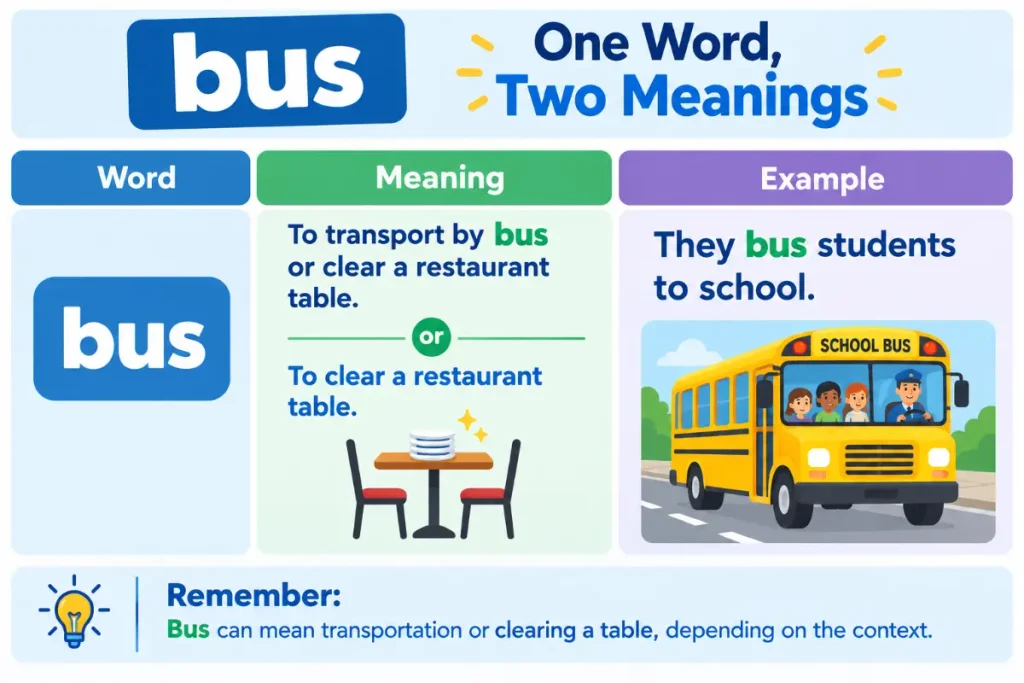
Busing vs Bussing vs Busser
These words are related, but they don’t mean exactly the same thing.
| Word | Meaning | Example |
|---|---|---|
| bus | To transport by bus or clear a restaurant table | They bus students to school. |
| busing | Present participle of bus | The district is busing students. |
| bussing | Common restaurant form; also used regionally for bus | She is bussing tables. |
| busser | A restaurant worker who clears tables | The busser cleared the dishes. |
| bused | Past form of bus | The students were bused to school. |
| bussed | Another past form, especially common in restaurant usage | He bussed several tables. |
This is why you may see several different spellings in restaurant job descriptions and everyday writing.
Busing vs Bussing: US vs UK Usage
Regional differences matter here.
In American English, busing is the usual present-participle spelling when bus means transporting people by bus. Cambridge labels this form as mainly UK for the transportation meaning.
American English
The school is busing students to another campus.
British English
The school is bussing students to another campus. Neither should automatically be treated as a spelling error. The difference reflects regional usage. For a US-focused article, essay, workplace document, or school assignment, busing is usually the better choice when you’re talking about transportation.
Is “Bussing” a Misspelling of “Busing”?
No. Bussing is not simply a misspelling of busing. Both spellings are used in English. The important question is what you mean and which variety of English you’re using. If you’re writing American English and talking about transporting people by bus, busing is generally preferred. If you’re talking about restaurant table service, bussing is a common American spelling.
For example:
- Preferred US transportation: The school is busing children to the new campus.
- Common US restaurant usage: The employee is bussing tables.
Common Mistakes With Busing and Bussing
Mistake 1: Assuming only “bussing” is correct
Because the word bus ends in s, writers sometimes assume that the only possible form is bussing.
Better for US transportation writing:
The district is busing students to school.
Mistake 2: Assuming “bussing” is always wrong
That’s also incorrect. Bussing is a legitimate form and is especially common in restaurant contexts. Cambridge documents its use for both restaurant work and transportation, depending on context and regional usage.
Mistake 3: Using “bussing” when writing formal US transportation copy
If your meaning is transportation and you’re writing for an American audience, busing is generally the more conventional choice.
Instead of:
The company is bussing employees to the airport.
Use:
The company is busing employees to the airport.
Mistake 4: Confusing “busing” with “busying”
These are completely different words.
- busing = transporting by bus or clearing tables
- busying = making someone or something busy
For example:
The school is busing students to another campus.
But:
She was busying herself with paperwork.
Busing or Bussing in Formal Writing
For formal American writing, choose the spelling that matches your meaning.
Academic writing
Use busing for transportation:
The study examined the effects of school busing on transportation patterns.
Professional writing
Use busing when discussing transportation:
The company provides employee busing between its main offices.
Restaurant writing
Bussing is natural when describing table service:
The position includes serving customers and bussing tables.
Texting and casual conversation
Either form may appear depending on context, but the meaning should remain clear.
Are you bussing tables tonight?
or
Is the school busing everyone to the game?
Which Is Correct: Busing or Bussing?
There isn’t one spelling that replaces the other in every situation. For American English transportation, busing is generally the preferred spelling. For American restaurant work, bussing is a very common spelling.
The simplest rule is:
US transportation → busing
US restaurant tables → bussing is common
UK transportation → bussing is common
This rule will cover most everyday writing situations.
A Quick Memory Trick
Think of busing as the US transportation form:
bus → busing
If you’re talking about a restaurant employee clearing tables, bussing may feel more natural:
bus tables → bussing tables
You don’t need to treat the double-s spelling as universally wrong. Instead, identify the meaning first.
Related Words and Forms
Understanding the word family can make these spellings easier to remember.
Bus
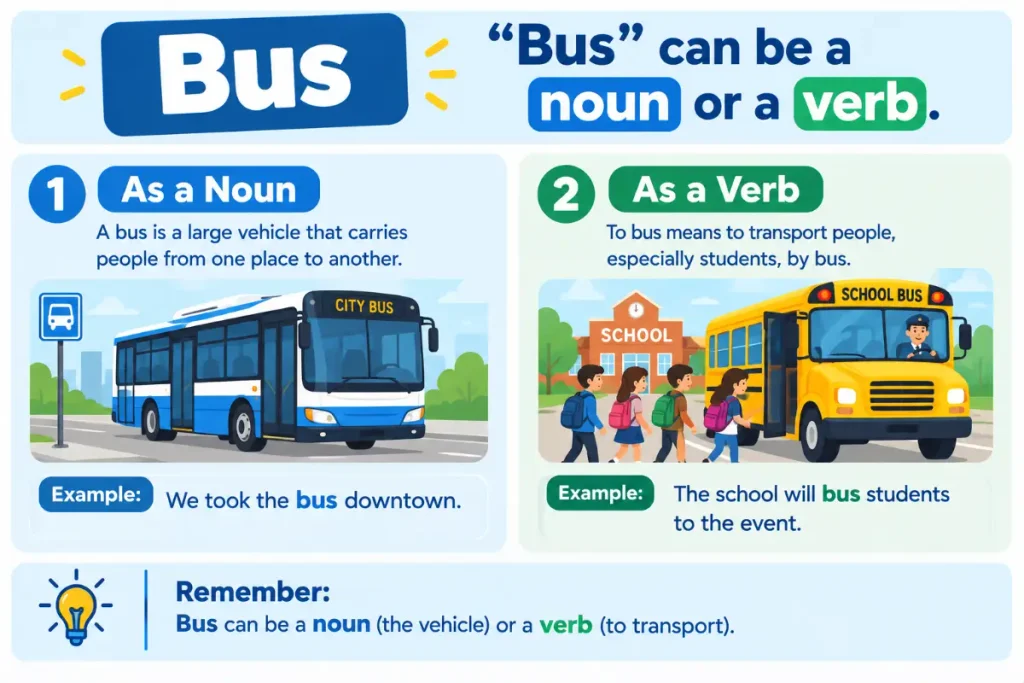
Bus can be a noun or a verb.
We took the bus downtown.
The school will bus students to the event.
Busing
Busing is the present participle commonly used in US English for transportation.
The district is busing students to another school.
Bussing
Bussing is commonly used in American restaurant contexts and is also a common regional form of the transportation verb.
She is bussing tables.
Bused
Bused is a common US past-tense form.
The students were bused to the museum.
Bussed
Bussed is another spelling, especially familiar in restaurant contexts and British English. The server bussed the tables after lunch.
Conclusion
In conclusion, busing and bussing can both be correct spellings, depending on the meaning and style of English being used. Busing is commonly used as the spelling of the verb related to “bus,” especially in American English. It can mean transporting people by bus or taking someone somewhere by bus.
Bussing is also a valid spelling and is commonly used when referring to clearing or carrying dishes in a restaurant. It may also appear as a variant of “busing” in some contexts. Because the two spellings can have different meanings, looking at the context is important when deciding which form to use.
For American English, busing is generally the preferred spelling when you mean traveling or transporting people by bus, while bussing is often used for restaurant-related work. Choosing the spelling that matches your intended meaning will make your writing clearer and easier to understand.
Frequently Asked Questions
Is busing or bussing correct?
Both are correct forms, but usage depends on meaning and region. In American English, busing is generally preferred for transporting people by bus, while bussing is especially common for clearing restaurant tables.
Which is correct in American English, busing or bussing?
For transportation, busing is generally the preferred American spelling. Bussing is also common in American English, particularly in the restaurant phrase bussing tables.
Is “bussing” correct for school transportation?
Yes, bussing can be found in English for school transportation, but busing is the more typical US spelling. British English commonly uses bussing for this meaning.
Is it busing tables or bussing tables?
Both busing tables and bussing tables are used in American English. Bussing tables is particularly common in restaurant-related writing and conversation.
How do you spell the verb form of bus?
In US English, busing is commonly used as the present participle when bus means transporting people. Bussing is also a valid form and is especially common for restaurant table service.
What is the past tense of bus?
In American English, bused is a common past-tense form, as in “The students were bused to the museum.” Bussed is also used, particularly in restaurant contexts and in other varieties of English.
Why does bussing have two s’s?
The spelling bussing follows a consonant-doubling pattern that appears in some English verb forms. However, American English commonly uses the single-s form busing for the transportation meaning. Cambridge specifically identifies busing as the US present participle for that sense.
1 thought on “Busing or Bussing: Which Is Correct?”