
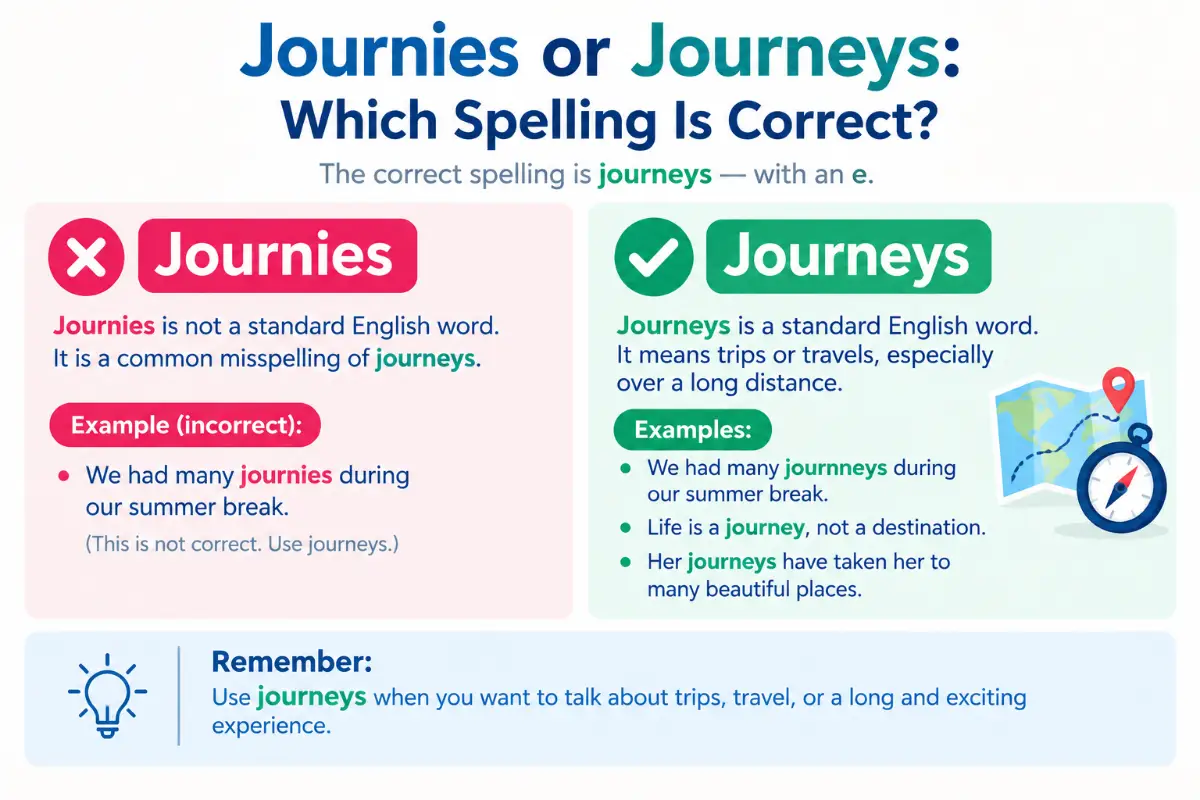
Have you ever typed “journies” and wondered if it looks right? This spelling mistake is common because many English words ending in consonant + y change the y to ies when they become plural.
The correct spelling is journeys, not “journies.” The word “journey” becomes “journeys” because the letter before the final y is a vowel. Journeys is the correct plural spelling of journey. “Journies” is incorrect. Use “journeys” when you mean more than one journey.
This guide explains the spelling rule, why the mistake happens, how to use “journeys” in sentences, and how it differs from similar words such as “travels” and “trips.”

Journies or Journeys: Which Is Correct?
The correct spelling is journeys.
| Spelling | Correct? | Explanation |
|---|---|---|
| journeys | Yes | Correct plural of “journey” |
| journies | No | Incorrect plural spelling |
| journey | Yes | Singular form |
| journeying | Yes | -ing form of the verb |
The singular noun is journey:
She went on a long journey.
The plural noun is journeys:
They have taken several journeys together.
“Journies” does not follow the correct spelling pattern for this word.
Why Is “Journeys” Spelled With Y?
The spelling becomes easier to understand when you look at the letter immediately before the final y. The word journey ends in -ey. The letter before the y is e, which is a vowel. When a noun ends in a vowel + y, you normally keep the y and add s to make it plural.
For example:
- journey → journeys
- boy → boys
- day → days
- key → keys
- toy → toys
- valley → valleys
- donkey → donkeys
So:
journey + s = journeys
You do not change the y to i because the word already ends in a vowel + y pattern.
Why Do People Spell It “Journies”?
“Journies” looks reasonable if you know another common English spelling rule. Many nouns ending in a consonant + y change the y to ies in the plural:
- city → cities
- story → stories
- country → countries
- party → parties
- family → families
- baby → babies
Because “journey” also ends in y, it can be tempting to apply the same rule. The important difference is the letter before the y.
Compare:
| Singular | Letter before Y | Plural |
|---|---|---|
| city | t | cities |
| story | r | stories |
| family | l | families |
| journey | e | journeys |
| boy | o | boys |
| key | e | keys |
In journey, the letter before y is e, a vowel. Therefore, the plural takes s, not ies.
The Easy Rule for Words Ending in Y
A simple rule can help you remember the difference.
Consonant + Y → Change Y to IES
When a word ends in a consonant followed by y, usually change y to ies.
Examples:
- city → cities
- baby → babies
- library → libraries
- country → countries
- company → companies
Vowel + Y → Add S
When a word ends in a vowel followed by y, keep the y and add s.
Examples:
- journey → journeys
- day → days
- boy → boys
- key → keys
- toy → toys
- essay → essays
This rule makes the difference between “journeys” and “journies” much easier to remember.
What Does “Journey” Mean?
A journey is a trip or period of traveling from one place to another. It can also describe a longer process of personal growth, learning, development, or change.
As a noun:
The journey from Chicago to Denver took several hours.
It can also describe an experience that develops over time:
Learning a new language can be a challenging journey.
The plural journeys simply means more than one journey.
Her journeys across the country gave her many memorable experiences.
Is “Journies” Ever Correct?
No. “Journies” is not the standard English plural of “journey.”Use journeys instead.
For example:
Incorrect:
He wrote about his journies through Europe.
Correct:
He wrote about his journeys through Europe.
The same correction applies in school assignments, emails, articles, resumes, websites, and everyday writing.
Journeys in Real Sentences
Here are natural examples showing how to use the correct spelling.
- Her journeys around the United States inspired her to write a book.
- We shared stories about our journeys during dinner.
- The travelers documented their journeys with photographs.
- Their journeys took them through several small towns.
- Each of their journeys taught them something new.
- The airline offers several options for long international journeys.
- His journeys across the country changed his view of American history.
- The students wrote essays about their journeys and experiences.
- Their family journeys created memories they still talk about.
- Many people describe education as a lifelong journey.
- The book follows the journeys of several young explorers.
- Her personal journeys helped her become more confident.
- These journeys were difficult but rewarding.
- The website shares stories from travelers and their journeys.
- Our journeys may take different paths, but we can still reach similar goals.
Notice that journeys works for both physical travel and experiences that develop over time.
Journey vs. Journeys
The difference between journey and journeys is simply singular versus plural.
| Word | Number | Example |
|---|---|---|
| journey | One | The journey was long. |
| journeys | More than one | Their journeys were different. |
Use journey when talking about one trip or one process.
My journey to California was exciting.
Use journeys when talking about multiple trips or multiple experiences.
My journeys to California taught me a lot.
Journeys vs. Trips: What’s the Difference?
“Journey” and “trip” can both refer to travel, but they do not always have exactly the same feel. A trip often focuses on the visit or planned travel experience. A journey often emphasizes the process of traveling from one place to another.
| Word | Common meaning | Example |
|---|---|---|
| journey | Travel from one place to another; a longer process | The journey across the country took weeks. |
| trip | A visit or period of travel | We took a trip to Florida. |
For everyday American English, trip is often the more casual choice.
We took a trip to New York.
“Journey” can sound more descriptive or literary:
The journey to New York was unforgettable.
“Journey” also works well for nonphysical experiences:
Her journey toward becoming a teacher took several years.
“Trip” usually does not carry that same meaning.
Journeys vs. Travels: What’s the Difference?
Travel and journey are closely related, but they have different grammatical uses. “Travel” often refers to the general activity of going from place to place.
I love to travel.
“Journey” usually refers to a particular trip or process.
The journey took six hours.
“Travels” can refer to someone’s experiences or movements in different places:
His travels introduced him to many cultures.
“Journeys” can describe specific trips:
His journeys across the country became the subject of his memoir.
The best choice depends on what you want to emphasize.
Journey as a Noun
“Journey” is most commonly used as a noun.
It can refer to:
- A trip from one place to another
- A long period of travel
- A personal experience or development process
- A difficult or gradual process toward a goal
Examples:
The journey home was peaceful.
Her journey through college changed her goals.
Recovery can be a long journey.
The plural form is journeys:
Their journeys through college were very different.
Journey as a Verb
“Journey” can also function as a verb, although it is less common in casual American conversation than phrases such as “travel” or “go.”
Examples include:
They journeyed across the country by car.
The explorers journeyed through the mountains.
The verb forms include:
- journey
- journeys
- journeyed
- journeying
Notice that journeys can also be the third-person singular form of the verb.
For example:
She journeys across the country every summer.
Here, “journeys” is a verb rather than a plural noun.
Common Mistakes With “Journeys”
The most common mistake is changing y to ies simply because the word ends in y.
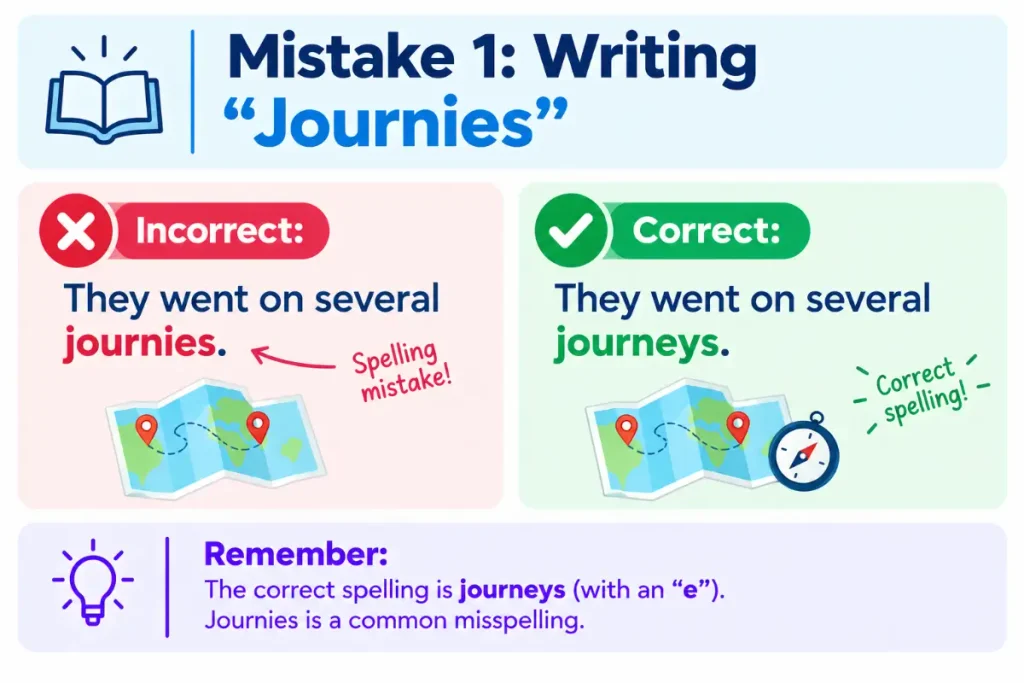
Mistake 1: Writing “Journies”
Incorrect:
They went on several journies.
Correct:
They went on several journeys.
Mistake 2: Applying the Wrong Y Rule
Some writers remember:
consonant + y → ies
But they forget that journey has a vowel before the y.
The ending is:
e + y
Since e is a vowel, keep the y and add s:
journey → journeys
Mistake 3: Confusing “Journeys” With “Journey’s”
“Journeys” and “journey’s” have different meanings. Journeys is the plural form.
Their journeys were exciting.
Journey’s is the possessive form.
The journey’s final stage was difficult.
The apostrophe changes the grammatical meaning.
Mistake 4: Using “Journies” in Formal Writing
A spelling error can make otherwise strong writing look careless. Always use journeys in resumes, essays, reports, professional emails, and published content.
How to Remember the Correct Spelling
Try this quick memory trick:
Journey has “ey,” so just add “s.”
Think:
journey → journeys
You can also compare it with familiar words:
key → keys
boy → boys
day → days
journey → journeys
All of these words keep the y because a vowel comes before it.
Another useful comparison is:
city → cities
story → stories
journey → journeys
The first two have a consonant before y. “Journey” has a vowel before y.
Correct and Incorrect Examples
| Incorrect | Correct |
|---|---|
| journies | journeys |
| several journies | several journeys |
| long journies | long journeys |
| their journies | their journeys |
| memorable journies | memorable journeys |
| international journies | international journeys |
Whenever you see journies, replace it with journeys.
Journeys in American English
In American English, journeys is the standard plural spelling. There is no special American spelling that changes “journeys” to another form. British English also uses journeys. So you can safely use journeys in:
- American English
- British English
- Canadian English
- Australian English
- Academic writing
- Business writing
- Everyday communication
This is not a US-versus-UK spelling difference. Journeys is the standard form across major varieties of English.
Formal and Casual Uses of “Journeys”
The word “journeys” works in both formal and casual writing, although the context can affect whether it sounds natural.
Professional Writing
The report describes the journeys of customers through the purchasing process.
Academic Writing
The study examines the journeys of immigrants as they adapted to new communities.
Everyday Conversation
We talked about our journeys during the road trip.
Social Media
Grateful for all the journeys, lessons, and memories along the way.
In very casual conversation, Americans may prefer trips, travels, or adventures depending on the situation. Still, “journeys” is grammatically correct.
Synonyms for “Journeys”
The best alternative depends on what you mean.
| Word/Phrase | Meaning | Tone | Example |
|---|---|---|---|
| trips | Visits or periods of travel | Everyday | We took several trips. |
| travels | Experiences of traveling | Neutral | Her travels took her abroad. |
| adventures | Exciting travel experiences | Casual | Their adventures were unforgettable. |
| voyages | Long journeys, especially by sea | Formal | The voyages lasted months. |
| expeditions | Organized journeys for a purpose | Formal | The team planned several expeditions. |
| excursions | Short trips, often for pleasure | Neutral | The school organized excursions. |
| tours | Trips involving several places | Neutral | They took tours of historic sites. |
| treks | Long or difficult journeys | Casual | Their treks took them into remote areas. |
| passages | Movement from one place to another | Formal | The passages across the ocean were difficult. |
| travels | Movement between places | Neutral | His travels shaped his writing. |
For everyday American English, trips is often the simplest replacement for physical journeys. For a longer or more meaningful experience, journeys may be a better choice.
Journeys in Personal and Figurative Writing
“Journey” has an important figurative meaning in modern English. People often describe personal development as a journey. This can include education, career development, learning, relationships, or reaching a personal goal.
For example:
Learning to play the piano has been a rewarding journey.
The plural can describe several people’s different experiences:
Their journeys toward successful careers took different paths.
This use is common in speeches, books, essays, blogs, and social media posts.
However, don’t use “journey” simply because it sounds more impressive. If you mean a normal short visit, trip may be clearer.
When Should You Use “Journeys”?
Use journeys when you are talking about two or more journeys.
Good examples include:
Her journeys across the country inspired her photography.
We compared our journeys through different parts of the United States.
The novel follows the journeys of three travelers.
Use journey when you mean one:
The journey lasted five hours.
If you mean travel in general, travel or travels may fit better:
He loves to travel.
If you mean a specific vacation or outing, trip may sound more natural:
We took a trip to Arizona.
A Quick Comparison: Journey, Journeys, Travel, and Trips
These four words are easy to confuse, but each has a useful role.
| Word | Main use | Example |
|---|---|---|
| journey | One trip or process | The journey was long. |
| journeys | More than one journey | Their journeys were memorable. |
| travel | General activity | I enjoy travel. |
| trips | Specific visits or periods of travel | We took two trips last year. |
Knowing this difference helps you choose the word that sounds most natural for your sentence.

Final Tips for Remembering “Journeys”
The key point is simple: journeys is the correct spelling, while “journies” is not.
Remember the spelling pattern:
- consonant + y → often change y to ies
- vowel + y → usually keep y and add s
Because “journey” ends in ey, the y stays in place:
journey → journey
Conclusion
Use journeys when you mean more than one journey, whether you’re talking about travel, life experiences, education, career development, or another long process. If you’re writing for an American audience, the same spelling applies.
So the next time you hesitate between “journies or journeys,” choose journeys. It is the standard, correct spelling and works naturally in both formal and everyday English.
In conclusion, “journeys” is the correct spelling of the plural form of “journey.” The spelling “journies” is incorrect and should not be used in standard English writing.
The word “journeys” refers to more than one trip, travel experience, or progression from one place or stage to another. For example, “Their journeys were filled with memorable experiences” uses the correct plural form. Overall, remember the spelling rule: when a word ends in a consonant followed by y, the y usually changes to ies; however, “journey” ends in a vowel before the y, so it simply takes -s to become journeys.
Frequently Asked Questions
Is “journies” correct?
No. “Journies” is an incorrect spelling. The correct plural form of “journey” is “journeys.”
How do you spell the plural of journey?
The plural is spelled journeys: journey + s. Keep the final y because the letter before it is the vowel e.
Why isn’t “journey” spelled “journies” in the plural?
Because “journey” ends in a vowel + y. Words with this pattern normally keep the y and add s, giving journeys.
Which is correct, “journies” or “journeys”?
Journeys is correct. “Journies” is a common spelling mistake caused by applying the consonant + y plural rule incorrectly.
Is “journeys” American or British English?
“Journeys” is standard in both American and British English. It is not a regional spelling difference.
What is another word for “journeys”?
Depending on the context, alternatives include trips, travels, adventures, voyages, excursions, tours, and expeditions. “Trips” is often the most natural casual alternative in American English.
What is the difference between “journey” and “journeys”?
“Journey” refers to one journey, while “journeys” refers to more than one. For example, “The journey was difficult” refers to one, while “Their journeys were different” refers to multiple journeys.
1 thought on “Journies or Journeys: Which Spelling Is Correct?”