
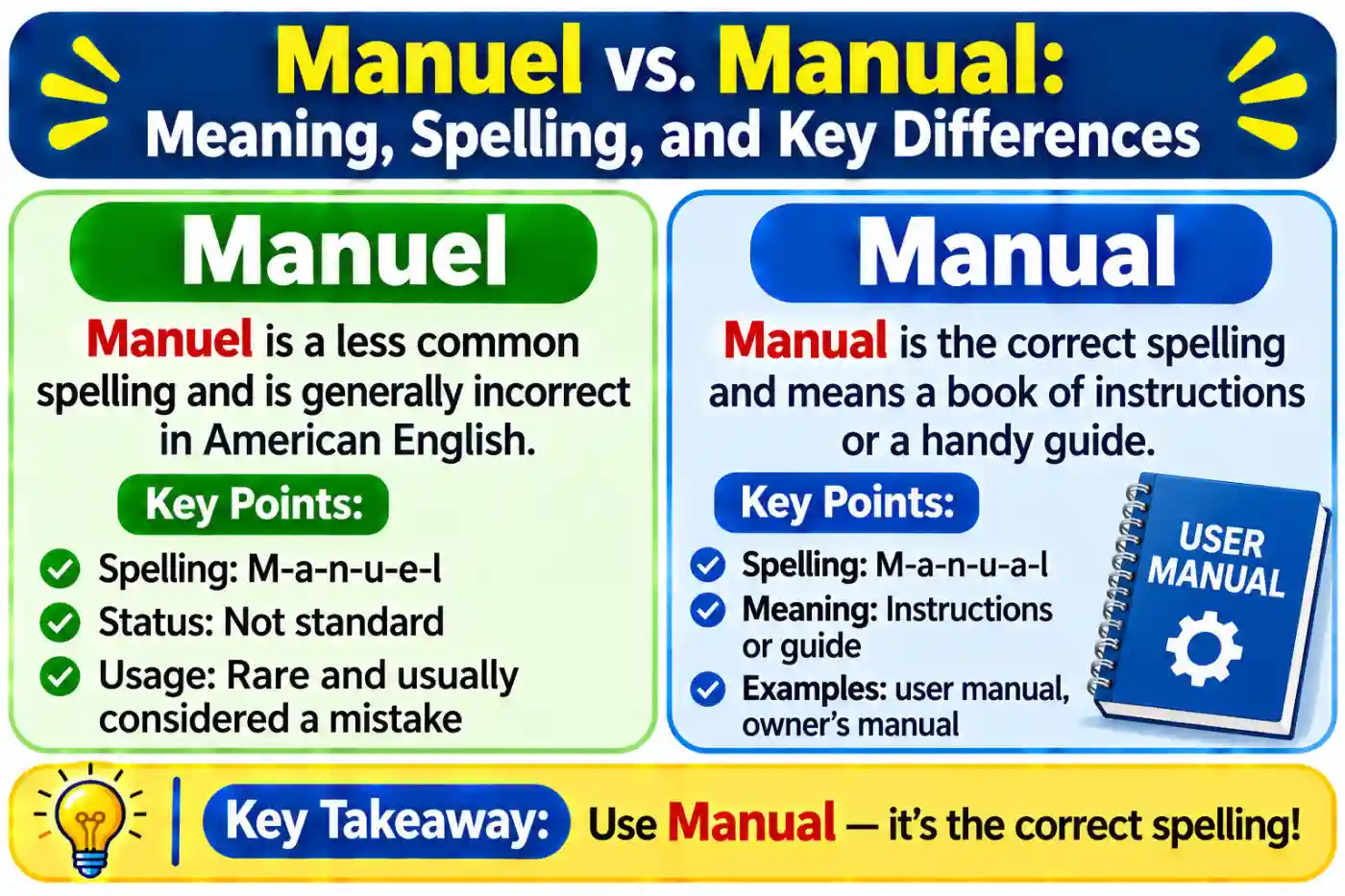
Have you ever written manuel instead of manual while completing a form, sending an email, or describing how something works? The words manuel vs manual can be confusing because they look almost identical, but they have different meanings and uses. One is commonly used as a personal name, while the other is a standard English word.
The correct choice depends on what you want to communicate. Manual is the correct spelling when you mean something done by hand, a guide with instructions, or a process that requires human effort. Manuel is primarily a masculine given name.
Manual is the correct word for instructions, hand-operated tasks, and work done without automatic assistance. Manuel is generally a person’s name, not an alternative spelling of manual.
Understanding this difference can help you avoid spelling mistakes in school assignments, workplace documents, emails, and everyday conversations. Let’s look at their meanings, pronunciation, examples, and common mistakes.
Manuel vs Manual: What’s the Difference?
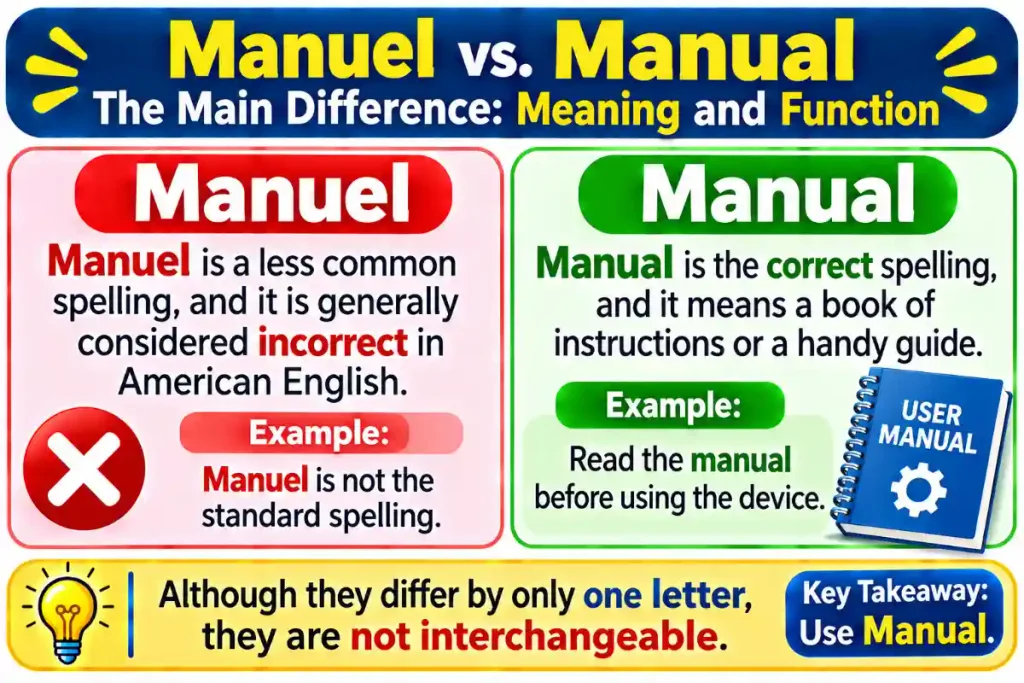
The main difference between manuel and manual is their meaning and grammatical function. Although they differ by only one letter, they are not interchangeable.
| Word | Meaning | Part of Speech | Example |
|---|---|---|---|
| Manuel | A masculine personal name | Proper noun | Manuel joined our team last week. |
| Manual | Done by hand or a book of instructions | Noun or adjective | Please read the instruction manual. |
Manuel is a proper noun, meaning it identifies a particular person. It is commonly used as a first name in Spanish-speaking countries and other parts of the world. Manual is a common English word with several meanings. It can describe something performed by hand rather than by a machine, or it can refer to a document that explains how to use or operate something.
When Should You Use Manuel?
Use Manuel when referring to someone whose name is Manuel.
Examples:
- Manuel is my new classmate.
- I spoke with Manuel about the project.
- Manuel works at the local grocery store.
- My uncle Manuel lives in California.
Because it is a person’s name, it begins with a capital letter in standard English writing.
When Should You Use Manual?
Use manual when describing a physical task, a hand-operated process, or a written guide.
Examples:
- I prefer driving a manual car.
- Please follow the instructions in the manual.
- The company still uses manual processes.
- She completed the task through manual labor.
Unlike a person’s name, manual is usually written with a lowercase first letter unless it begins a sentence or appears in a title.
What Does Manuel Mean?
Manuel is a masculine given name commonly associated with Spanish and Portuguese naming traditions. It is used as a first name in many countries and communities. The name Manuel has historical and religious connections. It is traditionally considered a Spanish and Portuguese form of the name Emmanuel, which comes from the Hebrew name Immanuel. The name Immanuel is commonly interpreted as “God is with us.” This meaning comes from the Hebrew elements traditionally associated with God and being with someone. Manuel is widely recognized as a personal name in Spanish-speaking communities, Portugal, and other parts of the world.
Manuel as a Proper Noun
A proper noun identifies a specific person, place, organization, or thing. Since Manuel is a personal name, it belongs to this grammatical category.
Here are some examples:
- Manuel is studying computer science at college.
- My friend Manuel invited me to his birthday party.
- Manuel helped his father repair the car.
- We met Manuel during our vacation in Florida.
- Manuel sent the documents yesterday.
- The teacher asked Manuel to read the next paragraph.
- My cousin Manuel recently moved to Texas.
In each sentence, Manuel identifies a particular person.
Why Is Manuel Capitalized?
Manuel is capitalized because English grammar requires proper nouns to begin with a capital letter.
Correct:
- Manuel is my neighbor.
- I received a message from Manuel.
- Have you met Manuel before?
Incorrect:
- manuel is my neighbor.
- I received a message from manuel.
- Have you met manuel before?
Writing someone’s name correctly is important in professional communication, schoolwork, invitations, and official documents.
What Does Manual Mean?
Manual means something done or operated by hand rather than automatically, or a book or document containing instructions. It can function as both a noun and an adjective. Its meaning depends on how it appears in a sentence.
For example:
- Noun: I lost the car’s owner’s manual.
- Adjective: My father drives a manual transmission vehicle.
These two uses are common in American English.
Manual as a Noun
As a noun, manual refers to a book, booklet, or document that provides instructions, information, or guidelines. A manual usually explains how to use, maintain, repair, or understand something.
Examples include:
- User manual
- Employee manual
- Instruction manual
- Training manual
- Technical manual
- Repair manual
- Safety manual
Example sentences:
- Read the user manual before installing the software.
- The employee manual explains the company’s policies.
- I found the instruction manual inside the box.
- The mechanic checked the repair manual.
- Our teacher gave us a laboratory manual.
- Please keep the safety manual near the equipment.
In these examples, manual refers to a written source of information.
Manual as an Adjective
As an adjective, manual describes an activity or process performed by hand or controlled directly by a person.
It often contrasts with automatic, computerized, or machine-operated processes.
Examples:
- The factory still performs some manual tasks.
- She prefers a manual coffee grinder.
- Manual labor requires physical effort.
- The technician entered the information manually.
- Our office uses manual recordkeeping for certain files.
- The driver chose a manual transmission.
Here, manual describes the type of work, equipment, or process involved.
Manual vs. Automatically: Understanding the Difference
One of the most common uses of manual is to describe something that does not happen automatically.
A manual process generally requires a person to perform or control an action. An automatic process uses a machine, system, or programmed function to perform the action with less direct human involvement.
| Manual | Automatic |
|---|---|
| Requires direct human action | Operates through a system or machine |
| Often involves physical effort | May require little physical effort |
| Can require repeated input | Can repeat programmed actions |
| Usually controlled by a person | Usually controlled by programmed settings |
Consider these examples:
- Manual payment: A person enters or processes the payment information.
- Automatic payment: A scheduled system processes the payment.
- Manual calculation: Someone works out the numbers.
- Automatic calculation: Software calculates the result.
- Manual operation: A person controls the equipment.
- Automatic operation: The equipment follows programmed instructions.
Neither method is always better. The right choice depends on the task, available equipment, accuracy requirements, and personal preferences.
Manuel vs Manual: Pronunciation Differences
Manuel and manual have different pronunciations, although some speakers may pronounce them similarly depending on their language background and accent. In American English, manual is commonly pronounced:
- Manual: MAN-yoo-uhl
- Manuel: man-WEL (a common Spanish-influenced pronunciation)
The pronunciation of Manuel can vary depending on the person’s language and cultural background.
| Word | Common Pronunciation | Stress |
|---|---|---|
| Manuel | man-WEL | Second syllable |
| Manual | MAN-yoo-uhl | First syllable |
The easiest way to distinguish them is to listen to the vowel sounds and notice the syllable stress.mHowever, pronunciation alone should not determine which spelling you use. The meaning and context are more reliable.
Manuel vs Manual: Correct and Incorrect Usage
Understanding when each word belongs in a sentence can prevent common writing mistakes. The following examples show how to choose the right word.
| Sentence | Correct or Incorrect? | Explanation |
|---|---|---|
| Manuel is my best friend. | Correct | Manuel is a person’s name. |
| Please read the manual. | Correct | Manual means an instruction guide. |
| I prefer a manuel transmission. | Incorrect | The correct word is manual. |
| My brother’s name is manual. | Incorrect | The person’s name should be Manuel. |
| The company uses manual processes. | Correct | Manual describes work done by people. |
| Manuel helped me repair my computer. | Correct | Manuel identifies a person. |
| The manuel explains how to install the program. | Incorrect | Use manual for an instruction guide. |
How to Correct Common Sentences
Here are some additional examples that demonstrate the difference.
Incorrect: I need to read the manuel before using the printer.
Correct: I need to read the manual before using the printer.
Explanation: The sentence refers to an instruction guide, so manual is the correct choice.
Incorrect: My friend manual is coming to visit.
Correct: My friend Manuel is coming to visit.
Explanation: The sentence refers to a person, so the proper name Manuel is required.
Incorrect: This machine requires manuel operation.
Correct: This machine requires manual operation.
Explanation: The adjective manual describes how the machine is operated.
Incorrect: Manuel labor can be physically demanding.
Correct: Manual labor can be physically demanding.
Explanation: Manual labor refers to work performed mainly through physical effort.
15 Examples of Manuel and Manual in Real Sentences
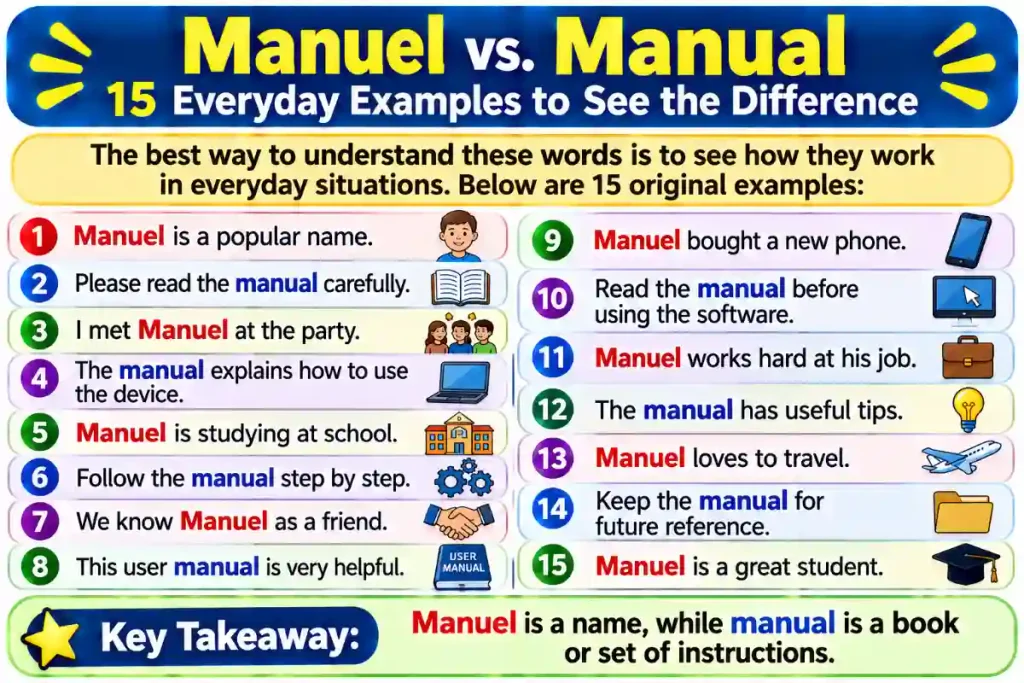
The best way to understand these words is to see how they work in everyday situations. Below are 15 original examples covering personal names, school, work, technology, and daily activities.
Examples Using Manuel
- Everyday conversation: Manuel is coming over for dinner tonight.
- Workplace: Manuel prepared the presentation for Monday’s meeting.
- School: Our teacher asked Manuel to explain his answer.
- Family: My cousin Manuel lives with his parents in Florida.
- Travel: Manuel booked our hotel rooms before the trip.
- Friendship: I have known Manuel since elementary school.
- Email: Hi Manuel, I wanted to ask about the meeting schedule.
Examples Using Manual
- Technology: The computer manual explains how to install the software.
- Automobiles: My brother enjoys driving a car with a manual transmission.
- Workplace: Employees must complete the manual verification process.
- Education: The instructor provided a manual for the training course.
- Everyday life: I prefer manual tools for small household repairs.
- Manufacturing: Some products still require manual inspection.
- Office work: The assistant entered the information through manual data entry.
- Home improvement: We followed the assembly manual to build the bookshelf.
These examples show that the correct spelling depends on the intended meaning, not simply how similar the words look.
Why Do People Confuse Manuel and Manual?
People often confuse Manuel and manual because they have almost identical spellings. Only one letter separates them, and both contain similar sounds. This makes it easy to type the wrong version, especially when writing quickly. There are several reasons for this confusion.
1. They Look Almost Identical
The difference between the two words is only the final vowel before the last letter.
- Manuel
- Manual
When reading quickly, people may not notice this small difference.
2. They Have Similar Pronunciation Patterns
Both words contain several similar sounds. Depending on someone’s accent or familiarity with the name Manuel, the distinction may not always be obvious.
3. Typing Errors
Autocorrect and spell-check tools do not always identify the intended meaning. Both Manuel and manual are legitimate words, so a spelling checker may accept either one. For example, if you type “Please read the manuel,” your software might not recognize the mistake because Manuel is a valid name.
4. Limited Understanding of Their Meanings
Someone who has not learned the difference between proper nouns and common nouns may use the words incorrectly. Remember that Manuel identifies a person, while manual describes an action or refers to instructions.
Manuel vs Manual: Common Related Words
Several English words are connected to the meaning of manual. Understanding them can help you choose more precise language.
| Word | Meaning | Example |
|---|---|---|
| Manually | By hand or through direct human action | She entered the information manually. |
| Manual labor | Physical work performed by people | Manual labor can require strength and endurance. |
| Manual transmission | A vehicle transmission operated by the driver | He prefers a manual transmission. |
| Instruction | Information explaining how to do something | Follow the instructions carefully. |
| Guide | A source of helpful directions or information | The guide explains the process. |
| Handbook | A small reference book | Read the employee handbook. |
| Automatic | Operating without continuous human control | The door has an automatic locking system. |
| Mechanized | Performed with the help of machinery | The farm uses mechanized equipment. |
| Automated | Controlled or performed by an automated system | The company automated its billing process. |
Manual vs. Manually
Manual and manually are related, but they serve different grammatical purposes.
- Manual: An adjective or noun.
- Manually: An adverb.
Examples:
- The company uses manual records.
- Employees enter the records manually.
The first sentence describes the records. The second explains how employees enter them.
Manual vs. Handbook
A manual and a handbook can both contain instructions or useful information, but their purposes may differ. A manual often provides detailed instructions for operating equipment, completing tasks, or following procedures. A handbook usually provides general information, rules, policies, or guidance.
| Manual | Handbook |
|---|---|
| Often explains procedures in detail | Often provides general guidance |
| May focus on equipment or processes | May focus on policies or reference information |
| Can be technical | Often written for everyday reference |
Examples:
- The technician consulted the equipment manual.
- The new employee received a company handbook.
Manual vs. Automatic
These words describe different ways of performing an action. Manual means a person performs or controls the action. Automatic means a system or machine performs it based on its design or settings.
Examples:
- The store uses manual inventory checks.
- The software performs automatic inventory updates.
The difference is especially important in technology, manufacturing, transportation, and workplace communication.
Common Mistakes When Using Manuel and Manual
Even experienced writers sometimes make spelling and word-choice mistakes. These errors are usually easy to correct once you understand the difference. Here are some common mistakes to avoid.
Mistake 1: Using Manuel Instead of Manual
Incorrect: Please check the owner’s manuel.
Correct: Please check the owner’s manual.
Why: An owner’s manual is a document containing information about a product or vehicle.
Mistake 2: Using Manual Instead of Manuel
Incorrect: Manuel is my younger brother’s name, but everyone calls him manual.
Correct: Manuel is my younger brother’s name.
Why: A person’s name must be written as a proper noun.
Mistake 3: Forgetting Capitalization
Incorrect: manuel will join us tomorrow.
Correct: Manuel will join us tomorrow.
Why: Personal names always begin with capital letters in standard English.
Mistake 4: Using Manuel in Technical Writing
Incorrect: The device requires manuel setup.
Correct: The device requires manual setup.
Why: The sentence describes a setup process performed by a person.
Mistake 5: Confusing Manual and Manually
Incorrect: The employee completed the form manual.
Correct: The employee completed the form manually.
Why: The sentence needs an adverb to explain how the employee completed the form.
Mistake 6: Assuming Spell-Check Will Catch Every Error
A spell-check tool may accept both words because they are correctly spelled in different contexts.
For example:
- Manuel is my colleague.
- I downloaded the instruction manual.
Both are correct. However, replacing one with the other changes the meaning. Always review the entire sentence rather than relying entirely on automatic spelling suggestions.
How to Remember the Difference Between Manuel and Manual
A simple memory trick can help you choose the correct word whenever you are writing. Think of Manuel as a name and manual as a method or guide.
Use these easy reminders:
- Manuel = Man’s name: Think of someone named Manuel.
- Manual = Instructions: Think of a user manual or instruction manual.
- Manual = By hand: Think of manual work or manual operation.
- Manually = An action: Think of someone entering information manually.
You can also remember these two simple questions:
- Am I talking about a person named Manuel? If yes, use Manuel.
- Am I talking about instructions or something done by hand? If yes, use manual.
These questions make the distinction easy to remember in everyday writing.
Which Word Should You Use in Different Situations?
The correct choice depends on the context. Here is how to use both words in common writing situations.
In Emails
Use Manuel when addressing or mentioning someone by name.
Example:
Hi Manuel,
Could you please send me the updated project information?
Use manual when discussing instructions or procedures.
Example:
Please review the user manual before starting the installation.
In Academic Writing
Use manual when discussing a process, a guide, or work performed by hand.
Example:
The students followed the laboratory manual during the experiment.
Use Manuel only when referring to a person with that name.
Example:
Manuel presented his research findings to the class.
In Workplace Communication
Manual is common in workplace discussions about procedures, equipment, and tasks.
Examples:
- The manager requested a manual review of the documents.
- Employees must follow the training manual.
- The company wants to reduce manual data entry.
Use Manuel when referring to an employee, customer, or colleague.
Example:
Manuel will lead the department meeting tomorrow.
In Everyday Conversation
Both words are natural in everyday English, but they serve different purposes.
Examples:
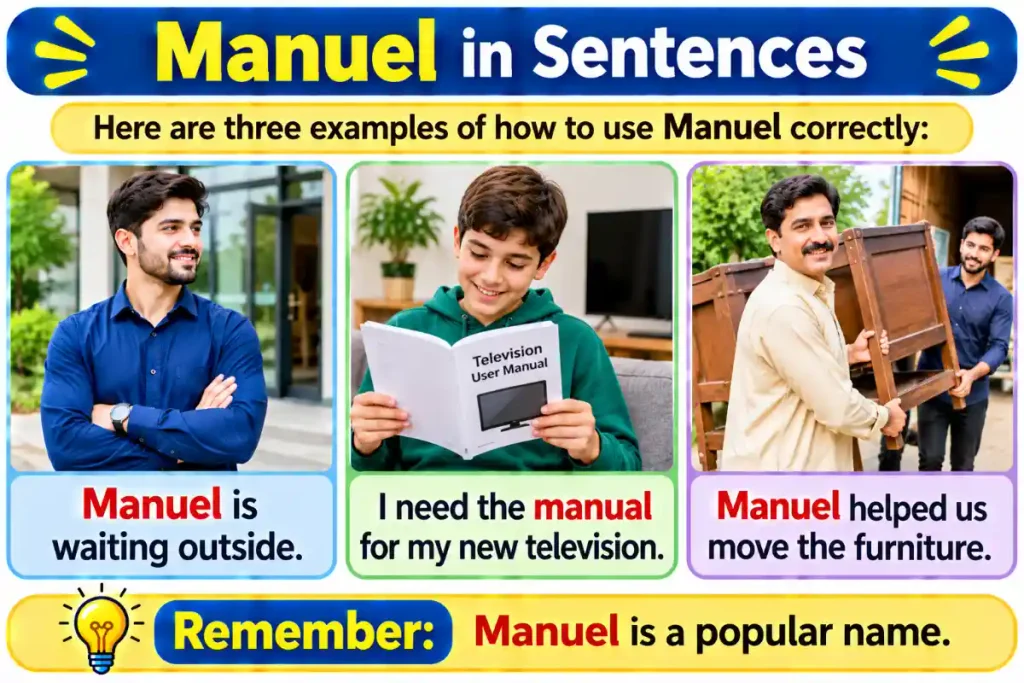
- Manuel is waiting outside.
- I need the manual for my new television.
- My father prefers a manual car.
- Manuel helped us move the furniture.
The key is to identify whether you are talking about a person or something related to hand-operated work or instructions.
Conclusion
Understanding the difference between Manuel vs. Manual is simple once you know what each word means. Manuel is a personal name, while manual is an English word used for instructions, hand-operated equipment, and tasks performed by people rather than automatic systems.
Remember to capitalize Manuel when referring to someone by name. Use lowercase manual when describing a process or an instruction guide, unless it begins a sentence or appears in a title.
Although these words look similar, they cannot replace each other. Before choosing one, consider the meaning of your sentence. If you’re talking about a person, write Manuel. If you’re discussing instructions or work done by hand, manual is the correct choice.
Frequently Asked Questions
1. Which is correct, Manuel or Manual?
Both are correct words, but they have different meanings. Manuel is a personal name, while manual refers to something done by hand or a book containing instructions.
2. Is Manuel a proper English word?
Yes, Manuel is a recognized personal name used in English and many other languages. It is commonly associated with Spanish and Portuguese naming traditions.
3. Is manual the correct spelling for an instruction book?
Yes, manual is the correct spelling for a book or document that provides instructions. For example, you might read an owner’s manual before using a new vehicle.
4. What is the difference between Manuel vs. Manual?
The difference is their meaning and use. Manuel identifies a person, whereas manual describes something performed by hand or refers to an instruction guide.
5. Does manual mean done by hand?
Yes, manual can describe an activity performed or controlled by a person rather than an automatic system. Manual labor and manual operation are common examples.
6. How do you spell manual correctly?
The correct spelling is M-A-N-U-A-L. Use this spelling when referring to instructions, hand-operated equipment, or work performed by hand.
7. Is Manuel the same as Emmanuel?
Manuel is traditionally a Spanish and Portuguese form of Emmanuel. Both names have historical connections to the Hebrew name Immanuel, although their spellings and pronunciations differ.
1 thought on “Manuel vs. Manual: Meaning, Spelling, and Key Differences”