
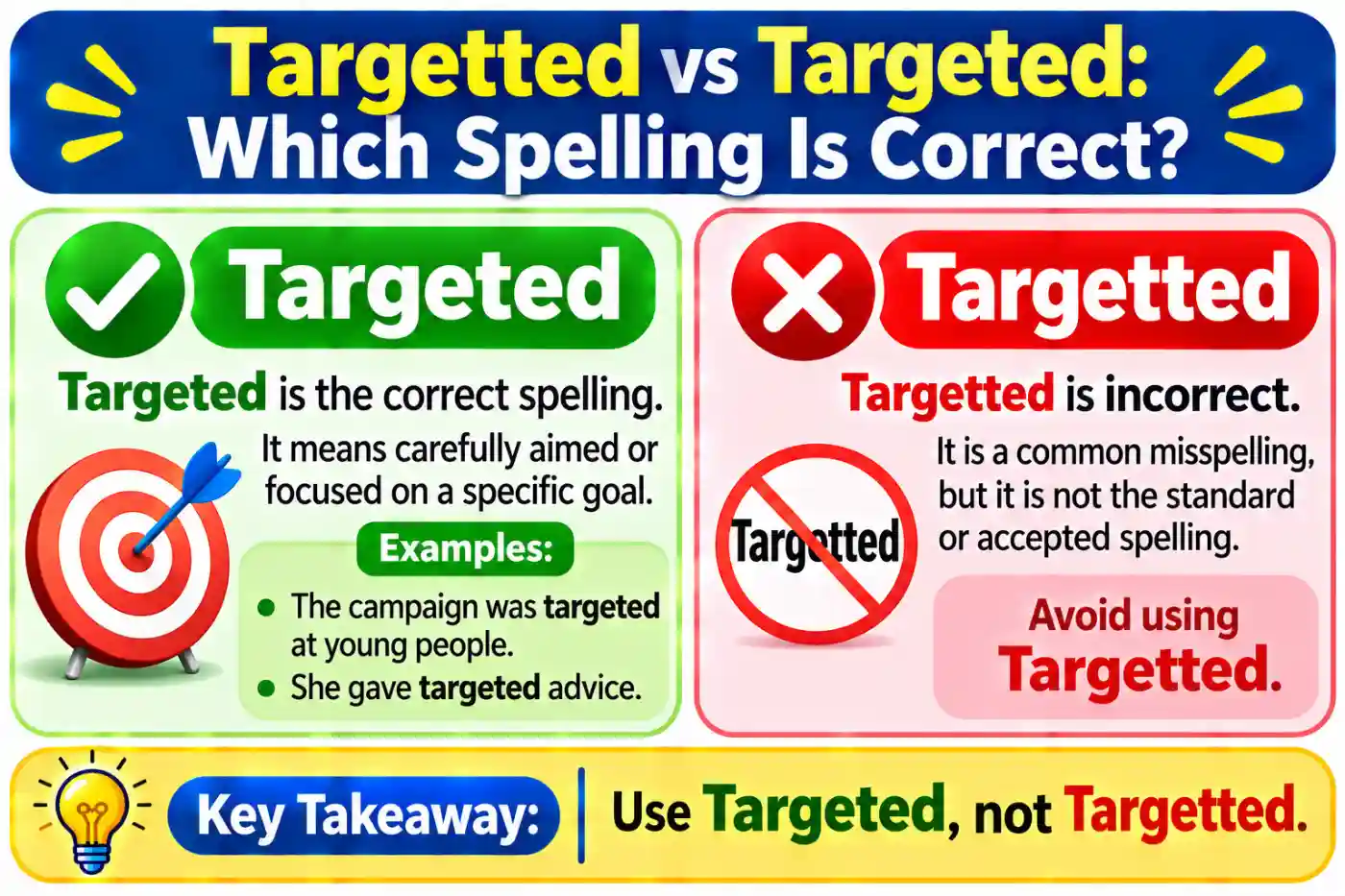
If you’re writing a professional email, resume, business report, or school assignment, you may wonder whether targetted vs targeted is the correct spelling. Both forms look reasonable because the word target ends in a consonant, and English spelling rules sometimes require doubling the final letter before adding a suffix.
However, there is a clear answer in American English: targeted is the correct spelling. The word targetted is a common misspelling and should be avoided in standard writing.
Targeted is the past tense and past participle of the verb target. It means directed toward a particular person, group, audience, goal, or result. It can also function as an adjective to describe something designed for a specific purpose.
Understanding why one spelling is correct makes it easier to avoid this mistake in everyday and professional writing. Let’s explore the spelling rule, meanings, examples, and related words.
Targetted vs Targeted: Which Is Correct?
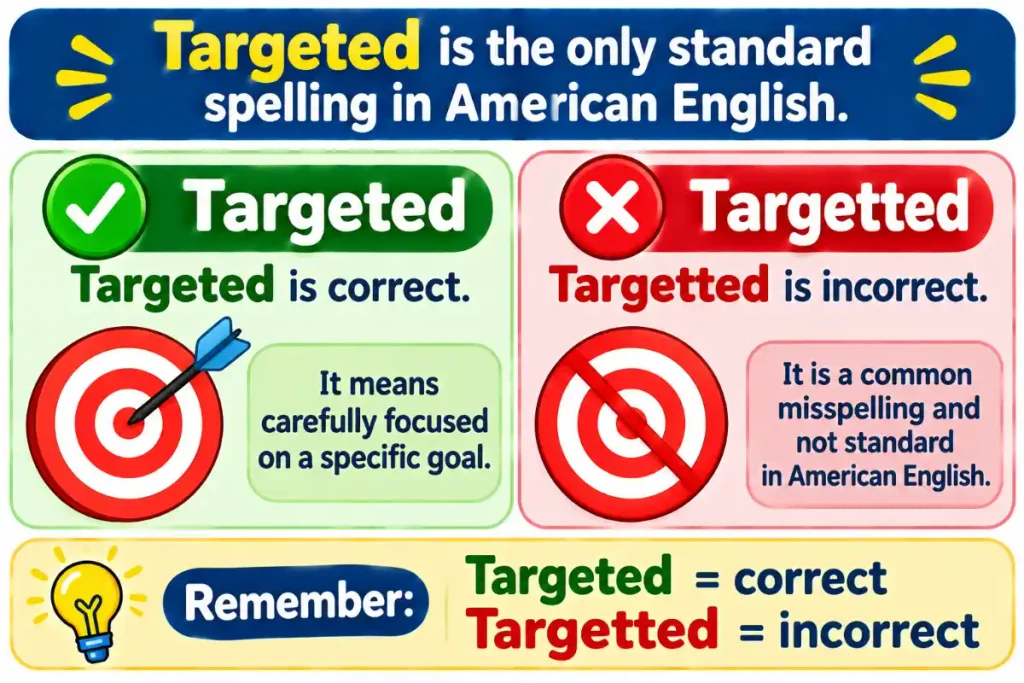
Targeted is the only standard spelling in American English. Targetted is incorrect because the word target does not double its final letter when you add the suffix -ed.
| Spelling | Correct or Incorrect | Explanation |
|---|---|---|
| Targeted | Correct | Standard American English spelling |
| Targetted | Incorrect | Contains an unnecessary extra T |
The correct spelling is used in professional documents, academic writing, marketing materials, news articles, and everyday communication.
Examples:
- Correct: The company targeted customers in major US cities.
- Incorrect: The company targetted customers in major US cities.
- Correct: We launched a targeted advertising campaign.
- Incorrect: We launched a targetted advertising campaign.
Remember that the correct spelling always contains one T before the ending -ed.
What Does Targeted Mean?
The word targeted means directed, aimed, or focused toward a particular person, group, object, or objective. It describes an action or approach that has a specific purpose rather than a general one. For example, a business might create a targeted marketing campaign to reach customers who are interested in its products. Similarly, a teacher might provide targeted support to students who need extra help with a particular subject. The word commonly appears in business, education, healthcare, advertising, technology, and everyday conversations.
Targeted as a Verb
Targeted functions as the past tense and past participle of the verb target. It describes an action that someone directed toward a particular goal or audience.
Examples:
- The marketing team targeted younger customers with its new campaign.
- The organization targeted communities that needed additional support.
- Police targeted areas with repeated traffic violations.
- The company targeted potential buyers through online advertisements.
In these sentences, targeted explains what someone directed their attention or efforts toward.
Targeted as an Adjective
Targeted can also function as an adjective. In this role, it describes something designed or directed toward a specific purpose, audience, or need.
Examples:
- The school introduced targeted reading programs.
- We received a targeted email about the new service.
- The company developed targeted advertisements for local customers.
- Employees received targeted training to improve their skills.
In each example, the word describes something focused on a particular group or objective.
Why Is Targeted the Correct Spelling?
The spelling of targeted follows an English suffix rule. When adding -ed to a verb, writers sometimes double the final consonant. However, this rule does not apply to every word.
For example:
- Stop → Stopped
- Plan → Planned
- Shop → Shopped
- Target → Targeted
The final T in target does not need to be doubled.
Understanding the Consonant-Doubling Rule
In English, a final consonant is often doubled when a one-syllable verb ends in a consonant-vowel-consonant pattern.
For example:
- Hop → Hopped
- Rob → Robbed
- Drop → Dropped
- Tap → Tapped
The doubling rule also applies to some longer verbs when the final syllable is stressed. However, target has two syllables: TAR-get. Its final syllable is unstressed. Therefore, the final T remains single when adding -ed.
This produces:
- Target → Targeted
- Target → Targeting
- Target → Targets
Not targetted, targetting, or targetts.
Targeted vs Targetting: Understanding the Related Spelling Rule
Another common spelling question involves the present participle of target. The correct form is targeting, not targetting.
| Base Word | Correct Form | Incorrect Form |
|---|---|---|
| Target | Targeted | Targetted |
| Target | Targeting | Targetting |
| Target | Targets | Targetts |
The same spelling principle applies to different forms of the word. The final T does not double when adding these endings.
Examples:
- The company is targeting new customers.
- The team targeted a younger audience.
- The advertisements target local businesses.
Learning these related forms helps prevent several spelling mistakes at once.
15 Examples of Targeted in Real Sentences
Seeing a word in different situations makes its meaning easier to understand. Here are 15 original examples showing how to use targeted naturally.
| No. | Context | Example Sentence |
|---|---|---|
| 1 | Business | The company targeted small businesses with its latest service. |
| 2 | Marketing | Our team created a targeted campaign for local customers. |
| 3 | Education | The teacher provided targeted lessons to improve reading skills. |
| 4 | Workplace | Employees received targeted training before the new software launch. |
| 5 | Advertising | The brand targeted shoppers interested in affordable products. |
| 6 | Healthcare | The program offered targeted support to people who needed additional assistance. |
| 7 | Technology | The application delivered targeted recommendations based on user preferences. |
| 8 | School | The school introduced targeted programs to help struggling students. |
| 9 | Communication | The manager sent a targeted message to department leaders. |
| 10 | Social Media | The business targeted local audiences through social media advertisements. |
| 11 | Research | Researchers targeted specific questions during the investigation. |
| 12 | Customer Service | The company developed targeted solutions for common customer problems. |
| 13 | Community | Volunteers targeted neighborhoods that needed additional resources. |
| 14 | Career | She targeted positions that matched her professional experience. |
| 15 | Everyday Life | We targeted the most important tasks before the end of the day. |
These examples show that targeted works in many contexts. It can describe marketing strategies, educational programs, workplace activities, and personal goals.
Targeted vs Aimed: What’s the Difference?
Targeted and aimed have similar meanings because both can describe directing something toward a particular objective. However, they differ slightly in usage.
- Targeted: Often suggests a specific person, group, audience, or objective.
- Aimed: Describes directing an action, effort, or object toward a particular result.
| Word | Meaning | Example |
|---|---|---|
| Targeted | Directed toward a specific group or objective | The campaign targeted new customers. |
| Aimed | Directed toward a particular purpose | The campaign aimed to increase sales. |
Targeted example: The company introduced targeted advertisements for college students. Aimed example: The new advertising strategy aimed to increase brand awareness. Both words are correct, but targeted often emphasizes the specific audience, while aimed can emphasize the intended result.
Targeted vs Focused: What’s the Difference?
The words targeted and focused are closely related, but they are not always interchangeable. Targeted usually describes something directed toward a particular group, person, or goal. Focused emphasizes concentration, attention, or effort.
| Word | Meaning | Example |
|---|---|---|
| Targeted | Directed toward a specific objective | The company created targeted advertisements. |
| Focused | Concentrated on a particular activity or goal | The team remained focused on improving customer service. |
Consider these examples:
- The school provided targeted assistance to students who needed it.
- The students remained focused during the lesson.
The first sentence describes specific support. The second describes attention and concentration.
Targeted vs Specific: What’s the Difference?
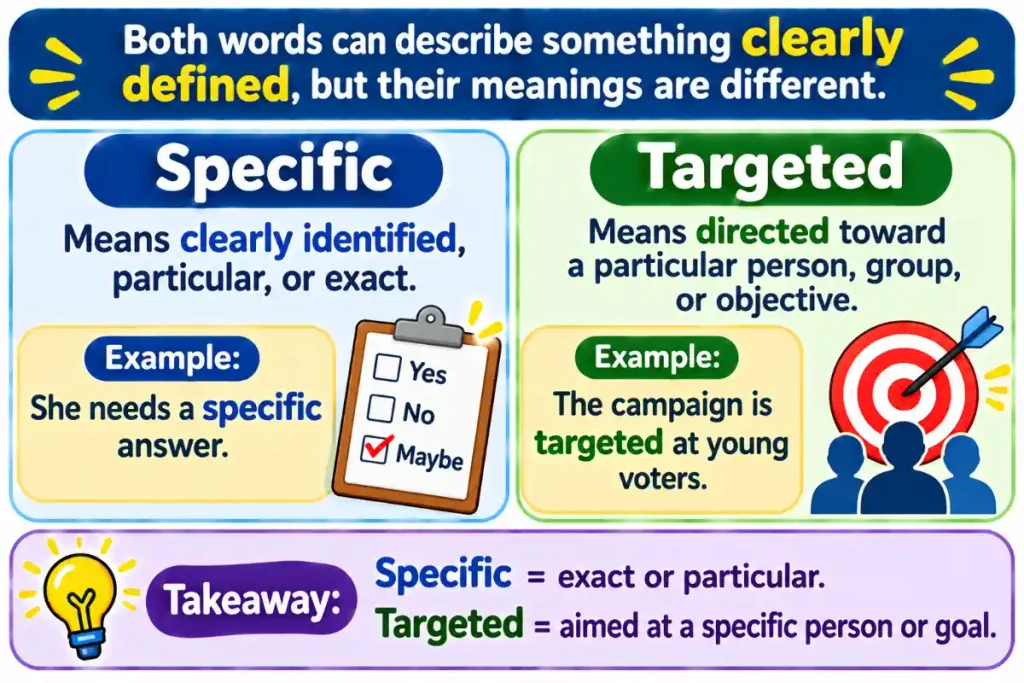
Both words can describe something clearly defined, but their meanings are different. Specific means clearly identified, particular, or exact. Targeted means directed toward a particular person, group, or objective.
| Word | Meaning | Example |
|---|---|---|
| Targeted | Directed toward a particular purpose | The company launched a targeted campaign. |
| Specific | Clearly identified or defined | The manager requested specific information. |
For example:
- The organization developed targeted programs for young adults.
- The report included specific details about the project.
Use targeted when describing direction or purpose. Use specific when identifying something clearly.
Synonyms for Targeted
Several words and phrases can replace targeted, depending on the sentence. However, not every synonym carries exactly the same meaning. Choosing the right alternative can make your writing more natural and prevent unnecessary repetition.
Common Synonyms
| Synonym | Meaning | Tone | Example |
|---|---|---|---|
| Directed | Pointed toward a purpose | Neutral | The campaign was directed at local businesses. |
| Focused | Concentrated on something | Neutral | The program focused on student development. |
| Aimed | Intended for a particular purpose | Everyday | The message was aimed at new customers. |
| Specific | Clearly identified | Neutral | The team addressed specific concerns. |
| Intended | Planned for a particular use | Neutral | The service was intended for small businesses. |
| Designed | Created for a purpose | Neutral | The program was designed for beginners. |
| Selected | Chosen from available options | Neutral | The company selected a particular audience. |
| Tailored | Adapted to individual needs | Professional | The company offered tailored solutions. |
| Specialized | Developed for a particular field | Professional | The hospital provided specialized services. |
| Customized | Changed to meet specific needs | Professional | Customers received customized recommendations. |
Formal and Professional Alternatives
These alternatives work well in business reports, academic writing, workplace communication, and formal documents.
| Alternative | Meaning | Example |
|---|---|---|
| Strategically directed | Carefully aimed toward an objective | Resources were strategically directed toward expansion. |
| Purpose-driven | Guided by a clear objective | The organization introduced a purpose-driven initiative. |
| Precisely aimed | Directed toward an exact goal | The campaign was precisely aimed at potential buyers. |
| Audience-specific | Created for a particular audience | The company developed audience-specific materials. |
| Customized | Adjusted to individual requirements | The business offered customized training. |
| Tailored | Adapted to a particular need | Employees received tailored guidance. |
| Specialized | Focused on a particular area | The center provided specialized assistance. |
| Goal-oriented | Focused on achieving an objective | The team adopted a goal-oriented strategy. |
Everyday Alternatives
For casual conversations and everyday writing, these alternatives may sound more natural:
- Focused on
- Aimed at
- Directed toward
- Intended for
- Made for
- Created for
- Built around
- Concentrated on
Examples:
- The program was made for new employees.
- The advertisement was aimed at local shoppers.
- The training focused on improving communication.
- The service was created for small business owners.
Choose an alternative based on the sentence’s meaning rather than replacing targeted automatically.
How to Use Targeted in Different Writing Situations
The word targeted is useful in both formal and informal communication. However, the best way to use it depends on your audience and purpose.
Targeted in Professional Emails
In professional emails, targeted can describe specific messages, services, campaigns, or recommendations.
Examples:
- We developed a targeted approach to reach potential clients.
- Please review the targeted recommendations before Friday.
- Our team prepared targeted materials for the upcoming meeting.
The word sounds professional and communicates a clear purpose.
Targeted in Resumes
You can use targeted in a resume when describing job applications, career goals, or professional strategies.
Examples:
- Developed targeted marketing campaigns to increase customer engagement.
- Created targeted training materials for new employees.
- Used targeted communication strategies to improve customer relationships.
However, make sure the word describes an actual responsibility or achievement. Avoid adding it simply to make a resume sound more impressive.
Targeted in Academic Writing
In academic writing, targeted can describe research, educational support, interventions, or specific objectives.
Examples:
- The study examined targeted educational programs.
- Researchers developed targeted questions for the investigation.
- The school introduced targeted support for students with different learning needs.
The word is appropriate when the subject involves a clearly defined group or purpose.
Targeted in Marketing
Marketing is one of the most common contexts for this word. Businesses use targeted campaigns to communicate with audiences who may be interested in particular products or services.
Examples:
- The brand launched a targeted social media campaign.
- Targeted advertisements helped the company reach local customers.
- The marketing team created targeted content for different age groups.
In this context, targeted often describes audience selection and marketing strategy.
Targeted in Everyday Conversation
You can also use the word in ordinary conversations without sounding overly formal.
Examples:
- We targeted the most important tasks first.
- The questions targeted the main issue.
- She targeted a few specific colleges for her applications.
Its meaning remains the same: directing attention or effort toward something specific.
American English vs British English: Is Targeted Spelled Differently?
No. Targeted is the standard spelling in both American and British English. Unlike some words that have different regional spellings, such as color and colour, the spelling of targeted does not change between these varieties of English.
| English Variety | Correct Spelling | Incorrect Spelling |
|---|---|---|
| American English | Targeted | Targetted |
| British English | Targeted | Targetted |
| Canadian English | Targeted | Targetted |
| Australian English | Targeted | Targetted |
The same spelling applies to the related forms:
- Targeting
- Targets
- Targeted
Therefore, you do not need to change the spelling when writing for American, British, Canadian, or Australian readers.
Common Mistakes When Using Targeted
Writers sometimes make spelling and word-choice mistakes when using targeted. Understanding these errors can help improve your writing.
1. Adding an Extra T
The most common mistake is writing targetted instead of targeted.
- Incorrect: The company targetted new customers.
- Correct: The company targeted new customers.
Remember that the base word target keeps its original spelling when adding -ed.
2. Confusing Targeted With Targeting
These forms have different grammatical functions.
- Targeted: Past tense or past participle.
- Targeting: Present participle or gerund.
Examples:
- The company targeted local customers last year.
- The company is targeting local customers this year.
Both are correct, but they describe different grammatical situations.
3. Using Targeted When Focused Is Better
Although these words are related, they do not always mean the same thing.
- Less natural: She remained targeted during the meeting.
- Better: She remained focused during the meeting.
Use focused when describing someone’s concentration or attention.
4. Using an Unnecessary Word
Sometimes writers add extra words that make a sentence less clear.
- Wordy: The campaign was targeted toward the specific group of customers.
- Clearer: The campaign targeted a specific group of customers.
Shorter sentences often communicate the same idea more effectively.
5. Using the Wrong Verb Form
Make sure the verb agrees with the sentence’s tense and structure.
- Incorrect: The company is targeted new customers.
- Correct: The company is targeting new customers.
After is, use the appropriate present participle in this sentence.
Quick Tips to Remember the Correct Spelling
If you frequently confuse targetted and targeted, these simple tips can help you remember the correct form.
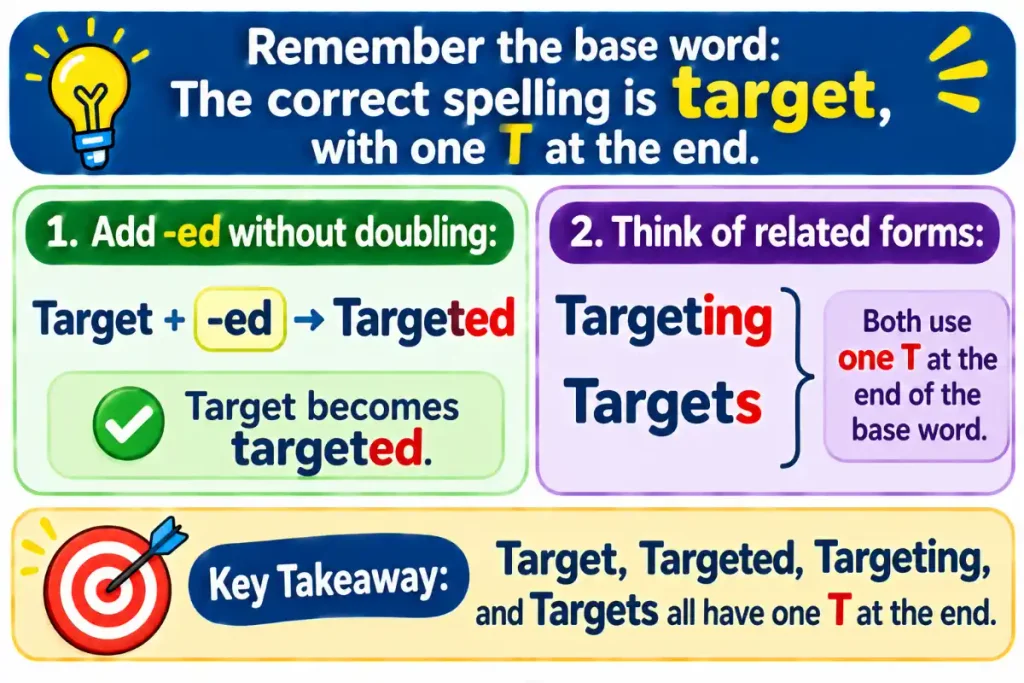
- Remember the base word: The correct spelling is target, with one T at the end.
- Add -ed without doubling: Target becomes targeted.
- Think of related forms: Targeting and targets also use one T at the end of the base word.
- Avoid unnecessary letters: The spelling targetted contains an extra T.
- Read your writing aloud: Checking your sentences can help you notice awkward word choices.
- Use spell-check: Most modern writing tools can identify targetted as a spelling error.
A simple memory trick is to remember that target already has its final T. You do not need to add another one before -ed.
Conclusion
Choosing the correct spelling makes your writing clearer and more professional. When comparing targetted vs targeted, remember that targeted is the correct form in American English, while targetted is a common spelling mistake. The word describes something directed toward a particular person, audience, purpose, or objective. It can function as both the past tense of target and an adjective in different sentences. The same spelling rule
applies to related forms such as targeting and targets. Whether you’re writing a business email, preparing a resume, completing a school assignment, or creating marketing materials, always use targeted. Keeping the final T single is a simple way to avoid this common mistake and make your writing more accurate.
Frequently Asked Questions
1. Which is correct, targetted or targeted?
Targeted is correct in standard American English. Targetted is a misspelling because the final T is not doubled when adding -ed.
2. Is targetted ever correct?
No. Targetted is not the standard spelling in American or British English. Use targeted in formal, professional, and everyday writing.
3. How do you spell targeted?
The correct spelling is T-A-R-G-E-T-E-D. It contains one T before the ending -ed.
4. Is it targeting or targetting?
Targeting is correct. The word target does not double its final T when adding -ing.
5. What does targeted mean?
Targeted means directed toward a particular person, group, purpose, or objective. For example, a targeted advertising campaign focuses on a specific audience.
6. Is targeted American or British English?
Targeted is correct in both American and British English. Neither variety uses targetted as its standard spelling.
7. What is another word for targeted?
Common alternatives include aimed, directed, focused, tailored, customized, and specific. The best choice depends on the sentence and intended meaning.
1 thought on “Targetted vs Targeted: Which Spelling Is Correct?”