
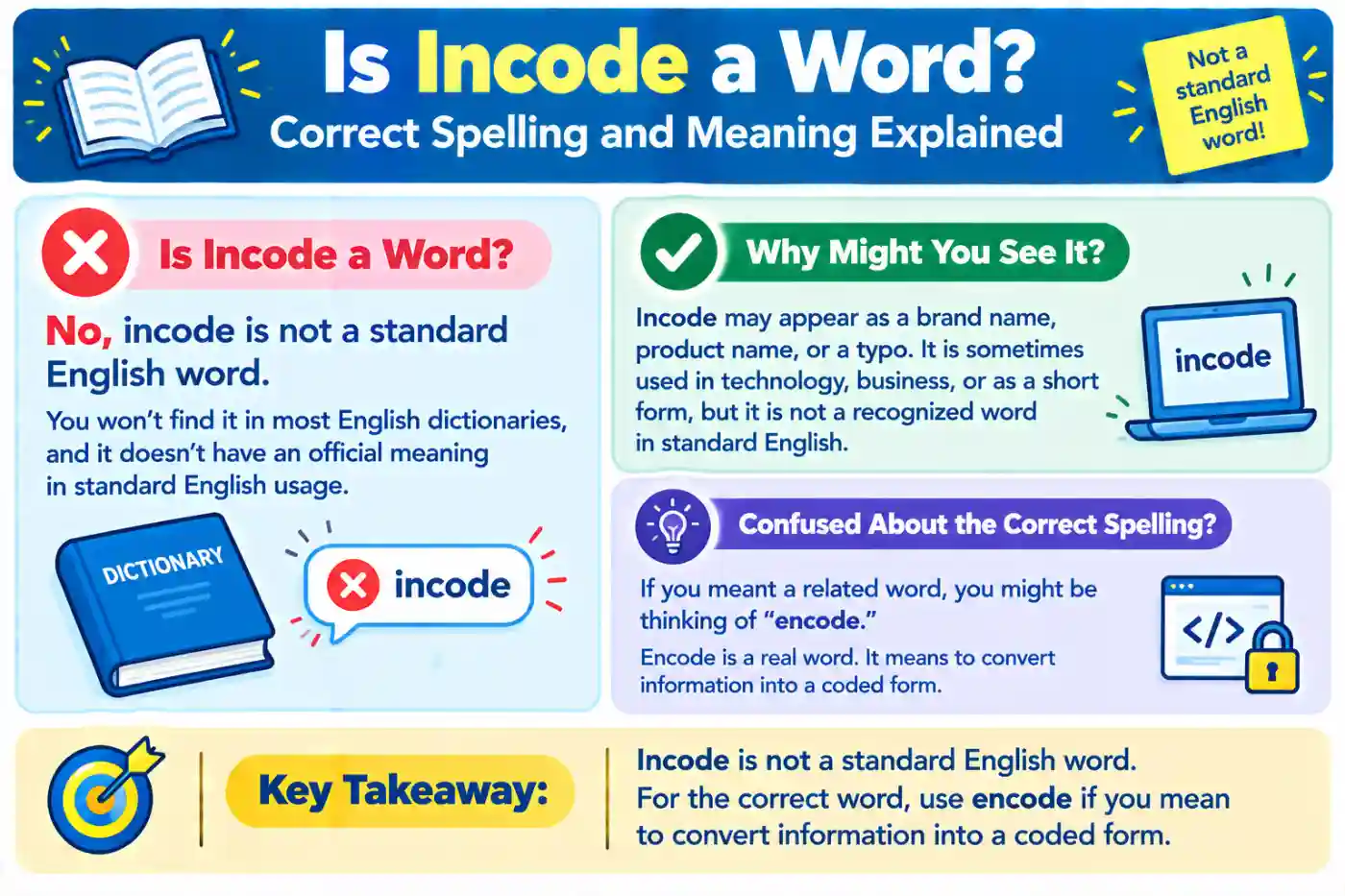
If you’re writing an email, completing a school assignment, or checking a technical document, you might wonder, is incode a word? The spelling may look reasonable, especially because English uses many words that begin with in-. However, the correct choice depends on what you want to say.
Incode is not a standard English word in general usage. If you mean to convert information into a code, the correct word is usually encode. If you mean to enter information into a computer system, input or enter may be more appropriate.
The confusion often comes from the similarity between incode, encode, and decode. These words look related, but they do not serve the same purpose in every context. Choosing the right one helps you communicate clearly and avoid spelling errors.
This article explains whether incode is correct, how to use encode and related terms, and which alternatives work best in everyday conversation, academic writing, and professional communication.

Is Incode a Word?
Incode is not generally recognized as a standard English word. Writers who use it to mean converting information into a code should normally use encode instead. In technical settings, Incode may also appear as a product name, brand name, or specialized identifier. For most everyday writing, encode is the appropriate word when you mean to represent information in a particular code or format.
Consider these examples:
- Incorrect for standard usage: The software will incode the message.
- Correct: The software will encode the message.
- Correct in another context: Please enter the information into the system.
- Correct: The program will decode the message.
The best replacement depends on the intended meaning. Encode refers to converting information into a coded form, while enter and input refer to putting information into a system.
What Does Incode Mean?
The spelling incode does not have a widely accepted meaning in standard English. Readers may interpret it as a misspelling of encode, particularly in sentences about computers, digital information, or secret messages. However, context matters. A company might use Incode as its official name, and a software developer might use incode as a variable, function, or project identifier. In those situations, the spelling may be intentional rather than a mistake.
Here are three possible situations:
| Context | Is incode appropriate? | Better choice or explanation |
|---|---|---|
| Everyday English | Generally no | Use encode when referring to coding information |
| Computer programming | Depends on the codebase | Follow the identifier or function name defined by the project |
| Brand or product name | Possibly | Preserve the official spelling of the name |
The important distinction is between a standard English word and a name or identifier created for a particular purpose. If you are writing for a general audience, avoid using incode unless you have a specific reason to retain that spelling.
Incode vs Encode: What’s the Difference?
The main difference between incode and encode is that encode is the established English verb, while incode is not the standard spelling for this meaning. Encode means to convert information into a particular system of symbols, signals, or representation. It is commonly used in computing, communication, data processing, and information security.
For example:
- The application encodes the data before sending it.
- The researcher encoded the interview responses for analysis.
- The device encodes audio into a digital format.
In contrast, incode should not normally replace encode in these sentences.
Examples of Correct and Incorrect Usage
| Sentence | Status | Explanation |
|---|---|---|
| The program will encode the file. | Correct | Encode is the standard verb. |
| The program will incode the file. | Generally incorrect | Use encode instead. |
| The technician encoded the information. | Correct | The past tense is encoded. |
| The technician incoded the information. | Generally incorrect | The standard past-tense form is encoded. |
| The system decodes the incoming message. | Correct | Decode means to interpret encoded information. |
| The system incodes the incoming message. | Generally incorrect | Use encodes if you mean converting information into code. |
A simple way to remember the difference is to use encode when creating a coded representation and decode when interpreting that representation.
What Does Encode Mean?
Encode is a verb that means to convert information into a particular form, code, or system of representation. The process can involve changing ordinary text into a coded message, representing characters digitally, converting audio or video into a particular format, or assigning categories to information for research. The exact meaning depends on the subject.
Encode in Everyday Language
In general communication, encode can describe putting information into a form that another person or system can interpret.
Examples include:
- The teacher asked students to encode their answers using the provided symbols.
- The device encodes the spoken message into digital data.
- The researcher encoded each response according to a set of categories.
- The application encodes the information before transferring it.
In these examples, encode describes a process of representation rather than simply typing information into a box.
Encode in Computing
In computer science, encoding means representing information according to a defined system or format. For instance, character encoding determines how text characters are represented as data. UTF-8 is a widely used character encoding that supports text from many writing systems. Video and audio encoding involve representing media in a format suitable for storage, processing, or transmission. Encoding does not necessarily mean encrypting information. Encoding focuses on representation, while encryption is intended to protect information from unauthorized access.
Encode in Research
Researchers may encode survey responses, interview transcripts, or observations by assigning labels or categories. For example, a researcher studying customer feedback might assign codes such as positive, negative, and neutral to different responses. This makes the information easier to organize and analyze. In this context, encode refers to a method of classifying or representing information, not necessarily to computer programming.
Encode vs Decode: Which Word Should You Use?
Encode and decode describe opposite stages of many information-processing tasks.
- Encode: Convert information into a coded or specified representation.
- Decode: Interpret or convert encoded information back into a usable form.
The two terms often appear together in computing, communication, and digital media.
| Word | Meaning | Example |
|---|---|---|
| Encode | Convert information into a specified representation | The software encodes the text. |
| Decode | Interpret encoded information | The software decodes the text. |
| Encryption | Transform information to protect its confidentiality | The application encrypts the private message. |
| Decryption | Reverse encryption using the appropriate key or method | The recipient decrypts the message. |
These distinctions matter because the words are not interchangeable. For example, a program may encode text as UTF-8 without encrypting it. The resulting data representation is not automatically secret or protected. Similarly, decoding a message is not always the same as decrypting it. Decoding interprets a representation, while decryption reverses a security-related transformation.
Encode vs. Input: What’s the Difference?
Another possible replacement for incode is input. The correct choice depends on whether you mean changing the representation of information or putting information into a system. Input means to enter or supply information to a computer, application, device, or process. Encode means to convert information into a particular code or representation.
Compare these examples:
- Input: Please enter your address into the online form.
- Encode: The system converts the text into a specified character format.
The first sentence describes supplying information. The second describes transforming how information is represented.
When Should You Use Input?
Use input when someone enters data into a system or provides information for a process.
Examples:
- Please input your account number.
- The employee entered the customer’s details into the database.
- The application accepts input from the keyboard.
- The researcher input the survey results into a spreadsheet.
In ordinary American English, enter often sounds more natural than input when talking about filling out forms. For example, “Enter your email address” is a common instruction for a website.
When Should You Use Encode?
Use encode when the process involves converting information into a defined representation.
Examples:
- The application encodes the message before transmission.
- The software encodes text using UTF-8.
- The video editor encodes the finished recording.
- The research team encoded the responses into categories.
If you mean “put information into a computer,” use enter or input. If you mean “convert information into a code or format,” use encode.
Is Incode Ever Correct?
Although incode is not the standard English spelling for the coding process described above, it can appear legitimately in certain contexts.
As a Brand or Product Name
Companies sometimes create names that differ from ordinary dictionary words. A business may use Incode as a product or service name. If you are referring to a specific brand, use the official spelling provided by that organization. A brand name does not need to follow ordinary spelling conventions to function as a proper noun.
As a Programming Identifier
Programmers can create variable names, function names, and other identifiers that do not appear in dictionaries.
For example, a developer might write:
In this example, incode is a variable name chosen by the programmer. It is valid as an identifier in this context, subject to the programming language’s naming rules. However, its use as an identifier does not make incode the standard English spelling of encode. When working with existing software, preserve established identifiers unless you are intentionally changing the code. Altering a variable or function name without updating its references can cause errors.
In Specialized or Historical Sources
A word may appear in an older document, a specialized glossary, or a local naming system without being part of standard modern English. If you encounter incode in such a source, examine the surrounding sentence and the source’s conventions before deciding whether it is a typo. For general writing, however, encode remains the safer choice for the intended meaning of converting information into a coded form.
Ten Correct Examples Using Encode
The following examples show how to use encode naturally in different situations.
- Technology: The application encodes the information before sending it to the server.
- School: Students learned how to encode letters using a simple symbol system.
- Research: The team encoded the interview responses into several categories.
- Work: Our developer will encode the data in the required format.
- Digital media: The editor encoded the video for online playback.
- Communication: The device encodes spoken words into digital signals.
- Data management: The software encodes special characters so that the system can process them correctly.
- Education: The lesson explains how computers encode letters and numbers.
- Business: The company uses software to encode product information for its database.
- Programming: The function encodes the text before returning the result.
Each example uses encode because the sentence describes converting information into a particular representation.
Common Mistakes Involving Incode and Encode
Writers may confuse incode with encode because the words look similar and because the prefix in- appears in many legitimate English words. The following mistakes are worth avoiding.
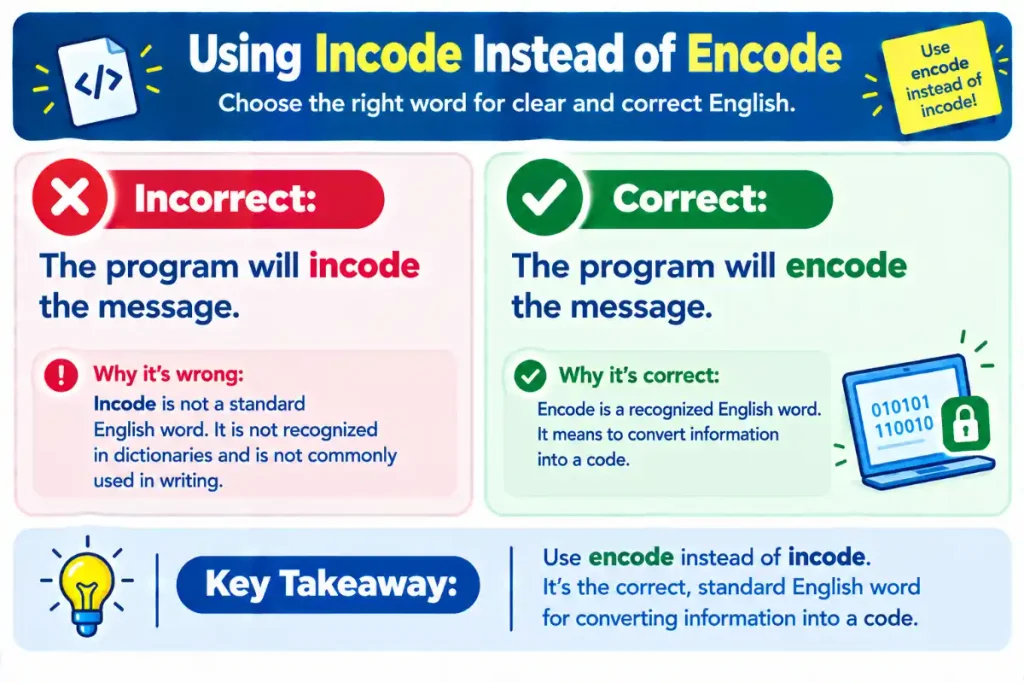
1. Using Incode Instead of Encode
Incorrect: The program will incode the message.
Correct: The program will encode the message.
The standard verb for converting information into a code or representation is encode.
2. Using Incoded Instead of Encoded
Incorrect: The computer incoded the file.
Correct: The computer encoded the file.
The standard past tense of encode is encoded. Its spelling follows the regular pattern of adding -d to the verb ending in silent e.
3. Confusing Encoding With Encryption
Incorrect: The file is encoded, so nobody can read it without a password.
Better: The file is encrypted, so unauthorized readers cannot access its contents without the required key or credentials.
Encoding alone does not guarantee confidentiality. Use encryption when you mean a security measure designed to prevent unauthorized access.
4. Using Encode When You Mean Enter
Incorrect: Please encode your phone number in the registration form.
Better: Please enter your phone number in the registration form.
The first sentence may suggest that the phone number needs to be converted into a coded representation. If the person simply needs to type the number into a form, enter is clearer.
5. Confusing Encoding With Decoding
Incorrect: The application decodes the text before converting it into the required coded format.
Potentially clearer: The application encodes the text into the required format.
The right verb depends on the direction of the conversion. Use encode to create the specified representation and decode to interpret an encoded representation.
6. Treating a Brand Name as an Ordinary Word
A product named Incode may use that spelling intentionally. When discussing the product, retain its official name rather than automatically replacing it with encode. The same principle applies to company names, software packages, and other proper nouns.
Related Words and Their Meanings
Several English words describe coding, entering, converting, and interpreting information. Understanding their differences can help you choose the most precise term.
| Word | Meaning | Example |
|---|---|---|
| Encode | Convert information into a specified representation | Encode the text as UTF-8. |
| Decode | Interpret encoded information | Decode the incoming message. |
| Encrypt | Transform information to protect confidentiality | Encrypt the document before sharing it. |
| Decrypt | Reverse an encryption process | Decrypt the file with the appropriate key. |
| Input | Supply information to a system | Input the results into the software. |
| Enter | Put information into a form or system | Enter your mailing address. |
| Convert | Change something from one form to another | Convert the document into a PDF. |
| Translate | Express information in another language or system | Translate the instructions into Spanish. |
| Format | Arrange or structure information | Format the text for the report. |
| Transcribe | Write down spoken or recorded information | Transcribe the interview. |
| Classify | Organize items into groups | Classify the responses by topic. |
| Interpret | Explain or determine the meaning of something | Interpret the coded results. |
These words may overlap in some technical situations, but they are not exact synonyms. Select the one that describes the action you intend to perform.
How to Choose the Correct Word in Professional Writing
Professional writing benefits from clear and accurate word choice. If you are unsure whether to use incode, encode, or another term, start by identifying the action in your sentence.
In Emails
Use straightforward language that readers can understand quickly.
Less clear: Please incode the customer information before submitting the form.
Clearer: Please enter the customer information before submitting the form.
If the task involves an actual encoding process, be more specific:
“The system will encode the customer information in the required format.”
In Academic Writing
Use encode when describing the conversion or categorization of information. Explain the method if readers need to understand how the encoding works.
Example: “The researchers encoded the survey responses according to three predefined categories.”
If the study involves qualitative coding, coded may be the more familiar and precise term, depending on the method.
In Technical Documentation
Use terminology that matches the actual process performed by the software.
For example:
- “The application encodes the text using UTF-8.”
- “The decoder converts the encoded data into readable text.”
- “The service encrypts sensitive information before storing it.”
Do not substitute encode for encrypt or input simply because the words seem related.
In Resumes and Job Applications
Use action verbs that accurately describe your work.
Instead of writing “Incoded customer records,” consider one of these options, depending on your responsibilities:
- “Entered customer records into the database.”
- “Encoded data into the required format.”
- “Classified customer feedback for analysis.”
- “Converted files into the required digital format.”
Specific wording helps employers understand what you actually did.
In Everyday Conversation
Most people do not need the technical word encode when they simply mean typing information into a form.
For example, “Enter your name here” is clearer than “Encode your name here” in an ordinary registration form.
Choose the simplest accurate word for your audience and situation.
Is Incode a Typo or a Technical Term?
The answer depends on where you found the word. In an ordinary sentence about converting data, incode is likely a spelling mistake for encode. In source code, a product description, or a company document, it may be an intentional name or identifier.
Use these questions to determine the likely meaning:
- Is the sentence about converting information into a code? Use encode in standard English.
- Is the sentence about typing information into a form? Use enter or input.
- Is the sentence about interpreting coded information? Use decode.
- Is the sentence about protecting private information? Consider encrypt.
- Is Incode the official name of a product or company? Preserve the name’s official spelling.
- Is
incodepart of a software project? Check the project’s documentation and naming conventions.
These questions help you distinguish an ordinary spelling error from a context-specific use.
Quick Tips for Remembering Encode
If you often confuse incode and encode, these simple reminders can help.
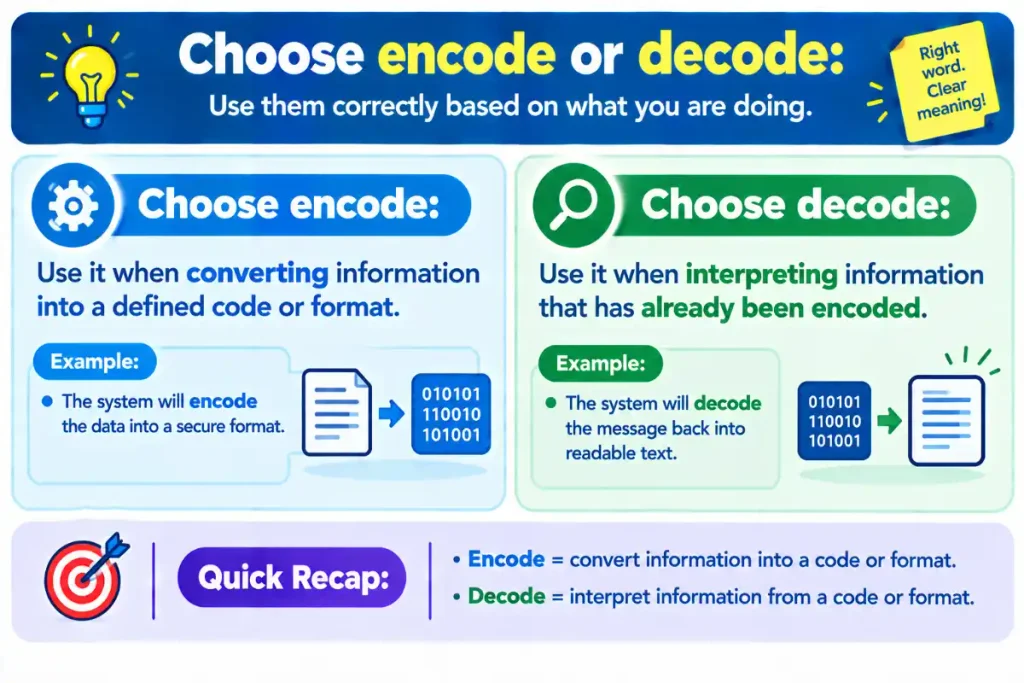
- Choose encode: Use it when converting information into a defined code or format.
- Choose decode: Use it when interpreting information that has already been encoded.
- Choose enter: Use it when typing information into a form or application.
- Choose input: Use it when supplying data to a system or process.
- Choose encrypt: Use it when transforming information to protect its confidentiality.
- Preserve proper names: Keep Incode if it is the verified name of a brand, product, or software identifier.
You can also remember the common forms of the verb:
| Verb form | Correct spelling |
|---|---|
| Base form | Encode |
| Third-person singular | Encodes |
| Present participle | Encoding |
| Simple past | Encoded |
| Past participle | Encoded |
For example, “The program encodes the message,” “The program is encoding the message,” and “The program encoded the message” are all grammatically correct. The spelling incoded is not the standard past-tense form for this meaning.
Conclusion
If you are wondering, is incode a word, the most useful answer is that it is not the standard English spelling for converting information into a code. In most sentences, encode is the correct choice. Its related forms include encodes, encoding, and encoded.
The best word still depends on the action you want to describe. Use decode when interpreting encoded information, enter or input when supplying data to a system, and encrypt when protecting information from unauthorized access. These distinctions make your writing more precise, especially in technical and professional settings.
Although Incode may be valid as a brand name or programming identifier, that specialized use does not make it a standard substitute for encode. When writing for a general American audience, choose the established word that communicates your meaning clearly.
Frequently Asked Questions
Is incode a real English word?
Incode is not a standard English word for converting information into a code. It may appear as a proper name or programming identifier, but encode is the usual spelling for the verb.
Is it incode or encode?
Encode is correct when you mean to convert information into a coded form or representation. Use incode only when it is an intentional name or identifier.
What does incode mean in computing?
In ordinary computing terminology, incode is not the standard verb for encoding information. It may refer to a custom identifier or a product name, depending on the software or context.
Is incoded the correct past tense of encode?
No. The correct past tense and past participle are encoded. For example, “The application encoded the data before sending it.”
What is the difference between encode and decode?
Encode converts information into a specified representation, while decode interprets or converts encoded information into a usable form. They describe opposite stages of many data-processing tasks.
Is encoding the same as encryption?
No. Encoding changes how information is represented, while encryption transforms information to protect its confidentiality. Encoding does not automatically make information secret.
Should I use encode or input?
Use encode when you mean to convert information into a particular representation. Use input or enter when you mean to supply information to a computer, application, or form.
1 thought on “Is Incode a Word? Correct Spelling and Meaning Explained”