

If you’re writing a work email, explaining a technical problem, or describing how you fixed an issue, you might wonder whether troubleshooted or troubleshot is the correct past tense of troubleshoot. Both forms appear in writing, but troubleshot is the standard and most widely accepted past-tense form in American English.
Troubleshoot means to identify, investigate, and resolve problems, especially with computers, software, machines, and other technical systems. Its past tense follows an irregular pattern, similar to verbs such as shoot and shut.
Troubleshot is the preferred past tense and past participle of troubleshoot. Although some people use troubleshooted by adding -ed, troubleshot is the safer choice for professional emails, résumés, technical reports, and academic writing.
Understanding the difference can help you describe completed work clearly and use the verb correctly in different tenses. This guide explains the standard spelling, grammar rules, common mistakes, and practical examples of troubleshoot, troubleshot, and troubleshooted.
What Does Troubleshot Mean?
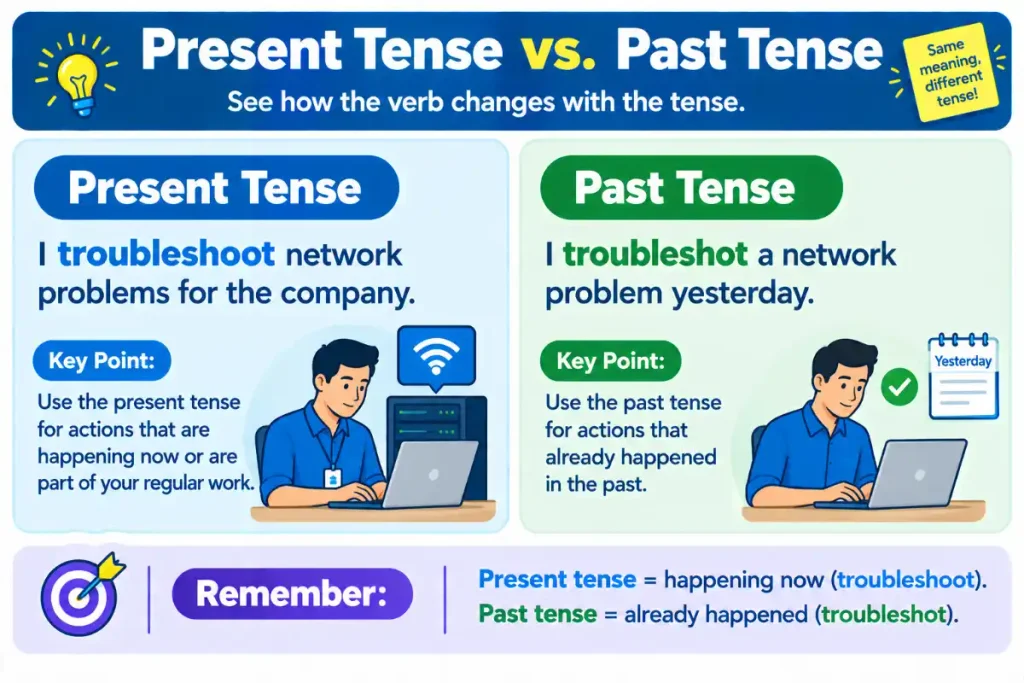
Troubleshot is the past tense and past participle of troubleshoot. It means that someone investigated a problem and worked to identify or fix its cause. The verb is especially common in technical and professional settings. People troubleshoot computers, network connections, software errors, electrical systems, vehicles, and equipment.
For example:
- Present tense: I troubleshoot network problems for the company.
- Past tense: I troubleshot a network problem yesterday.
- Past participle: I have troubleshot several network problems this week.
In each example, the verb describes the process of finding and addressing a problem. Troubleshooting does not always mean that someone completely fixed the issue. A person can troubleshoot a system, identify the cause, and recommend a solution without resolving the problem immediately. For instance, a technician might say, “I troubleshot the printer and identified a faulty cable.” This sentence means the technician investigated the problem and found its cause, even if replacing the cable happened later.
Troubleshooted or Troubleshot: What’s the Difference?
The main difference between troubleshooted and troubleshot is that troubleshot is the established irregular form, while troubleshooted is a less common regularized form. English has both regular and irregular verbs. Regular verbs usually form the past tense by adding -ed, as in worked and fixed. Irregular verbs change form in other ways, as in shoot becoming shot. Because troubleshoot contains the verb shoot, its traditional past-tense form follows the same pattern.
| Word | Status | Example |
|---|---|---|
| Troubleshoot | Correct present-tense form | I troubleshoot computer errors. |
| Troubleshot | Standard past-tense form | I troubleshot the computer yesterday. |
| Troubleshot | Standard past participle | I have troubleshot this issue before. |
| Troubleshooted | Less common alternative | I troubleshooted the device last week. |
| Troubleshooting | Present participle or gerund | She is troubleshooting the connection. |
Is Troubleshooted Incorrect?
Troubleshooted is understandable, and some speakers use it by applying the regular -ed ending. However, it is not the preferred form in standard American English. If you want to follow established usage, choose troubleshot instead. It sounds natural in technical documentation, professional communication, and everyday conversation.
For example:
- Less preferred: The technician troubleshooted the server yesterday.
- Preferred: The technician troubleshot the server yesterday.
Both sentences communicate the same basic idea, but the second uses the standard irregular past tense. This distinction matters most when you want your writing to sound polished and consistent. In a résumé, formal report, or workplace email, troubleshot is the better choice.
What Is the Past Tense of Troubleshoot?
The past tense of troubleshoot is troubleshot. Use troubleshot when describing an investigation or problem-solving process that took place in the past. The form does not change based on the subject.
Examples:
- I troubleshot the software issue.
- You troubleshot the connection.
- He troubleshot the faulty printer.
- She troubleshot the login problem.
- We troubleshot the network outage.
- They troubleshot the equipment failure.
Notice that the verb stays the same with I, you, he, she, we, and they. Unlike the present-tense form troubleshoots, the past-tense form does not take an additional ending for third-person singular subjects.
Troubleshoot Verb Forms at a Glance
Use this table to choose the correct form for the sentence you are writing.
| Verb form | Correct spelling | Example |
|---|---|---|
| Base form | Troubleshoot | I need to troubleshoot the issue. |
| Third-person singular | Troubleshoots | She troubleshoots software problems. |
| Simple past | Troubleshot | She troubleshot the issue yesterday. |
| Past participle | Troubleshot | She has troubleshot similar issues. |
| Present participle | Troubleshooting | She is troubleshooting the system. |
| Gerund | Troubleshooting | Troubleshooting requires patience. |
The most important distinction is between troubleshot and troubleshooting. Use troubleshot for completed actions and troubleshooting for ongoing actions or the general activity of finding and fixing problems.
Why Do People Confuse Troubleshooted and Troubleshot?
The confusion comes from the way English forms past-tense verbs.
Most English verbs use the regular -ed ending. For example:
- Fix becomes fixed.
- Repair becomes repaired.
- Diagnose becomes diagnosed.
- Investigate becomes investigated.
- Troubleshoot is often incorrectly regularized as troubleshooted.
However, troubleshoot is a compound verb formed from trouble and shoot. The verb shoot has the irregular past-tense form shot, so troubleshoot traditionally becomes troubleshot.
Compare these related verbs:
| Present tense | Past tense | Past participle |
|---|---|---|
| Shoot | Shot | Shot |
| Overshoot | Overshot | Overshot |
| Reshoot | Reshot | Reshot |
| Troubleshoot | Troubleshot | Troubleshot |
These patterns help explain why troubleshot is the preferred form. People may still write troubleshooted because they recognize the verb as a technical term and apply the familiar regular-verb rule. Others may encounter the less common form in informal writing and assume it is standard. The easiest solution is to remember that troubleshoot follows the pattern of shoot, not work or repair.
How to Use Troubleshot Correctly in a Sentence
Use troubleshot when the subject investigated a problem in the past. The word can describe a completed task, a previous work responsibility, or an earlier attempt to find the cause of an issue. Here are several useful patterns.
1. Use Troubleshot for a Completed Action
When an action happened at a specific time in the past, use the simple past tense.
Examples:
- I troubleshot the internet connection before the meeting.
- The technician troubleshot the faulty air conditioner on Monday.
- Our IT team troubleshot the login issue after several employees reported problems.
These sentences describe actions that occurred in the past.
2. Use Troubleshot With Has, Have, or Had
Use troubleshot as a past participle with an appropriate helping verb.
Examples:
- I have troubleshot similar problems in previous projects.
- She has troubleshot several software errors this month.
- We had troubleshot the network before the second outage occurred.
The helping verb determines the tense. The main verb remains troubleshot.
3. Use Troubleshooting for an Ongoing Action
If someone is currently investigating a problem, use troubleshooting with an appropriate form of be.
Examples:
- I am troubleshooting the payment system.
- The engineer is troubleshooting the new software.
- They were troubleshooting the server when the power went out.
Do not use troubleshot to describe an action that is still in progress unless the sentence separately refers to a completed past action.
12 Examples of Troubleshot in Real Sentences
The following examples show how to use troubleshot naturally in American English across work, school, technology, and everyday situations.
- Work: The IT specialist troubleshot the company’s email server before the workday began.
- Technology: I troubleshot my laptop after it stopped connecting to Wi-Fi.
- Customer service: The support representative troubleshot the payment error and explained how to resolve it.
- School: Our computer science instructor showed us how she troubleshot a coding problem.
- Networking: The network administrator troubleshot the connection after several employees lost internet access.
- Software development: The developer troubleshot the application and found an error in the latest update.
- Home maintenance: My brother troubleshot the smart thermostat before calling a repair technician.
- Electronics: The technician troubleshot the television and discovered that the cable was damaged.
- Remote work: I troubleshot the video conference software before joining the client meeting.
- Small business: The store manager troubleshot the checkout system after customers reported payment delays.
- Job interview: I explained how I troubleshot a difficult technical issue under a tight deadline.
- Teamwork: Our engineering team troubleshot the equipment failure and identified the part that needed replacement.
Each example uses troubleshot to describe an investigation that happened in the past.
Examples With Different Verb Tenses
Understanding tense is just as important as choosing the correct spelling.
| Tense | Example sentence |
|---|---|
| Simple present | I troubleshoot software problems every day. |
| Simple past | I troubleshot a software problem yesterday. |
| Present perfect | I have troubleshot similar problems before. |
| Past perfect | I had troubleshot the system before the technician arrived. |
| Present continuous | I am troubleshooting a software problem now. |
| Past continuous | I was troubleshooting the system when it restarted. |
| Future | I will troubleshoot the issue tomorrow. |
These examples demonstrate that the verb changes according to the time and structure of the sentence. The past participle remains troubleshot in perfect tenses.
Troubleshot or Troubleshooting: Which Should You Use?
Troubleshot describes a past action or acts as a past participle. Troubleshooting describes an ongoing action or functions as a noun referring to the process of finding and resolving problems.
| Situation | Correct form | Example |
|---|---|---|
| A completed task | Troubleshot | I troubleshot the computer yesterday. |
| An ongoing task | Troubleshooting | I am troubleshooting the computer. |
| A general skill | Troubleshooting | Troubleshooting is one of my strengths. |
| A past experience | Troubleshot | I have troubleshot hundreds of devices. |
| A future task | Troubleshoot | I will troubleshoot the device tomorrow. |
When Should You Use Troubleshooting?
Use troubleshooting when discussing a process, activity, or skill.
For example:
- Troubleshooting network errors takes patience.
- She is responsible for troubleshooting software issues.
- My troubleshooting skills helped the team identify the problem.
In a résumé, you might list technical troubleshooting as a skill. If you want to describe a completed achievement, however, troubleshot is more appropriate.
For example:
- Skill: Technical troubleshooting and system maintenance.
- Achievement: Troubleshot network problems and restored access for employees.
The correct choice depends on whether you are naming a skill or describing an action.
Troubleshot or Fixed: What’s the Difference?
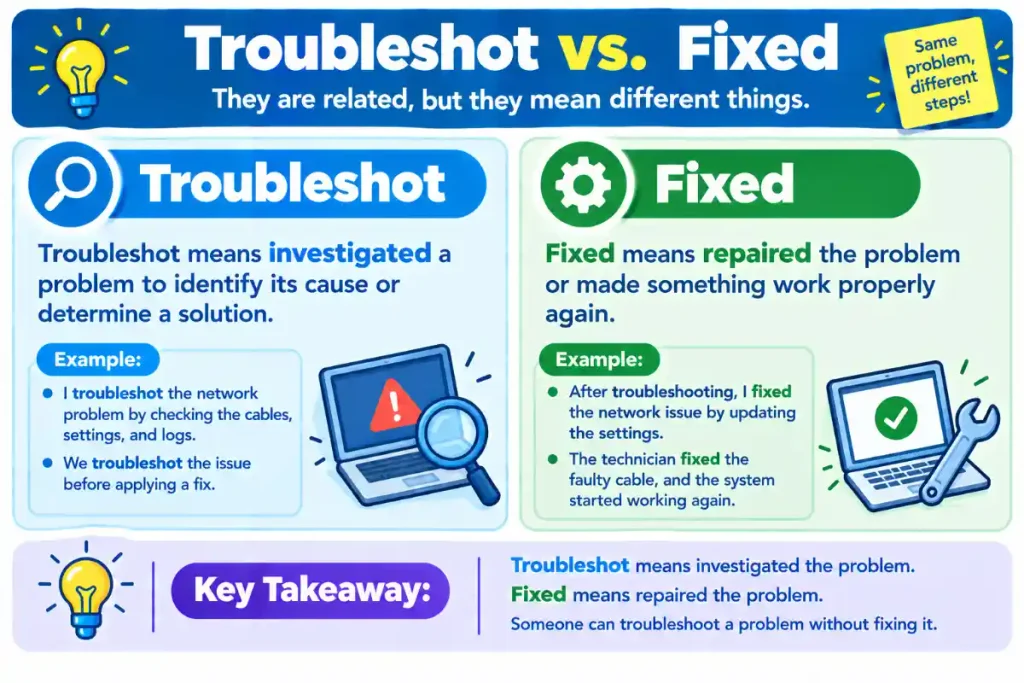
Troubleshot means investigated a problem to identify its cause or determine a solution. Fixed means repaired the problem or made something work properly again. Someone can troubleshoot a problem without fixing it.
| Word | Meaning | Example |
|---|---|---|
| Troubleshot | Investigated a problem | I troubleshot the printer to identify the cause. |
| Fixed | Corrected the problem | I fixed the printer by replacing the cable. |
| Diagnosed | Identified the nature or cause of a problem | The technician diagnosed a faulty power supply. |
| Repaired | Restored something damaged or faulty | The technician repaired the printer. |
| Resolved | Successfully dealt with an issue | The team resolved the network outage. |
Consider this example:
“The technician troubleshot the server but could not fix it before the end of the shift.”
The sentence is perfectly logical because investigating a problem does not guarantee an immediate solution.
If you know the issue was completely corrected, fixed, repaired, or resolved may communicate the result more clearly.
Troubleshot or Diagnosed: What’s the Difference?
Troubleshot and diagnosed overlap in meaning, but they emphasize different parts of problem-solving. Diagnosed focuses on identifying the nature or cause of a problem. Troubleshot often describes a broader process that can include testing, investigating, diagnosing, and trying possible solutions.
For example:
- The technician diagnosed the computer’s overheating problem.
- The technician troubleshot the computer, tested its cooling system, and identified a blocked air vent.
The first sentence emphasizes identifying the problem. The second describes a broader investigation. In medical settings, diagnosed has a specific meaning related to identifying a disease or condition. Troubleshot is generally more appropriate for technical systems, equipment, processes, and operational issues.
Troubleshot or Problem-Solved: What’s the Difference?
Problem-solved is a broad expression that describes finding a way to deal with a difficulty. Troubleshot usually emphasizes investigating a specific malfunction or technical issue.
For example:
- The manager problem-solved by changing the team’s schedule.
- The technician troubleshot the software error by testing different settings.
The first sentence describes a general solution to a challenge. The second focuses on a technical investigation. You can use problem-solving when discussing a broad skill and troubleshooting when discussing the more specific ability to investigate technical problems. For instance, a résumé might list both problem-solving and technical troubleshooting as separate skills because they can involve different tasks.
Can You Use Troubleshot in a Résumé?
Yes. Troubleshot is a strong choice for a résumé when describing completed technical work. It is concise, specific, and appropriate for professional writing. Use it to explain what you investigated, which systems you worked on, and what outcome you achieved. Whenever possible, include the result rather than listing a task without context.
Résumé Examples
- Troubleshot hardware and software issues to support daily business operations.
- Troubleshot network connectivity problems across office workstations.
- Troubleshot application errors and collaborated with developers to identify solutions.
- Troubleshot printer and scanner malfunctions to reduce workplace disruptions.
- Troubleshot system configuration issues during software installations.
These statements use active voice and begin with a clear action verb.
How to Make a Résumé Bullet More Effective
Compare these two examples:
- Weak: Responsible for troubleshooting computer problems.
- Stronger: Troubleshot computer problems and helped restore access to essential business applications.
The second example emphasizes the action and its practical purpose. Only claim results you can support. If you investigated an issue but did not resolve it, describe the investigation accurately instead of claiming that you fixed the problem.
For example: “Troubleshot recurring application errors and documented findings for the engineering team.” This wording is useful when the investigation contributed to a solution but another person or team completed the repair.
Is Troubleshot Formal or Informal?
Troubleshot is appropriate in both formal and informal English. It is common in technical workplaces, IT support, engineering, customer service, and everyday discussions about equipment or software problems.
Its suitability depends more on the subject and audience than on the level of formality.
| Context | Example | Suitability |
|---|---|---|
| Professional email | I troubleshot the connection and identified the likely cause. | Appropriate |
| Technical report | The engineering team troubleshot the device under normal operating conditions. | Appropriate |
| Résumé | Troubleshot application errors and documented corrective actions. | Appropriate |
| Academic writing | The researchers troubleshot the equipment before repeating the test. | Appropriate when accurate |
| Casual conversation | I troubleshot my laptop last night. | Natural |
| Text message | I troubleshot the Wi-Fi, but it still isn’t working. | Natural |
For readers who may not be familiar with technical language, consider a simpler alternative such as investigated the problem or worked to fix the issue. For a technical audience, troubleshot often communicates the intended meaning efficiently.
Is Troubleshot Used in American and British English?
Troubleshot is understood in both American and British English. The past-tense distinction between troubleshot and troubleshooted is not a standard US-versus-UK spelling difference. American writers should generally use troubleshot, and British writers can use the same form.
For example:
- American English: The technician troubleshot the computer.
- British English: The technician troubleshot the computer.
The spelling does not need to change when writing for a British audience. Some related vocabulary differs by region, but those differences do not affect the standard past tense of troubleshoot. For American readers, the safest choice remains troubleshot in professional, educational, and everyday contexts.
Common Mistakes to Avoid
Several mistakes can make sentences involving troubleshoot less clear or grammatically incorrect.
1. Using Troubleshooted in Formal Writing
Less preferred: The engineer troubleshooted the network problem.
Preferred: The engineer troubleshot the network problem.
Use the established irregular form to maintain standard usage.
2. Using Troubleshot for an Ongoing Action
Incorrect: I am troubleshot the computer right now.
Correct: I am troubleshooting the computer right now.
The present continuous tense requires am, is, or are followed by the -ing form.
3. Using Troubleshoot Instead of Troubleshot
Incorrect: Yesterday, I troubleshoot the software error.
Correct: Yesterday, I troubleshot the software error.
The word yesterday signals a completed past action, so the simple past tense is appropriate.
4. Using Troubleshoot Instead of Troubleshot After Have
Incorrect: I have troubleshoot this problem before.
Correct: I have troubleshot this problem before.
The present perfect tense requires a past participle after have or has. The standard past participle of troubleshoot is troubleshot.
5. Confusing Troubleshooting With the Final Solution
Potentially misleading: I troubleshot the issue, so the issue is fixed.
Clearer: I troubleshot the issue and identified the cause, but the repair is still pending.
Troubleshooting describes an investigation or problem-solving process. It does not automatically mean that the issue has been resolved.
6. Using the Wrong Verb Form After Did
Incorrect: Did you troubleshot the computer?
Correct: Did you troubleshoot the computer?
After did, use the base form of the main verb. The past tense is already expressed by did.
The same rule applies to other questions and negatives:
- Did she troubleshoot the printer?
- We did not troubleshoot the problem.
- Why did they troubleshoot the system again?
Avoid combining did with the past-tense form.

Quick Tips for Remembering the Correct Form
Use these simple rules to choose the correct word without second-guessing yourself.
- Remember shoot → shot. Since troubleshoot contains shoot, the standard past tense is troubleshot.
- Use troubleshot for completed past actions. For example, “I troubleshot the network yesterday.”
- Use have or has troubleshot for present perfect sentences. For example, “She has troubleshot similar errors before.”
- Use troubleshooting for ongoing actions. For example, “We are troubleshooting the software.”
- Use troubleshoot after did, will, can, or should. For example, “Did you troubleshoot the issue?”
- Choose precise verbs when the result matters. Use diagnosed for identifying a cause, fixed for correcting a problem, and resolved for successfully dealing with an issue.
- Use troubleshot in résumés and technical reports. It is the standard, professional choice.
A useful memory trick is to say the two verbs together: shoot, shot; troubleshoot, troubleshot. The matching pattern makes the correct form easier to recall.
Conclusion
When deciding between troubleshooted or troubleshot, choose troubleshot for standard American English. It is the established past-tense form of troubleshoot and also serves as its past participle. Use it in professional emails, résumés, technical reports, academic writing, and everyday conversations.
Remember that troubleshooting means investigating a problem, while fixing or resolving it means correcting the issue. These actions may happen together, but they do not always mean the same thing. Choose a verb that accurately describes your work and the result you achieved.
If you’re unsure which form to use, follow the pattern shoot, shot; troubleshoot, troubleshot. This simple rule will help you write clear, natural sentences and avoid the less preferred form troubleshooted.
Frequently Asked Questions
Is troubleshooted or troubleshot correct?
Troubleshot is the standard and preferred past tense of troubleshoot. Although some people use troubleshooted, the irregular form is the safer choice in standard American English.
How do you spell the past tense of troubleshoot?
Spell the past tense troubleshot. For example, “I troubleshot the computer after it stopped working.”
Is troubleshooted ever acceptable?
Troubleshooted appears in some informal and technical writing, but it is less widely accepted than troubleshot. For polished professional writing, use troubleshot.
Is troubleshot also the past participle?
Yes. Troubleshot serves as both the simple past tense and the past participle. For example, “I troubleshot the issue yesterday” and “I have troubleshot this issue before.”
What is the present tense of troubleshot?
The base form is troubleshoot. Use it for the present tense with I, you, we, and they. Use troubleshoots with he, she, and it.
Can I write “I have troubleshooted the issue”?
Although readers will likely understand the sentence, the preferred standard form is “I have troubleshot the issue.” The past participle troubleshot is the more established choice.
What is another word for troubleshot?
Depending on the context, alternatives include investigated, diagnosed, tested, analyzed, repaired, and resolved. These words have slightly different meanings, so choose the one that accurately describes what you did.
2 thoughts on “Troubleshooted or Troubleshot: Which Is Correct?”