
If you’re writing a work email, responding to a client, or addressing a mistake with a coworker, “I’m sorry” isn’t always the best choice. The right professional apology alternatives can help you sound sincere, responsible, and confident without sounding stiff or overly formal.
The best alternative depends on what happened. You might need to acknowledge a mistake, take responsibility for a delay, express regret, or repair a relationship. Phrases such as “I apologize for the oversight,” “Thank you for your patience,” and “I take responsibility for the mistake” each communicate something slightly different.
This guide explains the most useful professional ways to apologize, when to use each one, and how to avoid apologies that sound weak, defensive, or insincere.

What Are Professional Apology Alternatives?
Professional apology alternatives are phrases you can use instead of a basic “I’m sorry” in workplace and business communication. They help you express regret, acknowledge responsibility, or show consideration while matching the seriousness of the situation. A strong professional apology usually does three things:
- Acknowledges what happened.
- Takes appropriate responsibility.
- Shows what you’ll do next, when necessary.
For example:
“I apologize for the delay. I should have provided the report sooner, and I’ll make sure the remaining materials are sent by Friday.”
That works better than simply saying, “Sorry about that,” because it identifies the problem and shows accountability.
Sure — 10 professional apology alternatives ka short table:
| # | Alternative |
|---|---|
| 1 | I apologize |
| 2 | My apologies |
| 3 | Please forgive me |
| 4 | I regret that |
| 5 | I’m truly sorry |
| 6 | Pardon me |
| 7 | I take responsibility |
| 8 | Please accept my apology |
| 9 | I sincerely apologize |
| 10 | I regret my mistake |
The Best Professional Apology Depends on the Situation
A useful apology should match the problem. Saying “I apologize for the inconvenience” after a serious personal mistake may sound impersonal, while “That was my mistake” may be too blunt for a sensitive client situation. Here are some of the most common situations and the wording that fits them.
For a Mistake
Use direct language when you made the error.
“That was my mistake. I entered the wrong figures in the report, and I’ve corrected them.”
Other good options include:
- “I take responsibility for the error.”
- “I apologize for the mistake.”
- “I should have caught that before sending the report.”
- “I recognize the error and have corrected it.”
The key is not to hide behind vague language.
For a Delayed Response
If you took too long to reply to an email or request, keep the apology simple.
“I apologize for the delayed response. I appreciate your patience.”
You can also say:
“Thank you for your patience. I’m sorry I wasn’t able to respond sooner.”
If you don’t need to explain the reason for the delay, don’t add a long excuse.
For Missing a Deadline
A missed deadline usually calls for both responsibility and a solution.
“I apologize for missing the deadline. I take responsibility for the delay and will have the completed document to you by 3 p.m. tomorrow.”
This is stronger than:
“Sorry I missed the deadline, but I had a lot going on.”
The second version may sound like you’re trying to shift responsibility.
For a Client or Customer
Customer-facing apologies should acknowledge the inconvenience and focus on resolution.
“We apologize for the inconvenience and appreciate your patience while we work to resolve the issue.”
For a more personal response:
“I’m sorry for the trouble this caused. I understand how frustrating this must be, and I’m working to get this resolved.”
For a Miscommunication
A misunderstanding doesn’t always mean one person was entirely at fault. Use language that recognizes the confusion without becoming defensive.
“I’m sorry for the misunderstanding. I should have been clearer about the deadline.”
Or:
“I apologize for the confusion. Let me clarify what I intended.”
For Giving Incorrect Information
Be especially direct when someone relied on information you provided.
“I apologize for the incorrect information in my earlier message. I’ve verified the details and want to provide the correct information below.”
This approach makes the correction clear and helps prevent further confusion.
For a Coworker
With a colleague, natural language is usually better than overly formal business language.
“I’m sorry I missed that detail. I’ll take care of it this afternoon.”
Or:
“That was my mistake. Thanks for catching it.”
You don’t need to write “Please accept my sincerest apologies” every time you make a small workplace mistake.
For an Inappropriate Comment
If your words offended someone, avoid making the apology about your intentions.
Instead of:
“I’m sorry if you were offended.”
Try:
“I apologize for what I said. It was inappropriate, and I understand why it was hurtful.”
The second version recognizes the impact rather than questioning the other person’s reaction.
Professional Apology Alternatives by Tone
The same basic message can sound very different depending on the relationship and situation.
Formal
Formal language works well in client communications, official correspondence, and serious workplace situations.
- “Please accept my apologies.”
- “I sincerely apologize for the error.”
- “I apologize for any inconvenience this may have caused.”
- “We regret the error.”
- “I acknowledge the mistake and take full responsibility.”
Example:
“Please accept my apologies for the delay in processing your request. We have now completed the review.”
Professional but Natural
For most workplace emails, this is the safest category.
- “I apologize for the delay.”
- “I’m sorry for the confusion.”
- “I appreciate your patience.”
- “That was my mistake.”
- “I should have confirmed the details first.”
- “Thank you for bringing this to my attention.”
Example:
“I’m sorry for the confusion. I should have clarified the deadline in my original email.”
Warm and Empathetic
Use these when the relationship or situation calls for a more human response.
- “I’m sorry this caused frustration.”
- “I understand why this was frustrating.”
- “I appreciate your patience while we work through this.”
- “I’m sorry for putting you in a difficult position.”
- “I regret that this created additional work for you.”
Example:
“I’m sorry for putting you in a difficult position. I appreciate your patience, and I’ll make sure you have the information you need today.”
Direct and Accountable
These phrases are especially useful when you need to demonstrate ownership.
- “That was my mistake.”
- “I take responsibility for the error.”
- “I should have handled this differently.”
- “I should have caught this sooner.”
- “I made an error in the original submission.”
Example:
“I take responsibility for the missed deadline. I should have raised the issue sooner.”
Professional Apology Alternatives for Email
An email apology should usually be short. Start with the apology, explain only what matters, and provide the next step.
Simple Email Apology
“We apologize for the inconvenience caused by the scheduling error. We’ve corrected the issue and confirmed your new appointment time.”
Apology for Missing a Deadline
“I’m sorry I wasn’t able to meet the original deadline. I take responsibility for the delay and will send the completed file by noon tomorrow.”
Apology After a Misunderstanding
“I’m sorry for the misunderstanding. I realize my earlier message wasn’t clear, so I’d like to clarify the next steps.”
These examples demonstrate an important principle: the apology should usually be followed by useful information.
Professional Apology Alternatives for Work Messages
Short workplace messages don’t need formal business language.
Instead of:
“Please accept my sincerest apologies for this unfortunate oversight.”
You could write:
“Sorry, I missed that. I’ll fix it now.”
For a slightly more formal situation:
“I apologize for missing that detail. I’ll update the document and send it back shortly.”
For a manager:
“I apologize for missing the deadline. I should have flagged the issue earlier, and I’ll have the revised version ready by tomorrow morning.”
“That was my mistake. Thanks for catching it.”
The relationship matters. A message to a close coworker can sound natural and direct, while a message to a customer may require more care.
Professional Apology Alternatives for Customer Service
Customer apologies often need to acknowledge both the problem and the customer’s inconvenience.
Useful phrases include:
- “We apologize for the inconvenience.”
- “We’re sorry for the trouble.”
- “We understand how frustrating this situation is.”
- “Thank you for your patience.”
- “We regret the error.”
- “We appreciate your understanding.”
- “We’ve corrected the issue.”
- “We’re taking steps to prevent this from happening again.”
A strong customer apology might look like this:
“We apologize for the inconvenience caused by the incorrect charge. We’ve corrected your account and issued the appropriate refund. Thank you for your patience while we resolved the issue.”
Notice that the message doesn’t spend several sentences defending the company. It acknowledges the problem and explains the solution.
Professional Apology Alternatives for a Resume or Cover Letter
Apology language usually doesn’t belong on a resume. A resume is meant to highlight qualifications, not explain mistakes. A cover letter can occasionally mention a career gap or other unusual circumstance, but you generally don’t need to apologize for it.
Instead of:
“I apologize for the two-year gap in my employment.”
Use neutral, factual language:
“After leaving my previous position, I took two years to care for a family member before returning to the workforce.”
This is not technically an apology alternative. It’s a better communication strategy: don’t apologize when you’re simply providing context.
Professional Apology Alternatives for Academic Writing
Academic writing generally favors precise, neutral language rather than conversational apologies.
Depending on the context, you might write:
- “I acknowledge this limitation.”
- “This was an error in the original analysis.”
- “The previous statement should be corrected.”
- “I regret the error.”
- “The earlier interpretation was incorrect.”
For example:
“The previous version contained an error in the calculation. The corrected result is shown below.”
This is often more appropriate than writing “I’m sorry” in a research paper or formal academic document.
10 Examples of Professional Apologies in Real Sentences
Here are varied examples showing how professional apology language works in real situations.
- Email: “I apologize for the delayed response, and I appreciate your patience.”
- Workplace mistake: “That was my mistake. I entered the wrong date and have corrected the schedule.”
- Client communication: “We apologize for the inconvenience and are working to resolve the issue as quickly as possible.”
- Missed deadline: “I’m sorry I missed the deadline. I should have communicated the delay sooner.”
- Miscommunication: “I apologize for the confusion. My previous email didn’t clearly explain the change.”
- Incorrect information: “I apologize for providing the wrong information in my earlier message.”
- Coworker: “Sorry, I overlooked that attachment. Thanks for pointing it out.”
- Manager: “I take responsibility for the error and have reviewed the process to make sure it doesn’t happen again.”
- Customer complaint: “I understand your frustration, and I’m sorry for the trouble this caused.”
- Serious workplace issue: “I sincerely apologize for how I handled the situation. I should have addressed the concern directly rather than delaying the conversation.”
“I Apologize” vs. “I’m Sorry”: What’s the Difference?
“I apologize” and “I’m sorry” can both be professional. The difference is mainly one of tone and context.
| Phrase | Tone | Best Use |
|---|---|---|
| I’m sorry | Natural, personal | Coworkers, everyday workplace communication, sensitive conversations |
| I apologize | Formal, direct | Business emails, customers, official communication |
| I sincerely apologize | More serious and emphatic | Significant mistakes or harm |
| Please accept my apologies | Formal and traditional | Official or highly professional correspondence |
| That was my mistake | Direct and accountable | Clear personal responsibility |
| I take responsibility | Strong and explicit | Serious errors or missed obligations |
“I apologize” is not automatically better than “I’m sorry.” In a normal conversation with a coworker, “I’m sorry I missed that” can sound more genuine than “I apologize for the oversight.”

“I Apologize” vs. “I Regret”: What’s the Difference?
“I regret” expresses sorrow about an outcome or mistake.
Compare:
“I apologize for the incorrect information.”
and:
“I regret the error in the original report.”
The first is a direct apology. The second is more formal and somewhat more detached.
“I regret” can be useful in formal writing, but it may sound cold if the situation calls for personal empathy.
“I’m Sorry for the Confusion” vs. “I Apologize for the Confusion”
Both are correct.
“I’m sorry for the confusion” sounds more conversational and personal.
“I apologize for the confusion” sounds more formal and businesslike.
For a coworker:
“I’m sorry for the confusion. I should have explained that more clearly.”
For a customer:
“We apologize for the confusion regarding the updated billing information.”
Neither phrase is universally better. Choose based on the relationship and seriousness of the situation.
How to Apologize Without Sounding Weak
A professional apology doesn’t require excessive self-blame. Avoid stacking apologies:
“I’m so, so sorry. I sincerely apologize. I feel terrible about this, and I really hope you can forgive me.”
That can make a workplace message uncomfortable and distract from the actual problem. Instead, use a simple structure:
Apology + responsibility + solution
For example:
“I apologize for the error. I should have verified the figures before sending the report. I’ve corrected the report and attached the updated version.”
This sounds confident because it doesn’t avoid responsibility or overdo it.
Apologies to Avoid in Professional Communication
Some phrases can weaken an apology or make it sound defensive.
“Sorry if…”
“I’m sorry if my comment offended you.”
The word “if” can suggest that you’re uncertain whether you did anything wrong.
Better:
“I’m sorry for the comment. It was inappropriate.”
“Sorry, but…”
“I’m sorry, but I was busy.”
The word “but” can make the apology sound like an excuse.
Better:
“I’m sorry for the delay. I should have let you know sooner.”
If an explanation is genuinely necessary, give it after taking responsibility.
“I apologize if there was any confusion.”
This can sound as though the confusion is entirely the other person’s problem.
Better:
“I apologize for the confusion. I should have made the instructions clearer.”
“Mistakes were made.”
This passive construction avoids identifying responsibility.
Better:
“I made an error in the report, and I’ve corrected it.”
“I’m sorry you feel that way.”
This phrase addresses the person’s reaction instead of the underlying issue. In many situations, it can sound dismissive.
Better:
“I understand why you’re frustrated, and I’m sorry for how this affected you.”
How to Write a Strong Professional Apology
For most workplace situations, you can build an effective apology in four steps.
1. Name the problem
Be specific about what went wrong.
“I apologize for sending the incorrect invoice.”
2. Accept responsibility
Don’t make the reader guess who is responsible.
“I should have reviewed the final figures before sending it.”
3. Explain the correction
Tell the reader what you’ve done or will do.
“I’ve corrected the invoice and attached the new version.”
4. Close appropriately
A simple thank-you can work well.
“Thank you for your patience.”
Put together:
“I apologize for sending the incorrect invoice. I should have reviewed the final figures before sending it. I’ve corrected the invoice and attached the new version. Thank you for your patience.”
That’s professional without sounding scripted.
When You Shouldn’t Apologize
Not every difficult interaction requires an apology. Sometimes “sorry” is used simply to be polite:
“Sorry, could you repeat that?”
That’s perfectly normal in conversation, but unnecessary in many professional messages. You also don’t need to apologize for:
- Asking a reasonable question
- Requesting clarification
- Setting a reasonable boundary
- Following an established policy
- Taking approved time off
- Having a different professional opinion
- Asking someone to meet an agreed deadline
Instead of:
“Sorry to bother you, but could you send the report?”
Try:
“Could you send the report when you have a chance?”
This sounds confident and respectful without an unnecessary apology.
Choosing the Right Apology: Mild to Strong
The seriousness of your language should match the seriousness of the situation.
Mild
Use for small oversights or minor inconveniences.
- “Sorry about that.”
- “I’m sorry I missed that.”
- “Thanks for catching that.”
- “I appreciate your patience.”
Moderate
Use for meaningful mistakes, delays, or communication problems.
- “I apologize for the delay.”
- “I apologize for the confusion.”
- “I should have communicated this sooner.”
- “I regret the mistake.”
- “That was my mistake.”
Strong
Use when your actions caused significant harm, disruption, or offense.
- “I sincerely apologize.”
- “I take full responsibility for my actions.”
- “I apologize for how I handled the situation.”
- “I recognize the impact this had.”
- “I should have handled this differently.”
Stronger wording isn’t automatically more professional. A serious phrase can feel excessive when the mistake is minor.
What Is the Best Professional Apology for an Email?
For a typical business email, “I apologize for the [specific issue]” is one of the safest professional apology alternatives.
For example:
“I apologize for the delay in getting these documents to you.”
If you want to sound warmer:
“I’m sorry for the delay, and I appreciate your patience.”
If you need to emphasize responsibility:
“I take responsibility for the delay and should have communicated the issue sooner.”
The best choice depends on the situation, but specificity usually makes an apology stronger.
Quick Tips for Choosing the Right Apology
Before sending a professional apology, ask yourself:
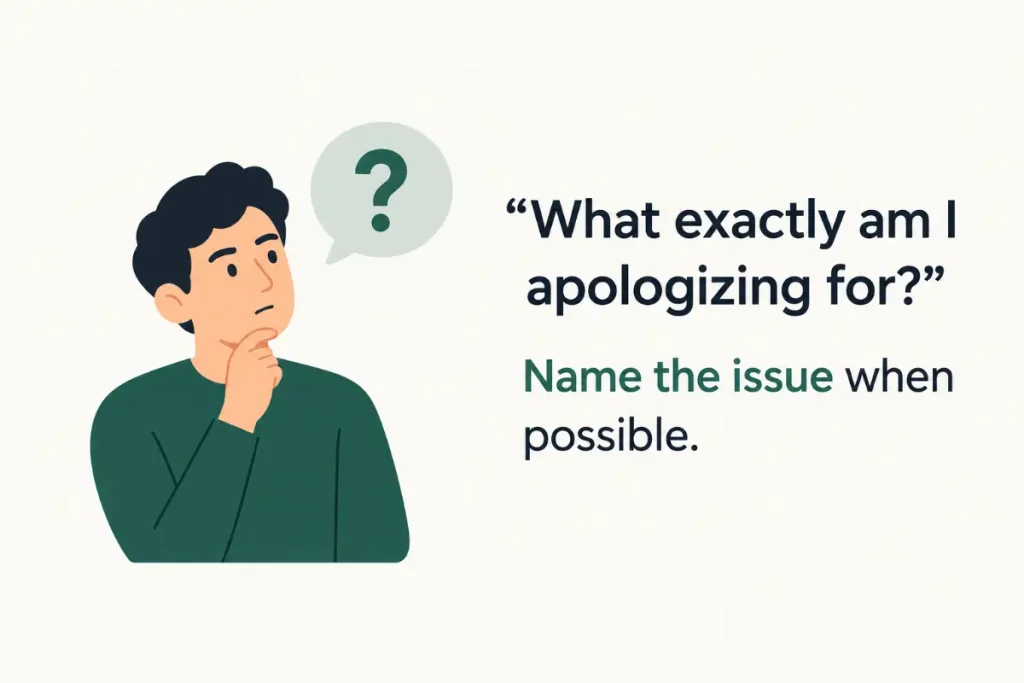
- What exactly am I apologizing for? Name the issue when possible.
- Do I need to accept responsibility? If you caused the problem, don’t hide behind vague wording.
- Does the tone fit the relationship? A client email may need more formality than a message to a teammate.
- Do I need to explain what happened? Give useful context, but avoid making excuses.
- What am I doing to fix it? Include the next step when one exists.
- Am I apologizing unnecessarily? Don’t apologize simply for making a reasonable request or expressing yourself.
- Does it sound like something I would actually say? Natural language is usually more effective than overly formal wording.
The strongest professional apology alternatives aren’t necessarily the most complicated. A clear “I apologize for the delay,” followed by a useful next step, often works better than a long and formal apology. Choose language that matches the seriousness of the situation, take responsibility when it’s appropriate, and focus on making the situation better. A professional apology should leave the other person with clarity about what happened and confidence that you’re handling it.
Conclusion
Choosing the right words can make a professional apology sound sincere, respectful, and confident. Instead of relying on “I’m sorry” every time, you can use professional apology alternatives such as “I apologize for the delay,” “I take responsibility for the mistake,” or “I appreciate your patience.” The best phrase depends on the situation, your relationship with the other person, and how serious the issue is. Keep your apology clear, take responsibility when appropriate, and explain how you’ll fix the problem when needed. A thoughtful apology doesn’t need to be long or overly formal—it simply needs to acknowledge the issue and show that you’re taking it seriously.
Frequently Asked Questions
What’s another way to say “sorry” professionally?
Common professional apology alternatives include “I apologize,” “I regret the mistake,” “I take responsibility,” “I should have handled this differently,” and “I appreciate your patience.” The best choice depends on the situation and your relationship with the reader.
Is “I apologize” more professional than “I’m sorry”?
“I apologize” generally sounds more formal, but “I’m sorry” can also be completely professional. In many workplace conversations, “I’m sorry” sounds more natural and personal.
How do you apologize professionally without saying sorry?
You can say, “I apologize for the delay,” “I take responsibility for the error,” “I regret the mistake,” or “I should have communicated this sooner.” These phrases acknowledge the problem without using the word “sorry.”
What’s a professional way to apologize for a mistake?
A strong option is, “I apologize for the mistake. I take responsibility and have corrected the issue.” If appropriate, add the specific action you’ve taken to prevent the problem from continuing.
What is a professional way to say “sorry for the inconvenience”?
You can say, “I apologize for the inconvenience,” “I’m sorry for the trouble this caused,” or “Thank you for your patience while we resolve this.” For customer communication, briefly explaining the solution can make the message more useful.
How do you apologize for a late response professionally?
Try, “I apologize for the delayed response. Thank you for your patience.” If the delay caused a larger problem, add what you’re doing to address it.
What is the best professional apology alternative for work?
For most workplace situations, “I apologize for [specific issue]” is a reliable choice. For smaller mistakes between coworkers, “That was my mistake” or “I’m sorry I missed that” can sound more natural.
1 thought on “Professional Apology Alternatives: 25 Better Ways to Say Sorry”