
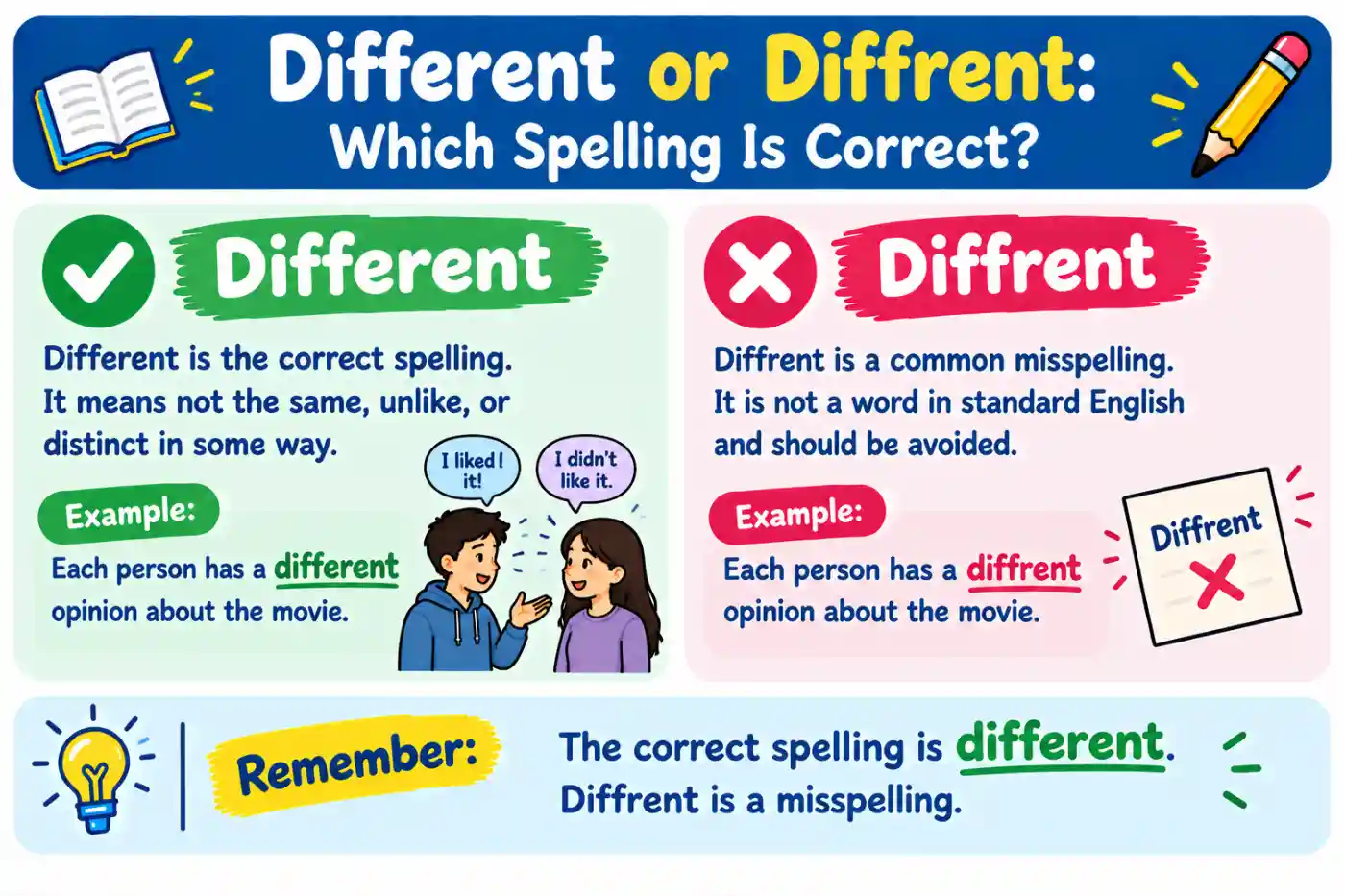
If you’re writing an email, completing a school assignment, or posting on social media, you may wonder whether different or diffrent is the correct spelling. The two forms look similar, but only one is accepted in standard American English.
Different is the correct spelling. Diffrent is a misspelling and should not be used in formal or informal writing when you mean the word different.
The word different means not the same as another person, thing, idea, or situation. It helps you describe changes, contrasts, and unique qualities in everyday communication.
In this article, you’ll learn the correct spelling, understand the word’s meaning, explore common spelling mistakes, and see examples that will help you use different confidently in your writing.
Different or Diffrent: What’s the Difference?
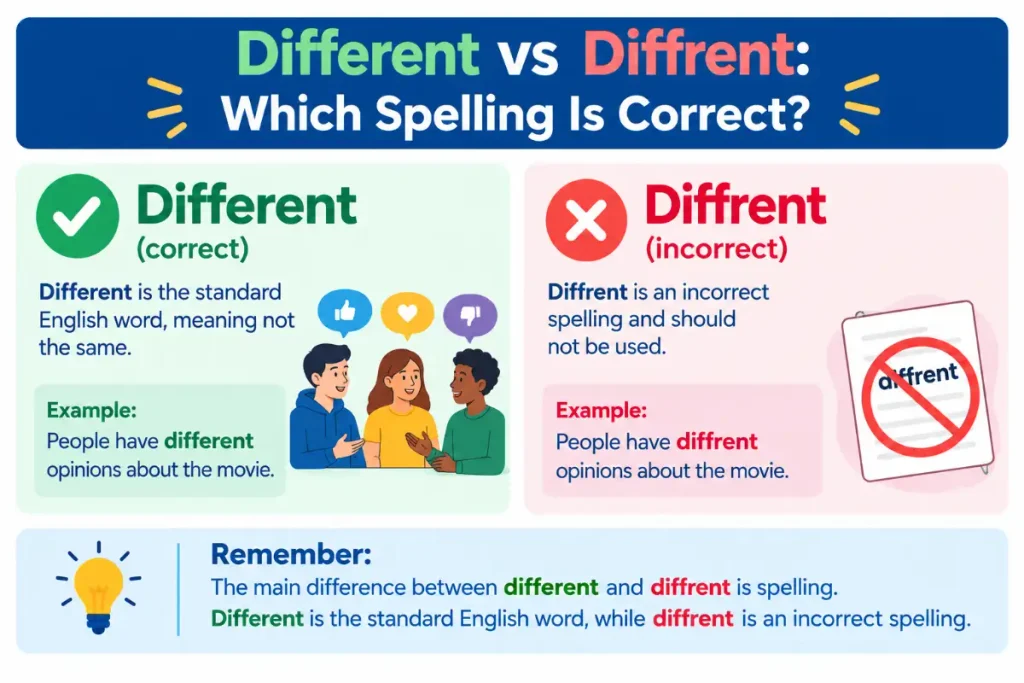
The main difference between different and diffrent is spelling. Different is the standard English word, while diffrent is an incorrect spelling.
| Word | Correct or Incorrect? | Meaning |
|---|---|---|
| Different | Correct | Not the same; unlike another thing |
| Diffrent | Incorrect | A misspelling of different |
Why Is Different Correct?
Different is the established spelling in American English dictionaries and standard written English. It contains the letters d-i-f-f-e-r-e-n-t, including the second e after the letter r.
For example:
- Correct: My new schedule is different from my old one.
- Incorrect: My new schedule is diffrent from my old one.
The incorrect form often appears because people leave out the second e when typing quickly or remembering the word from its pronunciation.
Is Diffrent Ever Correct?
No. Diffrent is not a standard spelling of the adjective different. If you see it in a text message, essay, email, or online post, it is generally a spelling error. Use different whenever you want to describe something that is not the same as something else.
What Does Different Mean?
Different is an adjective that describes something that is not the same as something else. It can refer to people, objects, opinions, choices, experiences, or situations. For example, two students may have different opinions about a book, or two stores may sell different products. In both cases, the word shows that the things being compared are not identical.
Different as an Adjective
An adjective describes a noun or gives more information about it. Different works this way by identifying how one person or thing differs from another.
Examples include:
- We chose a different restaurant for dinner.
- Each student has a different learning style.
- Her new job offers different opportunities.
- The two paintings have different colors.
- My brother and I enjoy different types of music.
In each sentence, different describes a noun and highlights a contrast.
Common Meanings of Different
The word can express several related ideas depending on the context.
| Meaning | Explanation | Example |
|---|---|---|
| Not the same | Two things are unlike each other | My answer is different from yours. |
| Distinct | Something has its own qualities | The artist has a different style. |
| Changed | Something is no longer as it was before | The neighborhood looks different now. |
| Unusual | Something stands apart from what is common | She brought a different idea to the meeting. |
| Various | Several things are not alike | We discussed different solutions. |
These meanings share one central idea: a distinction between people, things, ideas, or situations.
How Do You Spell Different Correctly?
The correct spelling is different. To spell it accurately, remember that it contains two consecutive f letters and includes an e after the r.
The word has nine letters:
D – I – F – F – E – R – E – N – T
A common error is to write diffrent by leaving out the first e that follows the double f.
A Simple Way to Remember the Spelling
Use this three-step method:
- Start with diff.
- Add erent.
- Combine the parts: diff + erent = different.
You can also remember the word by focusing on its middle letters: DIFF-E-RENT. The goal is to recognize the complete spelling rather than rely only on how the word sounds.
Why Do People Misspell Different?
Several factors can make the word difficult to spell correctly.
- Fast typing: People may leave out a letter while typing quickly.
- Pronunciation: In everyday speech, the middle vowel sounds can be less noticeable.
- Visual similarity: The incorrect form diffrent looks close to the correct word.
- Memory errors: Writers may remember the double f but forget the following e.
- Autocorrect limitations: Spell-checking tools do not always catch every error, especially in unusual contexts.
Reading your writing aloud can help you catch awkward sentences, but proofreading the actual letters is the best way to identify this particular spelling mistake.
Different vs Diffrent: Examples in Real Sentences
Seeing the correct form in everyday situations makes it easier to remember and use.
Correct Examples With Different
Here are 12 original examples showing how different works in common contexts.
- School: My science teacher explained the same concept in a different way.
- Work: We need a different plan to finish the project on time.
- Email: Could you send me a different version of the report?
- Shopping: This store sells different brands of running shoes.
- Travel: We took a different route to avoid traffic.
- Family: My sister and I have different tastes in movies.
- Technology: The updated app has a different layout.
- Food: I would like to try a different dish tonight.
- Social media: Everyone shared a different opinion in the comments.
- Job applications: I tailored my resume for different positions.
- Daily life: The park looks different after the renovation.
- Conversation: Let’s consider a different approach before making a decision.
Every sentence uses different to describe a contrast, variation, or change.
Incorrect Examples With Diffrent
The following sentences contain the misspelling. The corrected versions show how to fix it.
| Incorrect Sentence | Correct Sentence |
|---|---|
| We need a diffrent plan. | We need a different plan. |
| Her opinion is diffrent from mine. | Her opinion is different from mine. |
| I bought a diffrent shirt. | I bought a different shirt. |
| They chose diffrent topics. | They chose different topics. |
| This version looks diffrent. | This version looks different. |
In each case, replace diffrent with different. The rest of the sentence can remain unchanged.
Different vs Similar: What’s the Difference?
Different and similar describe relationships between things, but they express contrasting ideas.
- Different means not the same or unlike in some way.
- Similar means alike in certain ways, though not necessarily identical.
For example:
- Different: The two phones have different screen sizes.
- Similar: The two phones have similar screen sizes.
The first sentence highlights a distinction. The second points out a resemblance. Use different when you want to emphasize a contrast. Use similar when you want to show that two or more things share qualities.
Different vs Various: What’s the Difference?
Different and various can both describe variety, but they are not always interchangeable. Various usually refers to several types, kinds, or examples.
| Word | Main Use | Example |
|---|---|---|
| Different | Highlights a contrast or distinction | The two teams used different strategies. |
| Various | Refers to several kinds or types | The library offers various resources. |
Consider these additional examples:
- Different: We received different answers to the same question.
- Various: We received questions about various subjects.
The first focuses on the answers being unlike one another. The second refers to a range of subjects.
What Words Are Similar to Different?
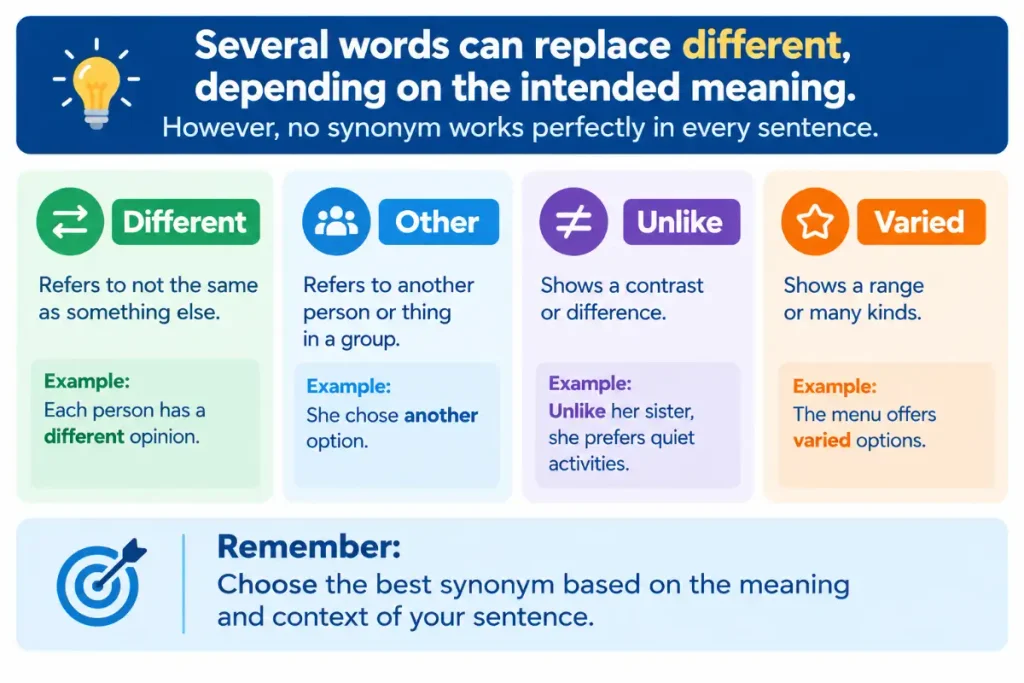
Several words can replace different, depending on the intended meaning. However, no synonym works perfectly in every sentence.
| Word | Meaning | Tone | Example |
|---|---|---|---|
| Distinct | Clearly separate or recognizable | Neutral | Each department has a distinct role. |
| Unlike | Not similar to something | Everyday | Her approach is unlike mine. |
| Dissimilar | Not alike | Formal | The two designs are dissimilar. |
| Unusual | Not common or expected | Everyday | He suggested an unusual solution. |
| Unique | One of a kind or especially distinctive | Neutral | The building has a unique design. |
| Separate | Not joined or treated as one | Neutral | Keep the files in separate folders. |
| Diverse | Showing a range of differences | Neutral | The city has a diverse population. |
| Varied | Including different types | Neutral | The course covers varied topics. |
| Distinctive | Having qualities that set something apart | Neutral | The brand has a distinctive logo. |
| Alternative | Another available choice | Neutral | We need an alternative method. |
| Contrary | Opposing or conflicting | Formal | The evidence supports a contrary conclusion. |
| Opposite | Completely or directly opposed | Neutral | They reached opposite conclusions. |
Which Synonym Should You Choose?
Choose a replacement based on the point you want to make.
- Use distinct to emphasize clear separation.
- Use similar when you mean almost the opposite of different.
- Use diverse to describe a range of people, ideas, or experiences.
- Use unique when something has a special or one-of-a-kind quality.
- Use alternative when you mean another option.
- Use unlike to make a direct comparison.
For example, you could write, “We need a different solution” or “We need an alternative solution.” Both are natural, but alternative more directly suggests another available option.
Is Different Used Differently in American and British English?
No significant spelling difference exists between American and British English for this word. Different is the standard spelling in both varieties.
| Variety of English | Correct Spelling | Example |
|---|---|---|
| American English | Different | The results were different. |
| British English | Different | The results were different. |
| Canadian English | Different | The results were different. |
| Australian English | Different | The results were different. |
Some English words have regional spelling differences, such as color in American English and colour in British English. However, different does not follow that pattern. If you’re writing for an American audience, use different. The same spelling is appropriate for British, Canadian, and Australian readers.
How Do You Use Different in Formal and Informal Writing?
Different is suitable for nearly every writing style. You can use it in professional documents, academic assignments, personal messages, and everyday conversation.
In Academic Writing
Use different to compare theories, research findings, methods, or interpretations.
Example: “The researchers tested different methods to evaluate the results.”
When writing an academic paper, make sure the comparison is clear. If you say that two studies produced different results, explain how those results differed when the distinction matters to your argument.
In Professional Emails
The word works well when discussing choices, revisions, or alternative plans.
Example: “Could you prepare a different version of the presentation for Friday’s meeting?”
This wording is direct and polite. You do not need a more complicated synonym simply to sound professional.
In Everyday Conversation
People commonly use different to discuss preferences, experiences, and changes.
Examples:
- “Let’s try a different restaurant.”
- “That sounds different from what you told me yesterday.”
- “I’d like to do something different this weekend.”
These sentences sound natural in spoken English and informal writing.
In Resumes and Job Applications
You can use different when describing varied responsibilities or experiences, but a more precise word may sometimes be stronger.
For example:
- General: I worked on different projects.
- More specific: I managed several projects involving customer service and data analysis.
The second sentence provides more useful information. The word different is correct, but specific details help employers understand your experience.
Common Mistakes to Avoid When Writing Different
Although different is a common word, spelling and usage errors can still occur.
1. Leaving Out the Letter E
Incorrect: The new design is diffrent.
Correct: The new design is different.
Remember the complete sequence of letters: d-i-f-f-e-r-e-n-t.
2. Confusing Different With Difference
Different is an adjective, while difference is a noun.
- Correct: The two plans are different.
- Correct: There is a difference between the two plans.
- Incorrect: The two plans are difference.
Use different to describe something. Use difference to name the distinction itself.
3. Using Differently When You Need Different
Differently is the adverb form of different. It describes how an action happens.
- Correct adjective: We chose a different route.
- Correct adverb: We traveled differently this time.
- Incorrect: We chose a differently route.
The noun following the word often helps you decide which form you need.
4. Making Unnecessary Comparisons
The phrase different than is common in American English, but some sentences sound clearer with different from.
For example:
- The new design is different from the original.
- The new design is different than I expected.
Both constructions occur in standard American English. In formal writing, different from is a reliable choice when comparing two nouns or things directly.
5. Trusting Autocorrect Without Proofreading
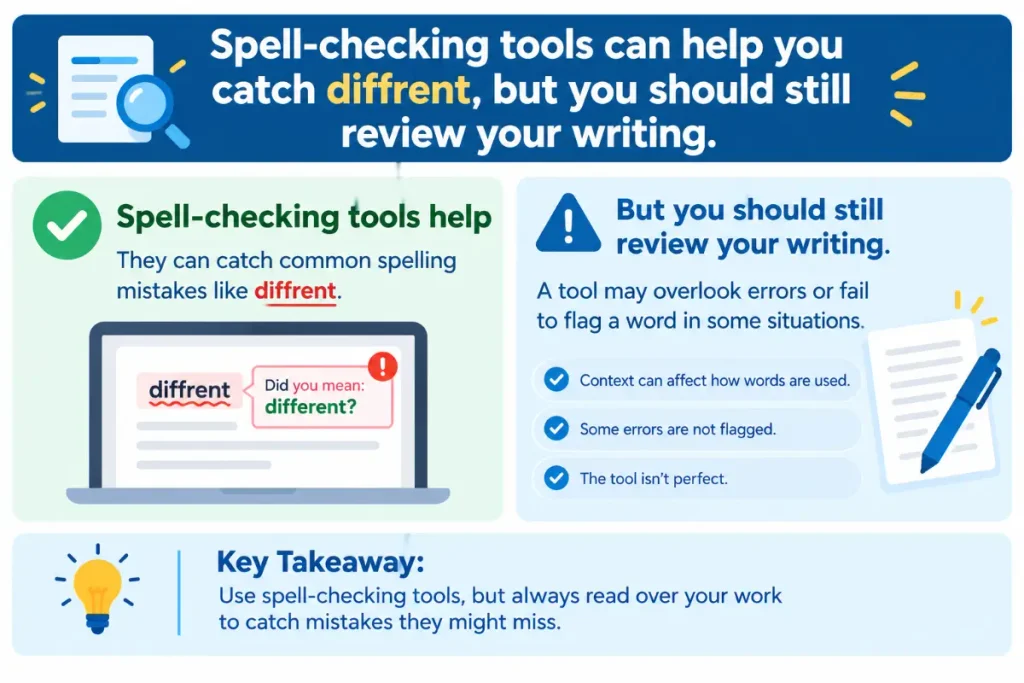
Spell-checking tools can help you catch diffrent, but you should still review your writing. A tool may overlook errors or fail to flag a word in some situations.
Read the sentence carefully and confirm that the spelling matches the word you intended.
Conclusion
Choosing the correct spelling helps make your writing clear and professional. When comparing different or diffrent, remember that different is the only standard spelling of the word in American English and other major varieties of English. The incorrect form, diffrent, simply leaves out a letter.
You can use different to describe contrasting opinions, changing situations, distinct qualities, and a variety of choices. Remember its nine-letter spelling, pay attention to the e after the double f, and proofread your work before submitting or sending it. If you need a synonym, consider words such as distinct, unlike, or varied, but make sure the replacement fits your sentence. With a little practice, you’ll recognize and spell different correctly in everyday writing.
Frequently Asked Questions
Is Different or Diffrent Correct?
Different is correct, while diffrent is a misspelling. Use different in schoolwork, emails, professional documents, and everyday writing.
How Do You Spell Different?
Spell it D-I-F-F-E-R-E-N-T. Remember the double f and the e that follows it.
Why Do People Spell Different as Diffrent?
People often leave out the e because they type quickly or do not remember the complete letter sequence. The two forms look similar, which can make the mistake easy to overlook.
What Does Different Mean?
Different means not the same as another person, thing, or situation. For example, “We have different opinions” means the people involved do not share the same opinion.
Is Different an Adjective?
Yes, different is an adjective. It describes nouns by showing that they are unlike, distinct, or not the same.
Is Different From or Different Than Correct?
Both phrases appear in standard American English. Different from is a dependable choice for direct comparisons, while different than often appears before a clause, as in “The outcome was different than I expected.”
What Is Another Word for Different?
Common alternatives include distinct, unlike, dissimilar, varied, and diverse. Choose the word that best expresses the specific kind of difference you want to describe.
1 thought on “Different or Diffrent: Which Spelling Is Correct?”