
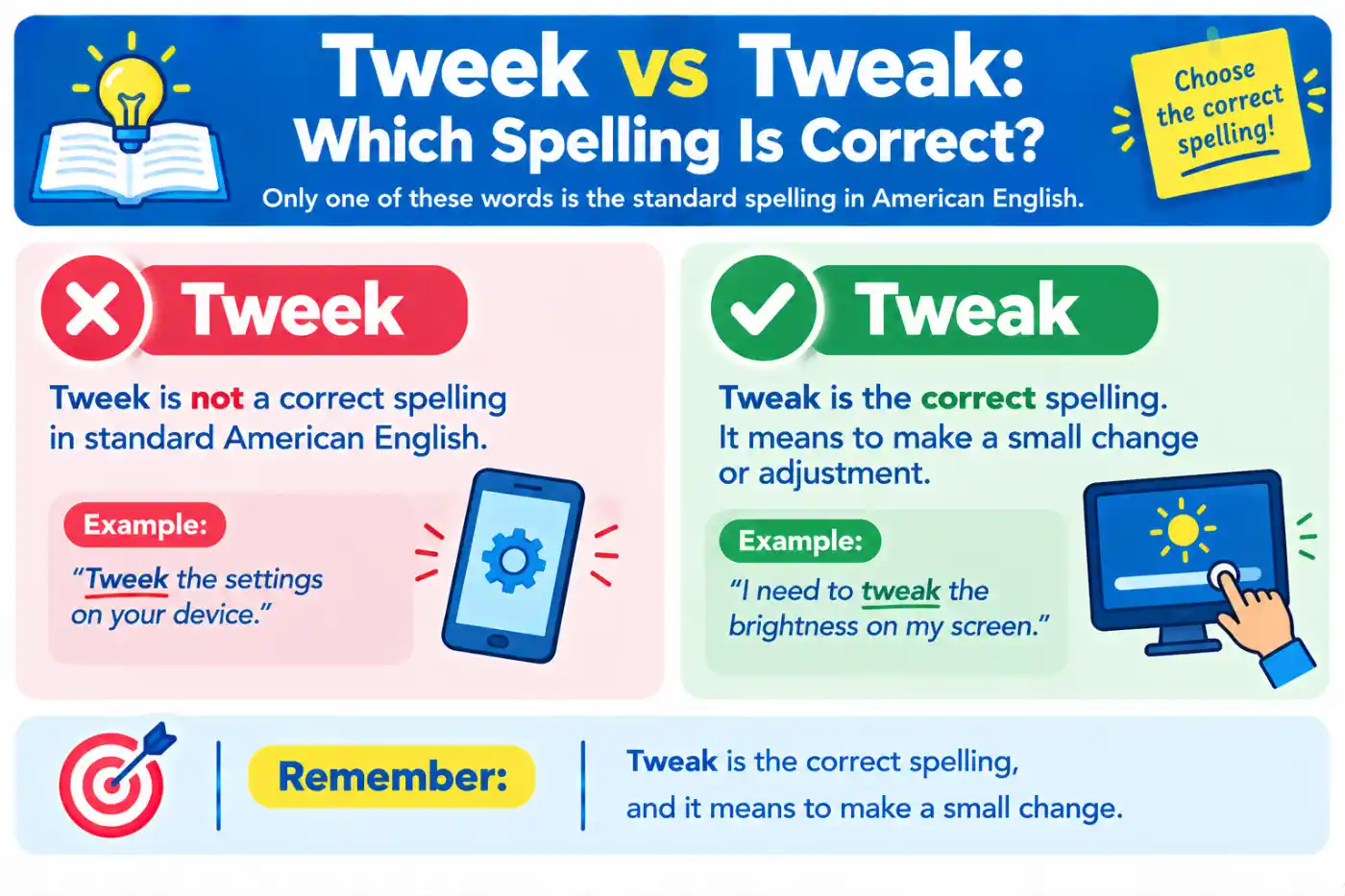
If you’re writing an email, editing a document, or explaining a small change to a project, you might wonder about tweek vs tweak. The two words look similar and sound almost identical, but they don’t have the same status in standard American English.
Tweak is the correct spelling for a small adjustment or a minor change. Tweek is generally a misspelling of tweak, although it can appear as a name, username, or informal spelling in specific contexts.
Understanding the difference helps you avoid spelling mistakes in school assignments, professional emails, and everyday messages. Let’s look at what tweak means, why people confuse these spellings, and how to use the correct word in natural sentences.
What Do Tweek and Tweak Mean?
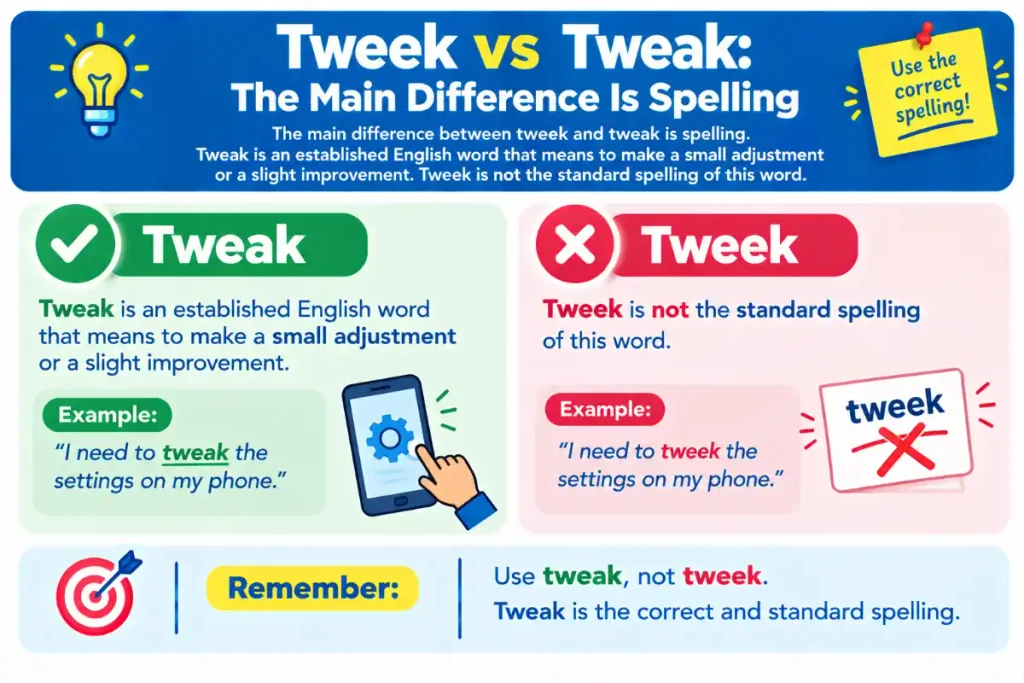
The main difference between tweek and tweak is spelling. Tweak is an established English word that means to make a small adjustment or a slight improvement. Tweek is not the standard spelling of this word.
What Does Tweak Mean?
The word tweak can function as both a verb and a noun. As a verb, it means to make a small change to improve something or make it work better. As a noun, it refers to the small change itself.
For example:
- Verb: I need to tweak the settings on my computer.
- Noun: The designer made a small tweak to the website.
- Verb: She tweaked her presentation before the meeting.
- Noun: One final tweak made the instructions easier to follow.
A tweak usually involves a minor adjustment rather than a complete replacement or major change. You might tweak a recipe by adding a little more seasoning, tweak a resume by improving a few bullet points, or tweak a schedule to make room for another activity. The word often suggests that something already works but could benefit from a small improvement.
What Does Tweek Mean?
Tweek is generally an incorrect spelling when you intend to use the standard word tweak. In ordinary American English, dictionaries and formal writing use tweak for a small adjustment.
For example:
- Incorrect: I need to tweek the font size.
- Correct: I need to tweak the font size.
However, Tweek may appear as a proper name, a username, a brand name, or a stylized spelling. In those cases, its correctness depends on the specific name or context. The issue is not that the letter combination is impossible; it is that tweek is not the standard spelling of the common word meaning a small adjustment.
Tweek vs. Tweak: Which Spelling Should You Use?
Use tweak whenever you mean to make a small change, adjustment, or improvement. Avoid tweek in standard writing unless you are using it as a specific name or intentional stylized spelling.
| Word | Status | Meaning | Example |
|---|---|---|---|
| Tweak | Correct | To make a small adjustment | I need to tweak the design. |
| Tweek | Generally incorrect | Nonstandard spelling of tweak | I need to tweek the design. |
The correct choice remains the same in most everyday situations, including text messages, schoolwork, business documents, and online posts.
How Do You Spell Tweak Correctly?
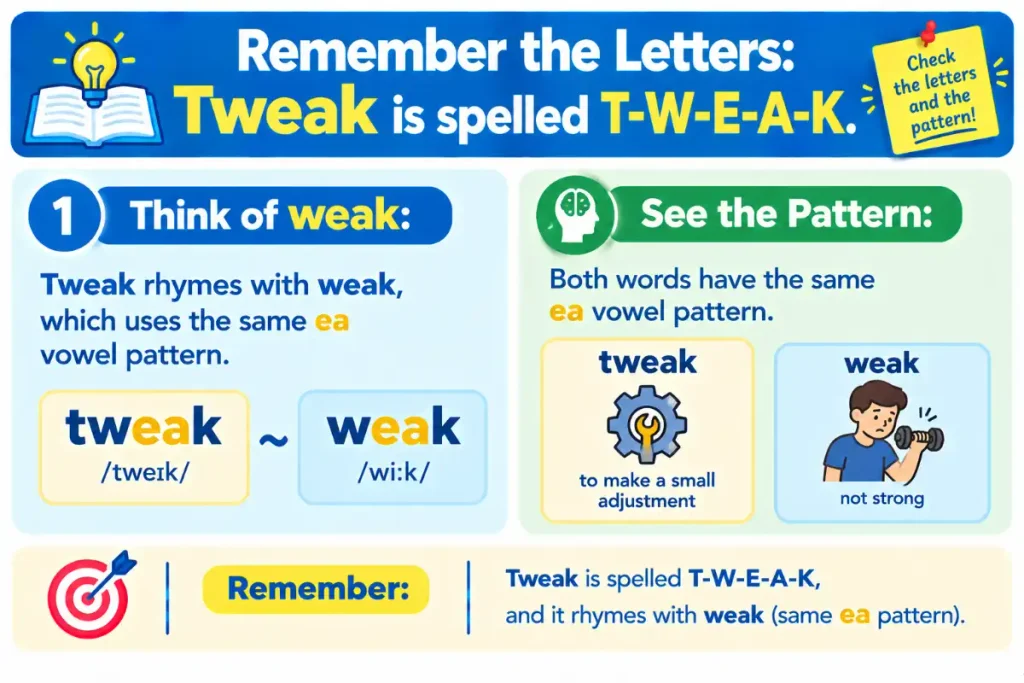
The correct spelling is T-W-E-A-K. Remember the letter combination ea, as in weak, which shares the same final sound. Here are three simple ways to remember it:
- Remember the spelling pattern: Tweak contains ea, not ee.
- Connect it with weak: Both tweak and weak have the same vowel sound.
- Practice it in a phrase: Write “tweak the settings” or “make a small tweak” to reinforce the correct spelling.
These simple habits can help you recognize the correct form when writing quickly.
Examples of Tweak in Real Sentences
Seeing tweak in different contexts makes its meaning easier to understand. The following examples show how Americans commonly use the word in everyday, academic, and professional situations.
Tweak as a Verb
When tweak functions as a verb, it describes the action of making a small change.
- Work: I need to tweak the report before sending it to my manager.
- School: The student tweaked her essay after receiving feedback from her teacher.
- Technology: You can tweak your phone’s display settings to improve readability.
- Cooking: Dad decided to tweak the recipe by adding more garlic.
- Design: The graphic designer tweaked the colors to make the poster easier to read.
- Writing: I tweaked the introduction to make the main idea clearer.
- Business: The company tweaked its pricing strategy after reviewing customer feedback.
- Everyday life: We had to tweak our weekend plans because of the weather.
- Fitness equipment: He tweaked the seat height on his stationary bike.
- Social media: She tweaked the caption before publishing her photo.
Each sentence describes a relatively small change rather than a complete transformation.
Tweak as a Noun
As a noun, tweak identifies the adjustment itself rather than the action of making it.
Here are five examples:
- The website needs one final tweak before launch.
- A minor tweak to the schedule gave everyone more time.
- The recipe turned out better after a small tweak.
- My resume needed a few tweaks before I submitted the application.
- The software update included a tweak to the notification settings.
Notice how the noun often appears after words such as small, minor, final, or few. These expressions emphasize the limited size of the change.
Why Do People Confuse Tweek and Tweak?
People often confuse tweek and tweak because the two spellings look similar and represent nearly identical pronunciations. When someone hears the word without seeing it written, the correct vowel combination may not be obvious. Several factors contribute to this confusion.
1. Similar Pronunciation
In standard American English, tweak rhymes with week and seek. The letters ea produce the long e sound, which may lead writers to use ee instead. However, English spelling does not always match pronunciation perfectly. Similar sounds can have different spellings, so hearing a word alone does not guarantee that you will spell it correctly.
2. Familiarity With Other Words
English contains many words with the ee spelling, including week, green, and screen. Writers may unconsciously apply that familiar pattern when spelling tweak. The best solution is to memorize tweak as a complete word rather than guessing its spelling from sound.
3. Fast Typing and Autocorrect
People often make spelling mistakes while texting, posting on social media, or typing quickly. A writer might enter tweek without noticing the error, especially when spell-check software does not flag every nonstandard form. Proofreading can help you catch these mistakes before sending a message or submitting a document.
Tweak vs Adjust: What’s the Difference?
Tweak and adjust have similar meanings, but they do not always communicate exactly the same idea.
| Word | Meaning | Typical Use | Example |
|---|---|---|---|
| Tweak | Make a small change, often to improve something | Minor refinements | I tweaked the layout. |
| Adjust | Change something to make it more suitable or accurate | Settings, positions, plans, or conditions | I adjusted the chair. |
| Modify | Change part of something | Designs, rules, or plans | We modified the agreement. |
| Revise | Review and change something | Writing, reports, or plans | She revised her essay. |
| Alter | Change something, sometimes significantly | General changes | They altered the original design. |
Use tweak when you want to emphasize a small refinement. Choose adjust when you want to describe making something suitable for a particular need. For example, you might adjust the volume on your television or tweak the audio settings to improve the sound quality.
Tweak vs Change: Which Word Is Better?
Both words describe making something different, but change is broader. A change can be small or substantial. A tweak usually suggests a minor adjustment.
Consider these examples:
- Tweak: I tweaked two sentences in the report.
- Change: I changed the entire structure of the report.
In the first sentence, the writer made a limited improvement. In the second, the writer may have made a much larger alteration. Use change when the size or purpose of the modification is not important. Use tweak when you want to emphasize that the modification is small.
What Are the Different Forms of Tweak?
The word tweak follows common English verb patterns. Knowing its forms can help you use it correctly in sentences.
| Form | Correct Spelling | Example |
|---|---|---|
| Base form | Tweak | I want to tweak the design. |
| Third-person singular | Tweaks | She tweaks the settings regularly. |
| Past tense | Tweaked | He tweaked the schedule yesterday. |
| Present participle | Tweaking | We are tweaking the final draft. |
| Noun, singular | Tweak | One tweak fixed the problem. |
| Noun, plural | Tweaks | The latest version includes several tweaks. |
Is It Tweaked or Tweeked?
Tweaked is the correct past-tense form of tweak. The spelling keeps the original ea and adds -ed.
- Correct: I tweaked the presentation yesterday.
- Incorrect: I tweeked the presentation yesterday.
Similarly, use tweaking rather than tweeking.
- Correct: She is tweaking the website.
- Incorrect: She is tweeking the website.
The same spelling pattern applies to the related noun forms, including tweak and tweaks.
Is Tweak Formal or Informal?
Tweak works in both casual and professional communication. It is a common choice when discussing small improvements to writing, software, plans, designs, and other work. However, the best word depends on your audience and the type of document.
In Professional Emails
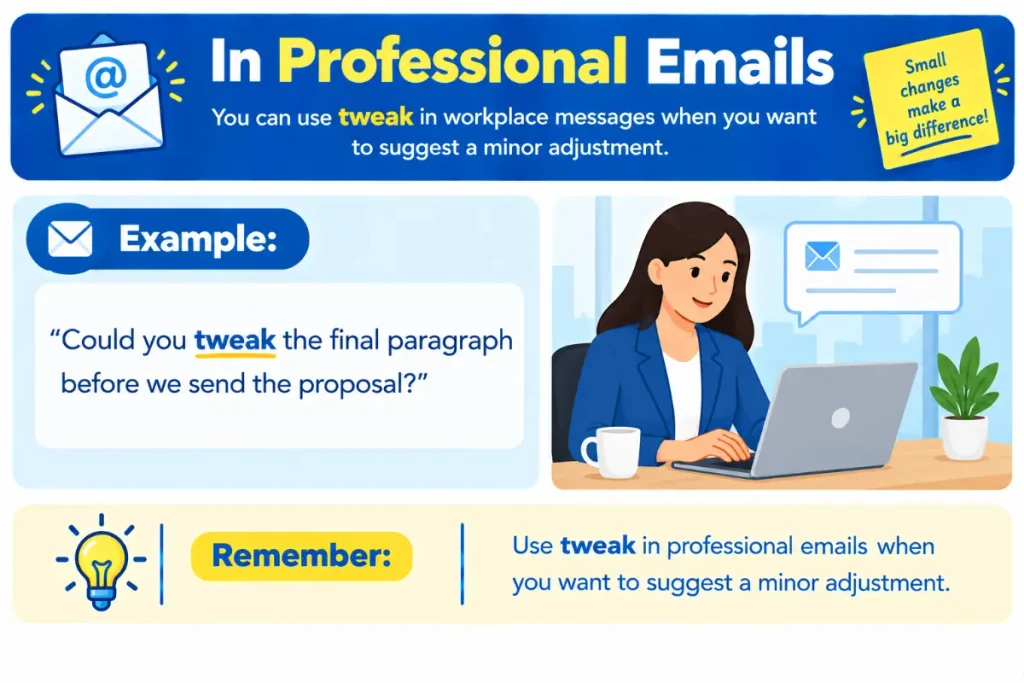
You can use tweak in workplace messages when you want to suggest a minor adjustment.
Example:
“Could you tweak the final paragraph before we send the proposal?”
For a more formal tone, you could write:
“Could you make a minor revision to the final paragraph before we send the proposal?”
Both sentences are correct. The first sounds conversational, while the second sounds more formal.
In Academic Writing
Tweak is understandable in academic writing, particularly when discussing small adjustments to a method, experiment, or draft. However, words such as adjust, revise, and modify may be more precise in formal research.
For example:
- Conversational: We tweaked the experiment settings.
- More formal: We adjusted the experimental settings.
Choose the term that best describes the actual change rather than avoiding tweak simply because it is less formal than some alternatives.
In Text Messages and Social Media
Tweak works naturally in casual messages and online conversations.
For example:
- “I’ll tweak the caption and post it tonight.”
- “Can you tweak the photo’s brightness?”
- “I made a few tweaks to my profile.”
Even in informal writing, use the standard spelling tweak when you mean a small adjustment.
Is Tweak Spelled the Same Way in American and British English?
Yes. Tweak is the standard spelling in both American and British English. The word does not have a common US-versus-UK spelling difference.
| Variety of English | Standard Spelling | Example |
|---|---|---|
| American English | Tweak | I need to tweak the settings. |
| British English | Tweak | I need to tweak the settings. |
| Canadian English | Tweak | I need to tweak the settings. |
| Australian English | Tweak | I need to tweak the settings. |
Although other English words have regional spelling differences, tweak remains the standard form across these varieties. Writers in the United States should use tweak in essays, emails, resumes, business reports, and everyday communication. The spelling tweek is not an accepted American alternative for the ordinary verb or noun.
Common Mistakes to Avoid
Understanding the correct spelling is important, but writers should also know how to use tweak naturally.
Mistake 1: Writing Tweek Instead of Tweak
This is the main spelling error.
- Incorrect: Please tweek the document.
- Correct: Please tweak the document.
Tip: Remember the ea spelling pattern in tweak.
Mistake 2: Using Tweak for a Major Transformation
Tweak generally suggests a small adjustment. Using it to describe a complete redesign may understate the amount of work involved.
- Less precise: We tweaked the entire building’s structure.
- More precise: We redesigned the building’s structure.
A large project may involve many small tweaks, but the overall transformation is better described with a word such as redesign or rebuild.
Mistake 3: Misspelling Tweaked or Tweaking
The correct forms are tweaked and tweaking, not tweeked and tweeking.
- Correct: The editor tweaked the headline.
- Correct: The editor is tweaking the headline.
Learn the complete set of forms to avoid repeating the same mistake in different tenses.
Mistake 4: Choosing a Vague Word When Precision Matters
Although tweak is useful, it may not always describe the change accurately. For example, revise is often a better choice when discussing substantial edits to a written document. Calibrate may be more suitable when adjusting equipment to meet a standard. Choose words that accurately describe the action.
What Are Some Alternatives to Tweak?
Several words can replace tweak, depending on the context. These alternatives are not always exact synonyms, so consider the size and purpose of the change.
| Word or Phrase | Meaning | Tone | Example |
|---|---|---|---|
| Adjust | Make something more suitable | Everyday | Adjust the screen brightness. |
| Modify | Make changes to something | Neutral or formal | Modify the original plan. |
| Revise | Improve or correct written material | Academic or professional | Revise the report. |
| Refine | Improve details or quality | Professional | Refine the design. |
| Edit | Correct or change written or visual material | Everyday or professional | Edit the paragraph. |
| Fine-tune | Make small, precise adjustments | Professional or casual | Fine-tune the settings. |
| Alter | Make something different | Neutral | Alter the schedule. |
| Amend | Make a formal change | Formal | Amend the agreement. |
| Improve | Make something better | Everyday | Improve the presentation. |
| Rework | Work on something again to improve it | Casual or professional | Rework the opening section. |
| Revamp | Make substantial improvements or changes | Informal or professional | Revamp the website. |
| Correct | Fix an error | Neutral | Correct the spelling mistake. |
For a small adjustment, tweak, fine-tune, and refine are often good choices. For more substantial changes, modify, revise, rework, or revamp may be more appropriate.
What Is the Opposite of Tweak?
There is no single antonym that fits every use of tweak. The best opposite depends on what you mean. If tweak means to make a small improvement, possible contrasting expressions include:
- Leave unchanged: Make no adjustments.
- Keep as it is: Preserve the existing version.
- Undo: Reverse a previous change.
- Revert: Return something to an earlier state.
- Overhaul: Make extensive changes rather than minor adjustments.
For example, “I tweaked the settings” describes a small adjustment, while “I reverted the settings” suggests returning them to a previous configuration. An overhaul is not a strict antonym, but it contrasts with a tweak because it usually involves a much more extensive change.
Quick Tips for Remembering Tweak
Use these simple tips to choose the correct spelling every time.
- Remember the letters: Tweak is spelled T-W-E-A-K.
- Think of weak: Tweak rhymes with weak, which uses the same ea vowel pattern.
- Connect it with small changes: A tweak is usually a minor adjustment.
- Learn related forms: Use tweaked, tweaking, and tweaks.
- Proofread professional writing: Check the spelling before submitting an essay, sending an email, or publishing a document.
- Use a synonym when needed: Choose adjust, revise, or modify if another word expresses your meaning more precisely.
These habits help you remember the standard spelling without relying entirely on spell-check tools.
Conclusion
The difference between tweek vs tweak is straightforward: tweak is the standard spelling when you mean to make a small adjustment or improvement, while tweek is generally incorrect in ordinary English writing. You can use tweak as both a noun and a verb in everyday conversations,
professional emails, academic work, and technical discussions. Its related forms include tweaks, tweaked, and tweaking. Remember the ea spelling pattern, which also appears in weak, to avoid this common mistake. If you need a more formal alternative, consider adjust, modify, or revise, depending on the situation. Choosing the correct word will help make your writing clearer, more accurate, and more professional.
Frequently Asked Questions
Is tweek or tweak correct?
Tweak is correct when you mean to make a small adjustment or improvement. Tweek is generally a misspelling of this word in standard American English.
What does tweak mean in simple words?
Tweak means to make a small change to improve something or make it work better. For example, you might tweak a recipe by adding a little more seasoning.
How do you spell tweak correctly?
Spell it T-W-E-A-K. The word uses ea, not ee, and rhymes with weak.
Is tweaked or tweeked correct?
Tweaked is correct. It is the past-tense form of tweak, as in “I tweaked the settings before the meeting.”
Can I use tweak in a professional email?
Yes. Tweak is appropriate in many professional emails, especially when discussing minor changes. For a more formal tone, you can use adjust, revise, or make a minor modification.
Is tweak a noun or a verb?
Tweak can function as both a noun and a verb. As a verb, it describes making a small adjustment; as a noun, it refers to the adjustment itself.
Is tweek ever a correct word?
Tweek may appear as a proper name, username, or intentional stylized spelling. However, it is not the standard spelling of the common English word meaning a small adjustment.
1 thought on “Tweek vs Tweak: Which Spelling Is Correct?”