
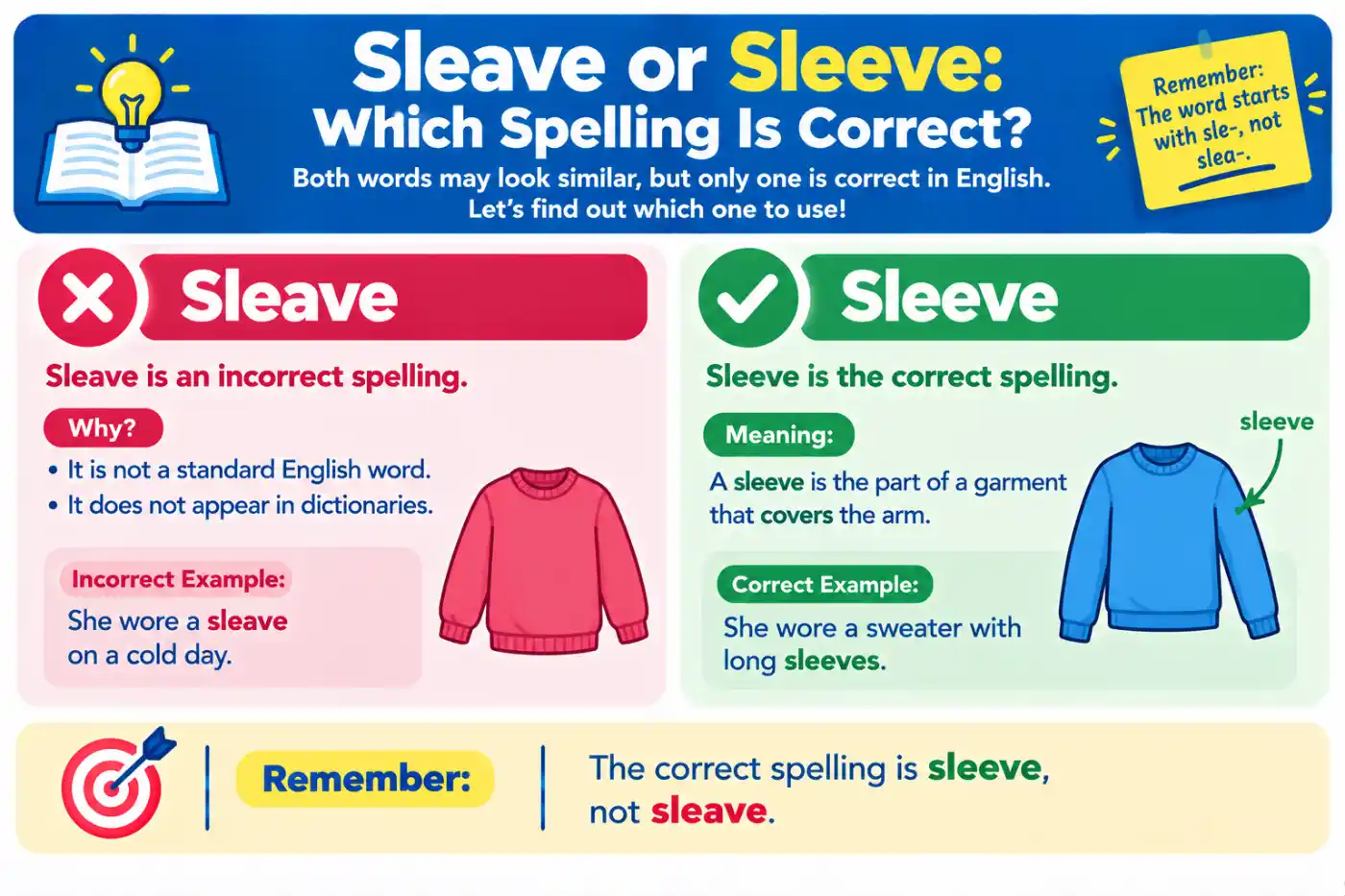
If you’re writing about a shirt, jacket, or other piece of clothing, you might wonder whether sleave or sleeve is the correct spelling. The two words look similar, but only one is the standard spelling for the part of a garment that covers your arm.
Sleeve is the correct spelling. Sleave is not the standard spelling for a clothing part and is usually a misspelling of sleeve in everyday writing.
The word sleeve is a common English noun used when describing clothing, fashion, and garment design. You may also see it in expressions such as up your sleeve or sleeve length, where it has a clear meaning.
Understanding the difference between sleave or sleeve will help you spell the word correctly in emails, school assignments, product descriptions, and everyday conversations.
What Does Sleeve Mean?
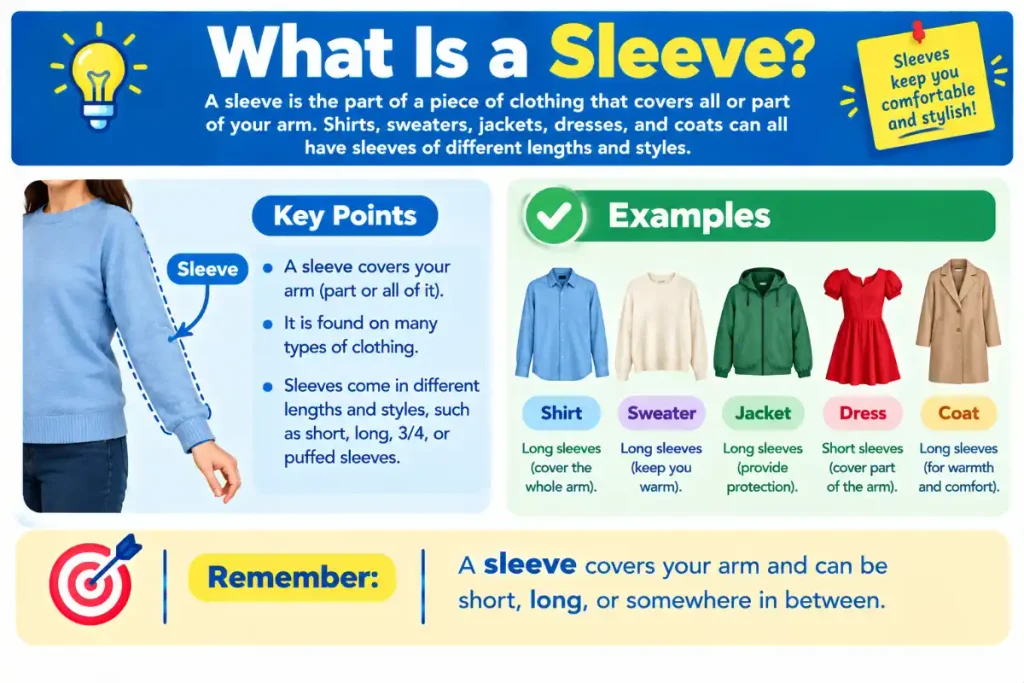
A sleeve is the part of a piece of clothing that covers all or part of your arm. Shirts, sweaters, jackets, dresses, and coats can all have sleeves of different lengths and styles.
For example, a short-sleeved T-shirt covers only part of your upper arm, while a long-sleeved shirt extends toward your wrist. Some garments have no sleeves at all. The word sleeve can also describe a protective covering for an object, such as a paper sleeve around a coffee cup or a protective sleeve for a laptop.
Examples of Sleeve in Sentences
- I rolled up my sleeves before washing the dishes.
- Her blue dress has long sleeves.
- The tailor shortened the sleeves of my jacket.
- He wiped the paint off his shirt sleeve.
- I bought a protective sleeve for my laptop.
- The child pulled on his father’s sleeve to get his attention.
- This sweater has loose sleeves and a comfortable fit.
- The shirt’s sleeves were too short for him.
- She wore a sleeveless dress to the summer party.
- The designer added lace to the sleeves of the wedding gown.
In each sentence, sleeve refers to a part of clothing or a covering for an object.
What Does Sleave Mean?
Although sleave is uncommon today, it is a real English word. Dictionaries identify it as an archaic or obsolete term for fine silk fibers or thread, especially silk that has not been twisted into a finished thread. It can also refer to tangled or matted fibers. You may encounter sleave in older literature, historical dictionaries, or discussions of traditional textile-making. It is not an alternative spelling for a clothing sleeve.
Examples of Sleave in Context
- The researcher explained the historical meaning of sleave during the literature lesson.
- The old dictionary described sleave as a type of fine silk fiber.
- The student found the word sleave while studying Shakespeare.
- The textile historian discussed how workers handled delicate silk fibers.
These examples show the word’s historical context rather than everyday modern usage.
Sleave vs Sleeve: Key Differences
The main difference between sleave and sleeve is their meaning and frequency of use. Although both words exist, they are not interchangeable.
| Feature | Sleeve | Sleave |
|---|---|---|
| Meaning | A garment’s arm covering or a protective cover | Fine silk fibers or tangled thread |
| Modern usage | Common | Rare or archaic |
| Part of speech | Noun and verb | Noun and, historically, verb |
| Everyday writing | Appropriate | Usually inappropriate |
| Common context | Clothing, electronics, machinery | Historical textiles and literature |
| Example | The jacket has a torn sleeve. | The text uses the historical word sleave. |
For most modern writing, sleeve is the word you need. Use sleave only when its specific historical meaning fits the context.
Why Do People Confuse Sleave and Sleeve?
There are several reasons these words can be confusing, especially for people learning English or proofreading their writing.
1. They Look Almost Identical
Both words contain the same letters except for the vowel in the middle. Because the difference is small, writers may accidentally type sleave when they mean sleeve.
2. They Sound the Same
In common modern pronunciation, sleave and sleeve are homophones: words that sound alike but have different spellings and meanings. This makes the distinction harder to notice when speaking.
3. Both Words Appear in Dictionaries
A spell-checker may accept sleave because it is a legitimate historical word. However, that does not mean it fits a sentence about clothing.
For example:
- Incorrect for the intended meaning: She rolled up her shirt sleaves.
- Correct: She rolled up her shirt sleeves.
Always consider a word’s meaning instead of relying on spell-check alone.
Correct vs. Incorrect Usage
Use the following examples to recognize when sleeve is the right choice.
| Incorrect or unsuitable usage | Correct usage |
|---|---|
| My shirt has a short sleave. | My shirt has a short sleeve. |
| The jacket’s sleaves are too long. | The jacket’s sleeves are too long. |
| Put the tablet in its protective sleave. | Put the tablet in its protective sleeve. |
| He rolled up his sleaves. | He rolled up his sleeves. |
| The tailor repaired the dress sleave. | The tailor repaired the dress sleeve. |
| I need a new laptop sleave. | I need a new laptop sleeve. |
In these examples, sleave is unsuitable because each sentence refers to clothing or a protective covering. The historical word itself is not inherently misspelled; it simply has a different meaning.
Common Expressions That Use Sleeve
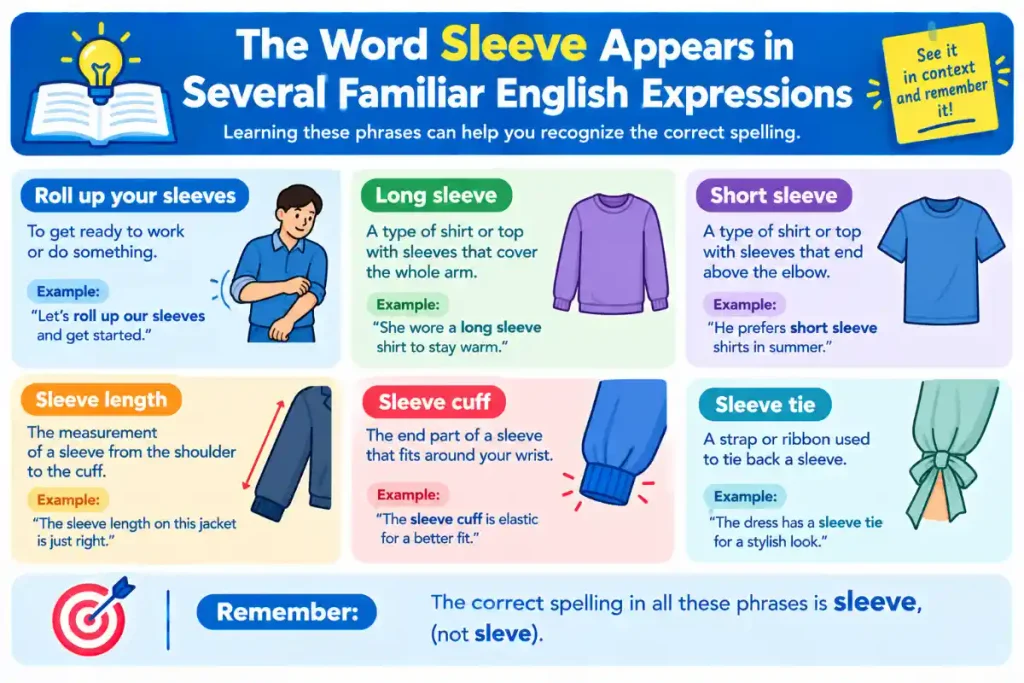
The word sleeve also appears in several familiar English expressions. Learning these phrases can help you recognize the correct spelling.
| Expression | Meaning | Example |
|---|---|---|
| Roll up your sleeves | Prepare to work hard | We rolled up our sleeves and cleaned the garage. |
| Have something up your sleeve | Have a secret plan or idea | She has another idea up her sleeve. |
| Wear your heart on your sleeve | Show your feelings openly | He wears his heart on his sleeve. |
| Laugh up your sleeve | Laugh privately or secretly | She laughed up her sleeve at the silly mistake. |
| Sleeve length | The measurement or length of a garment’s sleeve | Check the sleeve length before ordering the shirt. |
These expressions use sleeve, not sleave. Choosing the correct spelling helps your writing remain clear and natural.
Sleeve as a Noun and a Verb
Understanding how sleeve works in a sentence can also help you use it correctly.
Sleeve as a Noun
As a noun, sleeve names a part of clothing or a protective covering.
Examples:
- The sweater has a loose sleeve.
- I placed the photograph inside a plastic sleeve.
- His jacket sleeves covered his wrists.
Sleeve as a Verb
As a verb, sleeve means to fit or provide something with a sleeve or protective covering. This use is less common than the noun.
Examples:
- The technician sleeved the cable to protect it.
- Please sleeve the document before storing it.
- The company sleeved the wires with protective material.
The past tense is sleeved, and the present participle is sleeving. These forms retain the spelling of sleeve.
Is Sleave or Sleeve Correct in American English?
In American English, sleeve is the standard word for a garment’s arm covering and for many protective coverings. The same spelling is standard in British, Canadian, and Australian English. Sleave is not a regional alternative for sleeve; it is a separate, rare historical word.
For everyday writing, use sleeve in:
- School assignments and essays
- Emails and text messages
- Clothing descriptions and online shopping listings
- Workplace documents
- Product manuals and technical instructions
You generally need sleave only when discussing historical language, older literature, or traditional silk fibers.
Quick Tips to Remember the Correct Spelling
Use these simple reminders when choosing between sleave and sleeve.
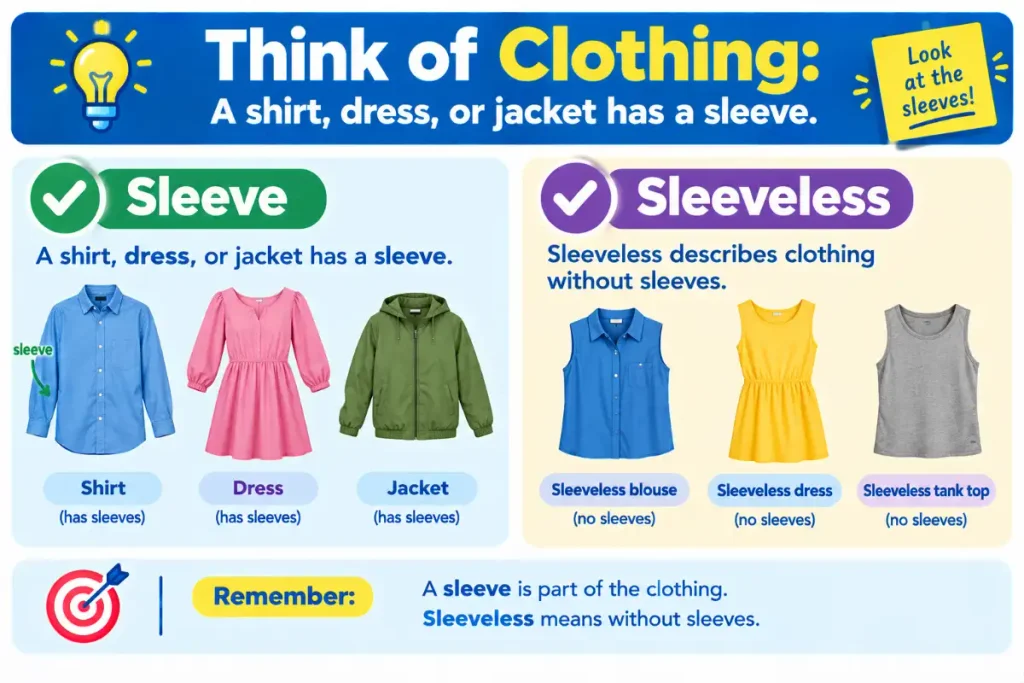
- Think of clothing: A shirt, dress, or jacket has a sleeve.
- Remember the related word: Sleeveless describes clothing without sleeves.
- Check the context: A protective covering for a laptop or cable is also a sleeve.
- Watch for the extra “a”: If you are describing clothing, write sleeve, not sleave.
- Consider the historical meaning: Reserve sleave for its rare textile or literary use.
The easiest rule is to use sleeve whenever you mean a clothing part or protective cover.
Conclusion
When deciding between sleave or sleeve, choose the word that matches your intended meaning. Sleeve is the standard modern spelling for the part of a shirt, jacket, or dress that covers the arm. It also refers to protective coverings for objects such as laptops, documents, and cables. In contrast, sleave is a genuine but rare historical word associated with fine silk fibers and tangled thread.
Although the two words look and sound similar, they are not interchangeable. For everyday writing, schoolwork, professional emails, and clothing descriptions, sleeve is the appropriate choice. Remember this simple distinction, and you’ll avoid a common spelling mistake while using English more accurately and confidently.
Frequently Asked Questions
Which is correct, sleave or sleeve?
Sleeve is correct for the arm covering of clothing and for protective coverings. Sleave is a separate, rare historical word referring to fine silk fibers or thread.
Is sleave a real word?
Yes, sleave is a real English word. However, it is archaic or obsolete in many of its historical senses and is rarely used in everyday writing.
How do you spell sleeve correctly?
Spell it S-L-E-E-V-E. The correct spelling for a shirt sleeve, jacket sleeve, or laptop sleeve is sleeve.
Why do people write sleave instead of sleeve?
People may confuse the two because they look similar and are generally pronounced alike. Since sleave is also a real word, some spell-checkers may not flag it as an error.
Is sleeve used only for clothing?
No. Sleeve can also describe a protective covering for a laptop, document, cable, or mechanical component. Its meaning depends on the context.
What is the plural of sleeve?
The plural is sleeves. For example, “The coat has long sleeves.” The rare historical word sleave has the plural sleaves, but that form is seldom used.
Is sleave or sleeve the British spelling?
Sleeve is the standard spelling in both American and British English. Sleave is an archaic term, not a British spelling variant of sleeve.
1 thought on “Sleave or Sleeve: Which Spelling Is Correct?”