
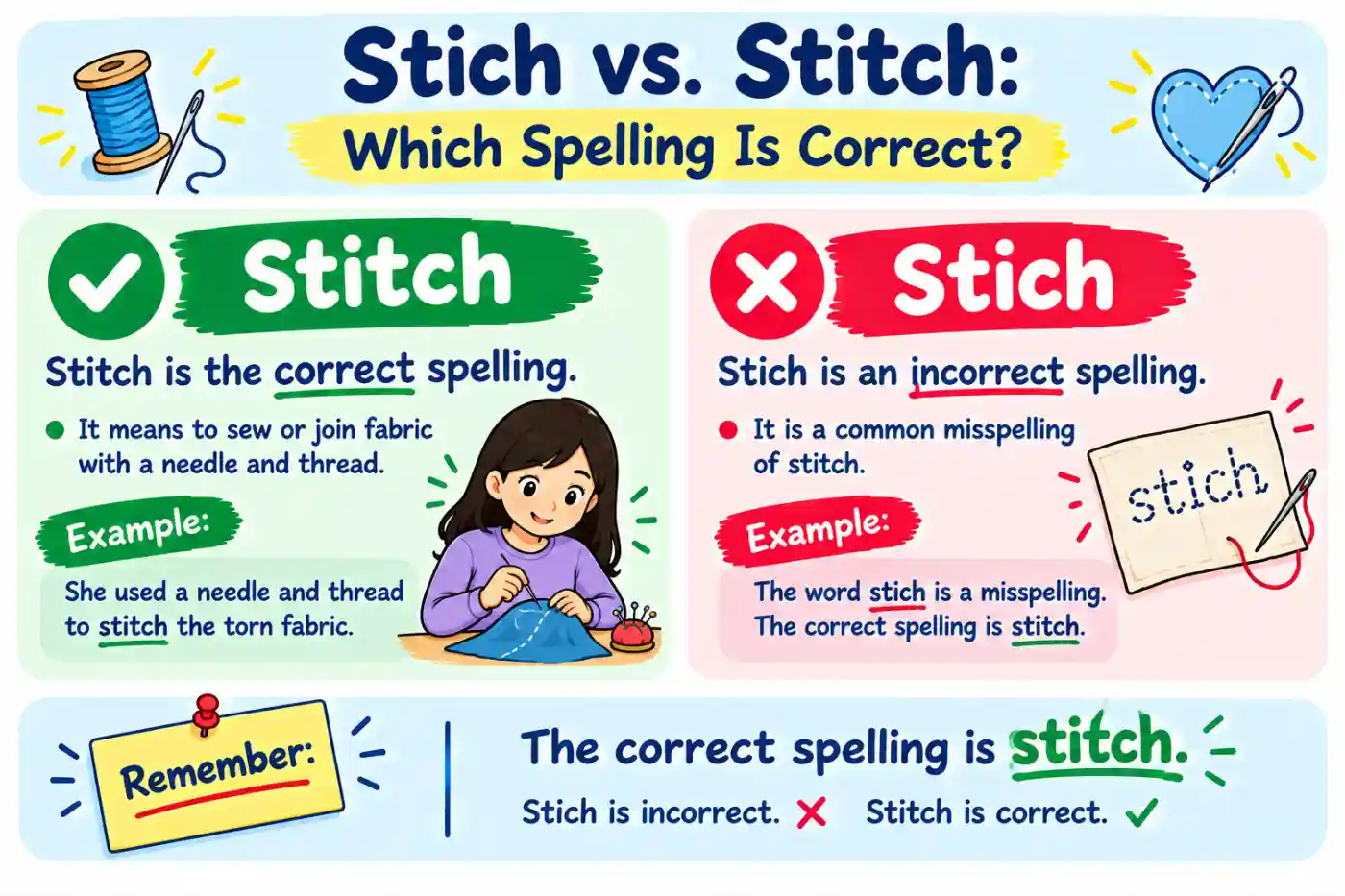
If you’re writing about sewing, repairing clothes, or making a craft project, you might wonder about stich vs stitch. The two spellings look similar, but only one is the standard spelling for the common English word referring to a loop of thread or a small sewing movement.
Stitch is the correct spelling in standard American English. Stich is generally a misspelling when you mean sewing, a stitch in fabric, or a sudden pain in your side.
The word stitch can function as both a noun and a verb. You can use it to describe a loop of thread, the act of sewing, or the process of joining fabric with thread. It also appears in expressions such as “not a stitch of clothing” and “in stitches,” which means laughing hard. This guide explains the difference between stich and stitch, shows how to use stitch correctly, and provides practical examples, related terms, and answers to common spelling questions.
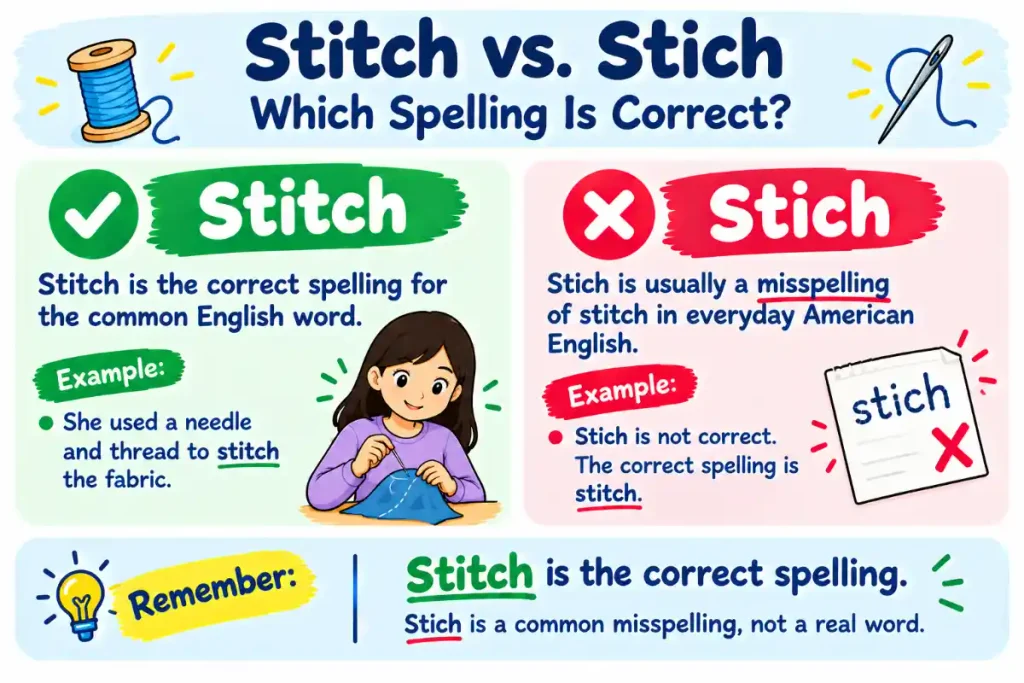
Stich vs Stitch: What’s the Difference?
Stitch is the correct spelling for the common English word. Stich is usually a misspelling of stitch in everyday American English.
| Word | Correct or Incorrect? | Meaning | Example |
|---|---|---|---|
| Stitch | Correct | A loop of thread, a sewing movement, or the act of sewing | She added a stitch to repair the tear. |
| Stich | Usually incorrect | A misspelling when intended to mean stitch | Incorrect: She added a stich to repair the tear. |
If you’re writing a school assignment, sewing instructions, a work email, or a social media post, choose stitch. The spelling stich may appear in names, usernames, or specialized contexts, but it is not the standard spelling of the ordinary English word.
What Does Stitch Mean?
Stitch has several related meanings, depending on how it is used in a sentence. It most often refers to sewing, but it can also describe a brief side pain or appear in informal expressions.
1. Stitch as a Noun
As a noun, stitch can refer to one loop of thread or one movement of a needle through fabric.
Examples:
- I need one more stitch to finish the hem.
- The tailor repaired the sleeve with a neat stitch.
- Her grandmother taught her several embroidery stitches.
- There isn’t a single stitch out of place in this jacket.
The word also appears in medical contexts. A stitch can refer to a small piece of thread used to close a wound, or to the act of closing it with that thread.
For example: The doctor used several stitches to close the cut.
2. Stitch as a Verb
As a verb, stitch means to join, repair, or decorate something using thread.
Examples:
- She will stitch the loose button back onto her shirt.
- My aunt stitches beautiful patterns onto tablecloths.
- The tailor stitched the torn pocket before returning the jacket.
- I learned to stitch a simple design during art class.
The verb can also describe joining things together, including pieces of fabric or digital images. For example: The designer stitched several photos together to create a panoramic image.
3. Stitch as a Sudden Pain
A stitch can also mean a sharp pain, often felt in the side during physical activity.
Example: I had to slow down because I developed a stitch in my side while running.
This meaning is common in everyday English. The spelling remains stitch, not stich.
4. Stitch in Informal Expressions
The word stitch appears in several familiar expressions.
– In stitches: Laughing very hard. Example: That comedy show had the whole audience in stitches.
– Not a stitch: Not even a small amount of clothing or fabric. Example: The doll wasn’t wearing a stitch of clothing.
– A stitch in time saves nine: Taking care of a small problem early can prevent a bigger problem later. Example: Fixing the loose seam now is a stitch in time that may save you a larger repair later.
These expressions use the standard spelling stitch.
Why Do People Confuse Stich and Stitch?
The confusion between stich and stitch mainly comes from their similar appearance and pronunciation. Both forms may look plausible to someone who is unsure about the spelling. However, standard English uses stitch, with the letters t-c-h at the end.
A few factors can make the mistake more likely:
- Similar spelling: The two words differ by only one letter.
- Unfamiliar spelling patterns: Writers may not remember that the word ends in -tch.
- Typing mistakes: The t may be accidentally omitted when typing quickly.
- Autocorrect errors: Spell-checking tools may not catch every mistake, especially when a word appears in a name or other unusual context.
The best solution is to remember the complete word rather than trying to spell it based on sound alone.
How Do You Spell Stitch Correctly?
The correct spelling is S-T-I-T-C-H: stitch. A simple way to remember it is to focus on the final three letters: tch.
Compare these examples:
- Correct: stitch
- Incorrect: stich
- Correct: stitching
- Incorrect: stiching
- Correct: stitched
- Incorrect: stiched
When you add endings to stitch, keep the original spelling pattern in mind.
| Word Form | Correct Spelling | Example |
|---|---|---|
| Base form | Stitch | I can stitch the fabric by hand. |
| Third-person singular | Stitches | She stitches small designs on bags. |
| Present participle | Stitching | He is stitching the torn seam. |
| Simple past tense | Stitched | They stitched the patch onto the jacket. |
| Past participle | Stitched | The fabric has been stitched together. |
Learning the word family makes it easier to avoid errors in longer sentences.
Examples of Stitch in Real Sentences
Here are 15 examples showing how stitch works in everyday situations.
Sewing and Clothing
- I used a blue thread to stitch the hole in my jeans.
- The tailor added a decorative stitch along the collar.
- My sister stitches small flowers onto her handmade bags.
- He stitched the loose seam before wearing the shirt.
- The sewing class taught us how to make a basic running stitch.
School, Work, and Crafts
- The students learned to stitch felt shapes together during art class.
- She used a strong stitch to attach the fabric label.
- The designer chose a decorative stitch for the new collection.
- I need to stitch the final pieces together before submitting my project.
- Our craft group practiced different embroidery stitches at the workshop.
Everyday Expressions and Other Meanings
- His joke had everyone in stitches.
- I felt a stitch in my side after running up the hill.
- There wasn’t a stitch of clothing in the laundry basket.
- A stitch in time can prevent a small repair from becoming a major one.
- The editor stitched several images together to make one wide picture.
Each example uses stitch or one of its standard grammatical forms.
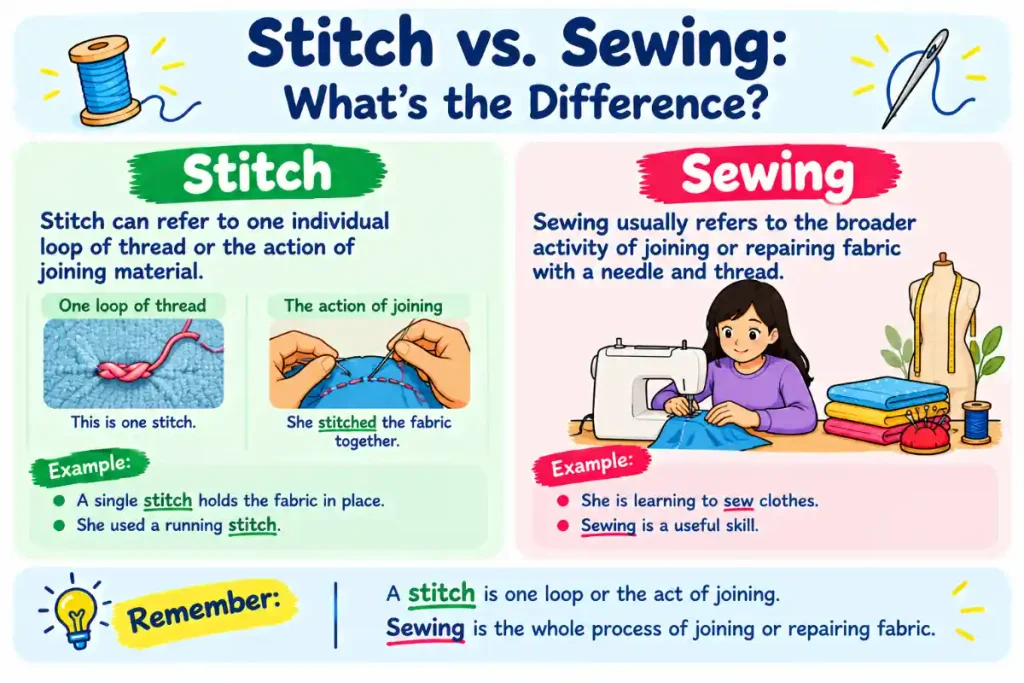
Stitch vs Sewing: What’s the Difference?
Stitch can refer to one individual loop of thread or the action of joining material. Sewing usually refers to the broader activity of joining or repairing fabric with a needle and thread.
| Word | Meaning | Example |
|---|---|---|
| Stitch | An individual loop or movement, or the act of joining material | She made a small stitch near the edge. |
| Sewing | The general activity of joining or repairing fabric | Sewing is one of her favorite hobbies. |
For example, you might spend an hour sewing a shirt and make hundreds of individual stitches in the process. Use stitch when discussing a particular sewing movement, pattern, or small repair. Use sewing when referring to the activity as a whole.
Stitch vs Seam: What’s the Difference?
A stitch and a seam are related, but they describe different parts of sewing. A stitch is a loop or movement made with thread. A seam is the line where two pieces of fabric are joined together.
| Word | Meaning | Example |
|---|---|---|
| Stitch | A single thread loop or sewing movement | One stitch came loose. |
| Seam | The line where pieces of fabric are joined | The seam along the sleeve needs repair. |
A seam is often made up of many stitches. If one stitch breaks, the seam may begin to come apart. Knowing this difference helps you describe clothing repairs accurately.
Stitch vs Stitches: Which Form Should You Use?
Use stitch for a singular item or action, and stitches for the plural noun or the third-person singular verb.
| Form | Usage | Example |
|---|---|---|
| Stitch | Singular noun or base verb | This stitch is too loose. |
| Stitches | Plural noun | The pattern uses several stitches. |
| Stitches | Verb for he, she, or it | She stitches the design by hand. |
| Stitched | Past tense or past participle | He stitched the patch onto his backpack. |
| Stitching | Present participle or gerund | Stitching requires patience and practice. |
The correct form depends on the sentence, not just on the spelling.
Examples:
- Correct: She stitches every Saturday.
- Correct: She made three stitches along the edge.
- Incorrect: She stichs every Saturday.
- Incorrect: She made three stiches along the edge.
Is Stitch Spelled Differently in American and British English?
No. Stitch is the standard spelling in both American and British English. Unlike words such as color and colour, which have recognized regional spelling differences, stitch does not change spelling between these varieties.
| Variety of English | Correct Spelling |
|---|---|
| American English | Stitch |
| British English | Stitch |
| Canadian English | Stitch |
| Australian English | Stitch |
For example:
- American English: I need to stitch this button onto my coat.
- British English: I need to stitch this button onto my coat.
- Australian English: I need to stitch this button onto my coat.
The spelling remains the same regardless of the audience.
Common Mistakes With Stitch
Writers sometimes make mistakes when spelling stitch, adding endings, or choosing related words. These examples show how to correct them.
Mistake 1: Leaving Out the T
Incorrect: I need to stich the torn pocket.
Correct: I need to stitch the torn pocket.
The word requires the letters t-c-h at the end.
Mistake 2: Misspelling Stitching
Incorrect: She is stiching the fabric.
Correct: She is stitching the fabric.
Keep the t when adding -ing to the base word.
Mistake 3: Misspelling Stitched
Incorrect: He stiched the patch onto his jacket.
Correct: He stitched the patch onto his jacket.
The past-tense form keeps the complete base spelling before adding -ed.
Mistake 4: Confusing Stitch With Seam
Incorrect: One seam came loose, leaving a single loop of thread undone.
Clearer: One stitch came loose along the seam.
Use stitch for the individual sewing movement and seam for the joined line of fabric.
Mistake 5: Using Stitch When Sew Is More Natural
Less natural: I need to stitch this shirt from scratch.
More natural: I need to sew this shirt from scratch.
Both verbs can be correct, but sew is generally the more natural choice when describing the complete process of making clothing. Stitch often emphasizes the individual movements or the joining of specific pieces.
Easy Tips for Remembering Stitch
If you often type stich by mistake, these simple tips can help:
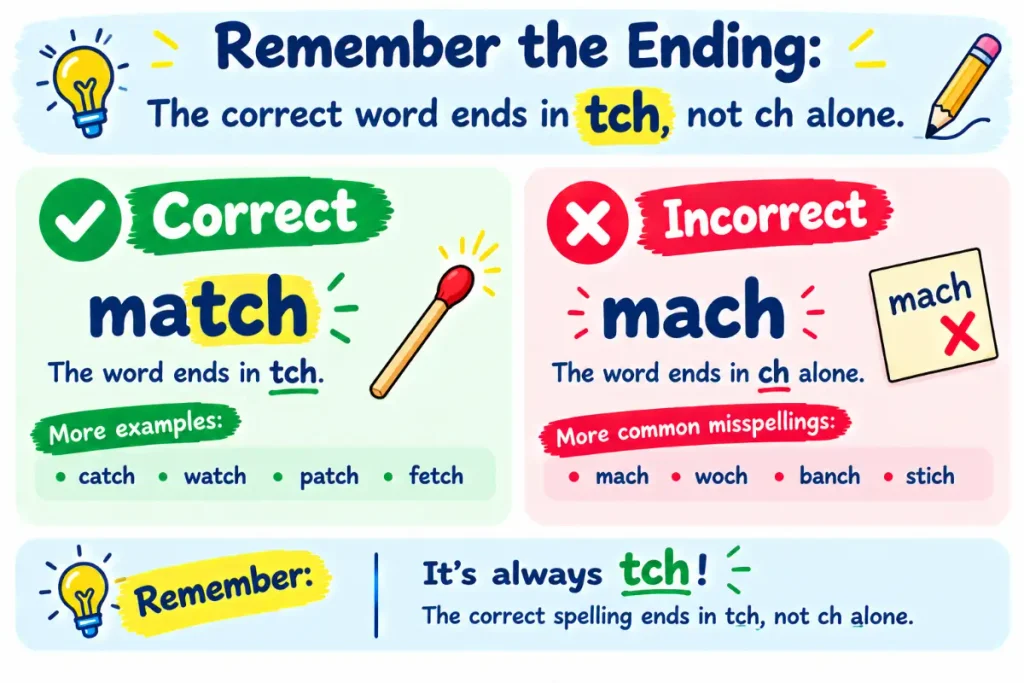
- Remember the ending: The correct word ends in tch, not ch alone.
- Connect it to sewing: Picture a needle and thread making a stitch in fabric.
- Practice related forms: Write stitch, stitches, stitching, and stitched together.
- Read your sentence aloud: Checking the sentence can help you catch mistakes that you overlook while typing.
- Use spell-checking tools: A spelling checker can help identify stich when it is intended to mean stitch.
The easiest reminder is that the correct spelling is always stitch when referring to sewing, thread, or the familiar expressions discussed above.
Conclusion
The spelling difference between stich vs stitch is simple: stitch is the standard English spelling, while stich is generally incorrect when referring to sewing, thread, or a sudden pain in the side. The correct spelling is the same in American and British English, so there is no need to adjust it for different audiences.
Use stitch when describing an individual sewing movement, a loop of thread, or the act of joining fabric. Remember its related forms, including stitches, stitching, and stitched, to avoid common writing mistakes. If you are unsure, focus on the ending: the word contains t-c-h. With this simple reminder, you can spell stitch correctly in schoolwork, craft instructions, emails, and everyday conversations.
Frequently Asked Questions
1. Which is correct, stich or stitch?
Stitch is correct for the standard English word referring to sewing, thread, or a sudden side pain. Stich is generally a misspelling.
2. How do you spell stitch?
The correct spelling is S-T-I-T-C-H. Remember the final three letters, tch, to avoid leaving out the second t.
3. Is stich ever a correct English word?
Stich is not the standard spelling of the common word stitch. It may appear in proper names or specialized contexts, but ordinary writing about sewing requires stitch.
4. What is the plural of stitch?
The plural is stitches. For example, “The tailor added several stitches to repair the sleeve.”
5. What is the difference between stitch and sewing?
A stitch is an individual loop or sewing movement, while sewing is the broader activity of joining or repairing fabric with thread.
6. Is stitch spelled the same in American and British English?
Yes. Both American and British English use stitch. There is no standard regional spelling difference between the two varieties.
7. What does it mean to be in stitches?
To be in stitches means to be laughing very hard. For example, “The comedian’s story had the entire audience in stitches.”
1 thought on “Stich vs Stitch: Which Spelling Is Correct?”