
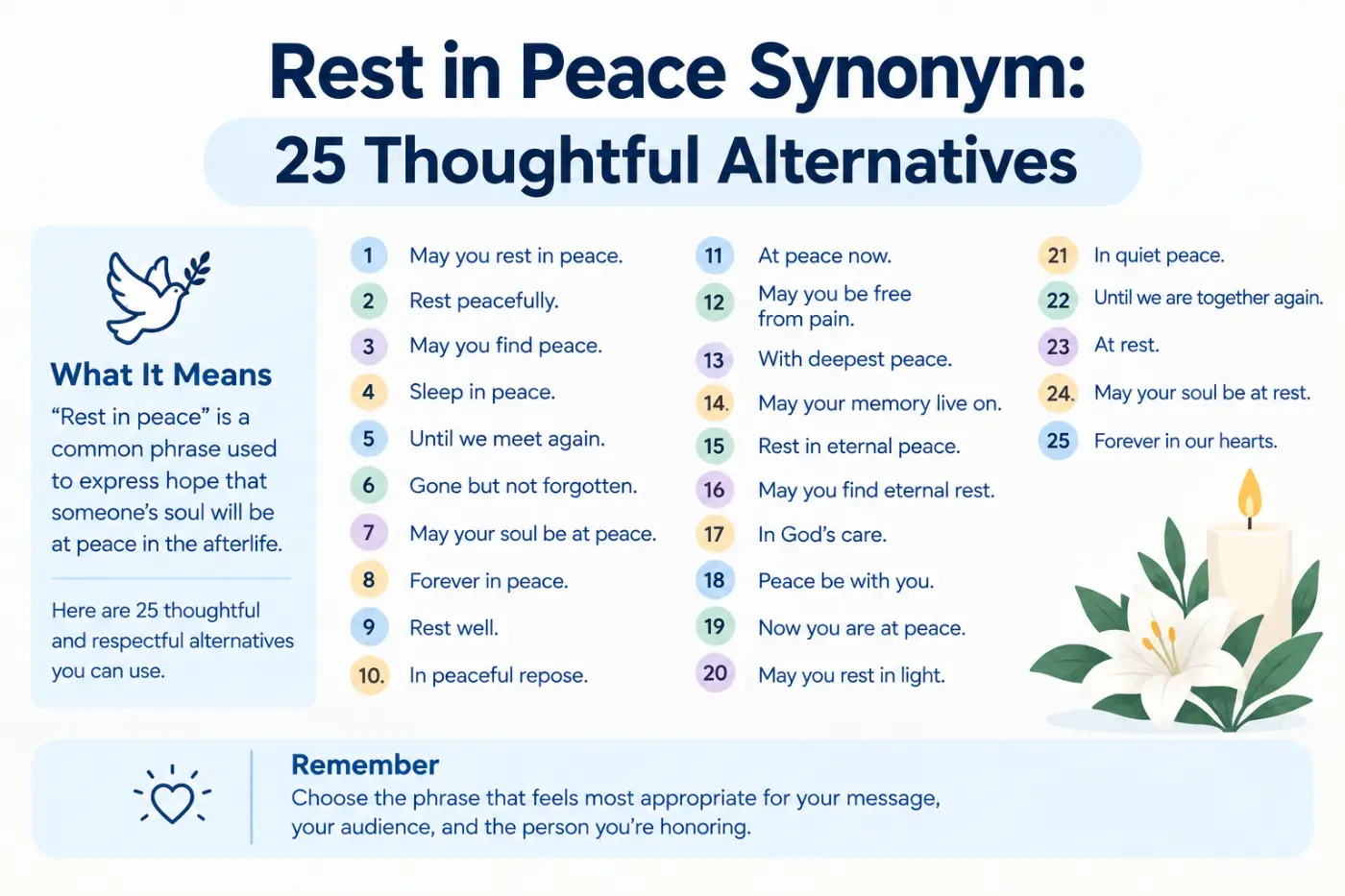
The best rest in peace synonym depends on the person who died, your relationship with them, and the tone of your message. Some alternatives express peace and remembrance, while others focus on love, faith, or the person’s lasting legacy.
Good alternatives to “rest in peace” include “may they rest peacefully,” “forever in our hearts,” “gone but never forgotten,” “may their memory be a blessing,” and “rest peacefully.”
Below, you’ll find thoughtful alternatives for different situations, including funeral messages, condolences, religious tributes, social media posts, and short messages.

What Does “Rest in Peace” Mean?
“Rest in peace” is a traditional expression used after someone’s death. It expresses a wish that the deceased may experience peace after death. The phrase is often shortened to RIP, especially in obituaries, memorial posts, and social media comments. Although “rest in peace” has religious and historical associations, people also use it in a general, nonreligious way. For that reason, the best alternative depends on the audience and context.
For example:
Rest in peace, Michael. You will be deeply missed.
A warmer alternative might be:
You will always be remembered and forever loved.
Both express sympathy, but the second focuses more on remembrance and affection than on the idea of resting after death. Not every alternative works in every situation. “Rest peacefully” is a close replacement for “rest in peace,” while “forever in our hearts” shifts the focus toward remembrance and love.
25 Thoughtful Alternatives to “Rest in Peace”
1. Rest peacefully
“Rest peacefully” is one of the closest alternatives to “rest in peace.” It is short, respectful, and gentle.
Rest peacefully, dear friend. You will always be remembered.
It’s suitable for sympathy messages, memorial posts, and personal tributes.
2. May they rest peacefully
This version sounds slightly more formal and works well when speaking about someone who has died.
May they rest peacefully and be remembered with love.
It’s especially useful when you want to avoid the abbreviation “RIP.”
3. Forever in our hearts
This phrase focuses on the relationship between the deceased and the people left behind.
Grandma, you will be forever in our hearts.
It’s warm and personal, making it a good choice for family tributes.
4. Gone but never forgotten
This is a familiar expression that emphasizes lasting remembrance.
Gone but never forgotten. Your kindness touched so many lives.
It works particularly well in short memorial messages.
5. Always remembered
If you want something simple and sincere, “always remembered” is an effective choice.
Your friendship will always be remembered.
Unlike “rest in peace,” it doesn’t make a statement about what happens after death.
6. Rest in eternal peace
This phrase adds a stronger spiritual or religious feeling.
May she rest in eternal peace.
Use it when the person’s beliefs or the context make spiritual language appropriate.
7. May their memory be a blessing
This is a thoughtful expression that places the emphasis on the person’s life and the memories they left behind.
May his memory be a blessing to everyone who knew him.
It’s especially meaningful when you want to honor someone’s influence rather than simply acknowledge their death.
8. At peace now
“At peace now” can offer comfort, particularly when someone experienced a long or difficult illness.
After such a difficult journey, we hope she is at peace now.
Use this phrase thoughtfully because it can imply that the person’s suffering has ended.
9. In loving memory
“In loving memory” is commonly used for memorials, dedications, photographs, and remembrance messages.
It’s more of a memorial phrase than a direct synonym for “rest in peace,” but it serves a similar purpose in many contexts.
10. You will be deeply missed
This option focuses directly on the grief of those who remain.
You will be deeply missed by everyone who knew you.
It’s especially appropriate in a condolence message to a family member or close friend.
11. Your memory lives on
This phrase highlights the continuing effect someone has on other people.
Your memory lives on in every life you touched.
It’s a good choice for celebrating someone’s impact.
12. Never forgotten
Short and powerful, “never forgotten” works well in memorial captions.
Forever loved. Never forgotten.
It can stand alone or be combined with a longer message.
13. May they find eternal peace
This is a more formal, spiritual expression.
May he find eternal peace and may his family find comfort.
It’s appropriate when a religious tone is welcome.
14. Peace be with them
This phrase has a spiritual feel and can work well in religious settings.
May peace be with her and with everyone who loved her.
It offers comfort without repeating the exact wording of “rest in peace.”
15. Rest well
Rest well, old friend. I’ll never forget you.
It’s best suited to a personal tribute rather than a formal condolence letter.
16. Until we meet again
This phrase can express the hope of seeing the person again, particularly in a spiritual or deeply personal context.
Until we meet again, you will remain in my heart.
Because it can imply an afterlife or reunion, consider the beliefs of the people reading the message.
17. May you rest among the angels
This is a poetic, explicitly spiritual expression.
May you rest among the angels, surrounded by eternal peace.
It’s best for religious or poetic tributes rather than professional messages.
18. Your legacy lives on
This alternative is particularly strong for honoring someone who made a meaningful contribution to a family, community, profession, or cause.
Your legacy lives on through everyone you inspired.
It celebrates the person’s continuing influence.
19. Your light will never fade
This is a poetic way to say that someone’s personality, kindness, or influence will remain.
Your light will never fade from our lives.
It works well in personal memorials and social media tributes.
20. We will carry your memory with us
This expression makes remembrance personal and active.
We will carry your memory with us wherever life takes us.
It’s particularly suitable for messages from a family, group of friends, or community.
21. Forever loved
This is concise and emotional.
Forever loved, forever remembered.
It’s suitable for memorial cards, captions, and inscriptions.
22. May your soul rest in peace
This is a direct spiritual variation of the original phrase.
May your soul rest in peace.
It is most appropriate when religious language fits the person’s beliefs or the setting.
23. Rest gently
Rest gently, dear friend. Your kindness will never be forgotten.
It’s less conventional than “rest in peace,” so it works best in personal writing.
24. Your memory will live forever
This phrase emphasizes the lasting place someone has in the memories of others.
Your memory will live forever in the hearts of your family.
It’s warm and appropriate for many memorial contexts.
25. Farewell, dear friend
Sometimes a simple goodbye says more than a traditional condolence phrase.
Farewell, dear friend. Thank you for all the wonderful memories.
This works especially well when you’re writing directly to the person who died.
Rest in Peace Synonyms by Tone
The right phrase depends heavily on tone. A funeral program calls for different wording than a text to a close friend.
Simple and respectful
Choose these when you want something sincere without sounding overly formal:
- Rest peacefully
- May they rest peacefully
- Always remembered
- Never forgotten
- Forever loved
- Rest well
Warm and emotional
These focus on love, memory, and personal loss:
- Forever in our hearts
- You will be deeply missed
- Your memory lives on
- We will carry your memory with us
- Forever loved
- Your memory will live forever
Religious or spiritual
These are appropriate when faith is an important part of the context:
- Rest in eternal peace
- May they find eternal peace
- May their memory be a blessing
- Peace be with them
- May you rest among the angels
- May your soul rest in peace
- Until we meet again
Formal
For an obituary, memorial program, workplace announcement, or other formal setting, consider:
- In loving memory
- May they rest peacefully
- May they find eternal peace
- Their memory will live on
- Their legacy lives on
- We extend our deepest condolences
Poetic
For a personal tribute, inscription, or memorial post:
- Your light will never fade
- Rest gently
- Until we meet again
- Your memory lives forever
- Your legacy lives on

Rest in Peace vs. Forever in Our Hearts
These phrases are similar in purpose but different in focus. “Rest in peace” expresses a wish for peace after death. “Forever in our hearts” focuses on the lasting emotional connection between the deceased and the people who loved them.
Compare:
Rest in peace, Uncle James.
with:
Uncle James, you will be forever in our hearts.
The first is a traditional farewell. The second feels more personal and emphasizes remembrance. If you want your message to feel warmer, “forever in our hearts” is often a strong choice.
Rest in Peace vs. Gone but Never Forgotten
Both phrases honor someone who has died, but they emphasize different ideas.
| Phrase | Main focus | Tone |
|---|---|---|
| Rest in peace | Peace after death | Traditional |
| Gone but never forgotten | Continued remembrance | Warm, familiar |
For example:
Rest in peace, David.
is a traditional memorial statement.
Gone but never forgotten, David. Your friendship meant so much to us.
adds a stronger sense of personal remembrance.
Rest in Peace vs. May Their Memory Be a Blessing
These expressions also differ in emphasis.
“Rest in peace” focuses on the deceased. “May their memory be a blessing” focuses on the meaning of their life and the comfort their memory may provide. The second phrase can be especially meaningful when you’re writing about someone whose life had a strong influence on others. May her memory be a blessing to her family and everyone who knew her. This is more specific and reflective than simply writing “RIP.”
How to Choose the Right Alternative
Before choosing a synonym, think about four things:
- Your relationship with the person
- The beliefs of the deceased and their family
- Where the message will appear
- How personal you want the message to sound
A short social media comment might call for:
Gone but never forgotten. ❤️
A sympathy card could say:
You will be deeply missed, and your memory will always remain in our hearts.
A religious funeral program might use:
May they rest in eternal peace.
A professional workplace announcement could be more restrained:
We extend our deepest condolences to his family and loved ones.
The best wording is the one that feels appropriate rather than the one that sounds most elaborate.
What to Say Instead of “Rest in Peace” in a Sympathy Card
A sympathy card usually benefits from warmth and sincerity.
Consider:
Your loved one will always be remembered with love.
Or:
Thinking of you and your family during this difficult time.
Or:
May the memories you shared bring you comfort in the days ahead.
You don’t have to use a direct replacement for “rest in peace.” A condolence message can focus on the living person’s grief rather than making a statement about the deceased.
What to Say Instead of “RIP” in a Social Media Post
“RIP” is common online, but a slightly longer message can feel more personal.
Try:
Gone but never forgotten. Rest peacefully, my friend.
Forever in our hearts. You will be deeply missed.
Your kindness touched so many people. Your memory will live on.
Rest peacefully. Thank you for the memories.
Sending love to everyone who knew and loved her.
Avoid making a social media tribute overly formal if the person was a close friend. Natural language usually feels more sincere.
What to Say Instead of “Rest in Peace” for a Friend
For a close friend, personal language is often stronger than a traditional phrase.
You could write:
I’ll miss you more than words can say.
Thank you for every memory. You will always have a place in my heart.
Rest well, my friend. I’ll never forget you.
Your friendship changed my life. I will carry your memory with me always. These messages don’t simply acknowledge the death. They communicate what the person meant to you.
What to Say Instead of “Rest in Peace” for a Family Member
Family tributes can be intimate and emotional.
Examples include:
You will always be part of our family and forever in our hearts.
Your love shaped our family, and your memory will live on through us.
We will carry your memory with us every day.
You were deeply loved, and you will never be forgotten.
For a parent, grandparent, sibling, or child, a specific memory or quality can make the message more meaningful than a generic phrase.
Religious vs. Nonreligious Alternatives
Not everyone shares the same beliefs about death or an afterlife. If you don’t know someone’s religious views, a neutral expression may be more appropriate.
Religious or spiritual
- May they rest in eternal peace.
- May their soul rest in peace.
- May they rest among the angels.
- Until we meet again.
- May their memory be a blessing.
Neutral
- Forever in our hearts.
- Gone but never forgotten.
- You will be deeply missed.
- Always remembered.
- Your memory lives on.
- We will carry your memory with us.
Neutral phrases are often the safest choice when you’re unsure what language the family would find comforting.
Common Mistakes When Writing a Condolence Message
A thoughtful message doesn’t need complicated language. In fact, simple wording is often better.
Mistake 1: Making the message about yourself
Instead of focusing entirely on your own feelings, acknowledge the family’s loss.
Less helpful:
I can’t believe this happened to me.
Better:
I’m so sorry for your loss. I’m thinking of you and your family.
Mistake 2: Using religious language without knowing the audience
A phrase about heaven, angels, or an afterlife may be comforting to some people but inappropriate for others. When you’re uncertain, choose a neutral expression such as:
May their memory bring you comfort.
Mistake 3: Using clichés without adding anything personal
“RIP” is perfectly understandable, but a personal detail can make a tribute more meaningful.
Instead of:
RIP. You will be missed.
try:
Rest peacefully, Mark. I’ll always remember your kindness and your terrible jokes.
A genuine memory can say more than a dozen formal phrases.
Mistake 4: Trying too hard to sound poetic
Grief doesn’t require elaborate language.
A simple:
You were deeply loved and will never be forgotten.
can be more effective than a long, ornate sentence.
Mistake 5: Saying the person is “in a better place”
This expression is common, but it can be sensitive. If the deceased had a painful illness, the phrase may feel comforting. In other situations, however, it can sound dismissive of the family’s grief. When in doubt, focus on sympathy and remembrance.
Is “Rest in Peace” Appropriate for Everyone?
“Rest in peace” is widely understood and commonly used, but it isn’t the only appropriate choice. If you know the person’s faith, cultural background, or personal preferences, you can choose language that respects those beliefs. If you don’t know, neutral wording is usually a considerate option.
For example:
I’m so sorry for your loss. Your loved one will always be remembered.
This expresses sympathy without making assumptions about religion or the afterlife.

Quick Guide to Choosing
Use this quick reference when you’re not sure what to write:
- Want the closest replacement? → “Rest peacefully.”
- Want something warm? → “Forever in our hearts.”
- Want something familiar? → “Gone but never forgotten.”
- Want something religious? → “May they rest in eternal peace.”
- Want something neutral? → “Always remembered.”
- Want something personal? → “You will be deeply missed.”
- Want something poetic? → “Your light will never fade.”
- Want to honor their influence? → “Your legacy lives on.”
- Want a short social media tribute? → “Forever loved, never forgotten.”
- Want to comfort the family? → “May their memory bring you comfort.”
Conclusion
- The best rest in peace synonym depends on what you want your message to communicate. If you want a close, traditional alternative, choose “rest peacefully.” For warmth and remembrance, “forever in our hearts,” “gone but never forgotten,” or “always remembered” may feel more personal. Religious messages can use phrases such as “may they rest in eternal peace,” while neutral messages can focus on the person’s memory and the family’s loss.
- Most importantly, don’t feel pressured to find perfect words. A short, sincere message can be more meaningful than an elaborate one. If possible, mention something specific about the person—their kindness, humor, friendship, or the memories you shared. That personal touch turns a familiar condolence phrase into a genuine tribute.
Frequently Asked Questions
What’s another way to say “rest in peace”?
Common alternatives include “rest peacefully,” “forever in our hearts,” “gone but never forgotten,” “always remembered,” and “may they rest in eternal peace.” The best choice depends on the tone and beliefs involved.
What is a good rest in peace synonym for a friend?
“Rest peacefully, my friend,” “you will always be remembered,” and “until we meet again” are warm choices for a close friend. You can also make the message more personal by mentioning a shared memory.
What can I say instead of RIP?
Instead of “RIP,” you can write “forever in our hearts,” “gone but never forgotten,” “rest peacefully,” or “you will be deeply missed.” A short personal message often feels more meaningful than an abbreviation.
Is “gone but never forgotten” appropriate for a funeral?
Yes. “Gone but never forgotten” is a familiar and respectful expression for memorials, funeral programs, sympathy cards, and tributes. It emphasizes continued remembrance rather than a particular religious belief.
What is a nonreligious alternative to “rest in peace”?
Good nonreligious choices include “forever in our hearts,” “always remembered,” “you will be deeply missed,” “your memory lives on,” and “gone but never forgotten.”
What is a religious way to say “rest in peace”?
Religious alternatives include “may they rest in eternal peace,” “may their soul rest in peace,” and “may they rest among the angels.” Choose language that fits the person’s faith and the family’s beliefs.
What is the most comforting alternative to “rest in peace”?
There isn’t one phrase that works for everyone, but “forever in our hearts” and “may their memory be a blessing” are often warm choices. For a personal message, adding a specific memory can make the words more comforting.
2 thoughts on “Rest in Peace Synonym: 25 Thoughtful Alternatives”