
You’re writing a text, email, essay, or social media post and want to describe someone who stays calm despite a difficult or surprising situation. Then you run into a familiar spelling question: unphased or unfazed?
The standard word for someone who remains calm, unaffected, or unconcerned is unfazed. For example, “She was unfazed by the criticism.”
Unfazed is the correct choice when you mean “not bothered, surprised, worried, or affected.” Unphased is sometimes used informally, but it is generally considered a nonstandard spelling when it is intended to mean “unfazed.”
The difference is easier to remember once you understand where unfazed comes from and how it relates to the verb faze.

Unphased or Unfazed: Which Is Correct?
Unfazed is the standard spelling when you mean calm, unbothered, or unaffected by something.
| Word | Standard for “unbothered”? | Meaning |
|---|---|---|
| unfazed | ✅ Yes | Not bothered, surprised, worried, or disturbed |
| unphased | ❌ Usually no | Often a misspelling of unfazed |
| fazed | ✅ Yes | Bothered, disturbed, or unsettled |
| unfaze | ✅ Yes | To not bother or disturb someone |
Examples:
She remained unfazed by the sudden change in plans.
He seemed completely unfazed by the criticism.
The loud noise didn’t faze the baby.
If your intended meaning is “not bothered,” choose unfazed.
What Does Unfazed Mean?
Unfazed means not bothered, upset, surprised, worried, or intimidated by something that might normally cause a reaction. It describes a person’s reaction to a situation.
For example:
The pitcher was unfazed by the hostile crowd.
This means the pitcher wasn’t noticeably bothered or intimidated by the crowd.
Another example:
Maya was unfazed when her presentation stopped working.
She stayed calm instead of becoming visibly upset or nervous. The word often suggests composure under pressure.
Unfazed in simple terms
You can think of unfazed as:
- calm
- unbothered
- untroubled
- unconcerned
- composed
- not intimidated
- not surprised
- not disturbed
The exact synonym depends on the situation.
Why Is Unfazed Spelled With an F?
The key to the spelling is the verb faze. Faze means to disturb, bother, unsettle, or intimidate someone. Its negative form is:
un + faze = unfaze
And the past participle or adjective is:
unfazed
So the spelling comes from faze, not phase. That’s why the standard word is:
unfazed
rather than:
❌ unphased
The confusion happens because faze and phase sound alike in many varieties of English. They are pronounced as homophones, but they have different meanings and spellings.
Faze vs. Phase: What’s the Difference?
Faze and phase sound the same, but they are different words.
The criticism didn’t faze her.
Here, the criticism didn’t bother her.
Phase
Phase is usually a noun meaning a stage or period in a process. It can also be a verb meaning to introduce or carry something out in stages.
The project is entering its final phase.
The company will phase in the new system over several months.
It does not normally mean “bother” or “disturb.”
| Word | Meaning | Example |
|---|---|---|
| faze | Bother or unsettle | The setback didn’t faze him. |
| phase | A stage or period | We’re entering the next phase. |
| unfazed | Not bothered or unsettled | She remained unfazed. |
| phased | Put into stages or organized by phases | The changes were phased in gradually. |
This distinction explains why unphased is usually incorrect when you’re trying to say that someone wasn’t bothered.
Why Do People Write Unphased?
The spelling unphased is easy to understand as a mistake because phase is a much more familiar word than faze.
People may hear:
“She was unfazed.”
and connect the sound to phase.
That can lead to:
❌ She was unphased.
But the word you’re looking for comes from faze:
faze → unfazed
This is a spelling issue involving homophones. The words sound alike but have unrelated meanings.
A useful way to remember it
Ask yourself:
Was the person bothered?
If the answer involves being bothered or not bothered, think faze.
- bothered → fazed
- not bothered → unfazed
If you’re talking about stages, periods, or steps in a process, think phase.
- a stage → phase
- introduced in stages → phased
Unfazed vs. Unaffected: What’s the Difference?
Unfazed and unaffected can overlap, but they aren’t always interchangeable. It suggests that something didn’t bother, worry, surprise, or intimidate the person.
She was unfazed by the negative comments.
Unaffected has a broader meaning. It can mean that something did not change or influence a person, object, or situation.
The building was unaffected by the storm.
You could also say:
He seemed unaffected by the criticism.
That suggests the criticism didn’t visibly change his emotional state.
The distinction is subtle:
| Word | Main idea | Example |
|---|---|---|
| unfazed | Not bothered or intimidated | She was unfazed by the challenge. |
| unaffected | Not changed or influenced | The schedule was unaffected by the delay. |
If you’re describing someone’s calm reaction to pressure, unfazed is usually more natural.
Unfazed vs. Unconcerned: What’s the Difference?
These words are close, but unconcerned can suggest a lack of worry or interest, while unfazed emphasizes a person’s reaction to something that could have caused distress.
He was unfazed by the difficult interview.
This means the interview didn’t seem to rattle him.
He was unconcerned about the interview.
This means he wasn’t worried about it. Someone can be unfazed while still caring deeply about an issue. The word describes the person’s reaction, not necessarily their level of concern about the broader matter.
Unfazed vs. Unbothered: What’s the Difference?
Unfazed and unbothered are often interchangeable in casual writing.
She remained unfazed by the criticism.
She remained unbothered by the criticism.
The tone differs slightly. Unfazed sounds more neutral and polished. It’s appropriate in professional, academic, and general writing. Unbothered is more conversational and can carry a stronger sense of confidence or indifference. For a formal report, unfazed is usually the safer choice. For a casual text or social media post, unbothered may sound more natural.
Unfazed vs. Unphased in a Sentence
The easiest way to see the difference is to compare correct and incorrect examples.
Correct
The athlete remained unfazed after missing the first shot.
Incorrect
The athlete remained unphased after missing the first shot.
Correct
She was unfazed by the sudden change in plans.
Incorrect
She was unphased by the sudden change in plans.
Correct
Nothing seemed to faze him.
Incorrect
Nothing seemed to phase him.
The pattern is consistent:
faze → fazed → unfazed
Not:
phase → phased → unphased
10 Examples of Unfazed in Real Sentences
Here are examples across everyday, professional, and academic contexts:
- The teacher remained unfazed when the projector stopped working.
- She was unfazed by the long line at the airport.
- Despite the criticism, the author seemed unfazed.
- He remained unfazed during the difficult interview.
- The dog was completely unfazed by the thunder.
- Our manager was unfazed by the last-minute change.
- She looked unfazed after making a small mistake during the presentation.
- The team appeared unfazed by the early deficit.
- He was unfazed when his original plan fell through.
- The student remained unfazed by the challenging questions.
In each sentence, unfazed describes someone or something that doesn’t appear bothered, frightened, surprised, or unsettled.
Can You Say “I Was Unfazed”?
Yes. I was unfazed is completely natural.
For example:
I was unfazed by the unexpected question.
You can also use the word after verbs such as:
- remain
- seem
- appear
- look
- stay
Examples:
She remained unfazed.
He seemed unfazed.
They appeared unfazed.
She looked unfazed.
The team stayed unfazed despite the pressure.
These constructions are especially common because unfazed works well as an adjective describing a person’s state or reaction.
Is Unfazed an Adjective?
Yes. Unfazed is commonly used as an adjective. It describes someone who isn’t bothered, disturbed, surprised, or intimidated.
For example:
He was unfazed by the rejection.
Grammatically, unfazed is also the past participle form of unfaze, and it functions adjectivally in sentences such as this one.
The related forms are:
| Form | Word | Example |
|---|---|---|
| Verb | faze | The criticism didn’t faze her. |
| Past tense | fazed | The criticism never fazed her. |
| Negative verb | unfaze | Nothing could unfaze him. |
| Adjective/past participle | unfazed | He remained unfazed. |
What Does Faze Mean?
Faze means to make someone feel bothered, disturbed, worried, confused, or intimidated.
For example:
The unexpected question fazed him.
That means the question made him uncomfortable or unsettled. In negative constructions, faze often appears with didn’t:
The unexpected question didn’t faze him.
This means he stayed calm. That’s closely related to:
He was unfazed by the unexpected question.
The two sentences communicate almost the same basic idea.
Fazed vs. Unfazed
These words are opposites in the relevant sense.
| Word | Meaning | Example |
|---|---|---|
| fazed | Bothered or unsettled | She was fazed by the criticism. |
| unfazed | Not bothered or unsettled | She was unfazed by the criticism. |
For a simple memory trick:
fazed = bothered
unfazed = not bothered
Important: Unfazed doesn’t always mean emotionless
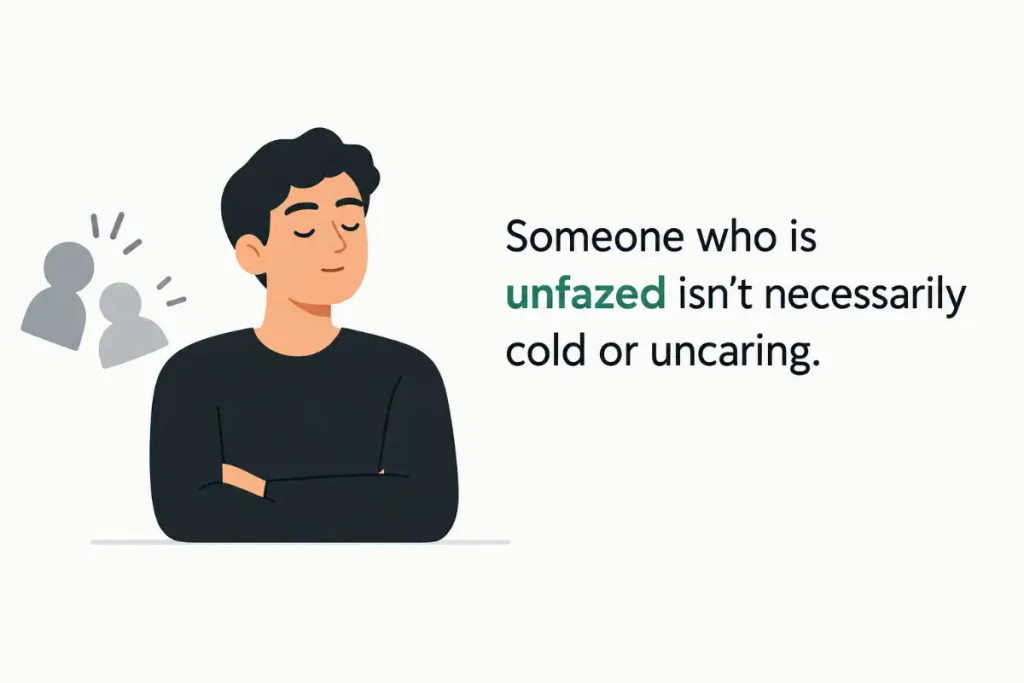
Someone who is unfazed isn’t necessarily cold or uncaring.
For example:
Although he was worried about the result, he remained unfazed during the interview.
He can have genuine concerns while still appearing calm and composed. So unfazed describes a reaction, not someone’s entire personality.
What Are Some Synonyms for Unfazed?
The best synonym depends on the context.
| Word or phrase | Meaning | Tone | Example |
|---|---|---|---|
| unbothered | Not troubled | Casual | She seemed unbothered. |
| calm | Not agitated | Neutral | He stayed calm. |
| composed | Calm and controlled | Formal | She remained composed. |
| untroubled | Free from worry | Neutral | He appeared untroubled. |
| unconcerned | Not worried | Neutral | She seemed unconcerned. |
| collected | Calm and self-controlled | Formal | He stayed collected. |
| cool | Calm under pressure | Casual | She stayed cool. |
| steady | Calm and controlled | Neutral | He kept a steady manner. |
| serene | Very peaceful and calm | Formal | She remained serene. |
| self-possessed | Confident and controlled | Formal | He was self-possessed during the interview. |
| unruffled | Not upset or disturbed | Formal | She remained unruffled. |
| impassive | Showing little emotion | Formal | He appeared impassive. |
| indifferent | Showing little concern | Neutral | She seemed indifferent to the criticism. |
| stoic | Showing little outward emotion during difficulty | Neutral/Formal | He maintained a stoic expression. |
| relaxed | Free from tension | Neutral | She looked relaxed. |
| unperturbed | Not disturbed or worried | Formal | He was unperturbed by the delay. |
These aren’t perfect substitutes in every sentence. For example, indifferent can suggest that someone doesn’t care, while unfazed only says that the person isn’t visibly bothered.
Unfazed Synonyms by Tone
Simple and everyday
Use these when you want plain, natural language:
- calm
- unbothered
- relaxed
- unconcerned
- unaffected
Professional or formal
These work well in reports, business writing, and formal descriptions:
- composed
- unruffled
- unperturbed
- self-possessed
- collected
Casual
These are more conversational:
- cool
- chill
- unbothered
- no big deal
Be careful with slang in professional writing. Unfazed itself is neutral enough for almost any standard context.
When Should You Use Unfazed?
Unfazed works well when describing a reaction to something that could reasonably cause concern or discomfort. Common situations include:
- criticism
- pressure
- unexpected news
- failure
- difficult questions
- setbacks
- confrontation
- delays
- stressful situations
- surprising events
- competition
Examples:
She was unfazed by the criticism.
He remained unfazed under pressure.
The player looked unfazed after the mistake.
They were unfazed by the unexpected delay.
The phrase often suggests that the person handled the situation with confidence or composure.
Is Unfazed Appropriate for Professional Writing?
Yes. Unfazed is a standard English word and can be used in professional writing.
For example:
The candidate remained unfazed when asked a difficult question.
The manager appeared unfazed by the unexpected change.
She remained unfazed under pressure and continued the presentation.
However, if you’re writing a highly technical or formal report, a more precise word may sometimes be better.
For example, instead of:
The system was unfazed by the change.
you might write:
The system was unaffected by the change.
That’s because unfazed is generally associated with a person or an entity being emotionally or psychologically unbothered, while unaffected can describe physical systems, results, schedules, and other things.
Is Unphased Ever Correct?
Unphased can appear in writing, but when someone uses it to mean “not bothered,” unfazed is the standard word to choose. There is an important reason not to treat every occurrence of unphased as a simple typo without checking the context: English can use phase in technical or specialized contexts.
For example, phase has meanings in science, engineering, mathematics, and other fields. A specialized use may produce words such as phased and potentially constructions involving a negative prefix.
But if your sentence means:
“not bothered or intimidated”
then the word you want is:
unfazed
For ordinary writing, this distinction will cover nearly every situation you’ll encounter.
Common Mistakes With Unfazed
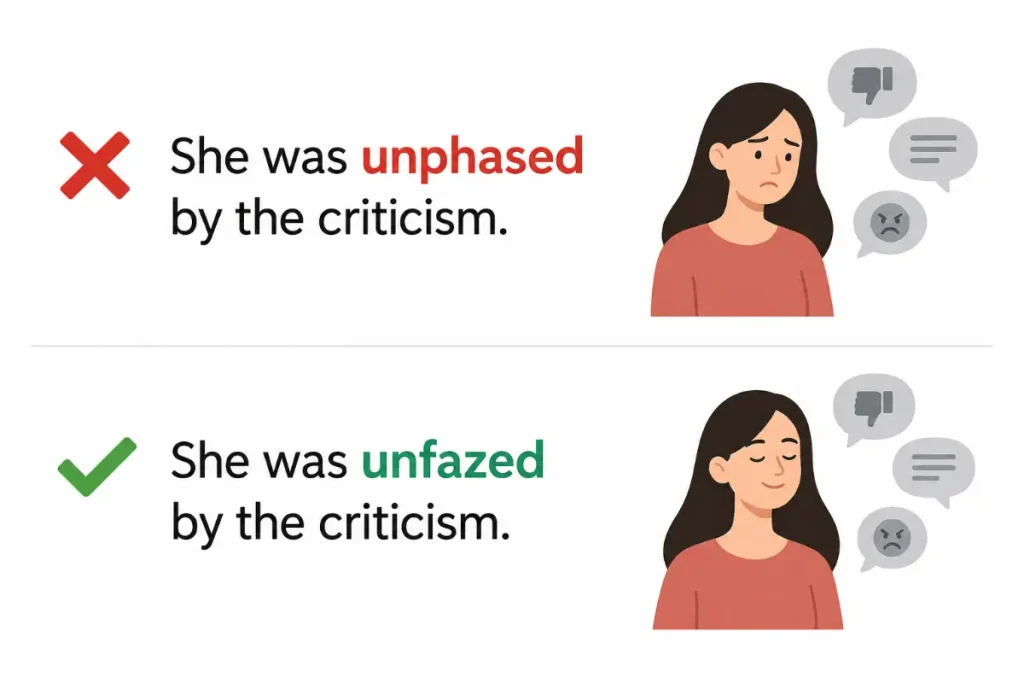
❌ She was unphased by the criticism.
✅ She was unfazed by the criticism.
Mistake 2: Writing phase when you mean bother
❌ The bad news didn’t phase him.
✅ The bad news didn’t faze him.
Mistake 3: Confusing phased with fazed
These words have completely different meanings.
The company phased in the new policy.
Here, phased means introduced gradually.
The criticism fazed her.
Here, fazed means bothered or unsettled.
Mistake 4: Assuming unfazed means uncaring
Someone can be unfazed while still caring deeply about an outcome.
She was unfazed by the criticism because she trusted her work.
The word describes her reaction, not her level of compassion or interest.
A Simple Memory Trick
The easiest way to remember unfazed is to connect it with faze = bother.
Think:
Faze = make someone nervous or uncomfortable.
Then add un-:
Unfazed = not bothered.
Another trick is to keep phase in its own category:
Phase = stage
Faze = bother
So:
unfazed = not bothered
This small distinction prevents both common spelling errors: unphased and phase when faze is required.
Conclusion
The correct choice between unphased or unfazed is usually unfazed when you mean “not bothered, worried, surprised, or intimidated.” The word comes from faze, a verb meaning to disturb or unsettle someone. That’s why the related forms are faze, fazed, unfaze, and unfazed.
Keep phase separate in your mind: it usually refers to a stage, period, or process. So a project can move into a new phase, and a company can phase in a policy, but a person can remain unfazed by criticism.
The simplest memory rule is faze = bother; unfazed = not bothered. If that’s the meaning you want, unfazed is the spelling to use.
Frequently Asked Question?
Is it unfazed or unphased?
Unfazed is correct when you mean “not bothered, worried, surprised, or intimidated.” Unphased is generally a misspelling in this context.
How do you spell unfazed?
The correct spelling is U-N-F-A-Z-E-D: unfazed. It comes from the verb faze, meaning to bother or unsettle.
What does unfazed mean?
Unfazed means calm and not bothered or disturbed by something that might normally cause concern, surprise, or discomfort.
Is “unphased” a word?
Unphased can appear in specialized or nonstandard usage, but it isn’t the standard spelling when you mean “unbothered.” In ordinary English, use unfazed for that meaning.
What’s the difference between fazed and phased?
Fazed means bothered or unsettled, while phased relates to phase, meaning a stage or period. For example, criticism can leave someone fazed, while a new policy can be phased in.
Is unfazed formal or casual?
Unfazed is a neutral English word that works in both casual and formal writing. It can be used in conversation, emails, essays, reports, and professional communication.
What’s another way to say unfazed?
Common alternatives include unbothered, calm, composed, unperturbed, unruffled, unconcerned, and unaffected. The best choice depends on whether you want to emphasize calmness, lack of concern, or lack of change.
2 thoughts on “Unphased or Unfazed: Which Is Correct?”