
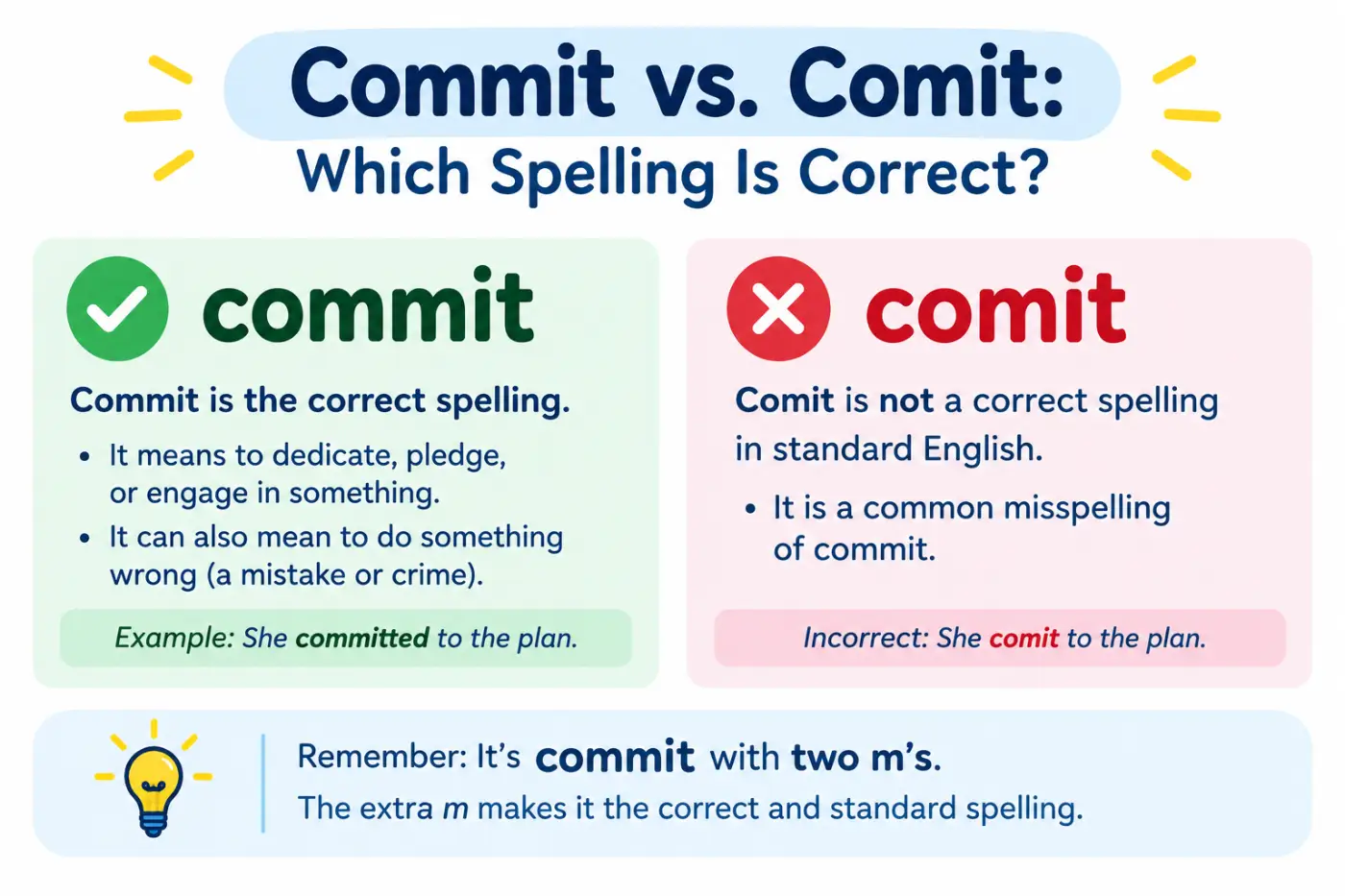
If you’re writing an email, essay, application, or text and wonder about Commit vs Comit, the correct spelling is commit. Comit is a common misspelling and is not accepted as the standard spelling of the English verb.
Commit means to dedicate yourself to a task, make a promise, or carry out an action. The word contains two ms, which some writers accidentally reduce to one. Remembering the double m can help you avoid this common spelling mistake.
In this guide, you’ll learn the meaning of commit, understand why comit is incorrect, and explore examples of how to use the word in sentences. You’ll also learn how to spell related forms, including committed and committing, correctly.
Commit vs Comit: Which Is Correct?
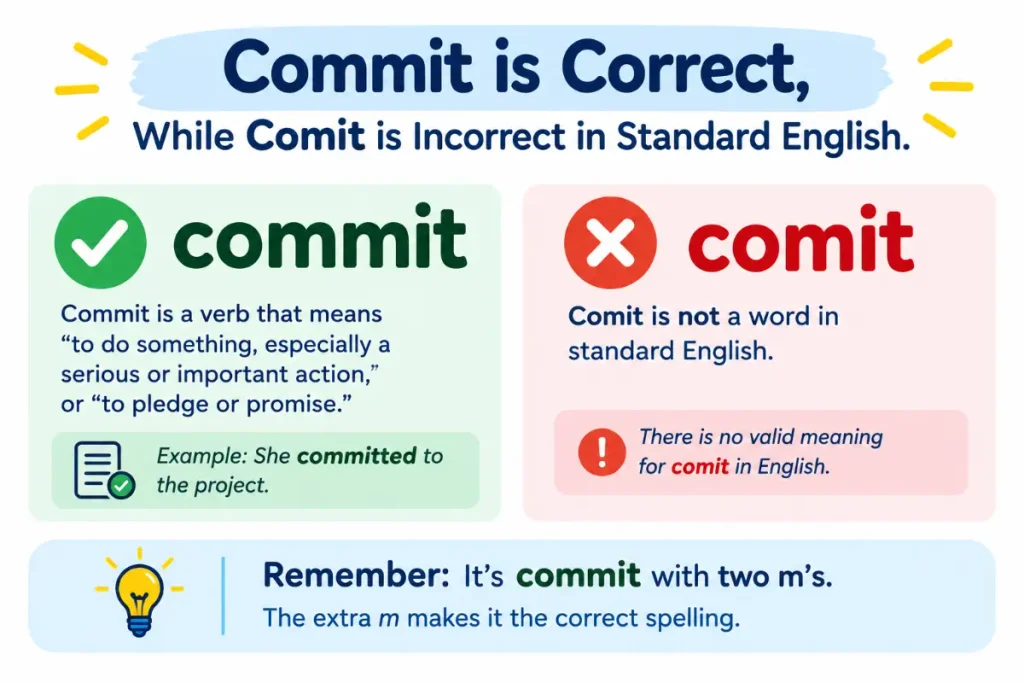
Commit is correct, while comit is incorrect in standard English.
| Spelling | Correct? | Meaning |
|---|---|---|
| commit | Yes | To carry out an action, make a serious promise, or devote yourself to something |
| comit | No | Not a standard English spelling |
The correct spelling contains two m’s:
c-o-m-m-i-t
For example:
- She decided to commit to the new schedule.
- He was accused of a serious crime, not asked to “comit” one.
- The company wants to commit more resources to the project.
If you’re choosing between commit vs comit, use commit.
What Does Commit Mean?
Commit is a verb with several related meanings. It can mean to carry out an action, make a firm promise, dedicate yourself to something, or officially put something into a particular state.
Commit means to carry out an action
The verb can mean to perform or carry out something, especially an action that is serious, deliberate, or wrong.
- The suspect was charged with committing a crime.
- She admitted that she had committed an error.
- The organization promised not to commit fraud.
Commit means to make a firm decision or promise
You can also commit to something when you agree to do it or support it.
- I commit to finishing the project by Friday.
- She decided to commit to regular practice.
- The team committed to improving customer service.
Commit means to devote yourself
When someone commits to a goal, relationship, project, or responsibility, they give it serious time, effort, or attention.
- He isn’t ready to commit to the new job.
- They committed themselves to helping the community.
- The student wants to commit more time to studying.
Commit can have a technical meaning
In technology, especially software development, a commit is a saved set of changes made to a project or codebase.
For example:
The developer made a commit after fixing the bug.
Here, commit can function as a noun as well as a verb.
How Do You Spell Commit Correctly?
The correct spelling is:
COMMIT
Break it into its letters:
C-O-M-M-I-T
The key point is the double m.
A common mistake is to write comit, leaving out one of the m’s. Another mistake is to become unsure when changing the word into another grammatical form.
Here are the common forms:
| Form | Correct Spelling |
|---|---|
| Base verb | commit |
| Third-person singular | commits |
| Present participle | committing |
| Past tense | committed |
| Past participle | committed |
| Noun | commitment |
Notice that the double m stays in the main forms of the word.
Why Is Comit Incorrect?
Comit is incorrect because standard English spells the verb with two m’s: commit. This isn’t simply a matter of American versus British spelling. Commit is the standard spelling in both American and British English. The error often happens because writers pronounce the word quickly and don’t notice the doubled consonant when spelling it. English has many words in which repeated letters are easy to overlook.
Compare:
- commit — correct
- comit — incorrect
- committed — correct
- comitted — incorrect
- committing — correct
- comitting — incorrect
The spelling pattern becomes easier to remember once you recognize that the base word itself contains mm.
Commit vs Comit in a Sentence
The easiest way to understand the difference is to see how the correct word works in ordinary sentences.
Correct examples with Commit
- I want to commit to this plan before the meeting.
- She decided to commit more time to her studies.
- The company will commit additional money to the project.
- He refused to commit to a specific date.
- You need to commit to your decision.
- The organization promised to commit more resources to the program.
- The player hopes to commit to the team for another season.
- We should commit these changes before closing the project.
- The investigation focused on whether anyone had committed a crime.
- She has committed herself to completing the course.
- They are committing significant resources to research.
- He made a commitment to improve his work habits.
Incorrect examples with Comit
These examples show the spelling mistake:
- I want to comit to the plan. ❌
- She decided to comit more time to school. ❌
- He comited to the project. ❌
- They are comiting their resources to the effort. ❌
The corrected versions are:
- I want to commit to the plan. ✅
- She decided to commit more time to school. ✅
- He committed to the project. ✅
- They are committing their resources to the effort. ✅
How Do You Use Commit?
The most common construction is commit to + noun or commit to + -ing form.
Commit to a noun
Use commit to when you promise to support, do, or take part in something.
- She committed to the project.
- They committed to the agreement.
- He committed to the plan.
Commit to an -ing verb
When commit to is followed by another verb, that verb normally takes the -ing form.
- I committed to studying every evening.
- She committed to saving money.
- They committed to improving the process.
A common mistake is using the base form after commit to:
- I committed to study every night. ❌
- I committed to studying every night. ✅
This happens because to can introduce an infinitive, as in to study, but in commit to, the word to functions as a preposition. A noun or gerund follows it.
Commit, Committed, and Committing
The spelling changes slightly when commit takes different endings, but the double m remains important.
Commit
Use commit as the base form.
- I will commit to the plan.
- They may commit additional funds.
Commits
Use commits with a third-person singular subject in the present tense.
- She commits to every project she starts.
- The system automatically commits the changes.
Committed
The past tense and past participle are committed, with two m’s and two t’s.
- He committed to the program.
- She has committed to the new schedule.
Committing
The present participle is committing, with two m’s and two t’s.
- They are committing more resources to the project.
- He is committing to a long-term plan.
These forms are easy to misspell:
- comited ❌ → committed ✅
- comiting ❌ → committing ✅
Why Does Commit Have Double Letters?
The spelling of commit follows a common English spelling pattern involving a stressed final syllable and a consonant before a vowel-ending suffix. The base word is commit, already spelled with mm. When adding endings such as -ed and -ing, the spelling becomes:
- commit → committed
- commit → committing
The final t is also doubled in these forms.
This gives you a useful visual pattern:
commit → committed → committing
Learning the family together can be easier than memorizing each spelling separately.
Commit vs Committed vs Commitment
These words are closely related but serve different grammatical roles.
| Word | Part of Speech | Meaning | Example |
|---|---|---|---|
| commit | Verb | To devote, promise, or carry out an action | I will commit to the plan. |
| committed | Verb/adjective | Past form of commit; dedicated to something | She committed to the project. |
| commitment | Noun | A promise, dedication, or obligation | Her commitment was clear. |
For example:
- We commit to the project.
- We are committed to the project.
- Our commitment to the project is strong.
The meanings are related, but the grammatical functions are different.
Commit vs Devote: What’s the Difference?
Commit and devote can have similar meanings, especially when talking about time, energy, or resources.
| Word | Meaning | Tone | Example |
|---|---|---|---|
| commit | Promise or dedicate yourself to something | Neutral to formal | She committed to the training program. |
| devote | Give time, effort, or resources to something | Neutral to formal | She devoted several hours to training. |
- He committed to the project.
- He devoted several hours to the project.
Both can be correct, but they emphasize slightly different ideas.
Commit vs Promise: What’s the Difference?
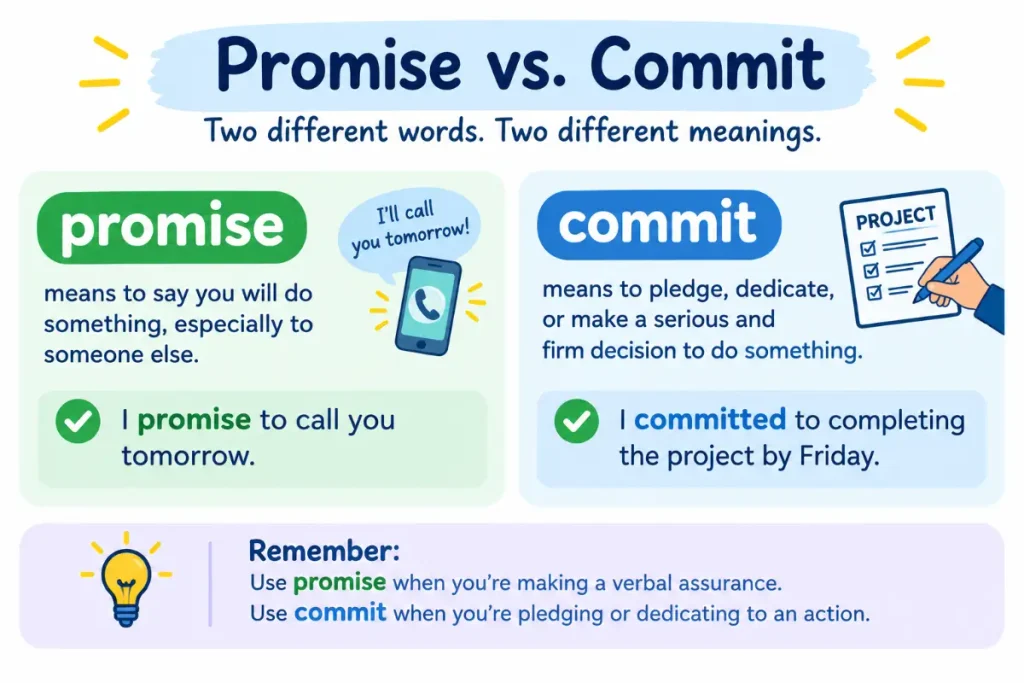
Promise and commit can overlap, but they aren’t always interchangeable. Promise usually focuses on saying that you will do something. Commit often suggests a stronger or more formal decision to do something or support something.
Compare:
- I promise to call you tomorrow.
- I committed to completing the project by Friday.
In everyday conversation, promise may sound more natural for personal situations. Commit is common in workplaces, organizations, planning, and discussions about goals or responsibilities.
Commit vs Agree: What’s the Difference?
Agree means that you share an opinion or accept a proposal. Commit usually goes further by indicating a firm decision, obligation, or dedication.
- We agree with the proposal.
- We committed to carrying out the proposal.
You can agree with an idea without promising to act on it. Commitment usually involves a stronger obligation or intention.
Commit vs Comit in American English
For US readers, the correct spelling is commit. There is no standard American spelling comit. The same is true in standard British English.
| Variety | Correct | Incorrect |
|---|---|---|
| American English | commit | comit |
| British English | commit | comit |
| Canadian English | commit | comit |
| Australian English | commit | comit |
Some English spelling differences vary by region, such as color/colour and center/centre. Commit/comit is not one of those differences. If you’re writing for an American audience, always use commit.
Commit in Professional Writing
Commit is common in professional and workplace communication. It can describe promises, resources, goals, schedules, or responsibilities.
Examples include:
- The company has committed to improving employee training.
- We cannot commit to a delivery date yet.
- The department will commit additional resources to the project.
- The team is committed to meeting the deadline.
In a professional email, use commit when you need to express a clear decision or obligation.
For example:
We can commit to completing the first phase by Friday.
This communicates a firm level of agreement without sounding overly casual.
Commit in Academic Writing
Commit is also appropriate in essays, research papers, and other academic contexts.
Examples:
- The researchers committed significant resources to the study.
- Students should commit sufficient time to their coursework.
- The author argues that governments should commit to long-term environmental policies.
However, the word should still be chosen based on meaning. If you simply mean “give time,” devote may sometimes be more precise.
Commit in Texting and Casual Conversation
Commit is perfectly acceptable in everyday conversation and informal writing.
For example:
- Are you ready to commit to the plan?
- I can’t commit yet.
- She finally committed to going.
- We need everyone to commit to the schedule.
In casual speech, people may also use simpler words such as promise, agree, or decide, depending on the situation.
Common Spelling Mistakes With Commit
The most common errors involve leaving out one of the repeated letters.
Comit
Comit ❌
Commit ✅
Example:
- I need to comit to a decision. ❌
- I need to commit to a decision. ✅
Comited
Comited ❌
Committed ✅
Example:
- She comited to the program. ❌
- She committed to the program. ✅
Comiting
Comiting ❌
Committing ✅
Example:
- They are comiting more money to the project. ❌
- They are committing more money to the project. ✅
Committ
Committ ❌
Commit ✅
The base verb ends with one t, not two.
- commit ✅
- committ ❌
The extra t appears when certain endings are added:
- commit → committed
- commit → committing
A Simple Memory Trick for Commit
A quick way to remember the spelling is:
Commit has two M’s: com + mit.
You can also remember the word family:
commit → committed → committing
If you remember the first word correctly, the other forms become easier to recognize.
Another useful reminder is:
Commit means to “make it” happen, so don’t omit the second M.
This is simply a memory aid, not a rule about the word’s actual origin.
Is Commit a Verb or a Noun?
Commit as a verb
- She will commit to the plan.
- He committed a serious offense.
- They committed themselves to the project.
Commit as a noun
In software development, a commit is a recorded set of changes made to a code repository.
- The developer pushed a new commit.
- Check the latest commit for the change.
This technical use is common in software and computing.
What Is the Origin of Commit?
Commit comes through French from Latin roots related to the idea of entrusting or bringing something together. Over time, English developed several meanings, including carrying out an action, entrusting something to someone, and dedicating oneself to a course of action. The word has been used in English for centuries, and its modern meanings developed from these earlier senses of entrusting or putting something into someone’s care or responsibility. You don’t need to know its history to spell it correctly, but the origin helps explain why commit has several related meanings.
Is Comit Ever Correct?
In standard modern English, comit is not the correct spelling of the common verb commit. If you see comit in an English sentence where the writer intends the verb meaning “to carry out,” “to dedicate,” or “to pledge,” it should normally be corrected to commit.
For example:
- Comit to the plan. ❌
- Commit to the plan. ✅
The spelling comit should not be used simply as an American or British alternative. It is not a standard regional spelling of commit.
Commit Synonyms and Alternatives
The best synonym depends on what commit means in a particular sentence. No single replacement works in every context.
| Word/Phrase | Meaning | Tone | Example |
|---|---|---|---|
| dedicate | Give time or effort to something | Neutral/Formal | She dedicated time to the project. |
| devote | Give resources, time, or attention | Neutral/Formal | He devoted his weekend to the work. |
| promise | Say you will do something | Everyday | I promise I’ll help. |
| pledge | Make a serious promise | Formal | The company pledged its support. |
| undertake | Agree to take responsibility for something | Formal | She undertook the task. |
| agree | Accept or consent to something | Everyday | They agreed to the plan. |
| accept | Take on an obligation or responsibility | Neutral | He accepted the assignment. |
| devote oneself to | Give strong personal effort | Formal | She devoted herself to teaching. |
| give yourself to | Dedicate yourself to an activity | Neutral | He gave himself to the work. |
| take on | Accept a task or responsibility | Everyday | She took on a new role. |
| take up | Begin spending time on an activity | Everyday | He took up photography. |
| support | Give help or backing | Neutral | They supported the initiative. |
| back | Support a person, plan, or idea | Casual | The group backed the proposal. |
| stand by | Continue supporting something | Everyday | She stood by her decision. |
| stick to | Continue following a plan or promise | Casual | We need to stick to the schedule. |
| adhere to | Follow a rule, plan, or agreement | Formal | Employees must adhere to the policy. |
| follow through on | Finish something you promised to do | Neutral | He followed through on his promise. |
| assume | Take responsibility or control | Neutral/Formal | She assumed responsibility. |
| embark on | Begin a significant activity | Formal | They embarked on a new project. |
| engage in | Take part in an activity | Formal | The company engaged in research. |
Choose the alternative based on the intended meaning rather than replacing commit automatically.
Mild to Strong Alternatives to Commit
The strength of commit depends on context, so alternatives can range from relatively casual to more forceful.
Mild
- agree
- plan to
- intend to
- take part in
- support
Moderate
- dedicate
- devote
- take on
- promise
- follow through on
Strong or formal
- pledge
- undertake
- bind oneself to
- devote oneself to
- assume responsibility for
For example, intend to may describe a plan without a firm obligation, while pledge often suggests a serious promise.
Antonyms of Commit
The opposite of commit depends on the meaning being used. When commit means dedicating yourself to something, possible opposites include:
- avoid
- withdraw
- reject
- abandon
- refuse
- disengage
For example:
- She committed to the project.
- She later withdrew from the project.
When commit means carrying out an action, the opposite might instead be:
- prevent
- avoid
- refrain from
- stop
The exact antonym should match the sentence and intended meaning.
Quick Reference: Commit vs Comit
If you only need the answer quickly, remember this:
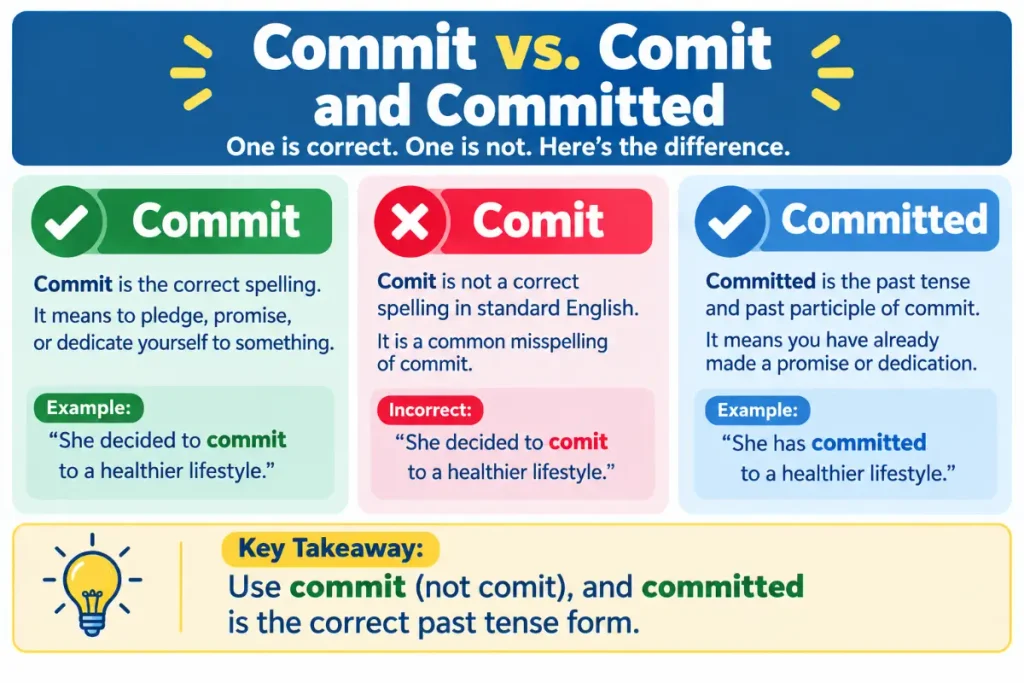
- Commit = correct spelling.
- Comit = incorrect spelling.
- Committed = correct past tense.
- Comitting = incorrect.
- Committing = correct present participle.
- Commitment = correct noun.
- Commit to + noun = correct.
- Commit to + -ing verb = correct.
Examples:
- commit to the plan ✅
- commit to studying ✅
- comit to the plan ❌
- comit to study ❌
Conclusion
When comparing commit vs comit, the correct spelling is always commit in standard English. The word contains two m’s: c-o-m-m-i-t. Comit is a common spelling mistake, not an alternative American or British spelling.
The verb commit can mean to promise, dedicate yourself to something, carry out an action, or accept responsibility. Its related forms include committed, committing, and commitment, which also retain the double m.
If you’re unsure while writing an email, essay, application, or everyday message, choose commit. A simple way to remember it is to learn the word family together: commit, committed, committing, commitment. Once you remember the double m, the commit vs comit spelling question becomes much easier.
Frequently Asked Questions
Which is correct, commit or comit?
Commit is correct, and comit is an incorrect spelling in standard English. The correct word has two m’s.
How do you spell commit?
The correct spelling is C-O-M-M-I-T: commit. Remember the double m in the middle.
Is comit a word?
Comit is not the standard spelling of the English verb commit. In ordinary English writing, use commit instead.
What does commit mean?
Commit can mean to carry out an action, make a firm promise, dedicate yourself to something, or put something into a particular state. Its exact meaning depends on context.
How do you spell committed?
The correct spelling is committed, with two m’s and two t’s. For example: “She committed to completing the project.”
Is committing spelled with two m’s?
Yes. The correct spelling is committing, with two m’s and two t’s. For example: “They are committing more resources to the project.”
What’s another way to say commit?
Depending on the context, alternatives include dedicate, devote, promise, pledge, undertake, agree, and take on. The best choice depends on whether you mean making a promise, giving effort, or accepting responsibility.
1 thought on “Commit vs Comit: Which Spelling Is Correct?”