
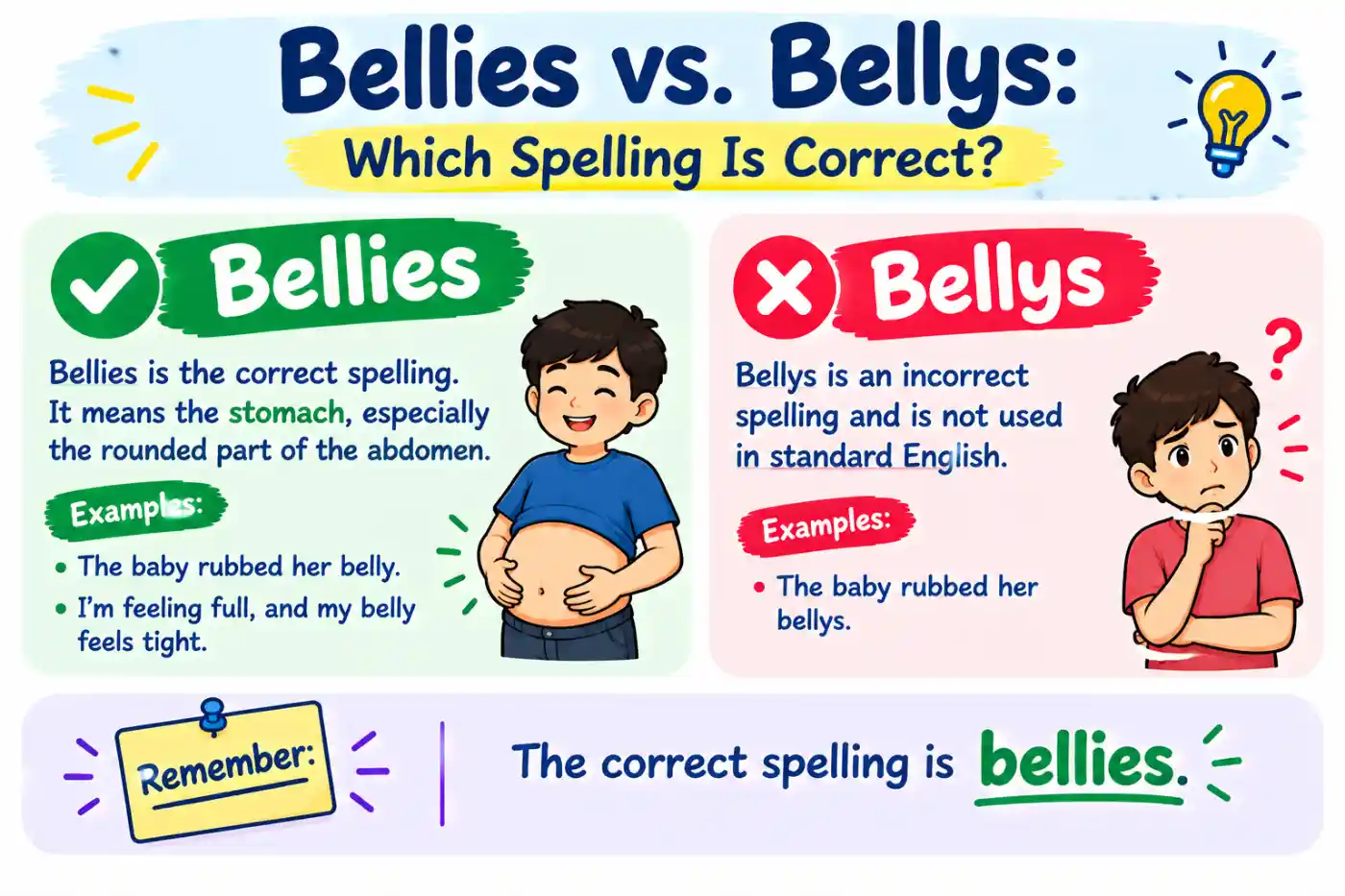
If you’re unsure about bellies vs bellys, the correct plural spelling is bellies. It refers to more than one belly and is the standard form used in American English. Bellys is a common misspelling that you should avoid in formal and everyday writing.
The spelling rule for bellies vs bellys is straightforward. When a singular noun ends in a consonant followed by y, you usually change the y to ies to form the plural. Since belly ends in a consonant followed by y, its correct plural form is bellies.
Understanding this rule can help you avoid similar spelling mistakes with other English words. In this guide, you’ll learn why bellies is correct, how to use it in sentences, and how its spelling compares with related words.
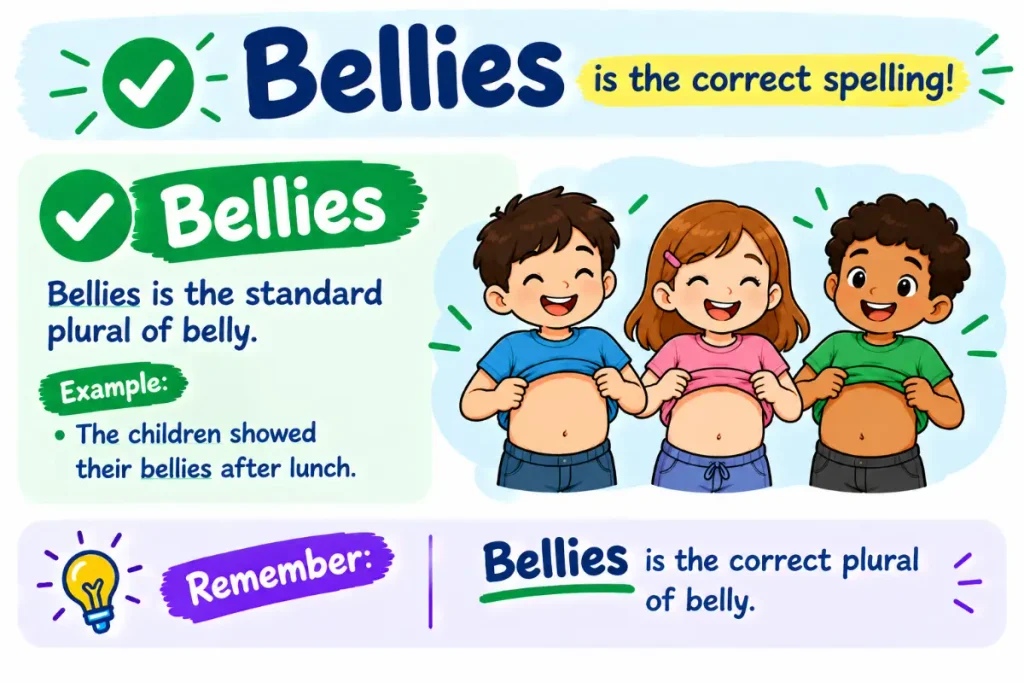
Bellies vs Bellys: Which Is Correct?
Bellies is correct, while bellys is incorrect in standard English.
| Spelling | Correct? | Explanation |
|---|---|---|
| bellies | Yes | Standard plural of belly |
| bellys | No | Incorrect plural spelling |
The singular form is belly, and the plural form is bellies.
- One belly
- Two bellies
- A full belly
- Full bellies
The spelling changes from y to ies because belly ends in a consonant + y.
How Do You Spell the Plural of Belly?
The plural of belly is spelled bellies. To form the plural, remove the final y and add ies:
belly → bellies
This follows the same pattern as many other English nouns:
- baby → babies
- city → cities
- story → stories
- family → families
- party → parties
- puppy → puppies
- country → countries
So if you’re unsure about bellies vs bellys, remember that belly follows the same plural pattern as baby and city.
Why Is “Bellys” Incorrect?
Bellys is incorrect because standard English generally changes a consonant + y ending to ies when forming a plural. The word belly ends with -ly, where the letter before y is l, a consonant. Therefore, the plural becomes:
belly → bellies
The spelling bellys incorrectly keeps the y and simply adds s.
Compare these examples:
- baby → babies, not babys
- lady → ladies, not ladys
- country → countries, not countrys
- belly → bellies, not bellys
This is why bellies is the form you should use in standard writing.
What Does “Belly” Mean?
Belly is a noun that commonly refers to the front part of the human body between the chest and hips. In everyday American English, it is a familiar and informal word for the abdomen or stomach area.
For example:
The baby kicked her belly.
It can also refer to the underside or rounded part of an animal or object.
For example:
The dog was lying on its belly.
The word can also be used informally in expressions such as belly laugh, meaning a deep or hearty laugh.
Belly as a Noun
The most common use is as a noun:
- His belly was full after dinner.
- The baby rested against her belly.
- The cat rolled onto its belly.
Belly as a Verb
Belly can also function as a verb, although this use is less common.
For example:
The boat’s sail bellied out in the wind.
Here, bellied describes something becoming rounded or bulging outward.
How Do You Form the Plural of “Belly”?
The plural is formed by changing the final y to ies:
belly + ies pattern → bellies
The general rule is:
If a noun ends in a consonant + y, change the y to ies.
Examples include:
| Singular | Plural |
|---|---|
| belly | bellies |
| baby | babies |
| city | cities |
| puppy | puppies |
| family | families |
| library | libraries |
| enemy | enemies |
There is an important exception to remember. If a noun ends in a vowel + y, you normally keep the y and add s.
Examples:
| Singular | Plural |
|---|---|
| boy | boys |
| toy | toys |
| day | days |
| key | keys |
| journey | journeys |
Since belly has a consonant before the final y, its plural is bellies.
Bellies in Real Sentences
Seeing the correct spelling in context can make the rule easier to remember.
- The children had full bellies after dinner.
- The puppies slept on their bellies.
- The dancers placed their hands on their bellies during the exercise.
- The babies had tiny bellies.
- The hikers packed enough food to keep their bellies full.
- The cartoon characters had unusually large bellies.
- The kittens rolled onto their bellies and stretched.
- The restaurant served meals large enough to fill several bellies.
- The pregnant women gently supported their bellies.
- The children laughed until their bellies hurt.
- The seals rested on their bellies near the shore.
- The family enjoyed a meal with warm food and happy bellies.
In every example, bellies is the correct plural spelling.
Common Mistakes With “Bellies”
The most common mistake is simply adding s to belly.
Incorrect: Bellys
The babies have round bellys.
Correct: Bellies
The babies have round bellies.
The same mistake occurs with many words ending in consonant + y.
Incorrect → Correct
- babys → babies
- ladys → ladies
- familys → families
- countrys → countries
- partys → parties
- bellys → bellies
Learning the general -y → -ies rule is more useful than memorizing bellies by itself.
Bellies vs Stomachs
Bellies and stomachs can sometimes refer to the same general area of the body, but they aren’t identical in tone or meaning.
| Word | Meaning | Tone | Example |
|---|---|---|---|
| bellies | Plural of belly; the abdominal area | Casual | The children had full bellies. |
| stomachs | Plural of stomach; the digestive organ or abdominal area | Neutral | Some foods can upset their stomachs. |
| abdomens | Plural of abdomen; the area between the chest and pelvis | Formal/medical | The doctor examined their abdomens. |
Belly is more conversational. Stomach is common in both everyday and somewhat formal speech. Abdomen is more precise in medical or technical contexts.
Example
Casual:
My belly hurts.
Neutral:
My stomach hurts.
Medical or formal:
The patient reported abdominal pain.
The best word depends on your context.
Bellies vs Abdomens
Bellies is an informal everyday term, while abdomens is more formal and anatomical.
You might say:
The children were lying on their bellies.
In a medical setting, you would be more likely to see:
The doctor examined the patients’ abdomens.
Neither word is simply a replacement for the other in every situation. Belly is natural in casual conversation, while abdomen is better suited to medical, scientific, or formal writing.
Belly vs Tummy
- Belly is casual and widely used.
- Tummy is softer and often used when speaking to or about young children.
For example:
The baby has a full tummy.
and:
The baby has a full belly.
Both can sound natural, but tummy has a more child-friendly tone. The plural of tummy is tummies, not tummys. This follows the same spelling pattern:
tummy → tummies
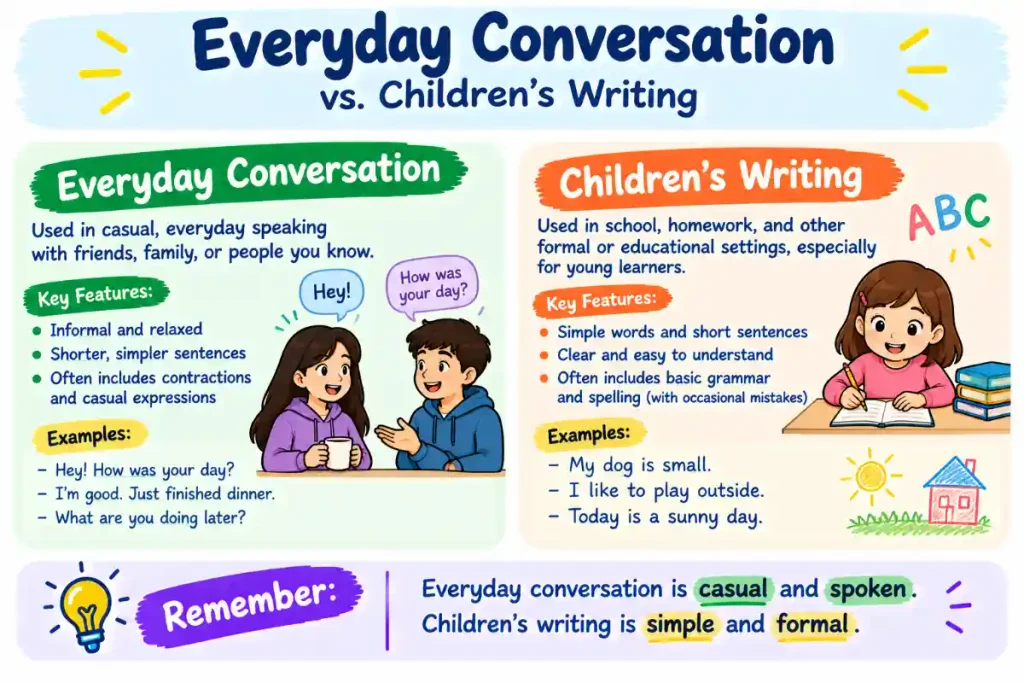
Is “Bellies” Formal or Informal?
Bellies is generally an informal or conversational word.
It works well in:
- Everyday conversation
- Casual writing
- Children’s writing
- Friendly social media posts
- Informal stories
- Humorous expressions
For formal or professional writing, alternatives such as abdomens or stomachs may be more appropriate depending on the meaning.
Casual
The kids went home with full bellies.
More neutral
The children went home with full stomachs.
Formal or medical
The patients’ abdomens were examined during the evaluation.
The choice isn’t only about correctness. It also depends on tone and context.
Is “Bellies” Used in American English?
Yes. Bellies is a normal plural form in American English. American English commonly uses belly in casual conversation and writing. It can describe a person’s abdomen, an animal’s underside, or the rounded underside of certain objects.
For example:
The kids were sleeping on their bellies.
The spelling bellies is also standard in other varieties of English. There is no standard US-versus-UK spelling difference between bellies and bellys.
Bellies vs. Bellies: Why Does the Spelling Change?
The important spelling change is not between two accepted forms. It is between the singular and plural:
belly → bellies
The final y changes to ie, followed by s. This happens because belly ends in a consonant + y.
Compare:
- belly → bellies
- city → cities
- party → parties
- family → families
But compare those with:
- boy → boys
- toy → toys
- day → days
- key → keys
The difference is the letter immediately before the y.
Consonant + Y
Change y to ies:
city → cities
belly → bellies
Vowel + Y
Keep y and add s:
toy → toys
boy → boys
This is a useful rule for spelling many English plurals.
How to Remember “Bellies”
A simple memory trick is:
One belly, two bellies.
Think of the word baby:
baby → babies
Since belly follows the same spelling pattern, you can remember:
belly → bellies
Another quick trick is to check the letter before y.
If it is a consonant, change y to ies.
belly: l + y → bellies
If it is a vowel, normally just add s.
boy: o + y → boys
Can “Bellys” Ever Be Correct?
In standard English, bellys is not the correct plural of belly. You may occasionally encounter bellys as a username, brand name, stylized name, fictional term, or other nonstandard spelling. Such uses don’t change the standard English plural.
For ordinary writing, use:
bellies
not:
bellys
If you’re writing an essay, email, article, school assignment, or professional document, bellies is the appropriate standard spelling.
“Bellies” in Different Contexts
The word can appear naturally in many types of writing.
Everyday Conversation
We had full bellies after the barbecue.
The casual tone makes bellies sound natural.
School Writing
The animals rested on their bellies during the afternoon.
This can work in a general educational context.
Creative Writing
The children ran home with tired feet and happy bellies. The word can give creative writing a warm, conversational feel.
Social Media
Good food, great friends, and full bellies!
This casual use is common and natural.
Professional or Academic Writing
In more formal contexts, abdomen, abdominal area, or stomach may be preferable depending on the intended meaning.
For example:
The study examined abdominal movement during exercise.
This sounds more formal than:
The study examined belly movement during exercise.
Is “Belly” the Same as “Stomach”?
Not always. In everyday conversation, people often use belly and stomach to refer to the same general area. Anatomically, however, the terms are different. The stomach is a specific digestive organ. The abdomen is the larger area of the body containing the stomach and several other organs. Belly is an everyday term that usually refers to the outside or general area of the abdomen.So the words overlap in casual use, but they aren’t exact anatomical equivalents.
What Is the Plural of “Belly Fat”?
The phrase belly fat is generally treated as an uncountable noun phrase, so you don’t normally pluralize fat.
For example:
Regular exercise can affect belly fat.
You would not normally write:
bellies fat
If you’re referring to multiple people, you could say:
They were discussing belly fat.
The word bellies is used when you are talking about multiple bellies:
The babies had round bellies.
What Is the Possessive Form of “Bellies”?
The possessive form depends on whether you’re talking about one belly or multiple bellies.
Singular Possessive
For one belly, use belly’s:
The baby’s belly’s movement was noticeable.
However, this construction can sound awkward, so rewriting the sentence is often clearer:
The movement of the baby’s belly was noticeable.
Plural Possessive
For multiple bellies, use bellies’:
The babies’ bellies’ movements were noticeable.
Again, this can sound awkward because two possessives are close together. A clearer version might be:
The movements of the babies’ bellies were noticeable.
The important spelling distinction is:
- belly = singular
- belly’s = singular possessive
- bellies = plural
- bellies’ = plural possessive
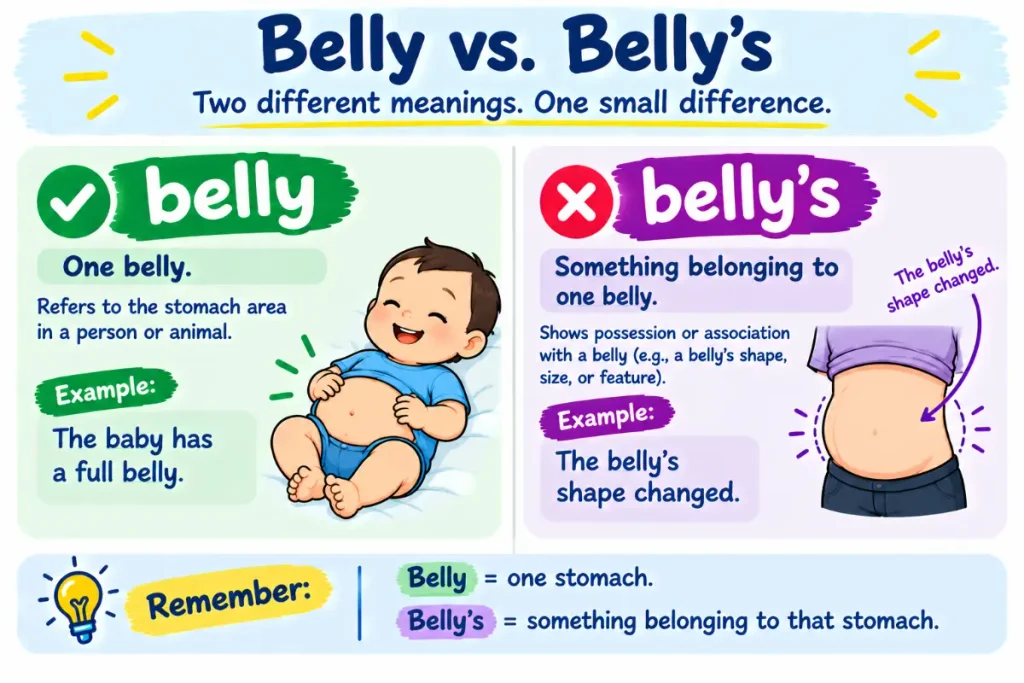
Quick Comparison: Belly, Belly’s, Bellies, and Bellies’
| Form | Meaning | Example |
|---|---|---|
| belly | One belly | The baby has a full belly. |
| belly’s | Something belonging to one belly | The belly’s shape changed. |
| bellies | More than one belly | The babies have full bellies. |
| bellies’ | Something belonging to multiple bellies | The bellies’ shapes differed. |
Apostrophes don’t make nouns plural. That’s an important point to remember.
Conclusion
When choosing between bellies vs bellys, the correct standard spelling is bellies. It is the plural form of belly, following the common English rule that changes a consonant + y ending to ies.
The easiest way to remember it is to connect belly with words such as baby → babies and city → cities. The same spelling pattern applies: belly → bellies. Bellys should not be used in standard English writing.
For casual conversation, bellies is a natural word for multiple stomach or abdominal areas. In formal or medical contexts, words such as stomachs or abdomens may be more appropriate. When in doubt, remember the simple rule: one belly, two bellies.
Frequently Asked Questions
Which is correct, bellies or bellys?
Bellies is correct. It is the standard plural of belly, while bellys is an incorrect spelling in standard English.
How do you spell the plural of belly?
The plural is spelled bellies: belly → bellies. The final y changes to ies because belly ends in a consonant followed by y.
Is “bellys” a word?
Bellys is not the standard English plural of belly. For normal English writing, use bellies.
Why does belly become bellies?
Belly becomes bellies because nouns ending in a consonant + y commonly change the y to ies when pluralized.
Is bellies American English?
Yes. Bellies is standard in American English and is also used in other varieties of English. There is no standard British spelling bellys.
What is another word for bellies?
Depending on context, alternatives include stomachs, abdomens, tummies, and midsections. The best choice depends on whether you want a casual, neutral, child-friendly, or formal tone.
What is the singular of bellies?
The singular of bellies is belly. For example, one belly, but two bellies.
2 thoughts on “Bellies vs Bellys: Which Spelling Is Correct?”