
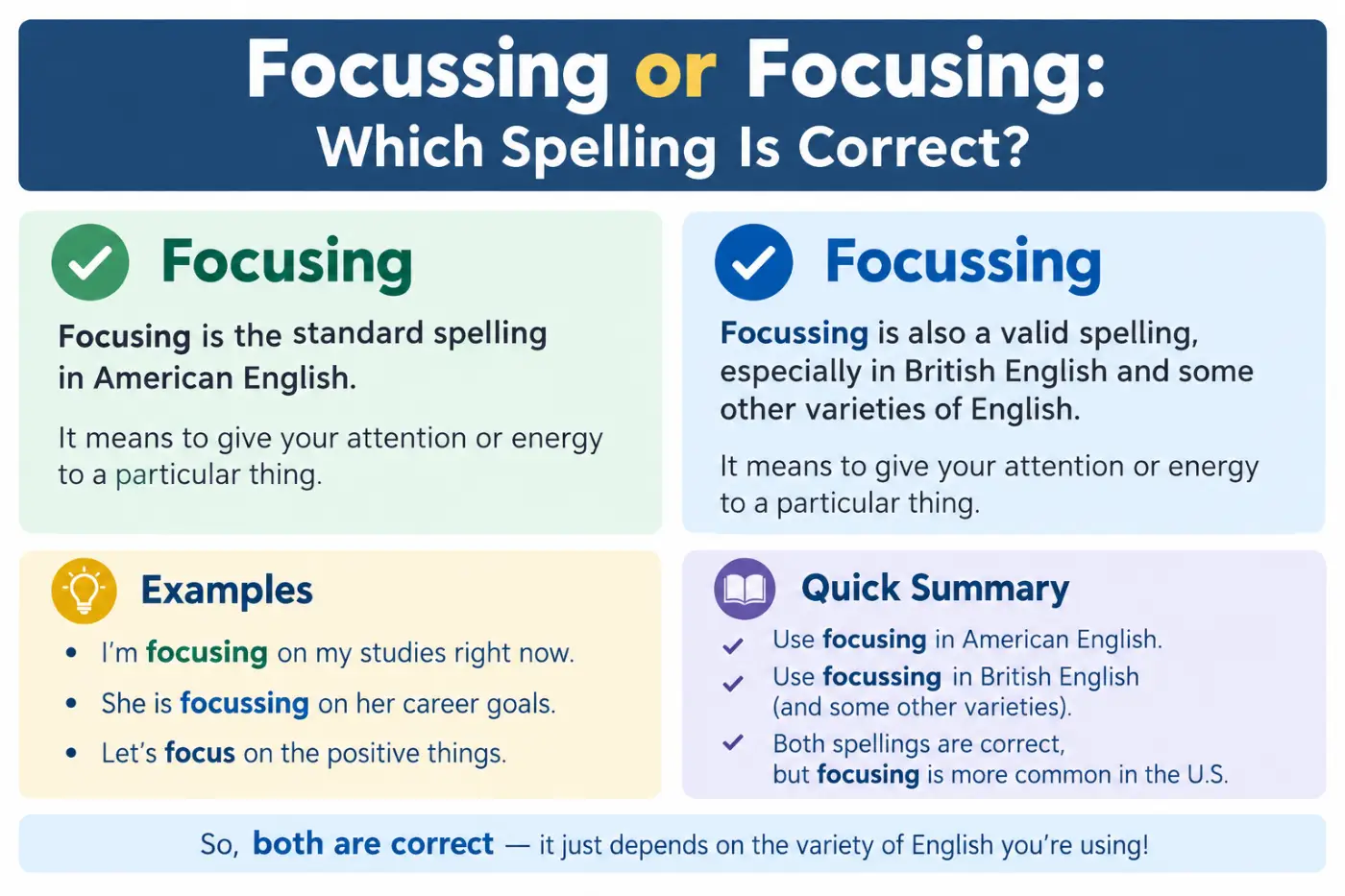
If you’re writing an email, school assignment, resume, or social media post, you may wonder whether to use focussing or focusing. Both spellings are correct, but the preferred form depends on the variety of English you use. Understanding this difference helps you choose the right spelling for your audience.
Focusing is the standard spelling in American English, while focussing is commonly used in British English and some other varieties. Both forms come from the verb focus and have the same meaning: directing attention toward a particular person, task, or subject.
In this guide, you’ll learn the difference between focussing or focusing, discover which spelling to use in American English, and explore clear examples to help you use the word correctly in everyday and professional writing..
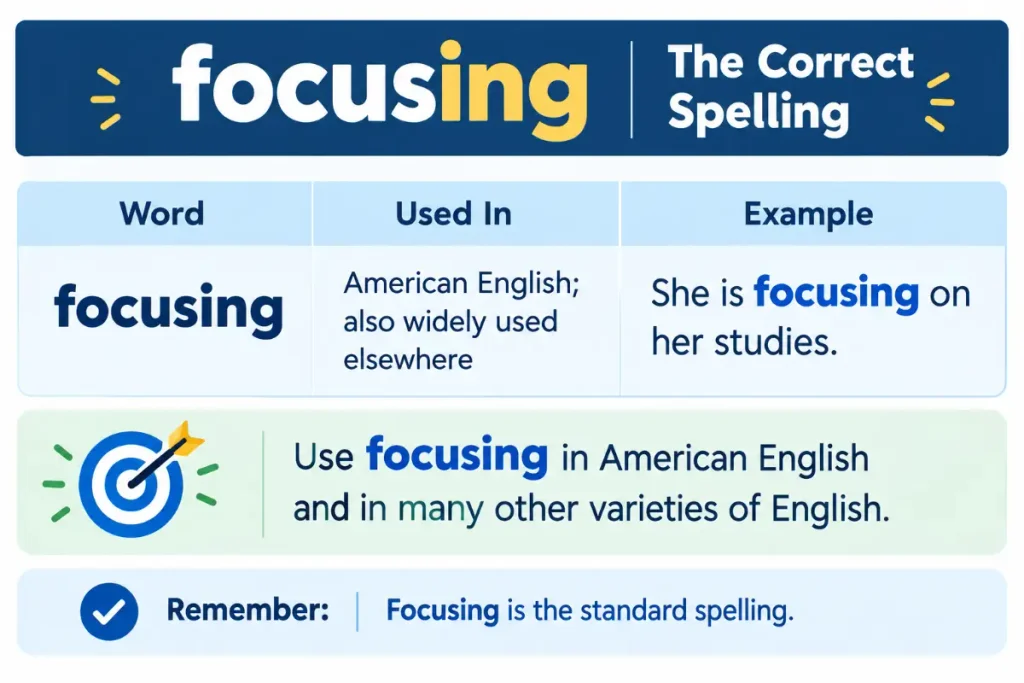
Focussing or Focusing: What’s the Difference?
The main difference is regional spelling preference.
| Spelling | Common Usage | Example |
|---|---|---|
| focusing | American English; also widely used elsewhere | She is focusing on her studies. |
| focussing | British English and some other varieties | She is focussing on her studies. |
For readers in the United States, focusing is the preferred spelling. Both forms come from the verb focus, meaning to direct attention, effort, or concentration toward something.
Is “Focusing” Correct?
Yes. Focusing is correct and is the usual American English spelling.
For example:
The team is focusing on improving customer service.
The spelling uses one s before the -ing ending:
focus + ing = focusing
Is “Focussing” Correct?
Yes. Focussing is also a legitimate spelling. It is particularly common in British English, where doubling the final consonant in certain words before adding a suffix is more common.
For example:
The students are focussing on their final project.
So focussing isn’t simply a misspelling of focusing. It is a regional spelling variant.
Why Are There Two Spellings?
The difference comes from English spelling conventions. The verb focus ends in a single s. When the -ing suffix is added, American English generally uses focusing rather than focussing. British English commonly allows or prefers the doubled consonant in this word, producing focussing. A similar difference appears with some other words:
- American English: focused
- British English: focussed
- American English: focusing
- British English: focussing
The important point is that the two spellings don’t represent two different meanings. They represent different spelling conventions.
Focusing vs. Focussing in American English
For American readers and American publications, focusing is generally the better choice.
Use focusing in:
- School assignments
- College papers
- Resumes
- Cover letters
- Business emails
- Workplace documents
- Websites aimed at US readers
- General American English writing
For example:
We are focusing on customer satisfaction this quarter.
The teacher asked the class to focus on the main idea.
I’m focusing on completing the report before Friday.
Using focussing in American writing isn’t likely to prevent readers from understanding you, but focusing matches standard US spelling conventions more closely.
Focusing or Focussing in British English
In British English, focussing is an accepted spelling and can be preferred by some style guides and writers.
For example:
The company is focussing on sustainable business practices.
British English also commonly uses focussed as the past-tense and past-participle form. American English generally uses:
- focused
- focusing
British English may use:
- focussed
- focussing
There is some variation even within British English, so focusing can also be found in British writing.
Focusing or Focussing: Which One Should You Use?
If you’re writing for a US audience, choose focusing. If you’re following British English conventions, focussing may be appropriate.
A simple rule is:
US English → focusing
British English → focussing
When a school, employer, publisher, or organization has its own style guide, follow that guide if it specifies a particular spelling.
Examples of “Focusing” in Sentences
Here are natural examples of focusing in American English:
- I’m focusing on my homework before I watch TV.
- The company is focusing on improving its customer service.
- She has been focusing on her career goals.
- Our teacher wants us to focus on the main argument.
- The photographer is focusing the camera on the subject.
- We’re focusing our attention on the most important issue.
- He is focusing on getting enough practice before the competition.
- The meeting will focus on next year’s budget.
- I’m trying to stay focused while studying.
- The new program is focusing on helping local businesses.
- She had trouble focusing during the long lecture.
- The manager asked everyone to focus on the deadline.
Notice that focusing can describe directing attention, effort, or even a camera toward a particular subject.
Examples of “Focussing” in Sentences
The same meaning can be expressed with focussing:
- She is focussing on her studies.
- The team is focussing on its long-term goals.
- The company is focussing on customer needs.
- He is focussing his attention on the problem.
- The students are focussing on their final assignment.
These sentences aren’t different in meaning from their versions with focusing. The spelling is the main difference.
What Does “Focusing” Mean?
Focusing is the present participle or gerund form of focus. The word can mean directing attention, effort, or concentration toward something.
For example:
She is focusing on her work.
Here, focusing means directing her attention toward her work. It can also refer to adjusting a camera, lens, or other optical device so that an image becomes clear:
The photographer is focusing the camera.
The word can also be used more broadly to describe concentrating on a particular goal, subject, or activity.
What Is the Base Word?
The base word is focus.
Its common forms include:
| Form | Example |
|---|---|
| Base form | focus |
| Third-person singular | focuses |
| Past tense | focused |
| Past participle | focused |
| Present participle | focusing |
| Gerund | focusing |
In British English, you may also see focussed and focussing.
Focusing vs. Focused
Focusing and focused are related, but they have different grammatical functions. She is focusing on her presentation.
Focused commonly describes a completed action or a person’s state of concentration.
She stayed focused during the presentation.
Compare these:
- I am focusing on the assignment.
- I am focused on the assignment.
The first emphasizes the activity of directing attention. The second emphasizes the state of concentration.
Focusing or Focuses
These forms also have different grammatical uses. Focuses is the third-person singular present form of focus:
The article focuses on American spelling.
Focusing is the -ing form:
The article is focusing on American spelling.
A useful pattern is:
- He focuses
- He is focusing
- He focused
- He has focused
Focusing or Concentrating
Focusing and concentrating can be close in meaning, but they aren’t always interchangeable.
The company is focusing on customer service.
Concentrating often emphasizes mental effort or sustained attention.
I need to concentrate while taking this exam.
You can often replace one with the other in casual contexts, but the best choice depends on the sentence.
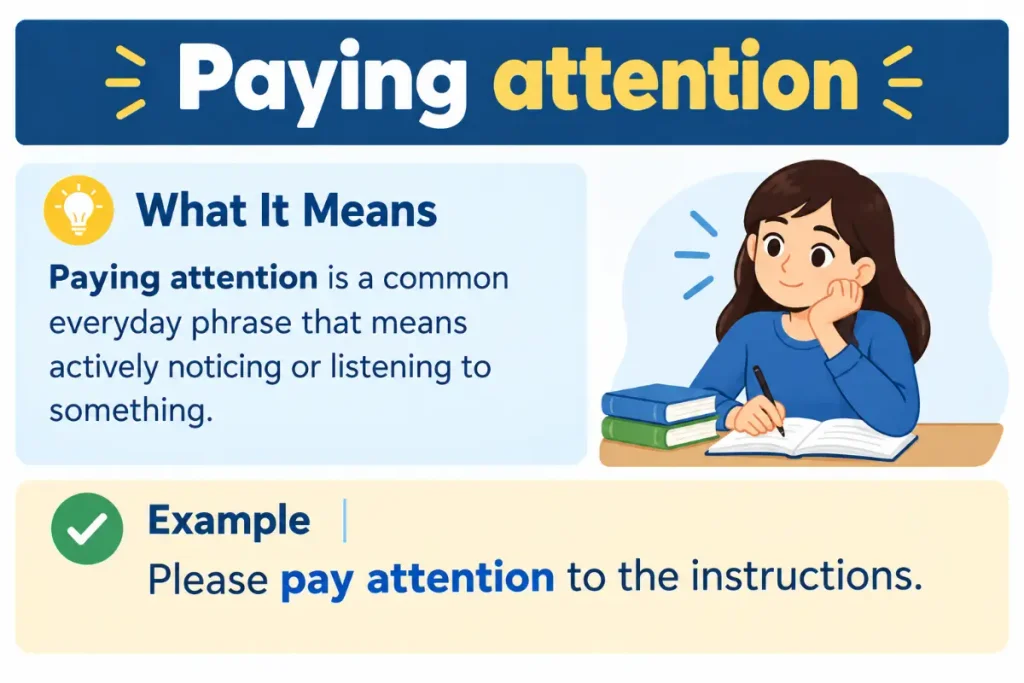
Focusing or Paying Attention
Paying attention is a common everyday phrase that means actively noticing or listening to something.
Please pay attention to the instructions.
Focusing can have a broader meaning:
We’re focusing on improving the entire process.
The second sentence isn’t simply about listening. It describes directing effort toward a particular goal.
Focusing vs. Centering
Centering can mean placing something in the middle or directing attention toward a central subject.
The discussion is centered on education.
Focusing is often more direct when describing attention, effort, or concentration:
The discussion is focusing on education.
Both can work, but they can carry slightly different nuances depending on context.
Common Mistakes With Focusing
Mistake 1: Assuming “Focussing” Is Always Wrong
Focussing isn’t automatically incorrect. It is an accepted spelling associated particularly with British English and other varieties that follow similar spelling conventions. Better approach: Consider your target variety of English.
For US writing:
focusing
For British-style writing:
focussing
Mistake 2: Mixing Regional Spellings
Using American and British spellings randomly can make your writing look inconsistent. For example, a document might use color, center, and focussing together. That combination isn’t necessarily impossible, but if you’re intentionally writing in American English, consistency is better.
For US writing, use forms such as:
- color
- center
- focused
- focusing
Mistake 3: Writing “Focussing”
Focussing is not the standard spelling.
The correct forms are:
- focusing
- focussing
The base word is focus, so don’t add an extra s to create an incorrect form.
Mistake 4: Confusing “Focusing” With “Focused”
These words don’t always fit in the same grammatical position.
Incorrect:
She is focused on her work yesterday.
Better:
She focused on her work yesterday.
Or:
She is focusing on her work today.
The tense and sentence structure determine which form you need.
Mistake 5: Using “Focusing” as a Noun Without Checking the Sentence
Focusing can function as a gerund, which means an -ing form can act as a noun.
For example:
Focusing on one task can improve productivity.
Here, focusing on one task functions as the subject of the sentence.
How to Remember the US Spelling
For American English, remember:
focus + ing = focusing
You don’t need to double the s.
A simple memory trick is:
US English: one S → focusing
This also helps with the related past-tense form:
focus → focused
If you’re writing for a US audience, focused and focusing are the spellings to use.
Is “Focusing” More Common Than “Focussing”?
In American English, focusing is the standard and much more familiar spelling. Focussing is more strongly associated with British English and related varieties. The difference is therefore mainly about regional spelling, not meaning or pronunciation. If you’re writing for an American audience, there’s little reason to choose focussing when focusing fits the same sentence.
Which Spelling Is Best for a Resume?
For a US resume, use focusing.
For example:
Focusing on customer retention and account growth
You might also write:
Focused on improving customer satisfaction
Both are correct, but they serve different grammatical purposes. When writing a resume, keep your spelling consistent with American English if you’re applying to US employers.
Which Spelling Is Best for an Essay?
For an American school or college essay, focusing is the natural choice.
Example:
This essay is focusing on the effects of social media on communication.
Depending on the sentence, a more natural construction might be:
This essay focuses on the effects of social media on communication.
The second version is often cleaner because the simple present focuses directly states the essay’s subject.
Which Spelling Is Best for a Professional Email?
Use focusing in a professional email written in American English.
For example:
Our team is focusing on the most urgent customer requests this week.
It is clear, standard, and appropriate for workplace communication.
Which Spelling Is Best for Texting?
For casual texting in the United States, focusing is the normal spelling.
For example:
I’m focusing on studying tonight.
Because texting is informal, people may shorten words or use casual language, but the standard spelling remains focusing.
A Quick Comparison of Related Forms
| Word | Function | Example |
|---|---|---|
| focus | Base verb/noun | We need to focus. |
| focuses | Present-tense verb | She focuses on details. |
| focused | Past tense/adjective | He focused on the task. |
| focusing | -ing form | They are focusing on the problem. |
| focussing | British-style -ing variant | They are focussing on the problem. |
Focussing or Focusing: Quick Answer
If you’re writing American English, use focusing. If you’re writing British English, focussing is an accepted spelling and may be preferred in some contexts. Neither spelling changes the basic meaning. Both mean directing attention, effort, or concentration toward something when used as the -ing form of focus.
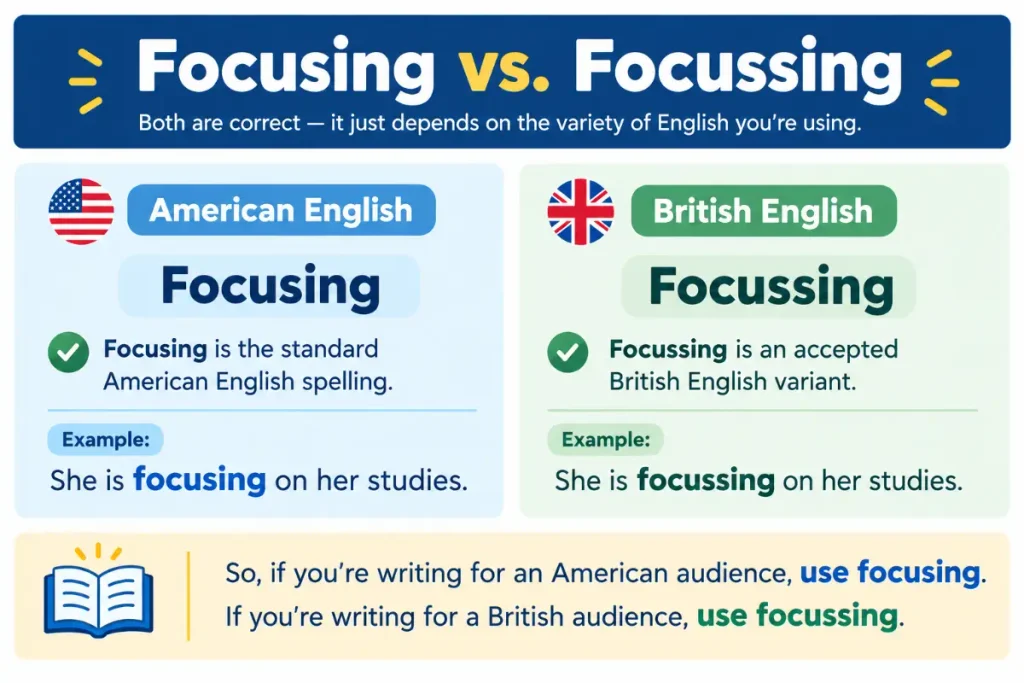
Quick Tips to Remember
- Focusing is the standard American English spelling.
- Focussing is an accepted British English variant.
- The two spellings have the same basic meaning.
- Don’t write focussing.
- Use focused in American English rather than focussed.
- Keep regional spelling consistent throughout your writing.
- For US resumes, essays, emails, and workplace documents, choose focusing.
Conclusion
When deciding between focussing or focusing, the main issue is regional spelling rather than meaning. Focusing is the standard choice for American English, while focussing is commonly used in British English and some other varieties. Both forms come from the verb focus and describe directing attention, effort, or concentration toward something.
For US readers, writers, students, and professionals, focusing is the safest and most natural choice. If you’re following British English conventions, focussing can be perfectly appropriate. The key is to stay consistent with the variety of English you’re using.
So, if your audience is primarily American, choose focusing. It is clear, familiar, and standard in US writing.
Frequently Asked Questions
Is focusing or focussing correct?
Both focusing and focussing are correct spellings. Focusing is preferred in American English, while focussing is commonly associated with British English.
How do you spell focusing in American English?
The standard American spelling is focusing, with one s before -ing.
Is focussing a British spelling?
Yes. Focussing is commonly used in British English and some other varieties that follow similar spelling conventions.
Which is correct, focusing or focussing?
Both are valid, but the preferred choice depends on the variety of English. For US readers, focusing is the usual choice.
Is focused spelled with one S or two?
In American English, the standard spelling is focused, with one s. British English also uses focussed.
Why does British English use focussing?
British English often uses doubled consonants in certain words before suffixes. This produces focussing from focus, while American English commonly uses focusing.
Can I use focussing in American English?
You can, and readers will understand it, but focusing is the more standard choice for American English. Use focusing when you want your spelling to match typical US conventions.
2 thoughts on “Focussing or Focusing: Which Spelling Is Correct?”