
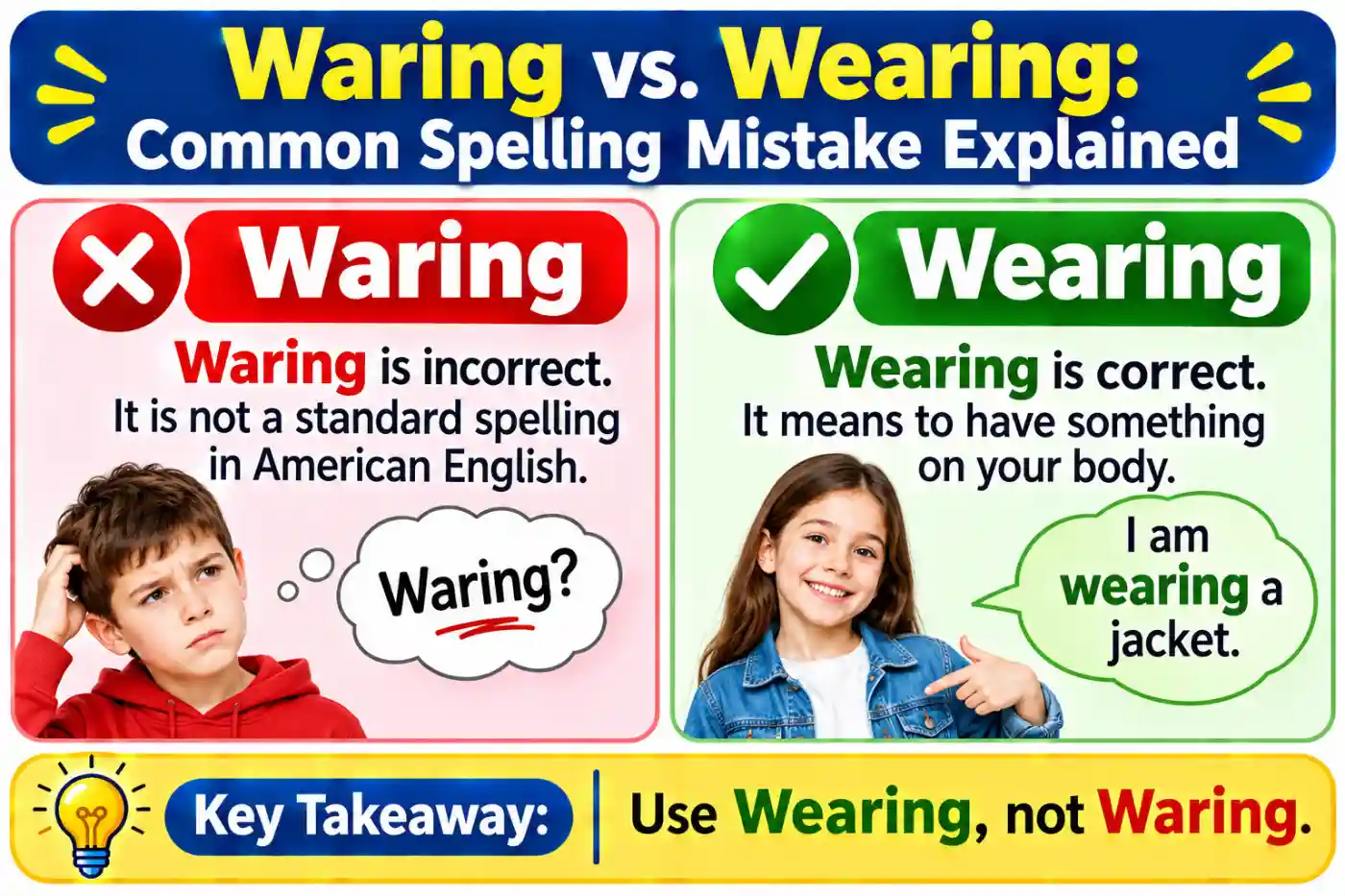
Have you ever been writing a sentence about clothes and wondered whether to use waring vs wearing? These two spellings look similar, but they have very different meanings. Choosing the wrong one can make a sentence confusing or grammatically incorrect.
The correct spelling for the action of putting on or having clothes, accessories, or other items on your body is wearing. The spelling waring is generally incorrect when you intend to describe this action.
Wearing is the correct form of the verb wear, while waring is not a standard spelling of that verb’s present participle. However, Waring can appear as a proper name or surname.
Understanding the difference between these words will help you avoid spelling mistakes in emails, school assignments, social media posts, and everyday writing. This guide explains their meanings, grammatical uses, sentence examples, and common spelling mistakes.
Waring vs. Wearing: Which Spelling Is Correct?
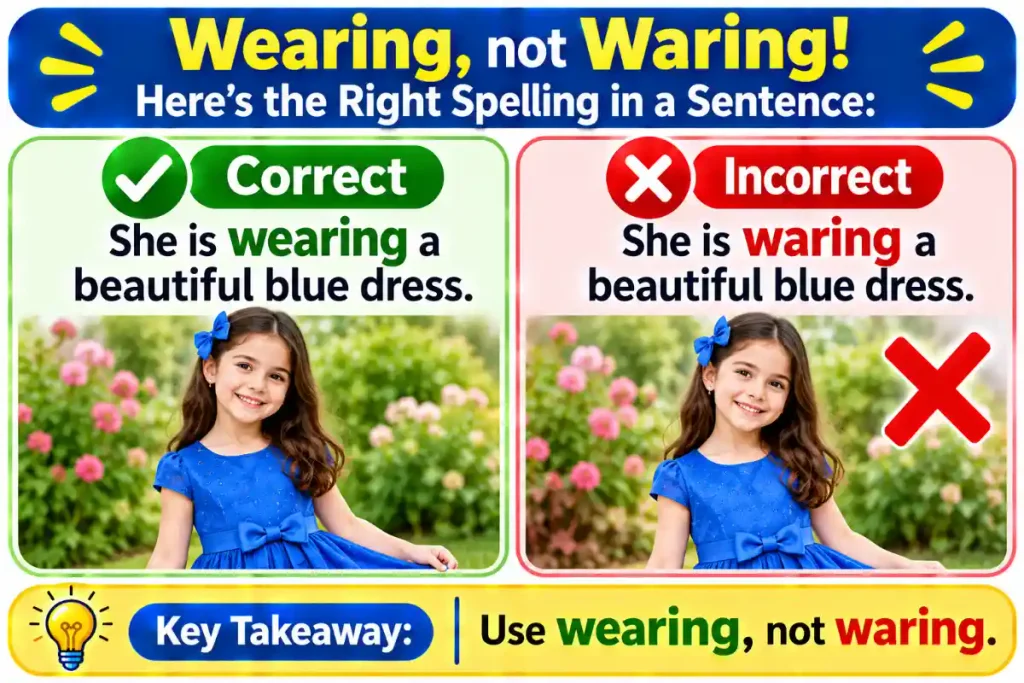
Wearing is the correct spelling when referring to clothes, shoes, jewelry, accessories, or having something on your body. Waring is not the standard spelling for this meaning. The confusion happens because both words sound similar when spoken quickly. However, the extra letter e in wearing is essential.
Consider these examples:
- Correct: She is wearing a beautiful blue dress.
- Incorrect: She is waring a beautiful blue dress.
- Correct: He was wearing his favorite sneakers.
- Incorrect: He was waring his favorite sneakers.
In both examples, wearing describes something a person has on their body.
Quick Comparison Table
| Word | Meaning | Correct Usage |
|---|---|---|
| Wearing | Having clothes or something on your body | She is wearing a jacket. |
| Waring | Not a standard form of the verb wear | Incorrect for describing clothes |
| Waring | A proper name or surname | Mr. Waring attended the meeting. |
The easiest way to remember the difference is that wearing comes from the verb wear. Whenever you describe clothing or accessories, use wearing.
What Does Wearing Mean?
Wearing is the present participle and gerund form of the verb wear. It describes having clothing, footwear, jewelry, or another item on your body. It can also describe using or displaying something regularly, such as wearing a watch, wearing a uniform, or wearing a smile. The word appears frequently in everyday American English because people use it to talk about clothing, personal style, uniforms, and accessories.
Examples of Wearing in Different Contexts
- She is wearing a red sweater today.
- My brother is wearing his new baseball cap.
- The students are wearing school uniforms.
- I enjoy wearing comfortable shoes.
- He was wearing a silver watch at the party.
In each sentence, wearing describes something a person has on.
Wearing as a Verb Form
Wearing is formed by adding -ing to the base verb wear.
| Verb Form | Word | Example |
|---|---|---|
| Base form | Wear | I wear glasses. |
| Third-person singular | Wears | She wears glasses. |
| Past tense | Wore | He wore a black suit. |
| Past participle | Worn | She has worn that dress before. |
| Present participle | Wearing | They are wearing uniforms. |
These forms are important because wearing does not work in every sentence where wear is needed.
For example:
- Correct: I wear a jacket every winter.
- Correct: I am wearing a jacket today.
- Correct: I wore a jacket yesterday.
- Incorrect: I am wore a jacket today.
The correct verb form depends on the tense and sentence structure.
What Does Waring Mean?
Waring is not a standard English spelling of the present participle of wear. If you want to describe someone putting on or having clothing on their body, you should write wearing. However, Waring does exist in English as a proper name, including a surname. It may also appear in company names, place names, and other titles.
For example:
- Mr. Waring works at a local school.
- The Waring family organized a reunion.
- Sarah Waring attended the business conference.
In these examples, Waring is a name rather than a verb describing clothing.
Is Waring Ever a Correct Word?
Yes. Waring can be correct when it functions as a proper noun, such as a person’s last name or a business name. However, it is incorrect when used as a substitute for wearing.
| Sentence | Correct or Incorrect? | Explanation |
|---|---|---|
| She is waring a coat. | Incorrect | Use wearing. |
| Mr. Waring is a teacher. | Correct | Waring is a surname. |
| They are waring new shoes. | Incorrect | Use wearing. |
| Waring attended the event. | Correct | Waring is used as a name. |
The meaning and context determine whether Waring is appropriate.
Why Do People Confuse Waring and Wearing?
People often confuse waring and wearing because the two spellings look almost identical. Both contain the letters w, a, r, and i, but wearing includes an additional e. There are several reasons this spelling mistake occurs.
1. Similar Pronunciation
In everyday conversation, wearing and waring may sound similar, especially when someone speaks quickly. Because the difference is not always obvious when listening, writers sometimes leave out the extra e.
2. Typing Too Quickly
Typing mistakes are common when people write text messages, emails, or social media posts quickly. Someone might accidentally type waring instead of wearing without noticing the missing letter.
3. Confusion About Verb Formation
Some English learners understand that the present participle usually ends in -ing but may not remember the correct spelling of the original verb. Since the base verb is wear, the correct form is wearing.
4. Spell-Checking Does Not Catch Every Error
Some spelling tools may not flag Waring because it can be a legitimate surname. This means a sentence such as “She is waring a dress” might not always receive the correction a writer expects. Always check the meaning and context rather than relying entirely on automatic spell-checking.
Correct vs Incorrect Usage of Wearing
The best way to understand the difference is to compare correct and incorrect sentences.
| Incorrect Sentence | Correct Sentence |
|---|---|
| She is waring a blue dress. | She is wearing a blue dress. |
| He is waring black shoes. | He is wearing black shoes. |
| I am waring my favorite jacket. | I am wearing my favorite jacket. |
| They were waring matching shirts. | They were wearing matching shirts. |
| Are you waring a uniform? | Are you wearing a uniform? |
| My sister is waring sunglasses. | My sister is wearing sunglasses. |
| The baby is waring a cute outfit. | The baby is wearing a cute outfit. |
| He has been waring the same coat. | He has been wearing the same coat. |
The correction is straightforward in these examples: replace waring with wearing whenever you mean having something on your body.
15 Examples of Wearing in Real Sentences
Here are 15 original examples showing how to use wearing naturally in different everyday situations.
- Everyday life: My mother is wearing a comfortable sweater because the weather is cold.
- School: All students are wearing their uniforms for the school assembly.
- Work: Daniel is wearing a formal suit for his job interview.
- Fashion: She is wearing a beautiful dress with matching shoes.
- Sports: The players are wearing their team jerseys during the game.
- Family: My little brother is wearing his favorite cartoon T-shirt.
- Shopping: I am wearing the new shoes I bought last weekend.
- Weather: Everyone was wearing warm jackets during the winter storm.
- Travel: The tourists are wearing comfortable clothes for their walking tour.
- Social events: Jessica is wearing a lovely outfit to her friend’s wedding.
- Professional communication: Employees are wearing identification badges inside the office.
- Accessories: He is wearing a gold watch that belonged to his grandfather.
- Health and safety: The workers are wearing protective clothing at the construction site.
- Sports activities: My cousin is wearing running shoes for his morning practice.
- Conversation: Are you wearing the shirt you purchased yesterday?
These examples show that wearing works with different types of clothing, accessories, and personal items.
How to Use Wearing Correctly in Grammar
Wearing is a flexible verb form. It can function as part of a continuous verb tense or as a gerund. Understanding these grammatical roles will help you use it correctly.
1. Wearing in the Present Continuous Tense
Use wearing with a form of the verb be (am, is, or are) to describe an action or situation happening now.
Examples:
- I am wearing a black jacket.
- She is wearing a new pair of jeans.
- They are wearing matching outfits.
- We are wearing comfortable clothes.
This structure is especially useful when describing what someone has on at the moment.
2. Wearing in the Past Continuous Tense
Use wearing with was or were to describe what someone had on during a particular time in the past.
Examples:
- He was wearing a gray sweater yesterday.
- They were wearing formal clothes at the ceremony.
- I was wearing my favorite shoes when we met.
3. Wearing as a Gerund
A gerund is a verb ending in -ing that functions as a noun.
Examples:
- Wearing comfortable shoes makes walking easier.
- Wearing a uniform is required at this school.
- I enjoy wearing traditional clothes.
- Wearing sunscreen is part of my outdoor routine.
In these sentences, wearing acts as the subject or object of the sentence.
4. Wearing After Certain Verbs
Some verbs can be followed by a gerund.
Examples:
- She enjoys wearing colorful dresses.
- He avoids wearing uncomfortable shoes.
- I love wearing casual clothes.
- They considered wearing matching uniforms.
The word wearing describes the activity in each example.
Wearing vs Wear: What’s the Difference?
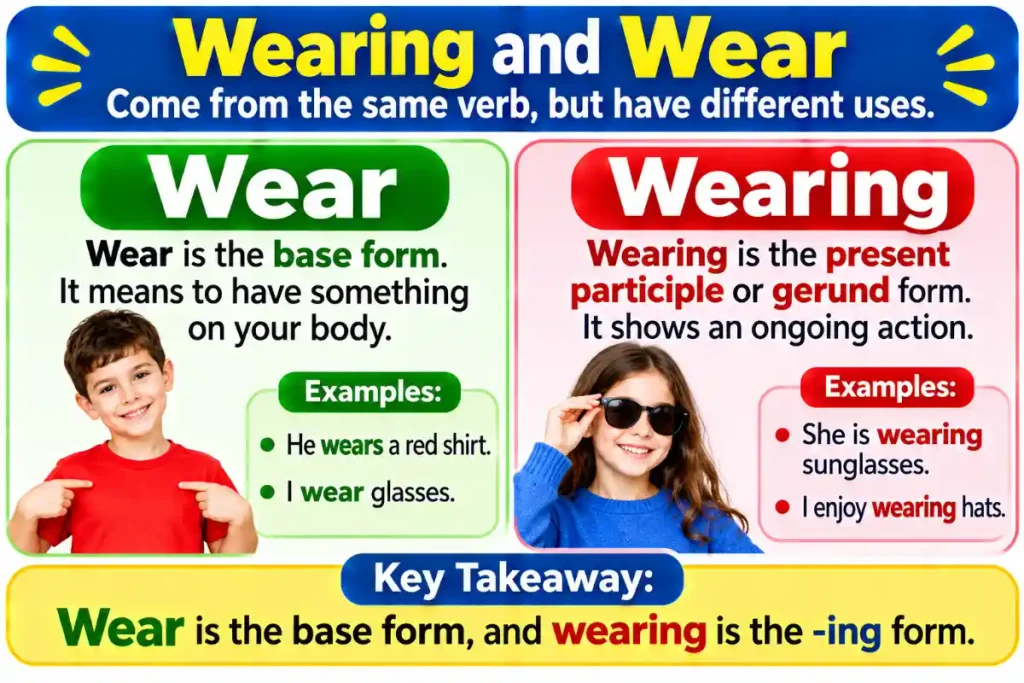
Wearing and wear come from the same verb, but they have different grammatical uses. Wear is the base form, while wearing is the present participle or gerund form.
| Feature | Wear | Wearing |
|---|---|---|
| Word type | Base verb | Present participle or gerund |
| Main use | General actions or habits | Ongoing actions or noun-like activity |
| Example | I wear glasses. | I am wearing glasses. |
| Tense | Present simple and other verb constructions | Continuous tenses and gerund constructions |
Examples:
- I wear a jacket every winter.
- I am wearing a jacket right now.
- She likes to wear sneakers.
- She enjoys wearing sneakers.
Use wear when the sentence requires the base verb. Use wearing when the grammar calls for the -ing form.
Wearing vs Worn: What’s the Difference?
Wearing and worn are two different forms of the verb wear. Worn can also function as an adjective describing something old or damaged through use.
| Word | Meaning | Example |
|---|---|---|
| Wearing | Having something on | She is wearing a jacket. |
| Worn | Past participle of wear | He has worn that jacket before. |
| Worn | Damaged through use | The shoes look worn. |
Examples:
- She is wearing a new dress.
- She has worn that dress before.
- His shoes are worn from years of use.
The context determines which form is correct.
Wearing vs. Putting On: What’s the Difference?
Wearing and putting on are closely related, but they describe different stages of an action.
| Word or Phrase | Meaning | Example |
|---|---|---|
| Wearing | Having clothes on | She is wearing a coat. |
| Putting on | The action of dressing | She is putting on a coat. |
For example:
- He is wearing his shoes. (The shoes are already on.)
- He is putting on his shoes. (He is in the process of putting them on.)
This distinction is useful when describing daily routines and clothing-related activities.
Common Mistakes to Avoid When Using Wearing
Even though wearing is a common English word, writers sometimes make mistakes when spelling or using it. Here are some common errors and their corrections.
1. Leaving Out the Letter E
Incorrect: She is waring a red jacket.
Correct: She is wearing a red jacket.
Remember that the correct spelling contains the letter e after w.
2. Using Wearing Without a Helping Verb
Incorrect: She wearing a beautiful dress.
Correct: She is wearing a beautiful dress.
When using wearing in the present continuous tense, include an appropriate form of be.
3. Confusing Wearing With Worn
Incorrect: He has wearing the same shoes for years.
Correct: He has worn the same shoes for years.
Use the past participle worn after has, have, or had in this construction.
4. Confusing Wearing With Wear
Incorrect: I am wear a new shirt.
Correct: I am wearing a new shirt.
After the helping verb am in the present continuous tense, use wearing.
5. Treating Waring as a Standard Clothing Verb
Incorrect: My father is waring a formal suit.
Correct: My father is wearing a formal suit.
Waring is not the standard present participle of wear.
Is Wearing Used Differently in American and British English?
No significant spelling difference exists between American and British English for the word wearing. Both varieties use wearing when describing clothing, footwear, accessories, or having something on the body.
| English Variety | Correct Spelling | Example |
|---|---|---|
| American English | Wearing | She is wearing a sweater. |
| British English | Wearing | She is wearing a jumper. |
| Canadian English | Wearing | He is wearing a jacket. |
| Australian English | Wearing | They are wearing uniforms. |
The main differences may involve vocabulary for clothing rather than the spelling of wearing. For example, American English commonly uses sweater, while British English often uses jumper. However, wearing remains the correct spelling in all these varieties.
Synonyms and Alternative Expressions for Wearing
Wearing has several related expressions, but the best alternative depends on the context. Some words describe having clothing on, while others refer to dressing, displaying, or using something. Here are useful alternatives and related expressions.
| Word or Phrase | Meaning | Tone | Example |
|---|---|---|---|
| Dressed in | Having particular clothes on | Neutral | She was dressed in blue. |
| Clad in | Covered or dressed in clothing | Formal | He was clad in a warm coat. |
| Sporting | Wearing something noticeable | Casual | She was sporting a new hat. |
| Donning | Putting on clothing | Formal | He was donning his uniform. |
| Putting on | Dressing yourself | Everyday | She is putting on her shoes. |
| Dressed up in | Wearing special or formal clothes | Casual | They were dressed up in costumes. |
| Outfitted in | Wearing a particular outfit | Neutral | The team was outfitted in matching shirts. |
| Garbed in | Dressed in particular clothing | Formal | The performers were garbed in traditional clothing. |
| Decked out in | Wearing decorative or impressive clothing | Informal | He was decked out in holiday clothes. |
| Adorned with | Decorated with accessories | Formal | She was adorned with gold jewelry. |
| Equipped with | Provided with necessary items | Professional | The workers were equipped with safety gear. |
| Covered in | Having something spread over a surface | Neutral | His jacket was covered in dust. |
These alternatives are not perfect replacements in every sentence. For example, donning usually describes the act of putting something on, while wearing describes having it on. Choose the expression that communicates your intended meaning clearly.
How to Remember the Correct Spelling of Wearing
Remembering wearing is simple when you connect it to the base verb wear. Here are a few practical tips.
1. Remember the Base Word
The base verb is wear. To make its present participle, add -ing.
Wear + ing = Wearing
This simple spelling pattern helps prevent the mistake.
2. Think About Clothing
Whenever you describe a shirt, dress, jacket, shoes, or accessories that someone has on, remember wearing.
Example: She is wearing a beautiful jacket.
3. Practice With Simple Sentences
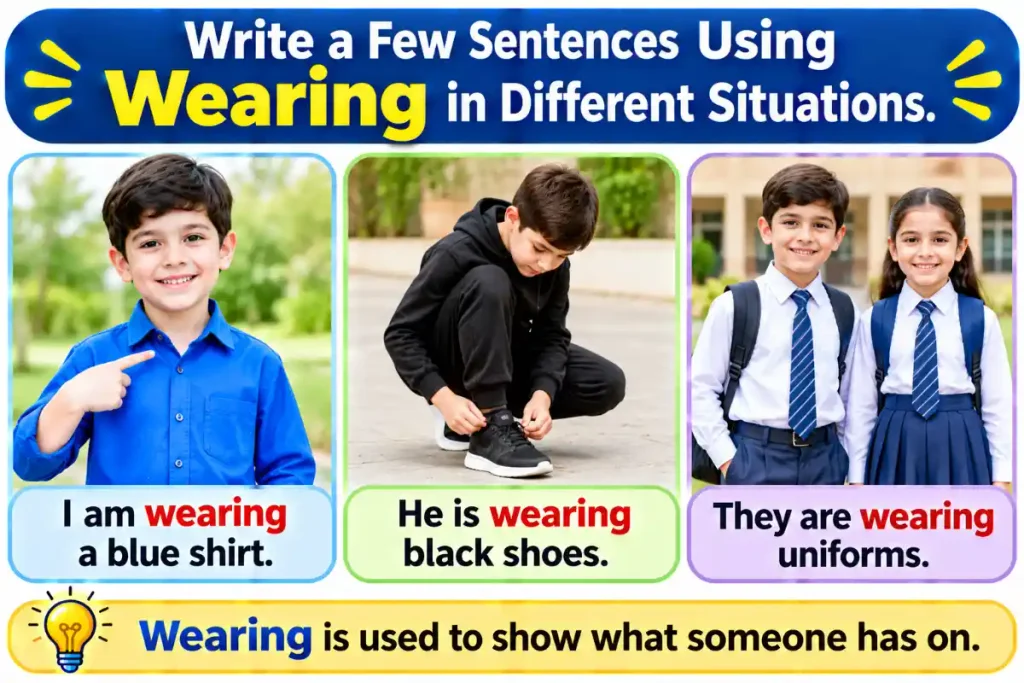
Write a few sentences using wearing in different situations.
- I am wearing a blue shirt.
- He is wearing black shoes.
- They are wearing uniforms.
Regular practice makes the correct spelling easier to remember.
4. Check for the Missing E
Before submitting an email, essay, or social media post, check whether you accidentally typed waring. The extra e is what makes the spelling correct.
Conclusion
Understanding the difference between waring vs wearing is important for clear and accurate English writing. Although the two spellings look similar, they do not have the same grammatical function. Wearing is the correct present participle and gerund form of the verb wear. It describes having clothes, shoes, accessories, or other items on your body. Waring, on the other hand, is generally used as a proper name or surname rather than a clothing-related verb.
To avoid spelling mistakes, remember the simple formula: wear + ing = wearing. Use wearing in sentences such as “She is wearing a beautiful dress” or “They are wearing school uniforms.” Pay attention to the extra letter e, especially when writing emails, assignments, and everyday messages. With regular practice, choosing the correct spelling will become natural and easy.
Frequently Asked Questions
1. Which Is Correct, Waring or Wearing?
Wearing is correct when describing clothes or something someone has on their body. Waring is not the standard spelling of the verb form.
2. How Do You Spell Wearing?
The correct spelling is wearing. It is formed by adding -ing to the base verb wear.
3. Is Waring a Real Word?
Waring can be a proper name or surname, but it is not the correct spelling of wearing when referring to clothing.
4. Why Do People Write Waring Instead of Wearing?
People often leave out the letter e because the two spellings look and sound similar. Typing quickly and unfamiliarity with verb forms can also cause this mistake.
5. What Is the Meaning of Wearing?
Wearing means having clothes, shoes, jewelry, or another item on your body. It can also describe using or displaying something, such as wearing a uniform or wearing a smile.
6. Is Wearing a Verb or a Noun?
Wearing can function as a verb form or a gerund. For example, “She is wearing a dress” uses it as part of a verb phrase, while “Wearing comfortable shoes is important” uses it as a gerund.
7. Is Wearing Correct in American English?
Yes. Wearing is the standard spelling in American English. British, Canadian, and Australian English also use the same spelling.
2 thoughts on “Waring vs. Wearing: Common Spelling Mistake Explained”