
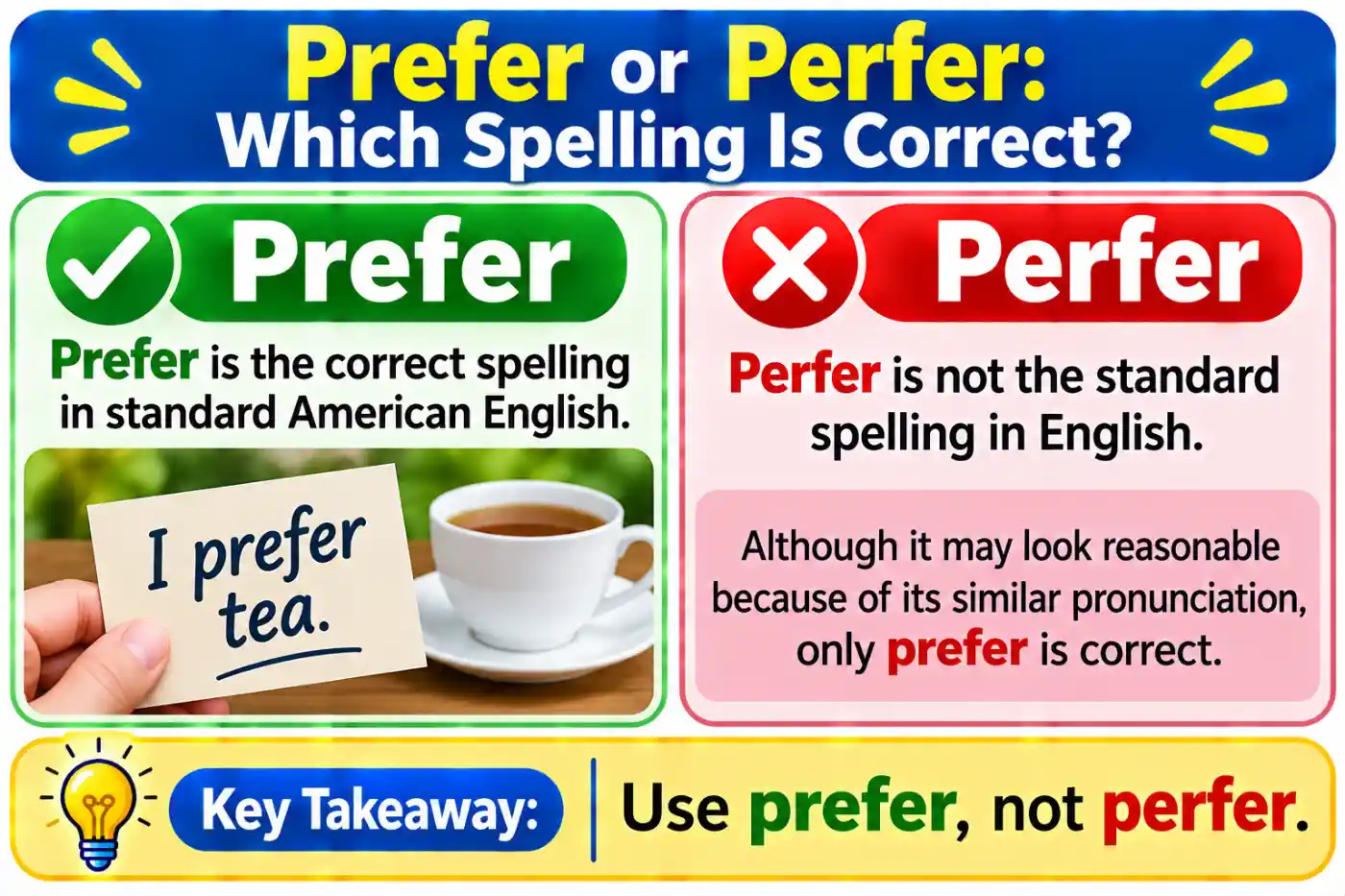
If you’re writing an email, completing a school assignment, or explaining your choice at work, you may wonder whether prefer or perfer is the correct spelling. The two forms look and sound similar, which makes this a common spelling mistake. However, only one is accepted in standard American English.
Prefer is the correct spelling. Perfer is a misspelling and should not be used in formal or informal writing. The correct word means to like, choose, or favor one thing over another.
Although the pronunciation can make the spelling confusing, remembering the correct letter order will help you avoid this mistake. Understanding the word’s meaning, pronunciation, grammar, and common uses will also make it easier to use confidently.
Prefer or Perfer: Which One Is Correct?
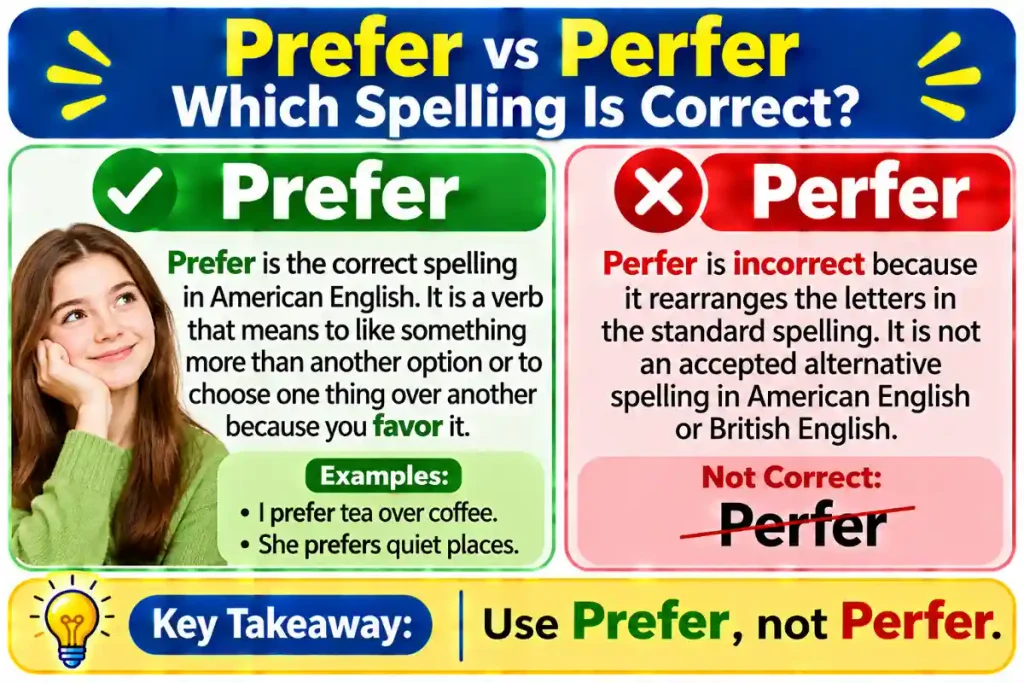
Prefer is the correct spelling in American English. It is a verb that means to like something more than another option or to choose one thing over another because you favor it. Perfer is incorrect because it rearranges the letters in the standard spelling. It is not an accepted alternative spelling in American English or British English. Here is a quick comparison:
| Spelling | Correct or Incorrect? | Meaning |
|---|---|---|
| Prefer | Correct | To like or favor one option more |
| Perfer | Incorrect | A common misspelling of prefer |
Examples:
- Correct: I prefer tea over coffee in the morning.
- Incorrect: I perfer tea over coffee in the morning.
The correct spelling is always prefer when you want to express a choice or personal preference.
What Does Prefer Mean?
The word prefer means to like, favor, or choose one person, thing, or activity more than another. It describes a personal choice based on someone’s interests, needs, opinions, or preferences. For example, someone might prefer working in the morning because they feel more productive early in the day. Another person might prefer studying at night because they enjoy a quieter environment. The word does not necessarily mean that the other option is bad. It simply shows that one choice is more appealing.
Simple Definition of Prefer
Prefer means:
- To like one thing more than another.
- To favor a particular choice.
- To choose something based on personal preference.
- To find one option more suitable or enjoyable.
Example: Sarah prefers reading physical books instead of using an electronic reader. This sentence means Sarah likes printed books more than digital books.
Prefer as a Part of Speech
Prefer functions as a verb. It describes an action, feeling, or choice. It is commonly used in everyday conversations, professional communication, academic writing, and personal statements.
Examples:
- I prefer homemade meals.
- They prefer traveling by train.
- My teacher prefers handwritten assignments.
- We prefer quiet restaurants.
The word can also appear in different grammatical forms, including preferred, preferring, and preference.
| Word Form | Part of Speech | Example |
|---|---|---|
| Prefer | Verb | I prefer coffee. |
| Prefers | Verb | She prefers tea. |
| Preferred | Verb (past tense) | He preferred the earlier schedule. |
| Preferring | Verb form | She is preferring the quieter option. |
| Preference | Noun | My preference is green tea. |
Why Do People Confuse Prefer and Perfer?
People often confuse prefer and perfer because the word’s pronunciation can make the correct letter order less obvious. When spoken quickly, the middle sounds may blend together. As a result, some writers accidentally place an extra letter in the word or rearrange its letters. There are several reasons this spelling mistake happens.
1. Similar Pronunciation
The sounds in prefer can be difficult to distinguish when someone speaks quickly. This can lead writers to spell the word based on how they think it sounds rather than how it is actually written. However, pronunciation does not change the correct spelling.
2. Incorrect Letter Order
Some people remember the general shape of the word but accidentally switch the letters.
The correct spelling is:
P-R-E-F-E-R
The incorrect version, perfer, changes the position of the first two vowels.
3. Typing Too Quickly
Typing mistakes are another common reason people write perfer instead of prefer. Someone may type quickly without checking the spelling, especially when writing text messages, emails, or social media posts.
4. Lack of Spelling Practice
Writers who do not frequently use a word may struggle to remember its correct spelling.
Reading, writing, and using prefer in different sentences can help make the spelling more familiar.
How to Spell Prefer Correctly
The easiest way to remember the correct spelling is to break the word into individual letters and focus on its first vowel combination. The correct spelling is prefer, with an R immediately after the P and an E following that R.
Remember this simple pattern:
PRE + FER = PREFER
Do not write PER + FER.
You can also remember that prefer begins with the same three letters as the word prepare: PRE. Although the two words have different meanings, their shared beginning can help you remember the correct spelling.
Prefer Spelling Breakdown
| Letter Group | Explanation |
|---|---|
| P | First letter |
| R | Second letter |
| E | Third letter |
| F | Fourth letter |
| E | Fifth letter |
| R | Sixth letter |
The word contains six letters and follows the spelling pattern P-R-E-F-E-R.
How to Use Prefer in a Sentence
Prefer is a flexible verb that works in many situations. You can use it to describe your favorite activities, food choices, work arrangements, communication styles, and everyday decisions. The following examples show how to use it naturally.
Everyday Life Examples
- I prefer walking to work because it helps me start my day.
- My brother prefers homemade food over restaurant meals.
- We prefer shopping in the morning when stores are less crowded.
- She prefers comfortable shoes for long walks.
- They prefer spending weekends with their family.
Workplace Examples
- My manager prefers employees to arrive a few minutes early.
- I prefer receiving important updates through email.
- The team prefers flexible working hours.
- Our company prefers digital records instead of printed documents.
- She prefers discussing important projects during scheduled meetings.
School and Academic Examples
- Most students prefer clear instructions before starting an assignment.
- I prefer studying in the library because it is quiet.
- The teacher prefers students to explain their answers.
- Daniel prefers science over history.
- Some learners prefer group discussions to individual activities.
Email and Professional Communication Examples
- I would prefer to receive the revised document by Friday.
- Please let me know if you would prefer another meeting time.
- We would prefer to discuss the proposal before making a decision.
- I prefer written confirmation for important business arrangements.
- Would you prefer a phone call or an email?
Social Media and Casual Conversation Examples
- I prefer the original version of this song.
- Do you prefer summer or winter?
- She prefers watching movies at home.
- I prefer simple designs over complicated ones.
- We prefer spending our holidays near the beach.
These examples demonstrate that prefer works naturally in both casual and professional situations.
What Are the Different Forms of Prefer?
Prefer has several grammatical forms. Knowing how to use each one correctly will help you write more clearly.
1. Prefer
Prefer is the base form of the verb. It is used with subjects such as I, you, we, and they.
Examples:
- I prefer black coffee.
- We prefer online classes.
- They prefer outdoor activities.
2. Prefers
Prefers is used with third-person singular subjects, such as he, she, and it.
Examples:
- She prefers fresh fruit.
- He prefers working independently.
- My father prefers traditional music.
3. Preferred
Preferred is the simple past and past participle form of prefer.
Examples:
- I preferred the previous design.
- She preferred the earlier appointment.
- They have always preferred smaller groups.
Notice that preferred has two F’s and two R’s.
4. Preferring
Preferring is the present participle form of the verb. It can appear in continuous verb constructions.
Examples:
- She is preferring the new arrangement.
- He is preferring a quieter work environment.
In everyday English, speakers often use the simple present instead when describing general preferences: “She prefers the new arrangement.”
5. Preference
Preference is the noun form. It refers to a person’s liking or choice.
Examples:
- My preference is to work from home.
- Everyone has a different preference.
- Please share your seating preference.
Common Grammar Patterns With Prefer
Knowing the spelling is important, but using prefer with the correct sentence structure matters just as much. Here are the most common patterns.
Prefer Something to Something Else
Use this structure when comparing two choices.
Pattern: Prefer + noun + to + noun.
Examples:
- I prefer coffee to tea.
- She prefers books to magazines.
- They prefer summer to winter.
In this structure, use “to” rather than automatically replacing it with “than.”
Prefer Doing Something to Doing Something Else
Use this pattern to compare two activities.
Pattern: Prefer + gerund + to + gerund.
Examples:
- I prefer walking to driving.
- He prefers cooking to eating out.
- We prefer reading to watching television.
Both activities should follow the same grammatical structure.
Prefer to Do Something
Use this structure when explaining an activity you favor.
Pattern: Prefer + to + base verb.
Examples:
- I prefer to study in the morning.
- She prefers to travel by train.
- They prefer to eat dinner early.
Would Prefer to Do Something
Use would prefer when expressing a specific or immediate choice.
Pattern: Would prefer + to + base verb.
Examples:
- I would prefer to meet tomorrow.
- We would prefer to stay home tonight.
- She would prefer to speak with the manager.
Would Prefer Someone to Do Something
Use this pattern when expressing what you want another person to do.
Pattern: Would prefer + person + to + base verb.
Examples:
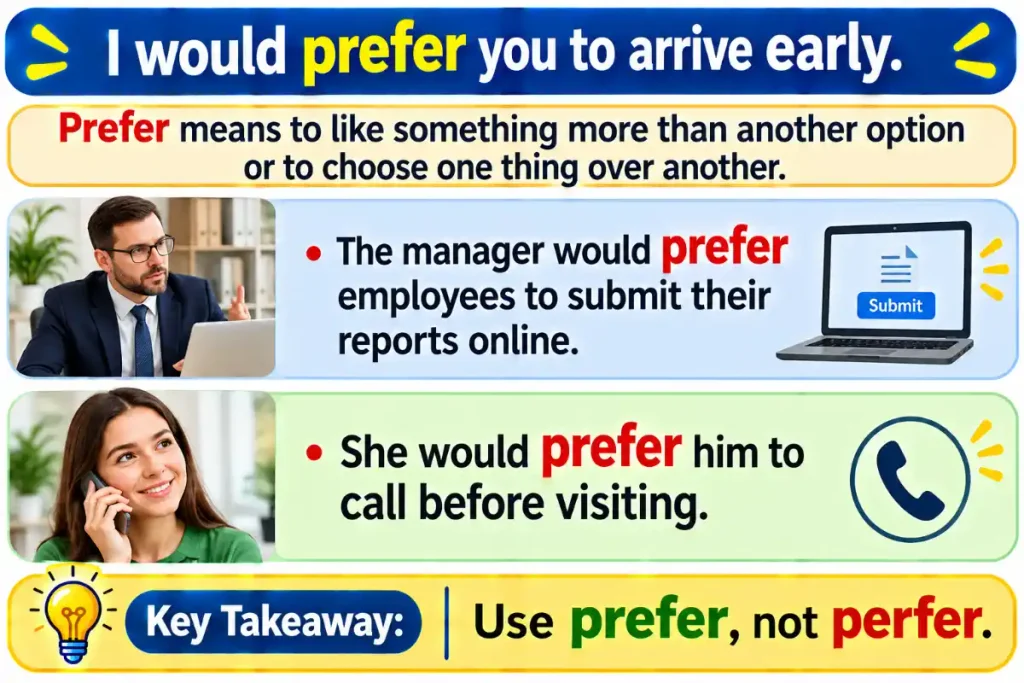
- I would prefer you to arrive early.
- The manager would prefer employees to submit their reports online.
- She would prefer him to call before visiting.
These patterns help you use prefer accurately in different situations.
Prefer vs Preference: What’s the Difference?
Prefer is a verb, while preference is a noun.
| Word | Part of Speech | Meaning | Example |
|---|---|---|---|
| Prefer | Verb | To favor one choice | I prefer tea. |
| Preference | Noun | A favored choice or liking | My preference is tea. |
Examples:
- Correct: I prefer working in the morning.
- Correct: My preference is to work in the morning.
- Incorrect: My preference working in the morning.
Use prefer when describing the act of favoring something. Use preference when naming the choice or liking itself.
Prefer vs Favorite: What’s the Difference?
Prefer describes choosing or liking one option more than another. Favorite identifies the person or thing someone likes best.
| Word | Meaning | Example |
|---|---|---|
| Prefer | To like one option more | I prefer tea to coffee. |
| Favorite | The most liked option | Tea is my favorite drink. |
Examples:
- I prefer blue shirts over red shirts.
- Blue is my favorite color.
- She prefers reading novels.
- Mystery novels are her favorite books.
Use prefer when comparing choices and favorite when identifying a top choice.
Prefer vs Favor: What’s the Difference?
Prefer usually describes personal liking or choosing one option over another. Favor can mean to support, approve of, or show a preference for someone or something.
| Word | Meaning | Example |
|---|---|---|
| Prefer | Like one option more | I prefer working remotely. |
| Favor | Support or approve of something | I favor the proposed changes. |
For example:
- I prefer the blue design.
- I favor the new company policy.
The first sentence describes a personal choice, while the second expresses support for a proposal.
Synonyms of Prefer: What Words Can You Use Instead?
Several words can replace prefer, depending on the sentence and intended meaning. However, not every synonym works in every situation. Here are useful alternatives organized by tone and context.
Everyday Synonyms
| Word | Meaning | Tone | Example |
|---|---|---|---|
| Like | Find something enjoyable | Casual | I like this design. |
| Choose | Select an option | Neutral | I choose the earlier flight. |
| Favor | Show a preference | Neutral | I favor the second proposal. |
| Enjoy | Take pleasure in something | Casual | I enjoy reading. |
| Pick | Select something | Casual | I’ll pick the blue one. |
| Want | Desire something | Everyday | I want the smaller size. |
| Select | Choose from available options | Neutral | Please select your preferred date. |
Formal and Professional Alternatives
| Word | Meaning | Tone | Example |
|---|---|---|---|
| Favor | Have a preference for | Professional | I favor the revised plan. |
| Opt for | Choose an option | Neutral | We opted for a digital solution. |
| Prioritize | Give something greater importance | Professional | We prioritize customer satisfaction. |
| Recommend | Suggest something as suitable | Professional | I recommend the second option. |
| Endorse | Publicly support something | Formal | The committee endorsed the proposal. |
| Advocate | Publicly support an idea | Formal | She advocates flexible scheduling. |
| Select | Make a deliberate choice | Formal | The team selected a new supplier. |
| Appreciate | Recognize the value of something | Neutral | I appreciate the simpler approach. |
Alternatives for Specific Contexts
| Word or Phrase | Meaning | Example |
|---|---|---|
| Have a liking for | Enjoy or favor something | He has a liking for classical music. |
| Be partial to | Have a particular fondness for | I’m partial to Italian food. |
| Have a soft spot for | Feel special affection for | She has a soft spot for old movies. |
| Lean toward | Show a tendency to choose | I’m leaning toward the first option. |
| Go with | Choose something | Let’s go with the original design. |
| Be inclined toward | Tend to favor something | He is inclined toward a simpler solution. |
| Have a preference for | Favor something | We have a preference for morning meetings. |
Choose the alternative that best matches your meaning. For example, opt for works well when describing a decision, while enjoy is more suitable when talking about an activity that gives you pleasure.
What Is the Opposite of Prefer?
The opposite of prefer depends on the context. Several words can express a lack of preference or a negative choice.
| Antonym or Alternative | Meaning | Example |
|---|---|---|
| Dislike | Not enjoy something | I dislike crowded places. |
| Reject | Refuse to accept something | She rejected the first proposal. |
| Avoid | Stay away from something | He avoids unnecessary meetings. |
| Disfavor | Regard something negatively | The policy fell out of favor. |
| Disapprove | Have a negative opinion | They disapprove of the changes. |
| Refuse | Say no to something | I refuse to accept the offer. |
For example, if someone prefers tea to coffee, you might say they dislike coffee. However, these expressions are not always interchangeable because preferring one option does not necessarily mean disliking another.
Is Prefer Used Differently in American and British English?
No significant spelling difference exists between American and British English for prefer. Both varieties use the same spelling:
- American English: Prefer
- British English: Prefer
The misspelling perfer is incorrect in both varieties. Some related words have regional spelling differences, such as favorite in American English and favourite in British English. However, prefer does not follow that pattern.
The verb is also used in similar grammatical structures in both varieties of English.
Examples:
- American English: I prefer traveling by car.
- British English: I prefer travelling by car.
Notice that the spelling difference appears in traveling and travelling, not in prefer.
Is Prefer Formal or Informal?
Prefer is a neutral word. You can use it in casual conversations, school assignments, professional emails, business documents, and academic writing. It does not sound overly formal or too casual, which makes it a useful choice in many situations.
Prefer in Professional Emails
Prefer works well when discussing schedules, communication methods, arrangements, and business decisions.
Examples:
- I would prefer to schedule the meeting for Thursday.
- Please let me know if you would prefer a different arrangement.
- We prefer to receive all documents electronically.
Prefer in Academic Writing
You can use prefer when discussing choices, research methods, or personal opinions.
Examples:
- Some students prefer visual learning methods.
- Researchers may prefer a different approach depending on the study.
- Many participants preferred the second option.
Prefer in Everyday Conversation
The word is equally natural in informal communication.
Examples:
- Do you prefer pizza or burgers?
- I prefer staying home on weekends.
- Would you prefer something cold to drink?
There is no need to replace prefer with a complicated alternative when the simple word communicates your meaning clearly.
Common Spelling and Grammar Mistakes With Prefer
Writers sometimes make mistakes when spelling or using prefer. Learning the most common errors can help you avoid them.
| Incorrect | Correct | Explanation |
|---|---|---|
| Perfer | Prefer | Incorrect letter order |
| Preffer | Prefer | One F is required in the base form |
| Prefered | Preferred | The past form doubles the R |
| Prefering | Preferring | The present participle doubles the R |
| Preferance | Preference | The correct noun spelling is preference |
| I prefer than tea | I prefer tea to coffee | Use the appropriate comparison structure |
| I prefer more tea | I prefer tea | Avoid unnecessary comparison wording when no comparison is intended |
Mistake 1: Writing Perfer Instead of Prefer
Incorrect: I perfer working in the morning.
Correct: I prefer working in the morning.
Remember the correct letter order: P-R-E-F-E-R.
Mistake 2: Writing Prefered Instead of Preferred
Incorrect: She prefered the earlier appointment.
Correct: She preferred the earlier appointment.
When forming the past tense, double the final R before adding -ed.
Mistake 3: Writing Prefering Instead of Preferring
Incorrect: He is prefering the smaller room.
Correct: He is preferring the smaller room.
The present participle requires two R’s before adding -ing.
Mistake 4: Confusing Prefer With Preference
Incorrect: My prefer is coffee.
Correct: My preference is coffee.
Prefer is a verb, while preference is a noun.
Mistake 5: Using the Wrong Comparison Structure
Incorrect: I prefer coffee than tea.
Correct: I prefer coffee to tea.
When comparing two things with prefer, the standard construction is prefer X to Y.
How to Remember the Correct Spelling of Prefer
Remembering prefer becomes easier when you use a simple spelling trick.
Here are a few practical ways to keep the correct spelling in mind.
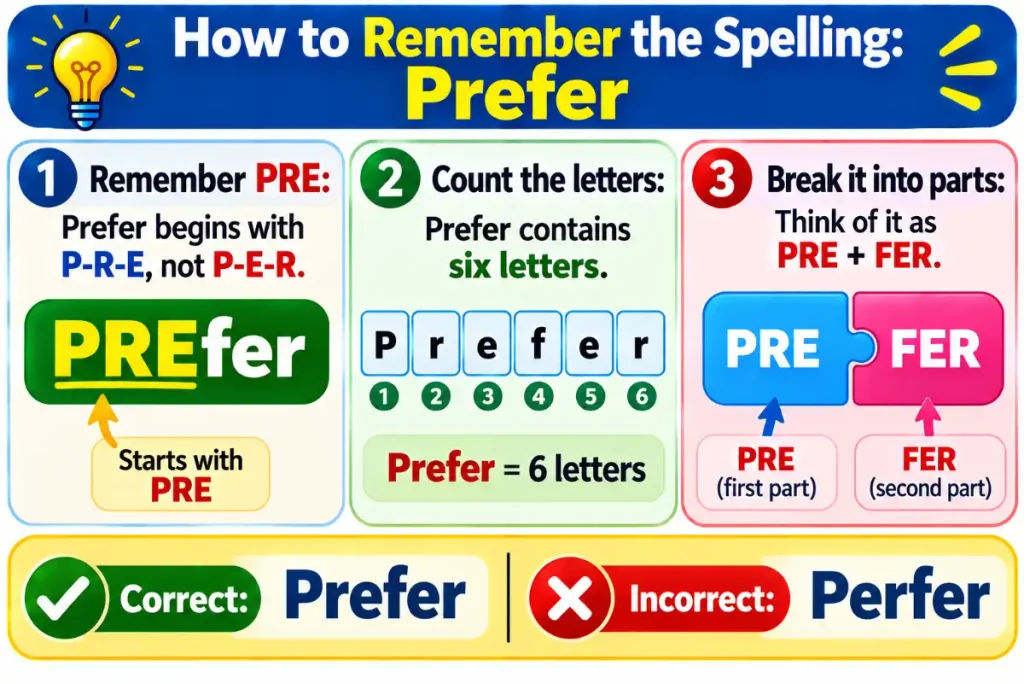
- Remember PRE: Prefer begins with P-R-E, not P-E-R.
- Count the letters: Prefer contains six letters.
- Break it into parts: Think of it as PRE + FER.
- Write it several times: Repeating the correct spelling helps build familiarity.
- Use it in sentences: Practice writing sentences about your daily choices.
- Remember the related noun: Preference also begins with PRE.
- Check your writing: Review emails and assignments for accidental misspellings.
A useful memory trick is to connect prefer with preference. Both words begin with the same three letters: P-R-E.
Conclusion
Choosing the correct spelling makes your writing clearer and more professional. When deciding between prefer or perfer, always use prefer because it is the only standard spelling in American and British English. The word is a useful verb that describes liking, favoring, or choosing one option over another.
Remember its six-letter structure: P-R-E-F-E-R. You can use it in everyday conversations, professional emails, academic assignments, and many other situations. Also, learn its related forms, including prefers, preferred, preferring, and preference, to avoid common grammar mistakes. With regular reading and writing practice, remembering the correct spelling becomes much easier. Whenever you need to express a choice or personal liking, prefer is the correct word to use.
Frequently Asked Questions
1. Is prefer or perfer correct?
Prefer is correct, while perfer is a misspelling. Use prefer when expressing that you like or favor one option more than another.
2. How do you spell prefer correctly?
The correct spelling is P-R-E-F-E-R. It contains six letters and begins with PRE.
3. Why do people spell prefer as perfer?
People often write perfer because they confuse the sounds or accidentally rearrange the letters. However, the standard spelling is always prefer.
4. Is perfer a real English word?
No. Perfer is not a standard English word. It is a common spelling mistake for prefer and should be corrected in writing.
5. What is the past tense of prefer?
The past tense is preferred, with two R’s. For example, “I preferred the earlier version of the document.”
6. What is the noun form of prefer?
The noun form is preference. For example, “My preference is to work in a quiet environment.”
7. Is prefer spelled the same in American and British English?
Yes. Both American and British English use prefer. There is no regional spelling variation between the two forms.
2 thoughts on “Prefer or Perfer: Which Spelling Is Correct?”