
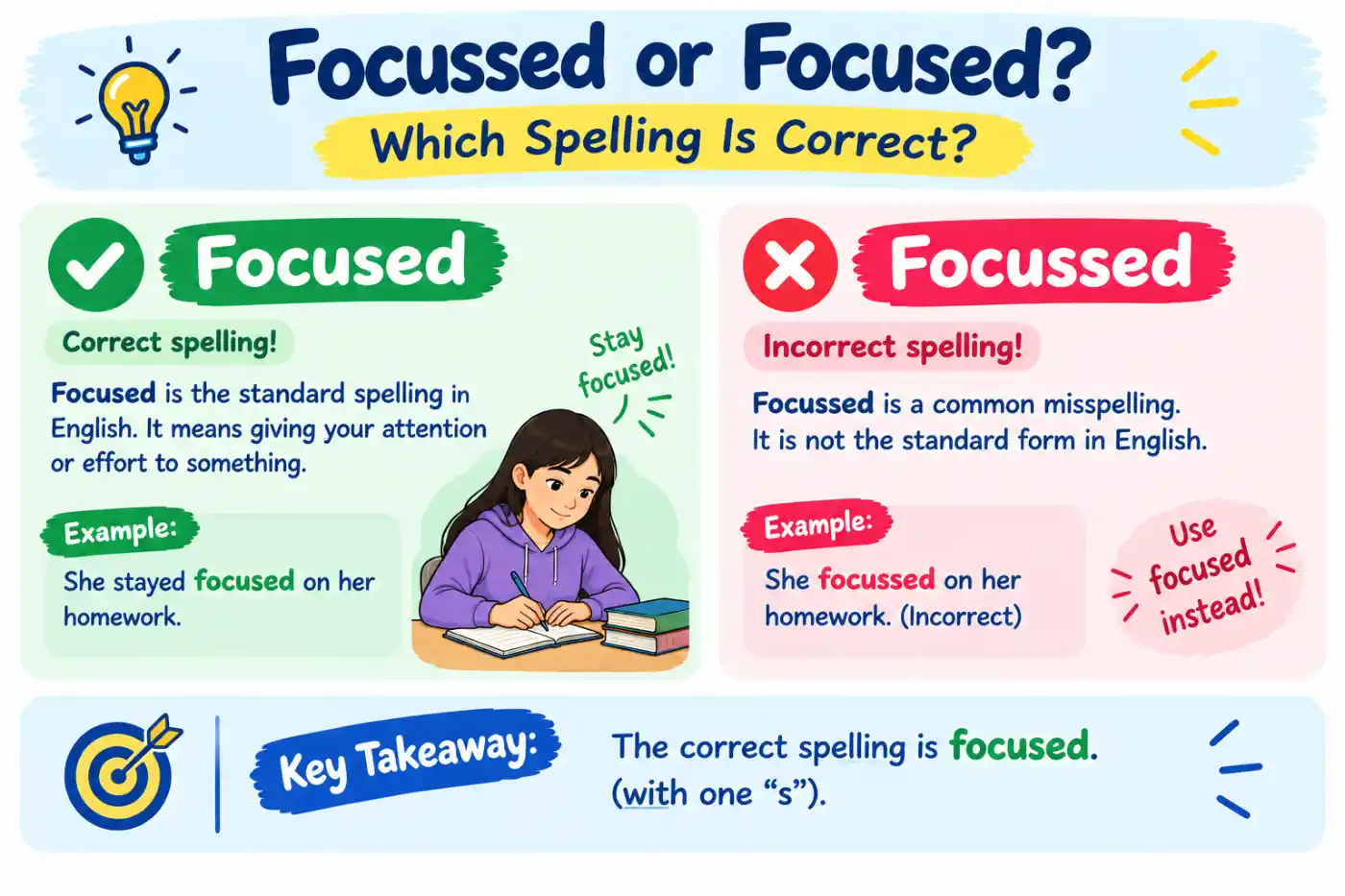
If you’re writing an email, resume, school assignment, or professional document, you may wonder whether focussed or focused is the correct spelling. Both forms appear in English, but they have different levels of use depending on the variety of English.
In American English, focused is the standard and preferred spelling. “Focussed” is a valid British English spelling, although “focused” is also widely used in British English.
For US readers, choose “focused.” It is the standard American spelling of the past tense and past participle of “focus.”
This guide explains the difference between focussed and focused, when to use each spelling, common mistakes, examples, and the best choice for professional and academic writing.

Focussed or Focused: What Is the Difference?
The main difference is regional spelling rather than meaning.
| Spelling | Main Usage | Example |
|---|---|---|
| Focused | American English; also common in British English | She stayed focused on her work. |
| Focussed | British English variant | She stayed focussed on her work. |
Both spellings come from the verb focus, meaning to direct attention, effort, or activity toward something. The important point is that focused has one “s” before the “-ed” ending, while focussed has two. For American readers, writers, students, and businesses, focused is normally the better choice.
Is “Focused” Correct?
Yes. Focused is the standard American English spelling.
Examples include:
- I stayed focused during the meeting.
- She is focused on finishing her degree.
- The team remained focused on its main goal.
- He focused his attention on the customer.
- The presentation focused on workplace safety.
American dictionaries and style conventions generally use focused as the preferred spelling. If you’re writing for a US audience, using focused keeps your spelling consistent with standard American English.
Is “Focussed” Correct?
Yes, but it is less common in American English. Focussed is an accepted spelling, especially in British English and some other varieties of English. British writers may use either focused or focussed, depending on their preferred style guide or regional convention.
For example:
The students remained focussed during the exam.
The sentence is grammatically correct. However, a US writer would normally write:
The students remained focused during the exam.
So “focussed” isn’t simply a misspelling. It is a legitimate spelling variant.
Why Does “Focussed” Have Two S’s?
The spelling difference comes from how English handles words ending in a vowel plus a consonant when adding certain suffixes. The verb is focus. When adding “-ed,” English can produce:
- focus → focused
- focus → focussed
The double-s version follows a spelling pattern found in some British English words. Similar differences appear in words such as:
- traveled / travelled
- canceled / cancelled
- labeled / labelled
American English often uses a single consonant in these forms, while British English frequently doubles the consonant. However, the pattern isn’t identical for every word, so writers shouldn’t assume that every American and British spelling follows exactly the same rule.
Focused or Focussed in American English
For American English, the choice is simple:
Use “focused.”
This spelling works well in:
- Business emails
- Resumes
- Cover letters
- Academic papers
- School assignments
- Websites
- News writing
- Professional reports
- Social media posts
- Everyday communication
Example for a Resume
Use:
Focused on improving customer satisfaction and team performance.
Not:
Focussed on improving customer satisfaction and team performance.
The second version isn’t necessarily grammatically wrong, but it can look unusual in American professional writing.
Example for Academic Writing
Use:
The study focused on the effects of sleep on student performance.
This spelling fits standard US academic writing.
Example for a Professional Email
I’m focused on completing the project before Friday.
This sounds natural to an American audience.
Focused or Focussed in British English
British English accepts focussed as a spelling variant, but focused also appears frequently.
For example:
The company is focused on sustainable growth.
or:
The company is focussed on sustainable growth.
Both can be found in British English. If you’re following a specific publication, university, employer, or style guide, follow its preferred spelling consistently. The key rule is consistency. Don’t switch randomly between focused and focussed in the same document.
What Does “Focused” Mean?
Focused means giving your attention, effort, or energy to a particular person, activity, subject, or goal. It can describe a person’s concentration:
Maria stayed focused while studying for her exam.
It can also describe an organization or activity:
The company is focused on improving customer service.
The word can also mean that something centers on a particular subject:
The discussion was focused on education policy.
In each example, focused suggests attention or concentration directed toward something specific.
What Part of Speech Is “Focused”?
Focused can function in several grammatical ways.
Focused as the Past Tense of “Focus”
When used as a verb, focused is the past tense and past participle of focus.
The teacher focused on the main problem.
Here, focused describes an action that happened in the past.
Focused as an Adjective
Focused can also describe someone or something that shows concentration or has a clear purpose.
She is a focused student.
Here, focused describes the student.
Another example:
We need a more focused approach.
In this sentence, focused describes the approach.
10 Examples of “Focused” in Real Sentences
Here are natural examples that show how Americans commonly use focused.
- I stayed focused on my assignment despite the noise.
- The manager focused on improving communication within the team.
- She is highly focused on her career goals.
- We need to stay focused during the final stage of the project.
- The meeting focused on ways to reduce costs.
- He remained focused while preparing for his job interview.
- The teacher asked the class to stay focused on the lesson.
- Our marketing plan is focused on reaching local customers.
- She focused her attention on the most important details.
- The new program is focused on helping students develop practical skills.
Notice that focused works naturally in conversations, workplace writing, education, and everyday situations.
Common Mistakes With Focused and Focussed
The biggest mistake is treating one spelling as universally correct or universally incorrect.
Mistake 1: Calling “Focussed” Always Wrong
“Focussed” isn’t automatically wrong. It is an accepted spelling in British English. The issue is regional preference. Better approach: Use focused for American English and follow the relevant style for British English.
Mistake 2: Using “Focussed” in US Writing Without a Reason
Although readers will understand focussed, it can look inconsistent with American spelling. For US-facing content, choose:
The report focused on customer behavior.
rather than:
The report focussed on customer behavior.
Mistake 3: Switching Between Both Spellings
Avoid writing:
The first section focused on sales, while the second section focussed on customer service.
If the document follows American English, use focused throughout:
The first section focused on sales, while the second section focused on customer service.
Consistency makes writing easier to read and edit.
Mistake 4: Confusing “Focus” With “Focused”
Focus is the base verb and noun.
I need to focus on my homework.
Focused is the past tense or an adjective.
I focused on my homework.
I am focused on my homework.
These forms serve different grammatical roles.
Focus or Focused or Focusing
These words come from the same verb but have different uses.
| Word | Function | Example |
|---|---|---|
| Focus | Base verb or noun | I need to focus. |
| Focused | Past tense, past participle, or adjective | She focused on the task. |
| Focusing | Present participle/gerund | He is focusing on the problem. |
Focus
Use focus for the basic verb:
Try to focus on the speaker.
It can also act as a noun:
My main focus is customer service.
Focused
Use focused for a completed action or as an adjective:
She focused on her studies.
She is focused on her studies.
Focusing
Use focusing for an ongoing action:
He is focusing on his final exam.
Focussed or Focused on?
The phrase focused on is the standard choice in American English.
Examples:
The company is focused on customer satisfaction.
The course is focused on practical skills.
She is focused on her long-term goals.
In British English, you may also see focussed on:
The company is focussed on customer satisfaction.
The meaning stays the same.
Focussed or Focused for a Resume?
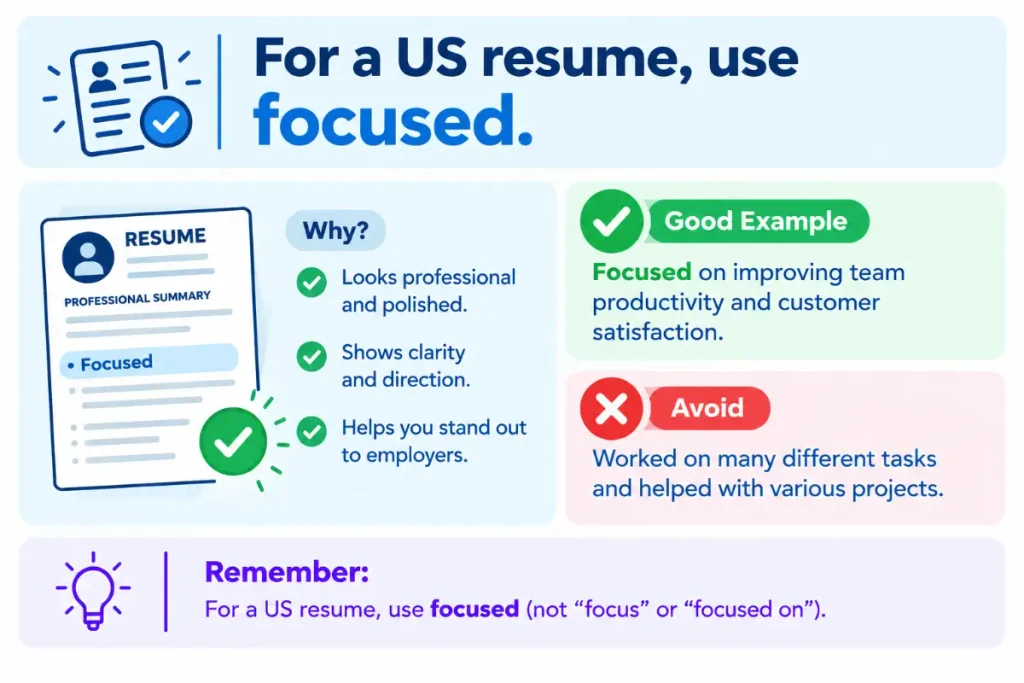
For a US resume, use focused.
For example:
Focused on improving team productivity and customer satisfaction.
You might also write:
Results-focused professional with experience in customer service.
For American employers, focused fits naturally with standard US spelling. If you’re applying to a company in the UK, you can use the spelling preferred by that employer or their style guide.
Focussed or Focused for Academic Writing?
For US academic writing, focused is the safest choice.
Example:
This paper focused on the relationship between technology and student learning.
If you’re writing for a British institution, check its preferred style. Both focused and focussed may be acceptable, but consistency matters. Academic writing also benefits from using focused only when it communicates the intended meaning. Don’t replace more precise verbs with focused simply because it sounds formal.
For example:
The study examined student behavior.
may be more precise than:
The study focused on student behavior.
The best word depends on what you actually mean.
Focussed or Focused in a Professional Email?
Use focused in an American professional email.
For example:
I’m focused on completing the remaining tasks this week.
Or:
Our team remains focused on providing reliable service.
The spelling is simple, familiar, and appropriate for professional communication.
Focussed or Focused in Casual Writing?
For casual American writing, use focused.
Examples:
I’m trying to stay focused today.
I need to get focused before the test.
Let’s stay focused and finish this.
In texting and informal communication, most US readers will naturally expect focused.
American English or British English
The spelling difference fits a larger pattern between American and British English.
| American English | British English |
|---|---|
| focused | focused / focussed |
| canceled | cancelled |
| traveled | travelled |
| labeled | labelled |
| modeled | modelled |
These patterns aren’t absolute rules for every word. English spelling has many exceptions and variations. The important distinction for this particular word is straightforward: focused is the preferred spelling for US English, while focussed is a recognized British variant.
Which Spelling Should You Use?
Your audience should determine your choice.
For US Readers
Use focused.
For UK Readers
Use focused or focussed, depending on the style you follow.
For Canadian Readers
Both forms can appear, although spelling preferences may vary by context and style guide.
For Australian Readers
Focussed is commonly encountered, while focused is also understood and used. If you’re writing for an international audience, focused is often a practical choice because it is widely recognized across English varieties.
Focused Synonyms
The best synonym depends on the context. Focused can describe concentration, attention, purpose, or a narrow subject.
| Word/Phrase | Meaning | Tone | Example |
|---|---|---|---|
| Concentrated | Giving strong attention to something | Neutral | She remained concentrated on the task. |
| Attentive | Paying close attention | Neutral | He was attentive during the meeting. |
| Concentrating | Actively directing attention | Everyday | I’m concentrating on my work. |
| Absorbed | Deeply interested in something | Neutral | She was absorbed in the book. |
| Engaged | Actively involved | Professional | The students remained engaged. |
| Dedicated | Strongly committed to something | Positive | He is dedicated to his work. |
| Committed | Determined to achieve something | Professional | She is committed to the project. |
| Intent | Giving serious attention | Formal | He was intent on finishing the task. |
| Determined | Strongly decided to achieve a goal | Positive | She remained determined to succeed. |
| Purposeful | Showing clear intention | Professional | He took a purposeful approach. |
| Goal-oriented | Directed toward achieving goals | Professional | She’s highly goal-oriented. |
| Single-minded | Concentrating strongly on one goal | Strong | He was single-minded about his objective. |
| Mindful | Paying careful attention | Neutral | Be mindful of the instructions. |
| Attuned | Aware and responsive | Formal | The team is attuned to customer needs. |
| Intentional | Done with a clear purpose | Professional | The campaign uses intentional messaging. |
Not every synonym works in every sentence. For example, dedicated describes commitment, while attentive describes awareness and concentration. Choosing the closest meaning creates clearer writing.
Focused or Concentrated: What’s the Difference?
Focused and concentrated can overlap, but they aren’t always interchangeable.
She is focused on completing the project.
Concentrated often emphasizes mental effort or close attention.
She concentrated on solving the problem.
In many everyday situations, both can work. Focused tends to sound more natural when discussing goals, priorities, plans, and professional work.
Focused or Dedicated: What’s the Difference?
Compare:
He is focused on improving his writing.
This tells us where his attention goes.
He is dedicated to improving his writing.
This emphasizes his commitment and effort. A person can be focused without being deeply dedicated, so the words aren’t exact substitutes.
Focused or Concentrating: What’s the Difference?
Focused can describe a state:
She is focused on her studies.
Concentrating usually emphasizes the action of paying attention:
She is concentrating on her studies.
Both sentences work, but focused can also describe a broader sense of purpose or direction.
Antonyms of Focused
Several words can express the opposite of focused, depending on the context.
- Distracted
- Unfocused
- Scattered
- Inattentive
- Unconcentrated
- Aimless
- Confused
- Disorganized
For example:
I was too distracted to finish the assignment.
Here, distracted provides a clear opposite to focused. Unfocused is especially useful when you want a direct grammatical opposite:
The meeting felt unfocused and unproductive.
How to Remember the Correct US Spelling
If you’re writing for an American audience, use this simple rule:
Focus + ed = focused
Think of the standard US form as the shorter spelling:
focused
If you’re writing in British English, you may encounter:
focussed
The safest choice for US websites, resumes, schoolwork, and business communication is focused.

Quick Answer: Focussed or Focused?
If you need the answer quickly, use focused in American English. “Focussed” is a valid spelling variant, especially in British English. It has the same meaning as focused, but it is less common in US writing. For a US audience, these are correct:
- She stayed focused.
- The report focused on sales.
- He is focused on his goals.
- The team remains focused on quality.
Conclion
In conclusion, both “focussed” and “focused” are correct spellings of the past tense and past participle of “focus.” The main difference is based on regional spelling preferences rather than meaning.
“Focused” is the more common spelling in American English, while “focussed” is more commonly used in British English and some other varieties of English. Both forms are grammatically correct when used consistently with the chosen style of English.
For most US-focused writing, “focused” is the preferred choice. However, if you are following British English conventions, “focussed” is perfectly acceptable. The key is to maintain consistent spelling throughout your writing.
Frequently Asked Questions
Is “focused” or “focussed” correct?
Both spellings are correct, but focused is the standard choice in American English. Focussed is an accepted variant, particularly in British English.
Is “focussed” wrong in American English?
Focussed isn’t necessarily wrong, but it is not the usual American spelling. US writers should generally choose focused.
How do you spell focused in American English?
The standard American spelling is focused, with one “s” before “-ed.”
Which is correct, focused on or focussed on?
Both are grammatically correct, but focused on is the preferred form in American English. British English may use either focused on or focussed on.
Why do British people spell focused as focussed?
Focussed follows a spelling pattern used in some British English words where a consonant gets doubled before certain suffixes. Focused remains common in British English as well.
Should I use focused on my resume?
Yes. If you’re writing a US resume, focused is the preferred spelling. For example: “Focused on improving customer satisfaction and team performance.”
Is focused a verb or an adjective?
Focused can be both. It functions as a verb in “She focused on the assignment” and as an adjective in “She is a focused student.”
2 thoughts on “Focussed or Focused: Which Spelling Is Correct?”