
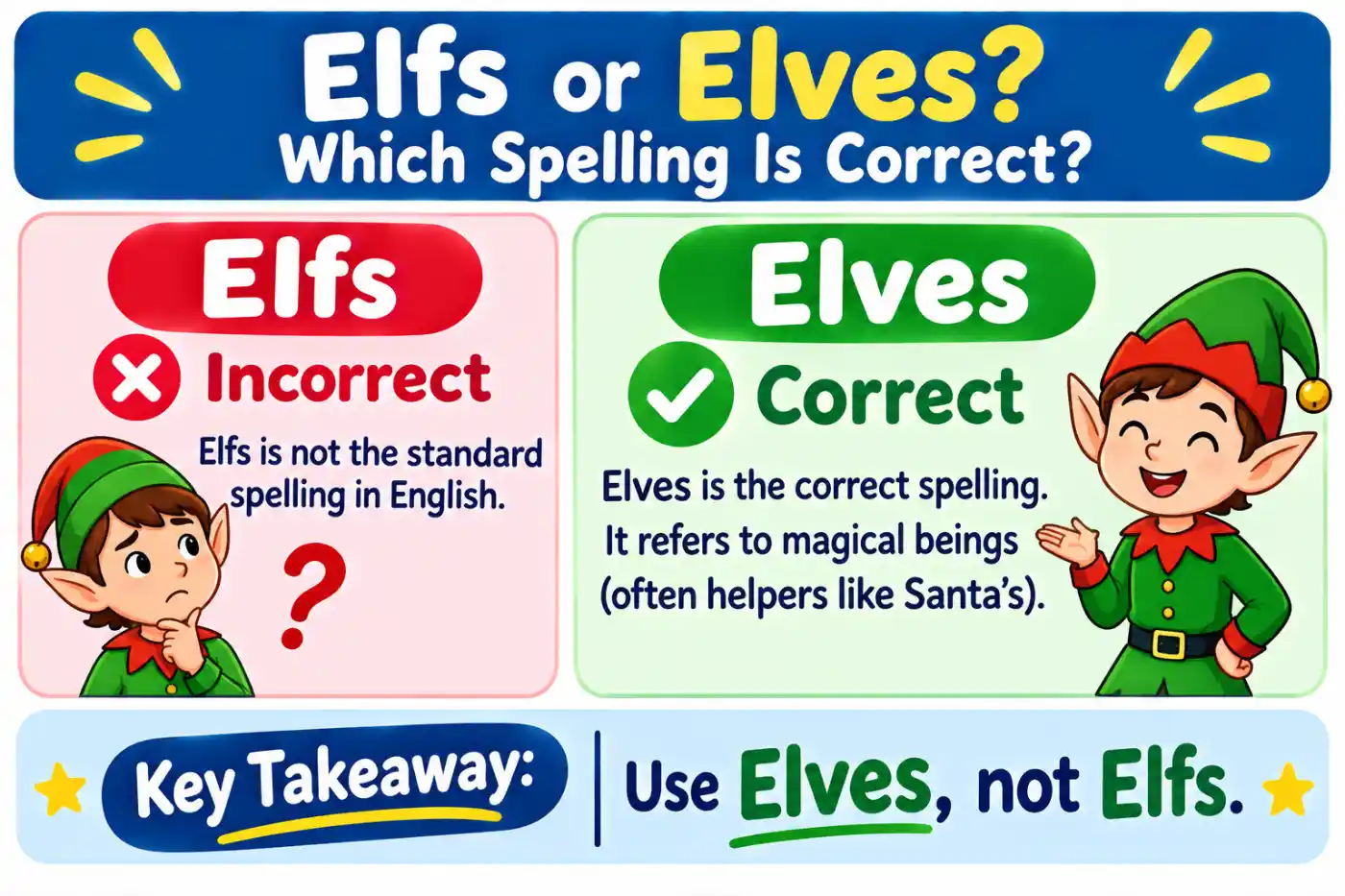
If you’re writing a Christmas story, describing Santa’s helpers, or talking about fantasy characters, you might wonder whether elfs or elves is the correct spelling. Both forms may look reasonable because most English nouns form their plurals by adding -s or -es. However, the word elf follows a different spelling pattern.
Elves is the correct standard plural of elf in American English. Elfs is generally considered a misspelling in modern standard usage, although it may appear in older texts, specialized contexts, or creative writing.
Understanding why elf changes to elves makes this spelling easier to remember. It also helps you use the word correctly in Christmas stories, school assignments, fantasy novels, and everyday conversations.
In this guide, you’ll learn the meaning of elf and elves, why the spelling changes, how to use the plural in sentences, and how elves differs from similar words such as dwarves, fairies, and fairy tales.
Elfs or Elves: Which Is Correct?
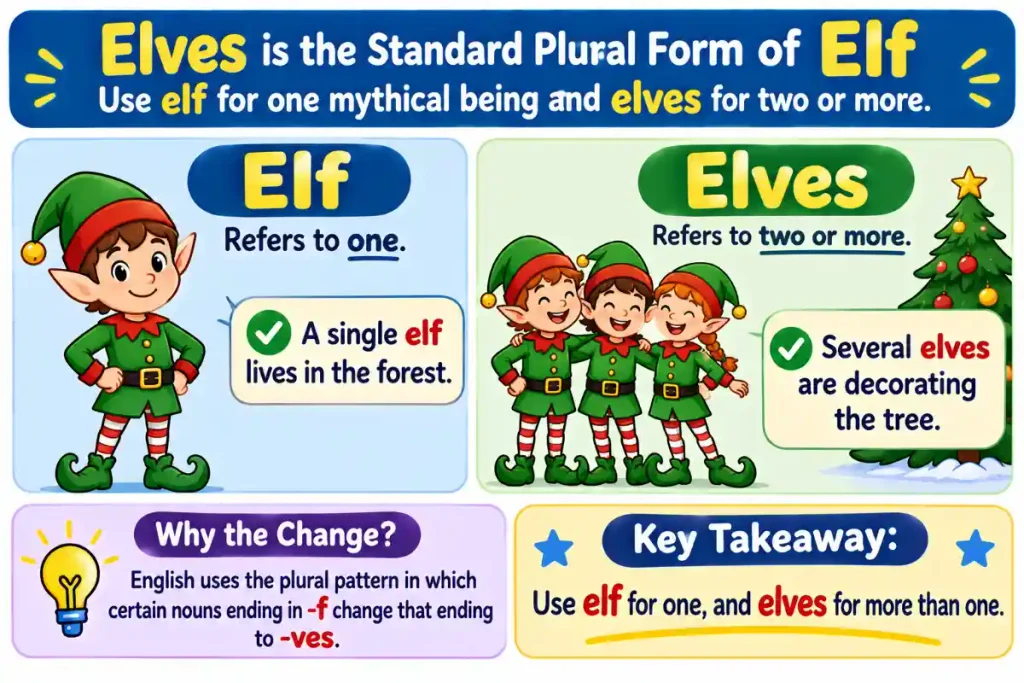
Elves is the standard plural form of elf. Use elf when referring to one mythical being and elves when referring to two or more. The spelling changes because English uses the plural pattern in which certain nouns ending in -f change that ending to -ves.
| Word | Correct Usage | Example |
|---|---|---|
| Elf | Singular | The elf helped Santa prepare the gifts. |
| Elves | Plural | The elves wrapped presents in the workshop. |
| Elfs | Generally nonstandard | The elves decorated the Christmas tree. |
In standard American English, choose elves for schoolwork, professional writing, stories, emails, and social media posts. Although elfs might seem logical because many nouns form their plurals by adding -s, it is not the usual modern spelling. If you’re unsure, remember that the accepted plural of elf is elves.
What Does Elf Mean?
An elf is a mythical or imaginary being that appears in folklore, fairy tales, fantasy literature, and popular culture. Elves often have magical abilities or a close connection to nature, although their appearance and characteristics vary across stories. In modern American culture, the word is especially common during the Christmas season because of the familiar image of Santa Claus’s elves. The word can also refer to fictional characters in fantasy books, movies, video games, and role-playing games.
Examples of Elf in a Sentence
Here are several examples showing how to use the singular noun elf correctly.
- The elf carried a small bag filled with toys.
- A friendly elf greeted the children at the Christmas festival.
- The fantasy novel follows an elf who protects an ancient forest.
- My little brother dressed as an elf for the school play.
- The artist drew an elf with pointed ears and a green cloak.
Each sentence refers to one elf. If you change the subject to two or more mythical beings, use elves instead.
For example:
- Singular: The elf lives in an enchanted forest.
- Plural: The elves live in an enchanted forest.
This distinction is important because the number of people or fictional beings determines which noun form you should use.
What Does Elves Mean?
Elves is the plural form of elf. It refers to two or more mythical beings traditionally associated with folklore, magic, or fantasy. The meaning depends on the context. In Christmas stories, elves are often portrayed as Santa’s helpers who make toys, prepare gifts, and assist with holiday activities. In fantasy literature, they may be portrayed as skilled archers, wise guardians, magical beings, or members of ancient civilizations. The plural form remains elves regardless of the type of elf being discussed.
Examples of Elves in a Sentence
- The elves worked together to finish the toys before Christmas Eve.
- Several elves appeared in the children’s holiday parade.
- The story describes elves who live deep inside a magical forest.
- We watched a movie about elves protecting a hidden kingdom.
- The artist painted three elves standing beside a waterfall.
- Santa’s elves checked the gift list before loading the sleigh.
- The video game allows players to create characters who belong to an ancient race of elves.
- The children wrote letters to the elves at Santa’s workshop.
- In the novel, the elves use their knowledge of nature to protect their homeland.
- The Christmas display featured tiny elves holding colorful presents.
These examples show how elves works in different settings. The spelling stays the same whether you’re describing holiday characters, imaginary creatures, or characters in a fantasy adventure.
Why Is the Plural of Elf Elves Instead of Elfs?
The main reason is that English has several traditional plural patterns. Although most nouns form their plurals by adding -s or -es, some nouns ending in -f or -fe change to -ves.
For example:
| Singular | Plural |
|---|---|
| Elf | Elves |
| Wolf | Wolves |
| Calf | Calves |
| Half | Halves |
| Shelf | Shelves |
| Leaf | Leaves |
| Knife | Knives |
| Wife | Wives |
The word elf follows this established pattern. Instead of adding an s directly to the end, the final f changes to v, and -es completes the plural form. This pattern developed through the history of English and related Germanic languages. Sound changes and historical spelling conventions helped shape the modern forms we use today. However, not every word ending in -f follows this rule. English has several exceptions, so it’s important to learn common plural forms individually.
Do All Words Ending in F Change to VES?
No. Some nouns ending in -f form their plurals by adding -s, while others use -ves.
| Singular | Plural | Rule |
|---|---|---|
| Elf | Elves | Changes to -ves |
| Wolf | Wolves | Changes to -ves |
| Leaf | Leaves | Changes to -ves |
| Roof | Roofs | Adds -s |
| Chief | Chiefs | Adds -s |
| Cliff | Cliffs | Adds -s |
| Belief | Beliefs | Adds -s |
| Safe | Safes | Adds -s |
These examples show why you shouldn’t assume that every word ending in -f follows the same rule. For example, roofs is the standard plural of roof, while wolves is the standard plural of wolf. Similarly, use elves rather than elfs in ordinary modern English. The most reliable approach is to learn familiar plural forms as vocabulary words and check a dictionary when you’re uncertain.
Elfs or Elves: What’s the Difference?
The difference between elfs and elves is mainly a matter of standard spelling. Elves is the accepted plural form used in modern American English. Elfs follows a regular-looking pattern, but it is generally not accepted as the standard plural in ordinary writing.
| Feature | Elfs | Elves |
|---|---|---|
| Standard modern plural | No, generally nonstandard | Yes |
| Meaning | Intended to mean multiple elves | Multiple mythical beings |
| School assignments | Avoid | Recommended |
| Professional writing | Avoid | Recommended |
| Christmas stories | Avoid in standard prose | Recommended |
| Fantasy writing | Usually avoid | Recommended |
Why Do Some People Write Elfs?
People may write elfs because they apply the usual English plural rule: add -s to a singular noun.
For example:
- Cat → cats
- Book → books
- Tree → trees
Applying that pattern mechanically to elf produces elfs. However, English has irregular plural forms that don’t follow the simplest rule. The correct standard form is elves, just as wolf becomes wolves.
Is Elfs Ever Acceptable?
In ordinary American English, elves is the correct choice. You should use it in essays, articles, emails, and most creative writing. An author might deliberately use elfs as an invented spelling, a character’s unusual wording, or a stylistic choice in a fictional setting. Historical texts or specialized sources may also contain unusual forms. Those cases don’t make elfs the normal modern plural. Unless you’re quoting a source or following a specific fictional convention, write elves.
How to Use Elf and Elves Correctly
The easiest way to choose between elf and elves is to identify whether you’re talking about one mythical being or more than one.
Use Elf for One Being
Use elf when the noun refers to a single character or creature.
Examples:
- An elf delivered the package.
- The elf wore a red hat.
- I drew an elf for my art assignment.
- A young elf discovered a hidden cave.
- The elf helped Santa organize the workshop.
Notice that the word elf stays in its singular form even when the sentence includes other nouns or descriptive words.
Use Elves for Two or More Beings
Use elves when the noun refers to multiple characters or creatures.
Examples:
- Two elves decorated the room.
- The elves prepared gifts for the children.
- Several elves appeared in the story.
- A group of elves guarded the castle.
- The elves gathered around the fire.
Words such as two, several, many, and a group of can help you recognize when a plural noun is needed. For instance, write “three elves,” not “three elf” or “three elfs.”
Match the Verb to the Noun
Choosing the correct noun form also helps you select the correct verb.
| Singular | Plural |
|---|---|
| The elf is friendly. | The elves are friendly. |
| The elf works late. | The elves work late. |
| The elf has a gift. | The elves have gifts. |
| The elf was waiting. | The elves were waiting. |
The noun and verb should agree in number. A singular subject usually takes a singular verb, while a plural subject takes a plural verb. For example, “The elf is making toys” is correct, and “The elves are making toys” is also correct. However, “The elves is making toys” is incorrect in standard English.
Common Mistakes When Using Elf and Elves
Even though the correct plural is straightforward, a few common errors can make writing less clear.
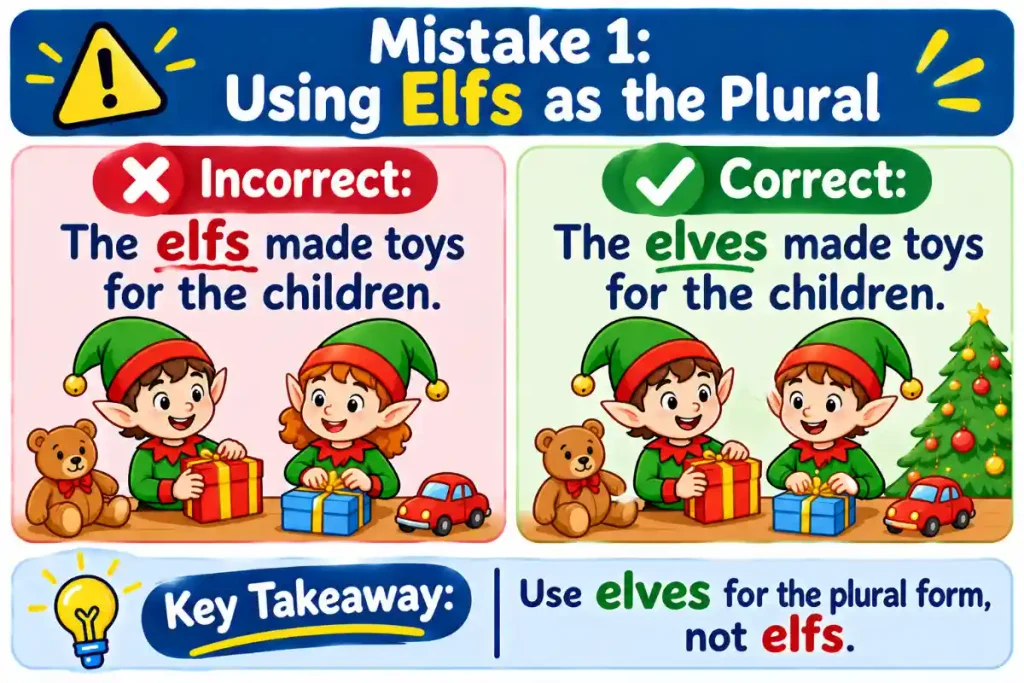
Mistake 1: Using Elfs as the Plural
Incorrect: The elfs made toys for the children.
Correct: The elves made toys for the children.
The word elf follows the -f to -ves plural pattern. Use elves when referring to multiple beings.
Mistake 2: Using Elf After a Number
Incorrect: Three elf waited outside the house.
Correct: Three elves waited outside the house.
A number greater than one generally requires a plural count noun. Because elf has an irregular plural, the correct form is elves.
Mistake 3: Using the Wrong Verb
Incorrect: The elves is preparing the presents.
Correct: The elves are preparing the presents.
The subject elves is plural, so it takes the plural verb are.
Mistake 4: Confusing Elf With Elves
Incorrect: The elves was inside the workshop.
Correct: The elves were inside the workshop.
Use was with a singular subject and were with a plural subject in this type of sentence.
Mistake 5: Assuming Every F-Ending Noun Uses VES
Incorrect: The rooves need repairs.
Correct: The roofs need repairs.
Although elf becomes elves, roof normally becomes roofs. English plural spelling includes exceptions, so don’t apply one pattern to every noun.
Mistake 6: Confusing Elves With Fairies
Elves and fairies are both mythical beings, but the terms aren’t always interchangeable. Their appearances, roles, and cultural backgrounds depend on the particular folklore or fictional world. For example, a story may describe elves as members of an ancient forest civilization and fairies as magical beings associated with enchantment. Other stories may portray them differently. Choose the term that matches the creature in the story rather than treating the words as exact synonyms.
Elf vs. Fairy: What’s the Difference?
An elf and a fairy are both figures in folklore and fantasy, but they can represent different kinds of mythical beings. An elf is often portrayed in modern fantasy as a humanoid being with pointed ears, unusual longevity, or special skills. A fairy is commonly associated with magic, enchantment, and supernatural abilities. Some popular depictions show fairies with wings, although wings aren’t a universal feature.
| Feature | Elf | Fairy |
|---|---|---|
| Plural | Elves | Fairies |
| Common associations | Folklore, fantasy, Christmas stories | Folklore, magic, fairy tales |
| Appearance | Often humanoid; varies by story | Varies widely; sometimes shown with wings |
| Typical fictional roles | Guardians, archers, magical craftspeople | Enchanters, magical helpers, supernatural beings |
| Example | The elves guarded the forest. | The fairies protected the garden. |
These descriptions are common conventions, not strict rules. Different traditions and fictional works use the terms in different ways. For example, Santa’s helpers are usually called elves in American Christmas stories. A magical character in a children’s fairy tale might instead be called a fairy.
Elves or Dwarves: What’s the Difference?
Elves and dwarves are two different plural nouns commonly used in fantasy literature and games. Dwarves are frequently portrayed as skilled miners, blacksmiths, builders, or craftspeople. These traits are common in fantasy traditions, but they aren’t universal.
| Feature | Elves | Dwarves |
|---|---|---|
| Singular | Elf | Dwarf |
| Plural | Elves | Dwarves |
| Common fantasy associations | Magic, forests, archery | Mining, metalwork, stonework |
| Example | The elves protected the ancient trees. | The dwarves built a strong mountain fortress. |
Both elves and dwarves illustrate plural forms that change the final f to v before adding -es. The word dwarfs is also an accepted plural in some contexts, including astronomy, as in white dwarfs. In fantasy writing, dwarves is widely used. The preferred form can depend on the meaning and style. This is a useful reminder that irregular plurals sometimes depend on context, while elves remains the standard plural of elf.
Elves in American English or British English
The spelling elves is standard in both American and British English. There is no regular US-versus-UK spelling difference for the plural of elf.
| Variety of English | Singular | Plural |
|---|---|---|
| American English | Elf | Elves |
| British English | Elf | Elves |
| Canadian English | Elf | Elves |
| Australian English | Elf | Elves |
You can use elves in American school assignments, British novels, Canadian articles, and Australian conversations. The main differences you may notice are related to vocabulary, storytelling traditions, or stylistic preferences rather than spelling. For instance, a writer may choose different terms for holiday characters or mythical creatures based on the story’s setting. If you’re writing for a US audience, use elf for one creature and elves for more than one. The same basic rule applies across the other varieties of English listed above.
What Is the Origin of the Word Elves?
The word elf has a long history in English and Germanic folklore. Its roots can be traced to older Germanic languages, in which words for elf-like beings appeared in stories and traditional beliefs. Over time, the word became part of English vocabulary and developed the plural form elves. The change from f to v reflects historical sound patterns and spelling conventions that survive in several English words. English has retained other examples of this pattern, including wolf/wolves, leaf/leaves, and knife/knives. These words don’t all share exactly the same history, but their modern plural spellings illustrate a similar pattern. The meaning of elf has also changed with literature and popular culture. Traditional folklore portrays elves in different ways across cultures. Modern fantasy often presents them as magical or long-lived beings, while American Christmas traditions commonly feature elves as Santa’s helpers. Although the details vary, the plural spelling remains consistent: elves.
Is Elves Singular or Plural?
Elves is plural, not singular. It refers to two or more beings, while elf refers to one.
Compare these examples:
- Singular: An elf entered the room.
- Plural: Two elves entered the room.
The same distinction applies when you use descriptive words.
- Singular: A small elf sat beside the tree.
- Plural: Small elves sat beside the tree.
You should also use the correct articles and verbs. For example, write “an elf” when referring to one elf, but “three elves” when referring to three. Avoid writing “an elves” because the singular article an requires a singular noun. Similarly, “many elf” is incorrect in standard English because many normally takes a plural count noun. These small grammar choices help make your writing clearer and more natural.
Can You Use Elves in Formal and Informal Writing?
Yes. Elves is appropriate in both formal and informal writing whenever the subject involves elves. The word is a standard plural noun, so you don’t need to avoid it in academic or professional contexts. What matters is whether the topic and tone suit the audience.
In School Assignments
Use elves in essays, reading responses, book reports, and creative-writing projects. Example: “The author portrays the elves as protectors of the natural world.”
In Professional Writing
Use elves when the subject involves holiday events, literature, entertainment, or fictional characters.
Example: “The holiday display features elves preparing gifts in a miniature workshop.”
In Text Messages
The correct spelling also applies to casual conversations.
Example: “The kids loved the elves at the Christmas festival!”
On Social Media
Use elves in captions, posts, and holiday updates.
Example: “Our little elves are ready for Christmas!”
The tone can change depending on the platform, but the standard spelling does not.
Quick Tips to Remember Elfs or Elves
If you sometimes forget whether to write elfs or elves, these practical tips can help.
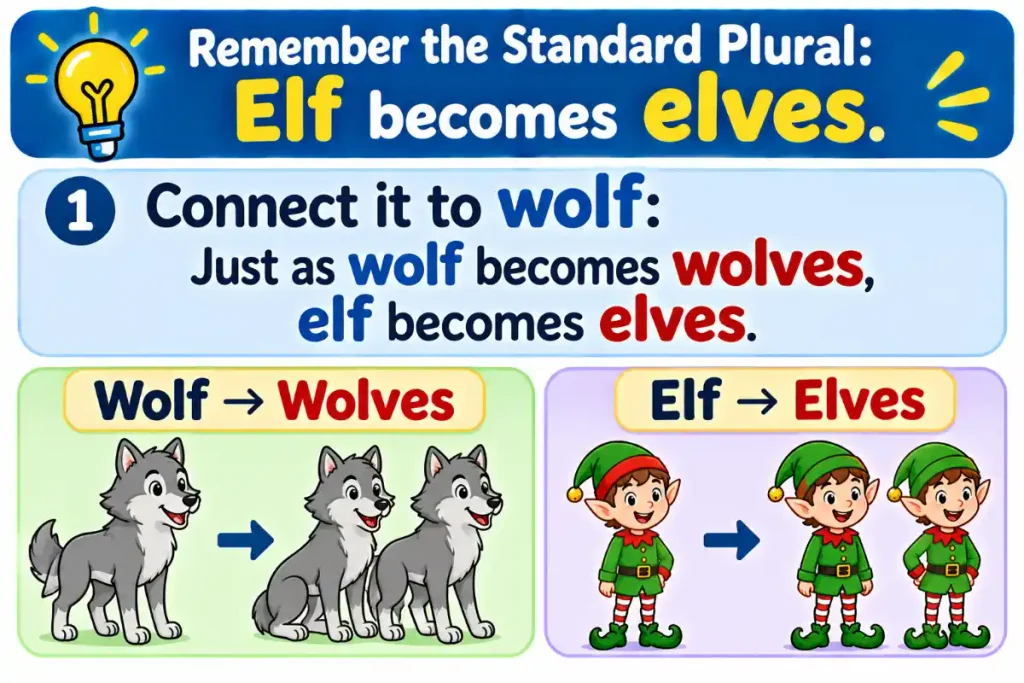
- Remember the standard plural: Elf becomes elves.
- Connect it to wolf: Just as wolf becomes wolves, elf becomes elves.
- Count the creatures: One elf, two elves, several elves.
- Watch for the final F: Some nouns ending in -f change to -ves, but others don’t.
- Check subject-verb agreement: Write “the elf is” and “the elves are.”
- Use the standard form in published writing: Choose elves for schoolwork, articles, emails, and stories.
- Learn exceptions separately: Remember that roof becomes roofs, not usually rooves in standard American usage.
A simple memory sentence is: One elf, two elves; one wolf, two wolves.
Repeating this pattern can make the correct spelling easier to recall when writing quickly.
Conclusion
When choosing between elfs or elves, remember that elves is the standard plural spelling in modern American English. Use elf for one mythical being and elves for two or more. Although elfs may look logical because many English nouns form their plurals by adding -s, it isn’t the usual accepted form.
The spelling pattern becomes easier to remember when you compare elf with wolf and wolves. Just keep in mind that English has exceptions, so not every noun ending in -f changes to -ves. Whether you’re writing a Christmas caption, completing a school assignment, or creating a fantasy story, choosing elves will help your writing remain clear and grammatically correct.
Frequently Asked Questions
1. Which is correct, elfs or elves?
Elves is the correct standard plural of elf in modern American English. Elfs is generally considered nonstandard and should be avoided in ordinary writing.
2. How do you spell the plural of elf?
Spell the plural as elves. The final f changes to v, and the plural ending becomes -ves.
3. Is elfs ever a correct spelling?
Elfs may appear as a deliberate stylistic choice, in unusual fictional conventions, or in historical material. However, elves is the standard plural for modern everyday English.
4. Is elves singular or plural?
Elves is plural. Use elf for one mythical being and elves for two or more.
5. Why does elf change to elves?
The word follows a traditional English plural pattern in which certain nouns ending in -f change to -ves. Other examples include wolf/wolves and leaf/leaves.
6. Is elves spelled the same way in American and British English?
Yes. Both American and British English use elves as the standard plural of elf. There is no regional spelling difference for this word.
7. What is the difference between elves and fairies?
Elves and fairies are different types of mythical beings, although their characteristics vary across folklore and fiction. Elves are often associated with fantasy worlds and Christmas traditions, while fairies are commonly associated with magic and enchantment.
1 thought on “Elfs or Elves: Which Spelling Is Correct?”