
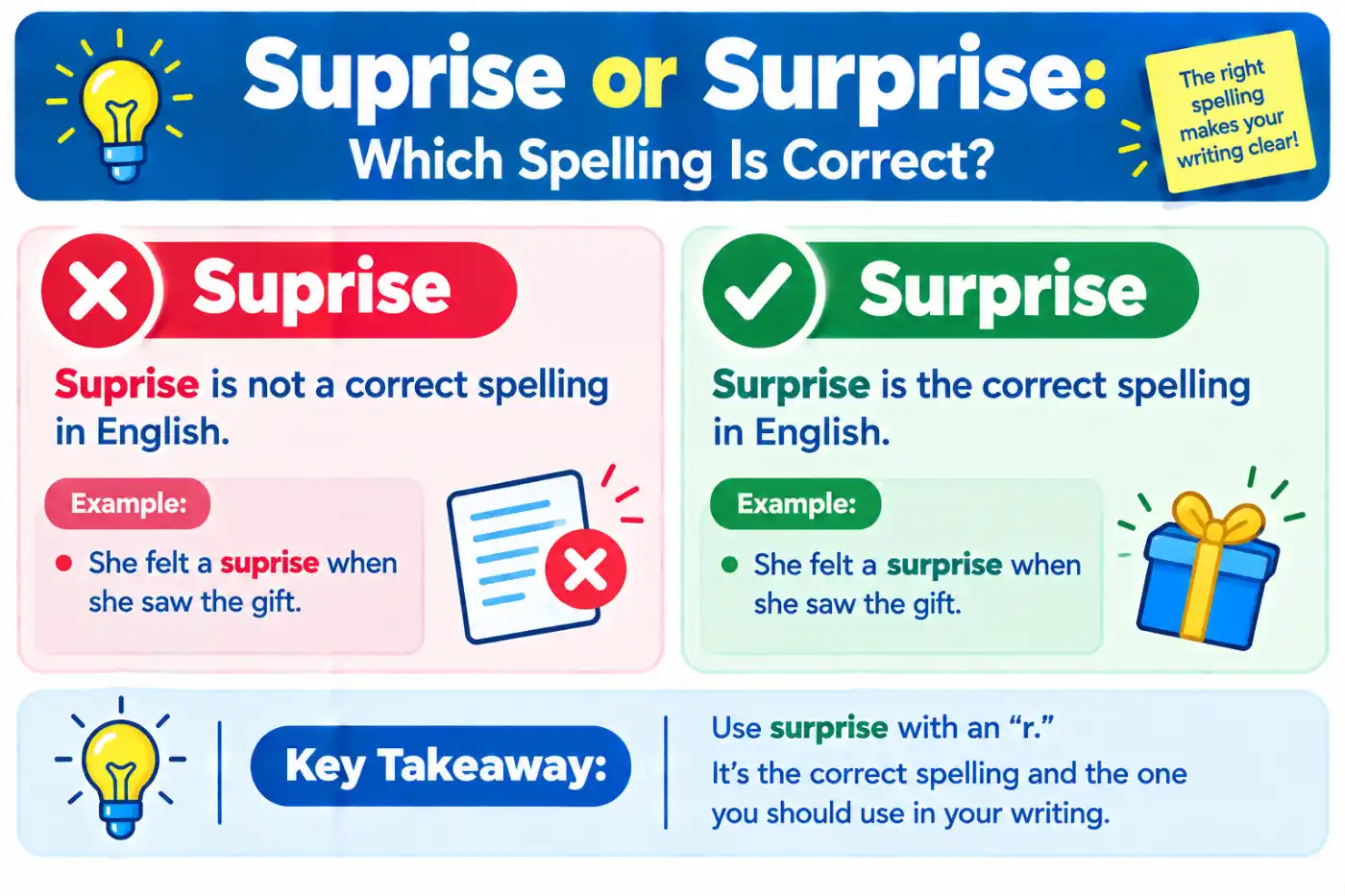
If you’re writing a text, email, school assignment, or social media post, you may wonder whether suprise or surprise is the correct spelling. The two words look almost identical, but only one is accepted in standard English. The confusion is common because the word’s pronunciation can make it easy to overlook the letter that belongs in the middle.
Surprise is the correct spelling. Suprise is a misspelling. In American English, always write surprise when you mean an unexpected event, feeling, gift, or action. The word can function as both a noun and a verb, so you can use it in sentences such as “The party was a wonderful surprise” and “I wanted to surprise my friend.”
Understanding the correct spelling helps you avoid mistakes in professional writing, schoolwork, personal messages, and everyday communication. This guide explains the meaning of surprise, why people misspell it, how to use it in sentences, and which related words and phrases can help you express the same idea more clearly.

Suprise or Surprise: Which One Is Correct?
Surprise is the only correct spelling in standard American English. The spelling suprise leaves out the first r after the initial su. Although readers may understand what you mean, you should correct the spelling before publishing or sending your writing.
| Spelling | Correct or Incorrect? | Explanation |
|---|---|---|
| Surprise | Correct | The standard spelling of the word |
| Suprise | Incorrect | A common misspelling that omits an r |
| Surprised | Correct | The past tense and past participle of surprise |
| Surprising | Correct | Describes something that causes surprise |
| Surprisingly | Correct | An adverb meaning in an unexpected way |
| Surprises | Correct | The plural noun or third-person singular verb form |
The key difference is simple: surprise contains two r’s, while suprise contains only one.
For example:
- Correct: “My parents planned a surprise birthday dinner.”
- Incorrect: “My parents planned a suprise birthday dinner.”
The first sentence uses the standard spelling. In the second sentence, the meaning remains understandable, but the spelling is wrong. When writing for an American audience, use surprise in every context. There is no American-versus-British spelling difference for this word.
What Does Surprise Mean?
Surprise refers to something unexpected or the feeling you experience when something happens that you did not anticipate. The word can describe a positive experience, a negative event, or a situation that simply differs from what someone expected. Its meaning depends on the context.
Surprise as a Noun
As a noun, surprise refers to an unexpected event, discovery, gift, or feeling.
Examples include:
- “The surprise made her birthday unforgettable.”
- “We received an unexpected surprise in the mail.”
- “His visit was a pleasant surprise.”
- “The final score came as a surprise to the fans.”
In these examples, surprise names an event or experience. The word can also describe the emotion someone feels when something unexpected happens.
For example, “Her face showed surprise when she opened the gift” describes an emotional reaction rather than the gift itself.
Surprise as a Verb
As a verb, surprise means to cause someone to feel unexpected wonder, shock, or amazement.
Examples include:
- “I want to surprise my sister with concert tickets.”
- “The unexpected announcement surprised everyone.”
- “Their team surprised the entire school by winning the championship.”
The verb often describes an action that produces an unexpected reaction.
Surprise as an Adjective in Common Phrases
Although surprise is not usually an adjective by itself, it appears before nouns in common expressions such as surprise party, surprise visit, and surprise announcement. In these phrases, it helps describe the kind of event being discussed. For example, “We organized a surprise party for our teacher” means the party was planned so the teacher would not expect it.
Why Do People Misspell Surprise as Suprise?
People often write suprise because the correct spelling does not always feel obvious when they pronounce the word. The letters in surprise can be difficult to remember, especially when someone types quickly or relies on the sound of the word. Several factors contribute to this mistake.
1. The Middle R Is Easy to Forget
The most direct reason for the error is that writers leave out one of the two r’s.
The correct spelling is:
S-U-R-P-R-I-S-E
The incorrect spelling is:
S-U-P-R-I-S-E
Compare the two forms carefully. The correct word contains an r immediately after the u and another r after the p.
2. Pronunciation Does Not Always Help
In everyday speech, people pronounce words quickly and may not notice every individual sound. Because the first r in surprise can be less noticeable in rapid speech, some writers forget to include it when spelling the word. This is a common reminder that pronunciation alone cannot always determine English spelling.
3. Typing Quickly Causes Errors
Writers sometimes omit letters while sending text messages, writing emails, or posting on social media. A familiar word can still contain a typing mistake, especially when someone does not proofread the final message. For instance, a person might type, “I have a suprise for you!” while preparing a birthday announcement The reader will probably understand the message, but the correct version is “I have a surprise for you!”
4. Familiarity Can Reinforce the Mistake
If someone repeatedly sees or types suprise, the incorrect form may begin to look familiar. That familiarity does not make the spelling correct. Reading carefully, using spell-checking tools, and practicing the correct letter sequence can help prevent the error.
How to Remember the Correct Spelling of Surprise
The easiest way to remember surprise is to focus on its two r’s. Instead of trying to memorize the entire word as one unit, break it into smaller parts.
Use the Two-R Rule
Remember this simple rule:
Surprise has two r’s: one after the u and one after the p.
Write the word slowly as you practice:
- SUR
- PRISE
- SURPRISE
This approach draws attention to the first r, which writers often omit.
Connect the Word to Related Forms
Learning related words can help reinforce the correct spelling.
| Word | Example |
|---|---|
| Surprise | The gift was a surprise. |
| Surprised | I was surprised by the news. |
| Surprising | The ending was surprising. |
| Surprisingly | The test was surprisingly easy. |
Each form keeps the original spelling of surprise. If you remember the base word correctly, you can usually spell its related forms correctly as well.
Proofread Before Sending
A quick review can prevent spelling mistakes in important writing. Before submitting an assignment, sending a professional email, or publishing a post, check words that you commonly misspell. Most word processors and writing applications can flag suprise as an error, although you should still review the entire sentence.
Surprise vs Suprised: What’s the Difference?
Surprise is the correct base word, while suprised is an incorrect spelling of surprised. The correct past-tense form adds -d to the base word surprise, producing surprised. It does not remove the first r.
| Word | Status | Example |
|---|---|---|
| Surprise | Correct | I planned a surprise for my parents. |
| Surprised | Correct | My parents were surprised by the visit. |
| Suprised | Incorrect | My parents were suprised by the visit. |
Use surprised when describing how someone felt after an unexpected event.
For example:
- Correct: “Mia was surprised by the announcement.”
- Incorrect: “Mia was suprised by the announcement.”
Remember that the spelling of the base word remains consistent when you form the past tense.
Surprise vs Surprising: How Are They Different?
Both surprise and surprising are correct, but they serve different grammatical purposes. Surprise can function as a noun or a verb. Surprising is the present participle of the verb and commonly functions as an adjective.
| Word | Part of Speech | Meaning | Example |
|---|---|---|---|
| Surprise | Noun | An unexpected event | The party was a surprise. |
| Surprise | Verb | To cause an unexpected reaction | I will surprise my brother. |
| Surprising | Adjective | Causing surprise | The result was surprising. |
Compare these sentences:
- “The news was a surprise.” Here, surprise is a noun.
- “The news was surprising.” Here, surprising describes the news.
- “The news surprised me.” Here, surprised is the past-tense verb.
Choosing the correct form depends on the sentence structure, not simply on the meaning.
Surprise vs Astonishment: Which Word Should You Use?
Surprise is a common, flexible word that works in casual and formal situations. Astonishment often suggests a stronger reaction, especially when something is difficult to believe.
| Word | Meaning | Tone | Example |
|---|---|---|---|
| Surprise | An unexpected event or reaction | Neutral | I felt surprise when I saw the results. |
| Astonishment | Great surprise or amazement | Stronger, more formal | She stared in astonishment at the discovery. |
Use surprise for everyday situations, such as receiving a gift or hearing unexpected news. Choose astonishment when you want to emphasize how strongly someone reacted. Other related words include amazement, shock, and wonder. These words overlap with surprise, but they do not always communicate exactly the same feeling.
Ten Examples of Surprise in Real Sentences
The following examples show how to use surprise naturally in everyday American English.
- Everyday life: “My brother planned a surprise dinner for our parents.”
- School: “The teacher’s announcement came as a surprise to the entire class.”
- Work: “The manager surprised the team by approving an extra day off.”
- Email: “I have a small surprise to share with everyone at tomorrow’s meeting.”
- Texting: “Don’t make any plans for Saturday because I have a surprise for you!”
- Social media: “We surprised our grandmother with a visit on her birthday.”
- Shopping: “The store offered a surprise discount at checkout.”
- Sports: “The underdog team surprised the crowd with a late victory.”
- Travel: “The unexpected change in our flight schedule came as a surprise.”
- Family: “The children were surprised when their cousins arrived early.”
These sentences demonstrate that surprise works in many settings. The spelling remains the same whether the word describes a gift, an unexpected result, an emotional reaction, or an action.
More Examples Using Surprised and Surprising
Understanding related forms makes it easier to use the word correctly.
Examples With Surprised
- “I was surprised to learn that the library had extended its hours.”
- “She looked surprised when her friends arrived at the restaurant.”
- “We were surprised by how quickly the project was completed.”
- “The coach seemed surprised by the team’s improvement.”
- “He was surprised that his application received a response so soon.”
Examples With Surprising
- “The documentary revealed a surprising fact about local history.”
- “It was surprising to see so many people attend the event.”
- “The report contained a surprising amount of useful information.”
- “Her answer was surprising because nobody expected that result.”
- “The weather took a surprising turn during our afternoon walk.”
Notice that surprised usually describes how a person feels, while surprising often describes something that causes that feeling. For example, “I was surprised” focuses on your reaction, whereas “The result was surprising” focuses on the result itself.
Is Surprise a Noun or a Verb?
Surprise can function as both a noun and a verb. You can identify its role by examining how it works in the sentence.
When Surprise Is a Noun
A noun names an event, experience, or feeling.
Examples:
- “The surprise was worth the wait.”
- “Her expression showed surprise.”
- “We prepared a surprise for the guests.”
In each sentence, surprise names something.
When Surprise Is a Verb
A verb describes an action or state.
Examples:
- “We will surprise the winner with a gift.”
- “The results surprised the researchers.”
- “His unexpected arrival surprised everyone.”
In these sentences, surprise or its related form describes the action that causes an unexpected reaction.
Common Verb Forms
| Verb Form | Example |
|---|---|
| Base form: surprise | I want to surprise her. |
| Third-person singular: surprises | The ending surprises readers. |
| Past tense: surprised | The announcement surprised us. |
| Present participle: surprising | The news is surprising. |
| Past participle: surprised | I have surprised my family before. |
Learning these forms helps you avoid spelling and grammar mistakes in longer sentences.
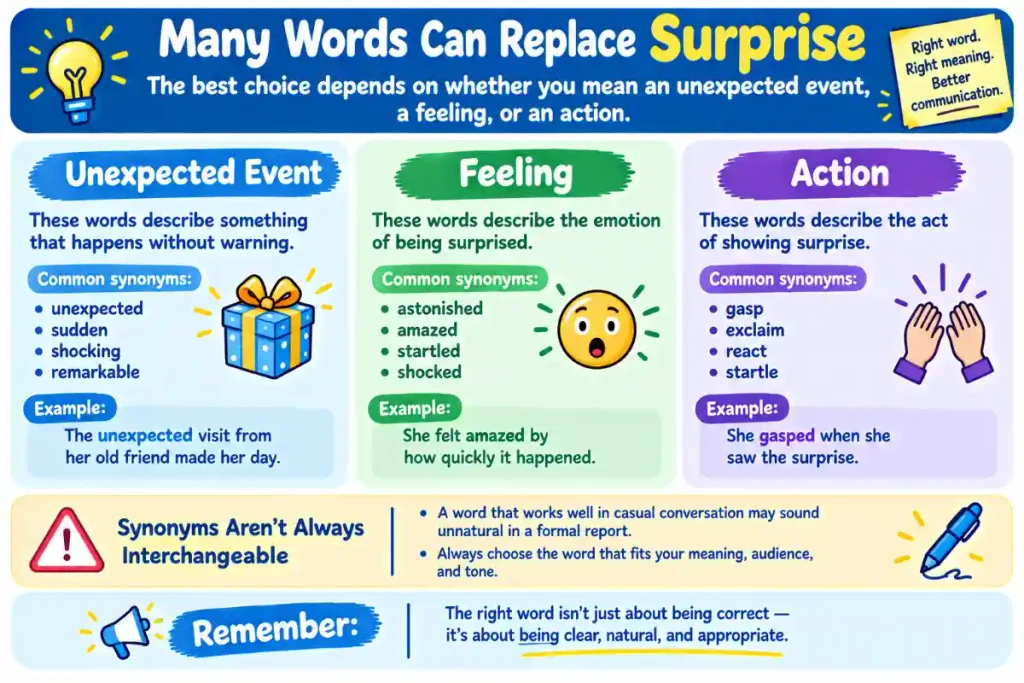
What Are Some Synonyms for Surprise?
Several words can replace surprise, depending on whether you mean an unexpected event, a feeling, or an action. However, synonyms are not always interchangeable. A word that works well in casual conversation may sound unnatural in a formal report.
Everyday Alternatives
| Word or Phrase | Meaning | Tone | Example |
|---|---|---|---|
| Unexpected event | Something that was not anticipated | Neutral | The cancellation was an unexpected event. |
| Shock | A strong, sudden reaction | Strong | The news came as a shock. |
| Amazement | A feeling of great wonder | Positive or neutral | She watched in amazement. |
| Wonder | A feeling of curiosity or admiration | Neutral | He looked at the display with wonder. |
| Startle | To cause a sudden reaction | Everyday | The loud noise startled me. |
| Unexpected gift | A gift that was not anticipated | Casual | The book was an unexpected gift. |
| Treat | Something enjoyable given to someone | Casual | They prepared a special treat for us. |
| Delight | Great pleasure | Positive | Her visit was a delight. |
Formal and Professional Alternatives
| Word or Phrase | Meaning | Tone | Example |
|---|---|---|---|
| Astonishment | Great surprise | Formal | The results caused widespread astonishment. |
| Amazement | Strong wonder or surprise | Neutral to formal | The discovery filled the audience with amazement. |
| Unexpected development | A change that was not anticipated | Professional | The team discussed the unexpected development. |
| Unforeseen event | Something that could not reasonably be predicted | Formal | The delay resulted from an unforeseen event. |
| Revelation | The disclosure of previously unknown information | Formal | The report offered a major revelation. |
| Startling discovery | A discovery that causes a strong reaction | Formal | The researchers reported a startling discovery. |
| Shock | A sudden, powerful reaction | Neutral to formal | The announcement came as a shock. |
Casual Expressions
| Word or Phrase | Meaning | Tone | Example |
|---|---|---|---|
| Plot twist | An unexpected change in a story or situation | Casual | That ending was a real plot twist. |
| Out of the blue | Happening unexpectedly | Informal | She called me out of the blue. |
| Curveball | An unexpected challenge or change | Informal | The schedule change threw us a curveball. |
| Jaw-dropping moment | An extremely surprising experience | Informal | The final performance was a jaw-dropping moment. |
| Pleasant surprise | An unexpected positive experience | Everyday | The free upgrade was a pleasant surprise. |
| Shock | Something that causes a strong reaction | Casual | Seeing him there was a shock. |
Choose the alternative that matches the meaning you want to convey. For example, shock often suggests a stronger or more upsetting reaction than surprise, while delight emphasizes pleasure rather than unexpectedness.
What Are the Antonyms of Surprise?
An antonym is a word with an opposite or contrasting meaning. Because surprise can refer to both an event and an emotional reaction, its antonyms depend on the context.
| Word | Meaning | Example |
|---|---|---|
| Expectation | Something anticipated | The result matched our expectations. |
| Predictability | The quality of being easy to anticipate | The story’s predictability made the ending less exciting. |
| Familiarity | The state of knowing something well | Familiarity with the routine reduced her surprise. |
| Foreknowledge | Knowledge of something before it happens | Their foreknowledge of the announcement removed the surprise. |
| Anticipation | Expectation of something that may happen | The anticipation made the event exciting. |
These words do not act as direct antonyms in every sentence. For example, expectation contrasts with the unexpected nature of a surprise, while predictability describes how easily an event can be anticipated.
Common Mistakes When Using Surprise
Correct spelling is only one part of using a word properly. Writers can also make mistakes with verb forms, sentence structure, and word choice.
Mistake 1: Leaving Out the First R
Incorrect: “I bought a suprise for my friend.”
Correct: “I bought a surprise for my friend.”
The correct spelling includes both r’s. Review the word carefully if you tend to omit the first one.
Mistake 2: Misspelling Surprised
Incorrect: “They were suprised by the announcement.”
Correct: “They were surprised by the announcement.”
Adding the past-tense ending does not remove the first r from the base word.
Mistake 3: Confusing Surprised With Surprising
Incorrect: “I was surprising by the result.”
Correct: “I was surprised by the result.”
Use surprised to describe the person’s reaction. Use surprising to describe something that causes surprise.
For example, “The result was surprising” is correct because the result caused the reaction.
Mistake 4: Using Surprise When Shock Is More Accurate
The words surprise and shock overlap, but they can express different levels of intensity.
Less specific: “The sudden announcement was a surprise.”
More intense: “The sudden announcement was a shock.”
Choose shock when you want to emphasize a strong, disturbing, or overwhelming reaction. Use surprise for a broader range of unexpected experiences.
Mistake 5: Forgetting Subject-Verb Agreement
Incorrect: “The unexpected result surprise everyone.”
Correct: “The unexpected result surprises everyone.”
When the subject is singular and the sentence uses the simple present tense, the verb usually takes an -s ending.
In the past tense, the sentence becomes “The unexpected result surprised everyone.”
Mistake 6: Using the Wrong Article
Incorrect: “It was an surprise.”
Correct: “It was a surprise.”
The word surprise begins with a consonant sound, so the correct article is a, not an.
Mistake 7: Treating Surprise as Always Positive
A surprise can be pleasant, unpleasant, confusing, or neutral.
For example:
- Positive: “The surprise birthday party made her happy.”
- Negative: “The unexpected bill was an unpleasant surprise.”
- Neutral: “The schedule change came as a surprise.”
Use descriptive words when the emotional meaning is important.
Is Surprise Spelled Differently in American and British English?
No. Surprise is spelled the same way in American and British English.
Some English words have regional spelling differences, such as color in American English and colour in British English. However, surprise does not follow that pattern.
| Variety of English | Correct Spelling |
|---|---|
| American English | Surprise |
| British English | Surprise |
| Canadian English | Surprise |
| Australian English | Surprise |
You do not need to change the spelling based on your audience’s location. The same standard form works in school assignments, business documents, news articles, and everyday messages across these varieties of English.
How to Use Surprise in Different Writing Situations
The word works in nearly every type of writing, but the surrounding sentence should fit the audience and purpose.
In Professional Emails
Use surprise when discussing an unexpected development, announcement, or event. Example: “The revised schedule came as a surprise, so we’ll need to adjust our plans.” For formal communication, you can also use unexpected development or unforeseen change when those expressions describe the situation more precisely.
In Academic Writing
In school assignments and academic writing, use surprise when it accurately describes an unexpected result or reaction. Example: “The experiment’s results surprised the students because they differed from their original predictions.”
For a more technical explanation, you might write, “The results differed from the expected outcome.” The second sentence is often more precise when you are describing research or a scientific observation.
In Text Messages
In casual messages, surprise is natural and friendly.
Example: “I have a surprise for you when you get home!” Although informal messages may contain abbreviations or hurried typing, the standard spelling remains the same.
In Social Media Posts
Use surprise to describe an unexpected event, gift, or announcement.
Example: “We planned a surprise visit for our grandparents, and they were so happy to see us.”
If you use the word in a caption or public post, check the spelling before publishing.
In Stories and Creative Writing
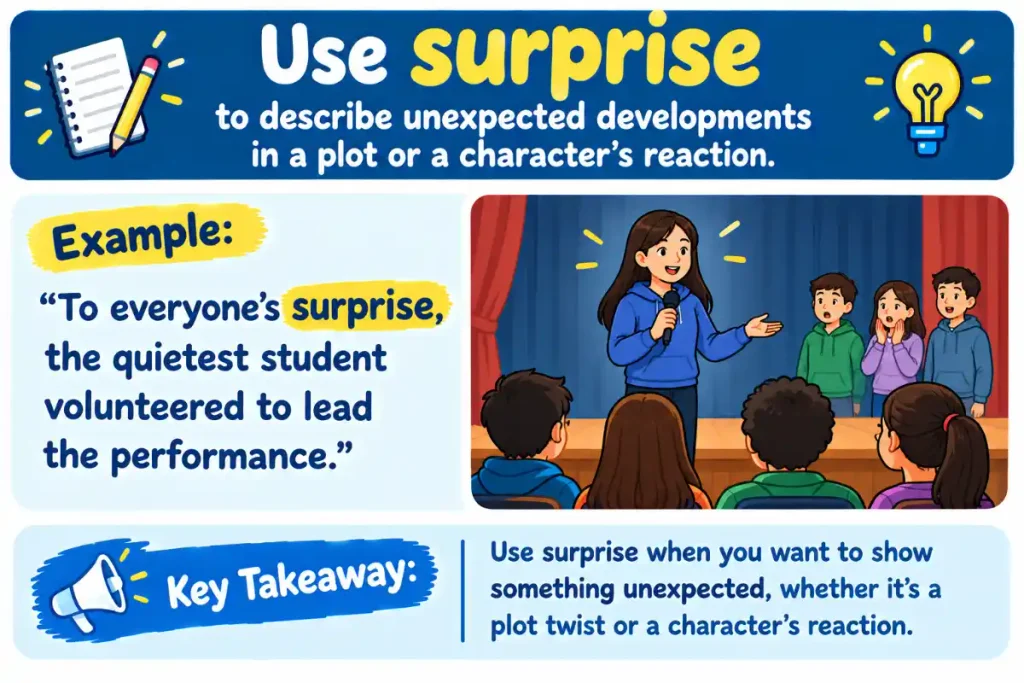
Writers often use surprise to describe unexpected developments in a plot or a character’s reaction. Example: “To everyone’s surprise, the quietest student volunteered to lead the performance.” Words such as astonishment, shock, and amazement can add variety, but choose them according to the intensity of the scene.
Conclusion
The correct choice between suprise or surprise is straightforward: always use surprise. The spelling suprise is incorrect because it leaves out the first r. This rule applies to American, British, Canadian, and Australian English, so you do not need to adjust the spelling for different audiences.
Remember that surprise can function as both a noun and a verb. Related forms, including surprised, surprising, and surprisingly, also retain the correct spelling pattern. Pay attention to the two r’s, check the word when proofreading, and choose related words such as astonishment or shock when they express your meaning more accurately. With a little practice, you’ll be able to spell and use surprise confidently in school assignments, professional emails, text messages, and everyday conversations.
Frequently Asked Questions
1. Is it suprise or surprise?
Surprise is correct, and suprise is incorrect. The correct spelling includes two r’s, one after the u and another after the p.
2. How do you spell surprise correctly?
Spell it S-U-R-P-R-I-S-E. Remember the two r’s to avoid leaving out a letter.
3. Why do people spell surprise as suprise?
People often omit the first r because they pronounce the word quickly or type without proofreading. The missing letter makes suprise a misspelling.
4. Is surprised spelled with two r’s?
Yes, surprised retains both r’s from the base word surprise. For example, “I was surprised by the news” is correct.
5. What is the difference between surprise and surprising?
Surprise can be a noun or a verb, while surprising usually functions as an adjective or participle. For example, “The result was a surprise” and “The result was surprising” are both correct.
6. Is surprise the same in American and British English?
Yes, both American and British English use the spelling surprise. Neither variety uses suprise as the standard form.
7. What is another word for surprise?
Depending on the context, alternatives include astonishment, amazement, shock, wonder, and unexpected event. Use shock for a stronger reaction and pleasant surprise for an unexpected positive experience.
2 thoughts on “Suprise or Surprise: Which Spelling Is Correct?”