
When you’re writing a text, email, school assignment, or social media post, you may pause over a simple spelling question: finaly or finally?
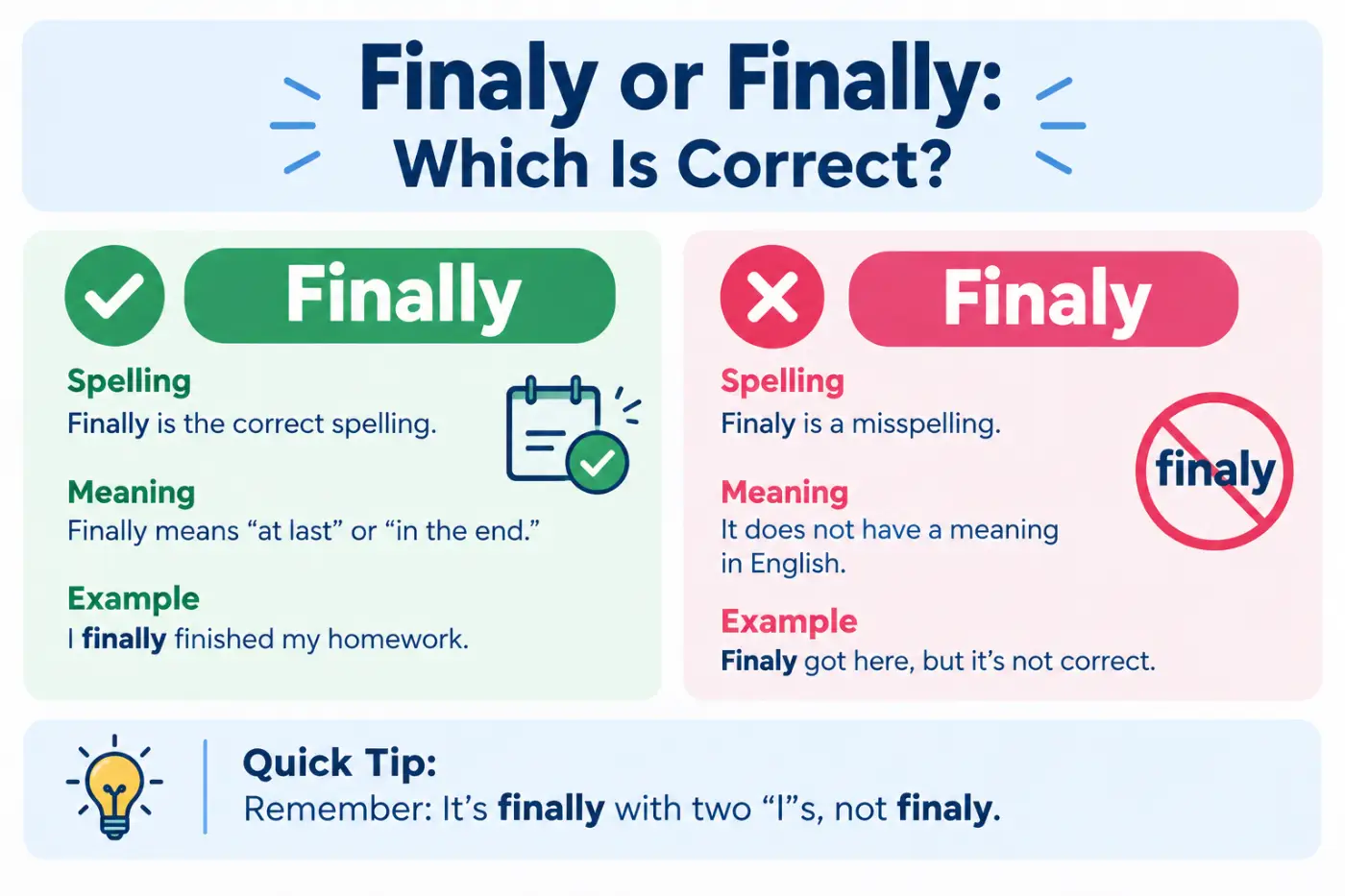
The correct spelling is finally. The spelling finaly is incorrect in standard English because the word keeps the double l before the ending -y.
Finally is an adverb that usually means “at last,” “after a long wait,” or “as the last point in a series.” For example: “We finally arrived home.”
This guide explains why finally is correct, how to use it naturally, common mistakes to avoid, and several examples you can use as a model.

Finaly or Finally: What Is the Correct Spelling?
Finally is the correct spelling.
| Spelling | Correct? | Example |
|---|---|---|
| finally | Yes | We finally finished the project. |
| finaly | No | We finaly finished the project. |
The key spelling point is the double l:
final + ly → finally
The incorrect form finaly drops one l, which makes it a common spelling mistake.
What Does Finally Mean?
Finally means something happens at the end of a process, after waiting, or as the last item in a sequence. It can have several closely related meanings:
- At last: Something happens after a delay or period of waiting.
- In the end: Something happens after a series of events.
- As the last point: You introduce the final item in a list or argument.
Finally meaning “at last”
This is one of the most common uses.
We finally found the keys.
The sentence suggests that finding the keys took some time or effort.
More examples:
- She finally received her package.
- I finally finished my homework.
- They finally agreed on a price.
- The bus finally arrived.
- He finally called me back.
Finally meaning “as the last point”
Finally can also introduce the last point in a discussion, explanation, or list.
For example:
First, check the address. Next, review the details. Finally, send the email.
Here, finally tells the reader that sending the email is the last step.
Why Is “Finaly” Incorrect?
The spelling finaly is incorrect because finally is formed from the adjective final and the suffix -ly. The word keeps the final l from final and adds another l before y:
final + ly = finally
This is similar to other words formed with -ly:
- final → finally
- usual → usually
- careful → carefully
- actual → actually
- beautiful → beautifully
Because the base word final already ends in l, it is easy to accidentally write finaly. However, standard English spelling uses finally.
How Do You Use Finally in a Sentence?
The position of finally can change depending on what you want to emphasize.
1. At the beginning of a sentence
You can use finally to introduce the last point in a sequence.
Finally, we decided to take the train.
This position is especially common in instructions, essays, presentations, and explanations.
2. In the middle of a sentence
Finally can appear before the main verb or after a form of the verb to be.
She finally understood the problem.
He was finally ready to leave.
This placement often emphasizes that something happened after a delay.
3. At the end of a sentence
Finally can also appear at the end.
We reached the hotel finally.
Although this construction is grammatically possible, it can sound less natural in everyday American English. In many situations, We finally reached the hotel sounds smoother.
10 Examples of Finally in Real Sentences
Here are natural examples from everyday situations:
- We finally arrived at the airport.
- She finally finished her college application.
- The doctor finally called with the results.
- I finally understand how this software works.
- After several attempts, he finally fixed the computer.
- They finally decided where to go for dinner.
- The rain finally stopped this morning.
- I finally found my missing notebook.
- First, wash the vegetables; finally, put them in the refrigerator.
- After weeks of preparation, the event finally began.
Notice that finally can describe both a long-awaited event and the last step in a sequence.
Finally vs. Final: What’s the Difference?
Final and finally are related, but they do different jobs in a sentence.
| Word | Part of speech | Meaning | Example |
|---|---|---|---|
| final | Adjective | Last; coming at the end | This is the final exam. |
| finally | Adverb | At last or as the last point | I finally passed the exam. |
Use final to describe a noun:
This is our final meeting.
Use finally to describe an action, situation, or statement:
We finally had our meeting.
A simple way to remember the difference is:
final = describes something
finally = describes how or when something happens
Finally vs. Eventually: What’s the Difference?
Finally and eventually can both describe something that happens after time has passed, but they don’t always carry the same feeling. Finally often emphasizes the result after waiting, difficulty, or frustration.
The train finally arrived.
This can suggest that the speaker had been waiting longer than expected. Eventually focuses more on the fact that something happened at some later point.
The train eventually arrived.
The sentence doesn’t necessarily emphasize impatience or relief.
| Word | Main idea | Example |
|---|---|---|
| finally | At last; after waiting | She finally replied. |
| eventually | At some later point | She eventually replied. |
Both words can be correct, but the choice depends on the meaning you want to express.
Finally vs. At Last
Finally and at last are often interchangeable when something happens after a wait.
We finally got home.
We got home at last.
However, at last can sound more emotional or expressive, especially when the speaker has been waiting for a long time.
Compare:
The package finally arrived.
The package arrived at last!
The second sentence can show stronger relief or excitement.
Finally vs. In the End
These expressions are also related but aren’t always interchangeable. Finally often describes the last event in a sequence or something that happens after waiting.
She finally agreed.
In the end often refers to the final result of a situation after considering different possibilities.
In the end, we chose the cheaper option.
A useful distinction is:
- Finally: focuses on the timing or final step.
- In the end: focuses on the final result.
Is Finally Formal or Casual?
Finally works in both formal and casual English.
In everyday conversation
I finally got some free time.
In a professional email
We finally received confirmation from the supplier.
In academic writing
Finally, the study considers the long-term effects of the policy.
In instructions
Finally, click the “Submit” button.
Because it works in many settings, you don’t usually need a more complicated replacement for finally.
How to Use Finally in an Essay
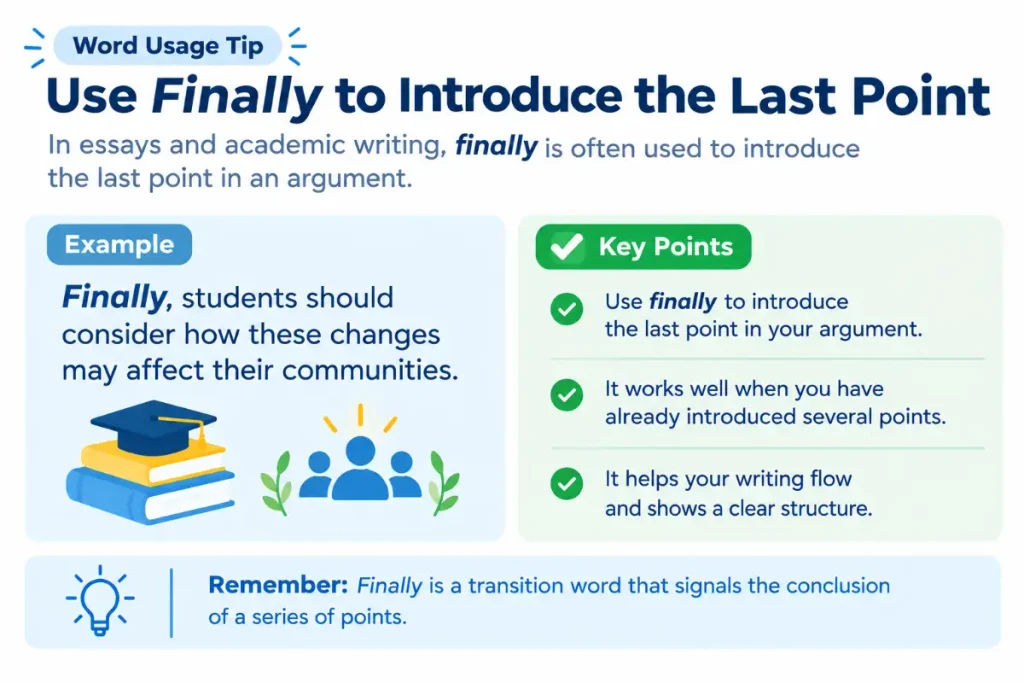
In essays and academic writing, finally is often used to introduce the last point in an argument.
For example:
Finally, students should consider how these changes may affect their communities.
It can be useful when you have already introduced several points:
First, the policy affects costs. Second, it changes access to services. Finally, it may influence long-term planning.
However, you don’t need to use finally every time you reach the end of a paragraph. If the relationship between your ideas is already clear, simply moving to the next sentence may be more natural.
How to Use Finally in an Email
Finally is common in professional emails when describing the completion of a process.
Examples:
We finally received the signed agreement.
The team has finally completed the review.
Finally, please confirm that you received the attached document.
The first two examples describe something that happened after a delay. The third introduces the final request or instruction.
How to Use Finally in Text Messages
Finally is completely natural in casual texting.
For example:
Finally made it home!
I finally finished that assignment.
We finally know what happened.
In casual messages, people may leave out the subject or other words, but the spelling remains finally, not finaly.
Common Spelling Mistakes With Finally
Writing “finaly”
Incorrect:
I finaly finished my work.
Correct:
I finally finished my work.
The easiest fix is to remember the two l’s.
Confusing final and finally
Incorrect:
I final finished my homework.
Correct:
I finally finished my homework.
Here, finally is needed because the word modifies the verb finished.
Adding an unnecessary ending
Another mistake is changing the word into an incorrect form such as finallee or finaly. The standard spelling is simply:
finally
A Quick Memory Trick for Finally
Think of the word as:
FINAL + LY
The word final already has one l, and adding -ly gives you another:
final + ly = finally
You can also remember this sentence:
“The final letter stays, and another L joins it.”
So when you’re unsure between finaly and finally, choose the version with two l’s.
What Part of Speech Is Finally?
Finally is an adverb. An adverb can modify a verb, adjective, another adverb, or an entire statement. In the case of finally, it often tells us when something happens or places an idea at the end of a sequence.
Examples:
She finally arrived.
Here, finally modifies the verb arrived.
Finally, let’s discuss the last issue.
Here, finally signals the final point in the discussion. The related adjective is final:
This is the final decision.
What Is the Origin of Finally?
Finally comes from the adjective final, which traces back through French and Latin roots connected with the idea of an end or boundary. English later formed the adverb finally by adding the suffix -ly. The word has long been used to express the idea of something occurring at the end or after a period of time. For everyday writing, however, the main point is simple: finally is the standard English spelling.
Finally in American English vs. British English
There is no important spelling difference between American and British English for finally.
Both use:
finally
The same spelling is standard in:
- American English
- British English
- Canadian English
- Australian English
So you don’t need a regional spelling variant when writing finally.
Correct vs. Incorrect Examples
| Incorrect | Correct |
|---|---|
| I finaly arrived. | I finally arrived. |
| She finaly called. | She finally called. |
| We finaly agreed. | We finally agreed. |
| They finaly finished. | They finally finished. |
| Finaly, we went home. | Finally, we went home. |
The error in each example is the missing second l.
Alternatives to Finally
Depending on the context, you can sometimes replace finally with another phrase.
| Alternative | Meaning | Tone | Example |
|---|---|---|---|
| at last | After waiting | Everyday | We arrived at last. |
| eventually | At some later point | Neutral | She eventually agreed. |
| in the end | Final result | Neutral | In the end, we stayed home. |
| ultimately | Final result or conclusion | Formal | Ultimately, the decision was yours. |
| lastly | The last item | Formal/neutral | Lastly, check your answers. |
| to conclude | Introduces a conclusion | Formal | To conclude, the plan is practical. |
| in conclusion | Introduces a final conclusion | Formal | In conclusion, the evidence is clear. |
| after all this time | After a long wait | Conversational | After all this time, he returned. |
These aren’t perfect replacements in every sentence. For example, ultimately usually focuses on the final result, while finally can simply indicate the last step.
When Should You Use Finally?
Use finally when you want to communicate one of these ideas:
- Something happened after waiting.
- Something happened after several attempts.
- Something happened at the end of a process.
- You are introducing the last point in a list.
- You are moving to the final part of an explanation.
For example:
After three hours, the repair was finally complete.
The word shows that the repair took time.
Another example:
Finally, check that all the information is correct.
Here, finally introduces the last instruction.
Quick Rule to Remember the Spelling
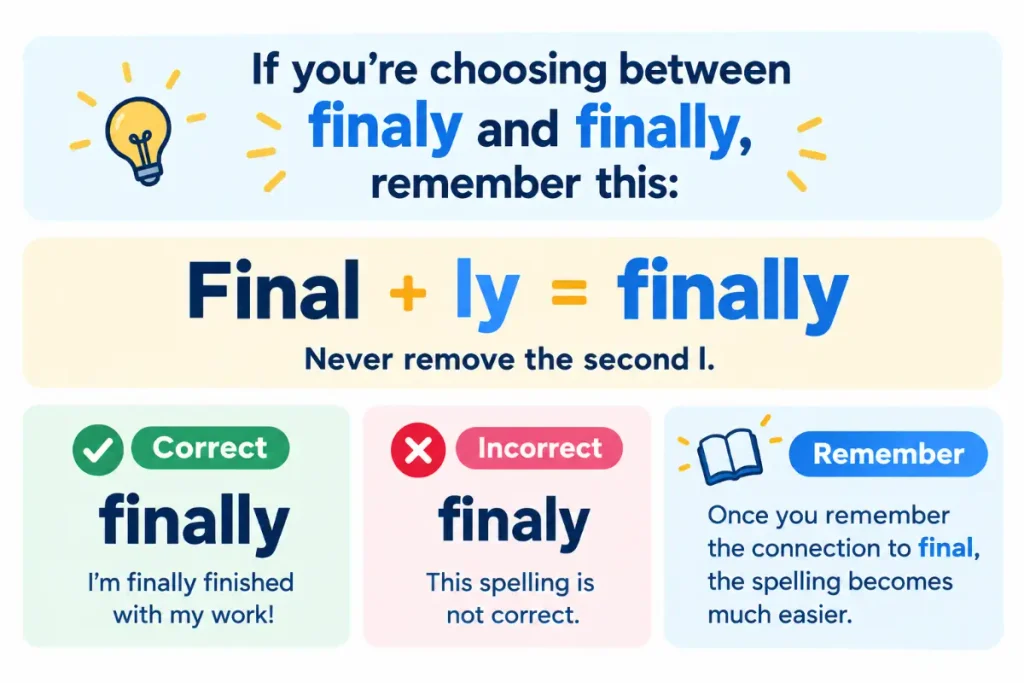
If you’re choosing between finaly and finally, remember this: Final + ly = finally Never remove the second l. The correct spelling is: finally The incorrect spelling is: finaly Once you remember the connection to final, the spelling becomes much easier.
Conclusion
The correct spelling is finally, not finaly. The word is an adverb that commonly means “at last,” “after a delay,” or “as the last point.” It works naturally in conversations, text messages, professional emails, essays, instructions, and everyday writing.
The easiest way to remember the spelling is to connect it to final: final + ly = finally. Keep both l’s, and you’ll have the standard English form. If you’re choosing between finally, eventually, or in the end, consider whether you want to emphasize a long wait, a later result, or the final outcome.
Frequently Asked Questions
Is “finaly” correct?
No. Finaly is a misspelling. The correct form is finally, with two l’s.
How do you spell finally?
The correct spelling is finally: F-I-N-A-L-L-Y.
What does finally mean?
Finally usually means “at last,” “after a delay,” or “as the last point in a series.”
Is finally an adverb?
Yes. Finally is an adverb. It commonly describes when something happens or introduces the final point in a sequence.
What is another way to say finally?
Depending on the sentence, alternatives include at last, eventually, in the end, ultimately, and lastly. The best choice depends on the exact meaning and tone.
Is finally used in American English?
Yes. Finally is standard in American English and has the same spelling in British English and other major varieties of English.
Which is correct, finaly or finally?
Finally is correct. The spelling finaly incorrectly leaves out one l
2 thoughts on “Finaly or Finally: Which Is Correct?”