
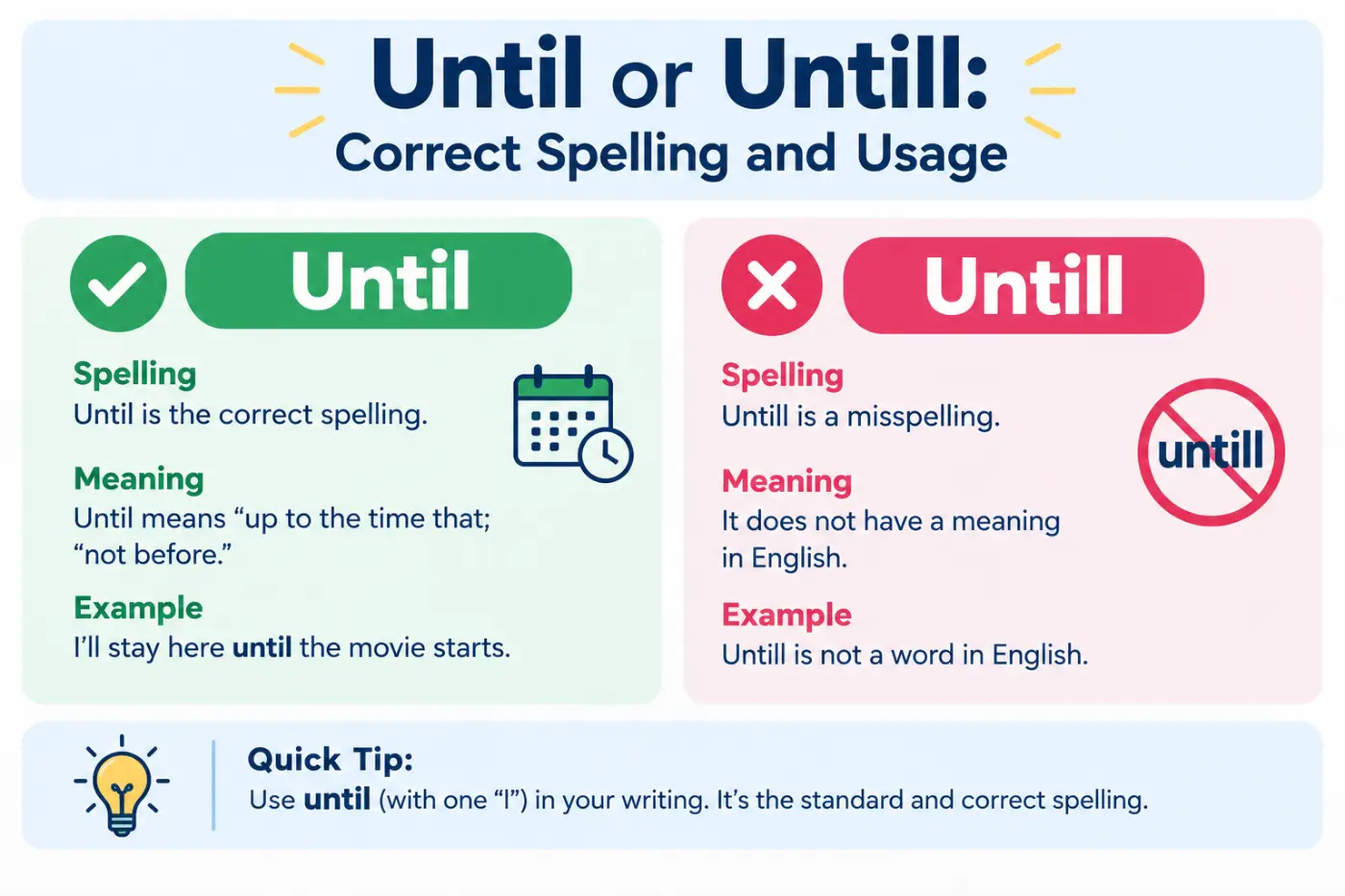
If you’re writing an email, essay, text, or social media post, you may pause over until or untill. The two forms look almost identical, but only one is standard English.
Until is the correct spelling. Untill is incorrect in standard American English. The word until is commonly used as a preposition, conjunction, or informal adverb to show that something continues up to a particular time or event.
In this guide, you’ll learn how to spell and use until correctly, why untill is a common mistake, and how until differs from related words such as till and by.
Until or Untill: Which Is Correct?
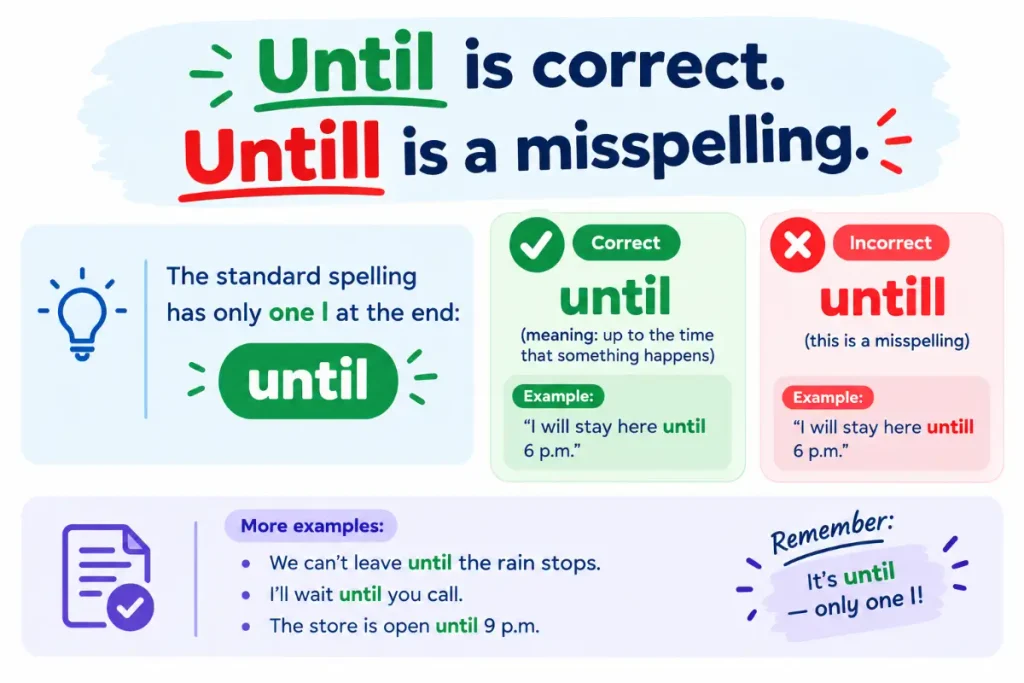
Until is correct. Untill is a misspelling.
The standard spelling has only one l at the end:
- Correct: until
- Incorrect: untill
The word until can refer to a time, event, or condition that marks the point when something stops or changes.
Examples
- Please wait until 5 p.m.
- I stayed at the office until everyone left.
- Don’t open the package until Friday.
- We won’t know the answer until the results arrive.
- She read until midnight.
The spelling untill is not the standard form used in American English. If you see it in an email, essay, resume, or other formal writing, it should be corrected to until.
What Does Until Mean?
Until means up to the time when something happens or up to a particular point in time. It often describes an action or situation that continues and then ends, changes, or is interrupted at a certain point.
For example:
I worked until 6 p.m.
This means the person continued working up to 6 p.m.
Another example is:
Stay here until I come back.
The instruction means to remain in the same place up to the time the speaker returns.
Until can refer to a specific time:
- until Monday
- until noon
- until next week
- until midnight
It can also introduce an event or condition:
- until the meeting ends
- until she arrives
- until the rain stops
- until you finish your homework
How Do You Spell Until?
The correct spelling is until:
U-N-T-I-L
There is only one L at the end.
A common mistake is to write untill, adding a second l. This may happen because many English words have double consonants in certain forms, or because writers assume until follows a spelling pattern that it does not.
Remember:
Until = one L
Correct spelling
- until
- until tomorrow
- until later
- until then
- until Monday
Incorrect spelling
- untill
- untill tomorrow
- untill later
- untill then
- untill Monday
The incorrect form can appear in casual online writing, but that does not make it a standard spelling.
Why Is “Untill” a Common Misspelling?
Untill is easy to write accidentally because the word until ends with a consonant sound and many English words use doubled consonants in other contexts.
Writers may also confuse until with words that contain double l, such as:
- still
- will
- full
- really
However, until does not follow that pattern.
Another reason for the confusion is that till is also a valid word with a similar meaning. Some people may mentally combine until and till and produce the incorrect spelling untill.
The simplest solution is to memorize the standard spelling:
Until has one L.
Until as a Preposition
Until can function as a preposition when it comes before a noun or noun phrase referring to a time.
Examples
- The store is open until 9 p.m.
- We won’t leave until Friday.
- She stayed there until the morning.
- The library will remain closed until next week.
- He worked until midnight.
In these sentences, until connects the action or state to a point in time.
Until as a Conjunction
Until can also introduce a clause containing a subject and verb.
Examples
- Wait until I call you.
- We stayed inside until the storm passed.
- Don’t start until everyone arrives.
- She didn’t understand it until her teacher explained it.
- I’ll stay here until you finish.
In these examples, until introduces an event or condition that marks the point at which something changes.
Until as an Adverb
Until can sometimes be used without an object when the meaning is already clear from context.
For example:
- I haven’t seen her until now.
- We can wait until then.
- He had never thought about it until recently.
Words such as now, then, and recently can help establish the time being discussed.
Until vs. Till: What’s the Difference?
Until and till generally have the same basic meaning. Both can mean “up to the time when.”
Compare:
- I waited until noon.
- I waited till noon.
Both sentences are grammatically acceptable.
The main difference is usually one of style and context. Until is widely accepted in formal and informal writing, while till is often more conversational.
| Word | Meaning | Typical tone | Example |
|---|---|---|---|
| until | Up to a certain time | Neutral | Wait until noon. |
| till | Up to a certain time | Casual/neutral | Wait till noon. |
Which Should You Use?
For school assignments, professional emails, academic writing, and other formal contexts, until is a straightforward choice. In everyday speech and casual writing, till is also common. Don’t confuse till with ’til. The shortened form ’til is informal and is often used to represent a shortened form of until, especially in casual writing.
Until vs. By: What’s the Difference?
Until and by both relate to time, but they don’t mean the same thing. Until focuses on how long something continues. By focuses on the deadline by which something should happen.
Compare these sentences:
- I will work until 6 p.m.
- I will finish the report by 6 p.m.
The first sentence means the person will continue working up to 6 p.m. The second means the report should be finished no later than 6 p.m.
| Word | Main idea | Example |
|---|---|---|
| until | Continuation up to a time | I’ll stay until Friday. |
| by | Deadline or latest time | I’ll finish it by Friday. |
This distinction is especially useful in workplace communication.
Another Example
You can stay here until 8 p.m.
This describes how long you’re allowed to stay.
You need to leave by 8 p.m.
This gives a deadline. Leaving can happen earlier, but it should happen no later than 8 p.m.
Until vs. Before
Until and before can also create different meanings.
Consider:
Don’t leave until I return.
This means you should remain there and leave only after the speaker returns.
Now compare:
Leave before I return.
This means you should leave at some point prior to the speaker’s return.
The words point in opposite directions with respect to the event.
| Word | Basic idea | Example |
|---|---|---|
| until | Continue up to an event | Wait until I arrive. |
| before | Earlier than an event | Leave before I arrive. |
10+ Examples of Until in Real Sentences
Here are natural examples showing how until works in everyday American English.
- Please keep the door closed until the meeting ends.
- I didn’t realize how late it was until I checked my phone.
- The restaurant serves breakfast until 11 a.m.
- She plans to stay in town until Sunday.
- We waited until the rain stopped before leaving.
- Don’t send the email until you’ve checked the attachment.
- He worked until midnight to finish the project.
- I’ll be here until you get back.
- The students stayed after class until their questions were answered.
- We won’t make a decision until we have all the information.
- The sale runs until the end of the month.
- I hadn’t heard about the change until this morning.
Notice that until can be followed by a time expression such as Sunday or 11 a.m., or by a clause such as the rain stopped or you’ve checked the attachment.
Until in Professional Writing
Until works well in professional communication because it is neutral and clear.
Professional email
Please keep the document confidential until the announcement is made.
Workplace communication
The updated schedule will remain in effect until further notice.
Business instructions
Please do not submit the form until all required fields have been completed.
Formal notice
The office will remain closed until Monday.
There is no need to replace until with a more complicated expression. It is already appropriate for formal writing.
Until in Academic Writing
Until is also common in essays, reports, and academic papers.
Examples include:
- The theory remained widely accepted until new evidence emerged.
- The researchers continued the experiment until they obtained consistent results.
- The population increased steadily until the early 2000s.
- The students did not understand the concept until the instructor provided an example.
In academic writing, the key concern is correct grammar and precise meaning, not avoiding the word until.
Until in Texting and Casual Conversation
Until is perfectly natural in everyday conversation.
You might say:
- I’ll wait until you get here.
- See you until tomorrow?
- I can’t leave until I finish this.
- Let’s stay until the movie ends.
- Don’t tell anyone until we’re ready.
In casual speech, till is also common:
- I’ll wait till you get here.
- Let’s stay till the movie ends.
Both can sound natural depending on the speaker and context.

Common Mistakes With Until
The most common problem is spelling, but until can also cause mistakes involving meaning and sentence structure.
Mistake 1: Writing “Untill”
Incorrect:
I’ll wait untill tomorrow.
Correct:
I’ll wait until tomorrow.
The second l should be removed.
Mistake 2: Confusing Until With By
Incorrect for a deadline:
Please finish the assignment until Friday. If the intended meaning is that Friday is the deadline, use by:
Please finish the assignment by Friday.
However, until Friday can be correct when describing continuation:
I will be out of town until Friday.
Mistake 3: Confusing Until With Before
These words can produce opposite meanings.
Don’t leave until I arrive.
Means: stay until I arrive.
Leave before I arrive.
Means: go away before I arrive.
Always consider whether you mean continuing up to an event or happening earlier than an event.
Mistake 4: Assuming “Untill” Is an Alternative Spelling
Untill is not a standard alternative spelling of until. It is simply a misspelling in standard English. This applies to American English as well as standard English usage more broadly.
Is “Untill” Ever Correct?
No. “Untill” is not the standard spelling of the English word. If you’re writing standard English, use until.
You may encounter untill in:
- Typographical errors
- Informal online posts
- Usernames or names
- Unedited text
- Search queries
- Old or nonstandard writing
Seeing the spelling in those contexts doesn’t make it a correct standard-English spelling.
Is Until American or British English?
Until is standard in both American and British English. There is no major US-versus-UK spelling difference here.
| Variety | Standard spelling |
|---|---|
| American English | until |
| British English | until |
| Canadian English | until |
| Australian English | until |
The spelling untill is not the standard form in these varieties.
Until vs. Till in American English
American English uses both until and till.
For example:
I’ll stay until Monday.
and:
I’ll stay till Monday.
Both are understandable and grammatically acceptable. In a formal document, until may be the safer stylistic choice because it is neutral and widely used across contexts. In casual conversation, till is common.
A Simple Memory Trick for Until
If you often write untill, use this quick memory trick:
Until = one L.
You can also break the spelling into parts:
un + til
The word ends with til, not till.
So:
- until ✓
- untill ✗
Another useful reminder is that until and till are related in meaning, but you don’t combine them to create untill.
Correct vs. Incorrect Examples
| Incorrect | Correct |
|---|---|
| I waited untill noon. | I waited until noon. |
| Stay here untill I return. | Stay here until I return. |
| The store is open untill 9. | The store is open until 9. |
| Don’t start untill Friday. | Don’t start until Friday. |
| She worked untill midnight. | She worked until midnight. |
| We won’t know untill tomorrow. | We won’t know until tomorrow. |
The correction is simple in each case: remove the extra l.
Quick Guide: Until, Till, and By
If you’re unsure which time word to choose, this quick comparison can help.
| Word | Use it when you mean | Example |
|---|---|---|
| until | Something continues up to a time | I’ll wait until noon. |
| till | Something continues up to a time, usually casually | I’ll wait till noon. |
| by | Something happens no later than a deadline | Finish it by noon. |
Think of It This Way
Until = duration
I worked until 6 p.m.
By = deadline
I finished the work by 6 p.m.
Till = similar to until
I worked till 6 p.m.
This simple distinction prevents many time-related word-choice errors.
Is Until One Word or Two?
Until is one word.
Don’t write it as two separate words such as un til. The standard spelling is:
until
It remains one word regardless of how it is used:
- until tomorrow
- until later
- until Monday
- until the end
- until she arrives
Can You Start a Sentence With Until?
Yes, you can start a sentence with until.
For example:
Until the rain stops, we’ll stay inside.
This structure is grammatically correct.
You can also place the until clause after the main clause:
We’ll stay inside until the rain stops.
Both versions work. Starting with until can put extra emphasis on the condition or time limit.
Can Until Be Used With “Not”?
Yes. Structures such as not … until are very common.
For example:
I didn’t understand the problem until she explained it.
This means the understanding happened after her explanation.
Another example:
The store won’t open until 10 a.m.
This means the store will remain closed before 10 a.m. and is expected to open at 10 a.m. The not … until structure is especially useful when describing when something finally happens.
Until vs. Not Until
These structures can express different emphasis.
I left until noon.
This sentence is generally not the natural way to express a simple departure time.
Instead, you might say:
I stayed until noon.
Or:
I didn’t leave until noon.
The second sentence emphasizes that the departure did not happen before noon.
More Examples
- She didn’t call until Friday.
- We didn’t start until everyone arrived.
- He didn’t notice the error until later.
- They didn’t announce the results until Monday.
When Should You Use Until?
Use until when you need to show that an action, situation, or condition continues up to a particular time or event.
It is especially useful for:
- Time periods
- Deadlines expressed as continuation
- Instructions
- Events
- Conditions
- Everyday conversation
- Professional writing
- Academic writing
Examples:
Stay here until 5 p.m.
The office will remain closed until Monday.
Wait until the light turns green.
She didn’t know until yesterday.

When Should You Avoid Until?
You don’t need to avoid until in formal writing. It is a standard, useful English word.
However, choose a different word when your intended meaning is different.
Use by when you mean a deadline:
Submit the application by Friday.
Use before when you mean earlier than a particular event:
Submit the application before the office closes.
Use during when you mean at some point within a period rather than continuing to its endpoint:
I called during the afternoon.
Choosing the right word depends on the exact time relationship you want to express.
Final Takeaway
When choosing between until or untill, use until. It is the standard spelling in American English, and the word can describe an action or situation that continues up to a particular time or event.
Remember the simplest rule: until has one L at the end. The spelling untill is not a standard alternative; it is a misspelling. Also keep until separate from by when expressing time. Until focuses on continuation, while by usually expresses a deadline.
For everyday conversation, professional emails, school assignments, and formal writing, until is a clear and reliable choice.
Frequently Asked Questions
Which is correct, until or untill?
Until is correct. Untill is a misspelling and should not be used in standard English.
How do you spell until?
The correct spelling is U-N-T-I-L: until. It has only one l at the end.
Is untill a word?
Untill is not the standard spelling of the English word. Use until instead.
Is until the same as till?
Until and till generally have the same basic meaning: up to a particular time or event. Until is neutral and works well in formal writing, while till is common in casual language.
What is the difference between until and by?
Until describes something continuing up to a particular time, while by usually gives a deadline. For example, “I will stay until Friday” describes duration, while “I will finish it by Friday” gives a deadline.
Is until used in American English?
Yes. Until is a standard word in American English. It is also standard in British, Canadian, and Australian English.
Why do people spell until as untill?
Untill is usually a spelling mistake. The extra l may come from confusion with words that contain double letters or from the similar word till.
2 thoughts on “Until or Untill: Correct Spelling and Usage”